In our culture, success is often seen as the ultimate destination—the long-awaited moment when effort finally blossoms into happiness. We are taught to dream, to strive, and to believe that once we reach our goals, fulfillment will naturally follow. Yet, both modern science and lived experience are beginning to tell a more nuanced story.
In recent years, research in neuroscience and psychology has revealed a quiet paradox: achieving our most cherished goals does not always bring lasting happiness. The brain’s reward system, driven by dopamine, is designed primarily for anticipation rather than arrival. It fuels the excitement of pursuit—the late nights, the hopeful striving, the vision of what could be. But once the goal is reached, that surge of motivation fades, and the emotional intensity often drops.
At the same time, psychologists describe a phenomenon known as hedonic adaptation—our tendency to quickly return to a baseline level of happiness even after major positive events. The dream job becomes routine. The long-awaited achievement becomes part of everyday life. What once felt extraordinary quietly becomes ordinary.
For some, this transition is subtle. For others, it can feel like an unexpected emptiness—a sense of “What now?” after the finish line has been crossed.
But this discovery is not discouraging. In fact, it is deeply illuminating.
It reminds us that the human mind is intricate, and happiness is more than just accomplishment. Success, by itself, is not designed to sustain joy—it is only one part of a much larger inner landscape.
True fulfillment begins when we understand this hidden pattern and learn to work with it, rather than against it.
A meaningful life is not built solely on reaching goals, but on what those goals serve. When ambition is guided by purpose—when our efforts contribute to something beyond personal gain—success no longer feels like an ending. Instead, it becomes a doorway.
This is why acts of kindness, compassion, and contribution carry such enduring power. Unlike fleeting achievements, they create a sense of connection and meaning that the mind does not easily adapt away from. They anchor us in something deeper than momentary reward.
Imagine a different way of living:
A life where ambition and inner well-being are not in conflict, but in harmony. A life where achieving a dream does not leave a void, but opens a new horizon of purpose. A life where each success is not a final destination, but a step toward greater understanding, compassion, and joy.
By understanding the brain’s hidden responses, we gain the ability to design such a life. We begin to see that fulfillment is not something waiting at the end of achievement—it is something woven into the journey itself.
In this light, success becomes more than personal victory. It becomes an opportunity to deepen meaning, to expand the heart, and to align our outer accomplishments with our inner growth.
Perhaps lasting happiness has never been about reaching the summit.
Perhaps it is about learning how to walk the path—with awareness, purpose, and a quiet, enduring sense of joy.
In times when the world feels overwhelmed by conflict, division, and uncertainty, many people are searching for deeper answers about human consciousness and the true purpose of life. One thinker whose work has inspired millions to reflect on these questions is Gary Zukav, a writer and former physicist known for exploring the relationship between science, consciousness, and spiritual growth.
Zukav first gained recognition through his book The Dancing Wu Li Masters, which introduced complex ideas of modern physics to general readers. Later, his bestselling book The Seat of the Soul shifted the conversation toward a deeper exploration of human consciousness and spiritual evolution. In this work, Zukav proposes a powerful idea: humanity is undergoing a transformation from seeking external power to discovering authentic power—the power that arises from the soul.
His message can be summarized in three simple yet profound movements of the human spirit:
Humanity must move from fear to love
from control to compassion
from external power to inner wisdom
Although Zukav approached these ideas through the lens of psychology and consciousness, they resonate deeply with teachings that have existed for thousands of years within Buddhism.
In Buddhist teachings, the mind is the source of both suffering and liberation. According to Gautama Buddha, our thoughts, intentions, and actions shape our experience of the world. This principle is closely connected to the law of Karma, which teaches that every action—whether physical, verbal, or mental—creates corresponding results.
When people act from fear, anger, or greed, they plant seeds of suffering. When they act from compassion, generosity, and wisdom, they create causes for peace and happiness.
Seen in this light, Zukav’s idea of moving from external power to authentic power reflects a timeless Buddhist insight: true strength does not arise from domination or control, but from the transformation of the mind.
In the modern world, success is often measured by status, wealth, or influence. Yet Buddhism reminds us that these forms of external power are temporary and unstable.
The Buddha taught that genuine freedom comes from cultivating inner qualities such as:
compassion
mindfulness
wisdom
loving-kindness
When these qualities grow within us, our consciousness naturally changes. Instead of reacting with fear or anger, we begin to respond with understanding and care. This is the beginning of authentic power—the same inner power Zukav describes.
Zukav believes humanity is evolving toward a new level of awareness, where people become more conscious of their intentions and the effects of their actions. This idea echoes the Buddhist path of awakening, where individuals gradually develop greater awareness of their thoughts and emotions.
Each moment offers a choice: to act from fear or from love, from control or from compassion.
If enough people choose compassion, the collective consciousness of humanity can also change. In this sense, spiritual transformation is not only personal—it is also global.
A Gentle Reminder for Our Time
In a world often shaken by conflict and division, Zukav’s words serve as a gentle reminder that true change begins within the human heart.
Humanity must move from fear to love, from control to compassion, from external power to inner wisdom.
These movements are not only philosophical ideals; they are practical steps toward creating a more peaceful world. When we cultivate compassion and awareness in our own lives, we are already contributing to the transformation of human consciousness.
As the Buddha taught, peace in the world begins with peace in the mind. And when one heart awakens to compassion, it quietly lights the path for many others.
In the rush of daily life, it’s easy for the mind to gravitate toward what is missing, stressful, or unresolved. Our attention naturally scans for problems—an ability that once helped our ancestors survive. Yet this same tendency can also make modern life feel heavier than it needs to be.
What if something as simple as practicing gratitude could gently reshape the way our minds experience the world?
Psychological research suggests that it can.
One influential study by Robert A. Emmons and Michael E. McCullough, published in the Journal of Personality and Social Psychology, explored exactly this question in their paper “Counting Blessings Versus Burdens: An Experimental Investigation of Gratitude and Subjective Well-Being in Daily Life.”
Their findings offer a fascinating glimpse into how small shifts in attention can create meaningful changes in emotional well-being.
In their study, participants were divided into different groups and asked to keep brief weekly records:
One group listed things they were grateful for.
Another group recorded daily hassles or difficulties.
A third group tracked neutral life events.
After several weeks, a clear pattern emerged.
Those who regularly wrote down what they were grateful for reported:
Higher levels of optimism
Greater life satisfaction
More positive emotional states
Even better physical well-being, including fewer physical complaints
Interestingly, participants in the gratitude group were also more likely to help others and engage in prosocial behavior.
The practice did not eliminate life’s difficulties. Instead, it subtly shifted the mind’s orientation—from scanning for burdens to noticing sources of support, meaning, and connection.
In other words, gratitude works not by denying reality, but by expanding what we notice within it.
The brain is remarkably adaptive. Neuroscience often refers to this capacity as neuroplasticity—the ability of neural pathways to strengthen through repeated patterns of thought and attention.
When we repeatedly focus on worries, the brain becomes efficient at worrying.
When we repeatedly notice blessings, the brain becomes better at recognizing goodness in everyday life.
Gratitude, then, can be understood as a kind of mental training. It gradually teaches the mind to hold a wider view of experience—one that includes not only challenges, but also resources, kindness, beauty, and moments of quiet grace.
The research suggests that gratitude does not require elaborate rituals. Even small, consistent practices can make a difference.
Here are a few simple ways to begin.
1. Keep a “Three Blessings” Journal
At the end of the day, write down three things you are grateful for.
They don’t have to be dramatic or extraordinary.
They might be:
A helpful conversation
A good meal
A quiet moment of rest
A problem that turned out better than expected
The key is consistency. Over time, this practice gently trains attention toward appreciation.
2. Ask “What Went Well Today?”
Instead of ending the day reviewing only unfinished tasks, pause and reflect:
What went well today?
This small shift reframes the day from a list of obligations into a landscape that also contains successes and kindness.
3. Express Gratitude to Someone
Research on gratitude often finds that expressing appreciation strengthens relationships.
Send a message, write a note, or simply say thank you in a sincere way.
Gratitude is not only an internal experience—it is also a social emotion that deepens connection.
4. Notice the Ordinary
Some of the most powerful gratitude moments come from ordinary experiences:
Warm sunlight through a window
The taste of morning tea
The reliability of a friend
When we slow down enough to notice these small gifts, everyday life begins to feel richer.
It’s important to emphasize that gratitude is not about pretending life is perfect.
Difficulties, uncertainty, and loss are part of the human experience.
Gratitude simply invites us to widen the frame of attention—to see that even within imperfect circumstances, moments of goodness continue to exist.
By learning to notice them, we cultivate a more balanced and resilient inner life.
The idea behind “counting blessings” may sound simple, even old-fashioned.
Yet research continues to show that this small shift in attention can ripple outward—affecting mood, relationships, and overall well-being.
Perhaps the most beautiful part of gratitude is its accessibility.
It requires no special equipment, no complicated training.
Just a moment of pause… and a willingness to notice what is already here.
In a world that often feels fragmented and fast-paced, many of us are searching for a compass—a way to live that feels both grounded and deeply ethical. Thich Nhat Hanh, the beloved Zen Master and founder of the Plum Village tradition, offered exactly that through the Five Mindfulness Trainings.
These aren’t rigid “commandments” or a list of “don’ts.” Instead, they are a modern, proactive framework for cultivating peace, protecting life, and nurturing happiness within ourselves and the world.
At their core, the trainings are a reinterpretation of traditional Buddhist precepts, designed for our modern, interconnected lives.
Reverence for Life This training is an invitation to cultivate compassion. It’s about more than just avoiding harm; it’s about actively protecting life and practicing nonviolence toward ourselves, our neighbors, and the natural world.
True Happiness We often chase wealth or fame, thinking they are the keys to joy. This training reminds us that true happiness is found in generosity and the ability to be content in the present moment. It encourages us to live simply and avoid exploiting others.
True Love In our relationships, integrity is everything. This training emphasizes responsibility and ensures that our most intimate connections are grounded in deep love, commitment, and respect for the harmony of families.
Loving Speech and Deep Listening Communication is a powerful tool for healing. By practicing deep listening without judgment and using speech that inspires hope and reconciliation, we can move mountains of misunderstanding and alleviate the suffering of those around us.
Nourishment and Healing What we “consume” isn’t just food. It’s the media we watch, the conversations we have, and the substances we use. This training focuses on mindful consumption to protect our mental and physical well-being from toxins and despair.
The beauty of the Five Mindfulness Trainings lies in how they address the complexities of the 21st century.
Interbeing: They are rooted in the understanding that we are not separate entities. What happens to the Earth happens to us. When we heal ourselves, we heal the world.
Universal Ethics: While born from Buddhist wisdom, these trainings are non-sectarian. They are accessible to anyone, regardless of their religious or spiritual background.
Transformation over Rules: This is an ongoing practice. The goal isn’t “perfection” but a continuous, mindful process of shifting our focus from self-interest to collective well-being.
Sangha (Community) Support: We don’t have to do this alone. These trainings are often practiced within a Sangha, a community of friends who support each other in staying mindful and compassionate.
The Five Mindfulness Trainings are a gift—a map that leads us back to our best selves. By embracing these guidelines, we contribute to a collective awakening, one mindful breath and one compassionate action at a time.
“The Five Mindfulness Trainings are the most concrete way to practice mindfulness. They show us how to live our lives in a way that brings peace and happiness to ourselves and to others.” — Thich Nhat Hanh
In times of uncertainty and turmoil, the voice of compassion becomes more precious than ever. Thich Nhat Hanh was a world-renowned Vietnamese Zen Buddhist monk, teacher, poet, author, and peace activist whose life embodied mindfulness and nonviolence. His profound influence reached far beyond the Buddhist community; he was nominated for the Nobel Peace Prize by Martin Luther King Jr., who recognized in him “an apostle of peace and nonviolence.”
Today, as the world feels divided and restless, his poem “Call Me by My True Names” invites us to look deeply into our shared humanity. It challenges us to see beyond separation—beyond “us” and “them”—and to recognize that within each of us lives both suffering and compassion. Reading his words now feels like a gentle but powerful reminder: true peace begins when we awaken to our interconnectedness.
Call Me by My True Names
Do not say that I’ll depart tomorrow because even today I still arrive.
Look deeply: I arrive in every second to be a bud on a spring branch, to be a tiny bird, with wings still fragile, learning to sing in my new nest, to be a caterpillar in the heart of a flower, to be a jewel hiding itself in a stone.
I still arrive, in order to laugh and to cry, in order to fear and to hope. The rhythm of my heart is the birth and death of all that are alive.
I am the mayfly metamorphosing on the surface of the river, and I am the bird which, when spring comes, arrives in time to eat the mayfly.
I am the frog swimming happily in the clear pond, and I am also the grass-snake who, approaching in silence, feeds itself on the frog.
I am the child in Uganda, all skin and bones, my legs as thin as bamboo sticks, and I am the arms merchant, selling deadly weapons to Uganda.
I am the twelve-year-old girl, refugee on a small boat, who throws herself into the ocean after being raped by a sea pirate, and I am the pirate, my heart not yet capable of seeing and loving.
I am a member of the politburo, with plenty of power in my hands, and I am the man who has to pay his “debt of blood” to, my people, dying slowly in a forced labor camp.
My joy is like spring, so warm it makes flowers bloom in all walks of life. My pain is like a river of tears, so full it fills the four oceans.
Please call me by my true names, so I can hear all my cries and laughs at once, so I can see that my joy and pain are one.
Please call me by my true names, so I can wake up, and so the door of my heart can be left open, the door of compassion.
Each time I read “Call Me by My True Names” by Thich Nhat Hanh, I feel both unsettled and awakened.
The poem asks us to see what we often refuse to see—that we are not separate from the suffering of the world. We are not only the compassionate helper, but also, in some deep and interconnected way, the frightened child, the victim, and even the one who causes harm. This is not an easy truth to hold. Yet it is a profoundly liberating one.
The poem gently dissolves the illusion of “us” and “them.” It invites us to return to our true humanity—tender, vulnerable, and deeply connected.
And perhaps, in remembering this, we take one small but meaningful step toward peace.
Creating Your Own “Micro Forest Bathing” in the City
Not everyone lives in a place like Santa Cruz, surrounded by forests and winding mountain trails. Most of us live in cities—enclosed by traffic, fast-paced workdays, concrete buildings, and endless schedules. It can feel as though nature is far away, almost out of reach.
But the truth is, we don’t need to escape deep into the mountains to reconnect with nature. Even in the heart of the city, we can create our own “Micro Forest Bathing” moments.
At its core, forest bathing has never been about a specific location. It is about slowing down and reconnecting with nature through all our senses. When we shift our attention, the city reveals many small places where we can breathe again and feel gently held by the natural world.
Here are a few simple and practical ways to experience the healing presence of nature—right where you are.
1. Find a Small Green Oasis
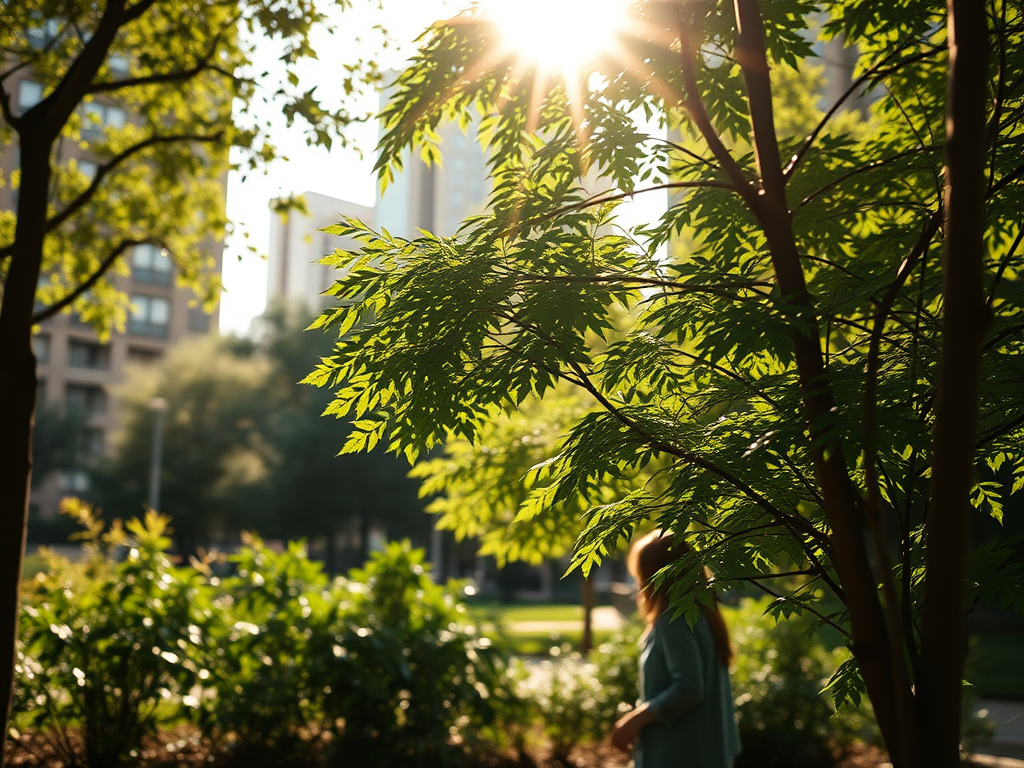
Even the busiest city has pockets of quiet greenery: a neighborhood park, a cluster of trees, a riverside path, a campus corner, or a small community garden.
The place doesn’t need to be grand. A couple of trees, a patch of grass, or a few flowering bushes are enough to soften the heart.
What matters is not the size of the space—but whether you allow yourself to pause.
2. Walk in the Spirit of Forest Bathing
Whether you’re in a city park or walking along a tree-lined street, you can bring the rhythm of forest bathing into your steps:
Slow your pace
Notice the color of the leaves
Feel the temperature of the wind against your face
Watch how sunlight filters through branches and falls on the ground
Listen for birds, even if there are only one or two
Gently touch the bark of a tree
When you do this, the city softens—and your mind grows quiet.
3. Create Your Own “Green Route”
You can weave nature into your daily routine in small, intentional ways:
Choose a street with more trees on your commute
Take a five-minute walk in a nearby park during breaks
Stroll through your neighborhood after dinner and notice changes in plants and seasons
With time, this route becomes your personal path of restoration—a place where your mind learns to rest.
4. Bring a Mini Forest Into Your Home
Even without stepping outside, you can invite nature indoors:
Keep a few easy-to-care-for plants (ferns, ivy, or monstera work beautifully)
Open your windows to let in light, air, and natural sounds
Light a wood-based scent such as sandalwood or cedar
Play gentle forest soundscapes in the background, sip a cup of tea, imagine yourself being embraced by the forest—the steady presence of trees around you, the earthy scent of soil, the calm rhythm of nature moving without urgency. Let your shoulders soften. Let your breath deepen.
Even a small touch of green can soften emotions and calm the nervous system.
5. Practice “Green Meditation”
Sit near a plant or by a window. Do nothing except observe:
The sheen of leaves
The movement of light and shadow
The patterns in stems and veins
Breathe slowly.
Five minutes of this will calm your mind far more deeply than ten minutes of scrolling on your phone.
6. Let Nature Become a Habit
Forest bathing is not something we do once in a while—it is a way of staying connected to life itself. You might:
Take a weekly green walk
Spend three minutes a day looking at the sky
Touch a tree when you feel overwhelmed
Sit quietly in a park when stress builds
Even a few minutes of this mindful pause can soothe the nervous system, quiet the mind, and restore inner balance. Sometimes, the forest we need most is the one we allow ourselves to enter inwardly.
These small acts, repeated gently, become powerful sources of renewal.
Whether you live near a forest, by the ocean, or in the center of a city, nature is always there, patiently waiting—for you to breathe, to slow down, and to be healed.
And when you finally grow still enough, you may discover this quiet truth:
Even within the city, the forest is never truly absent. 🌿
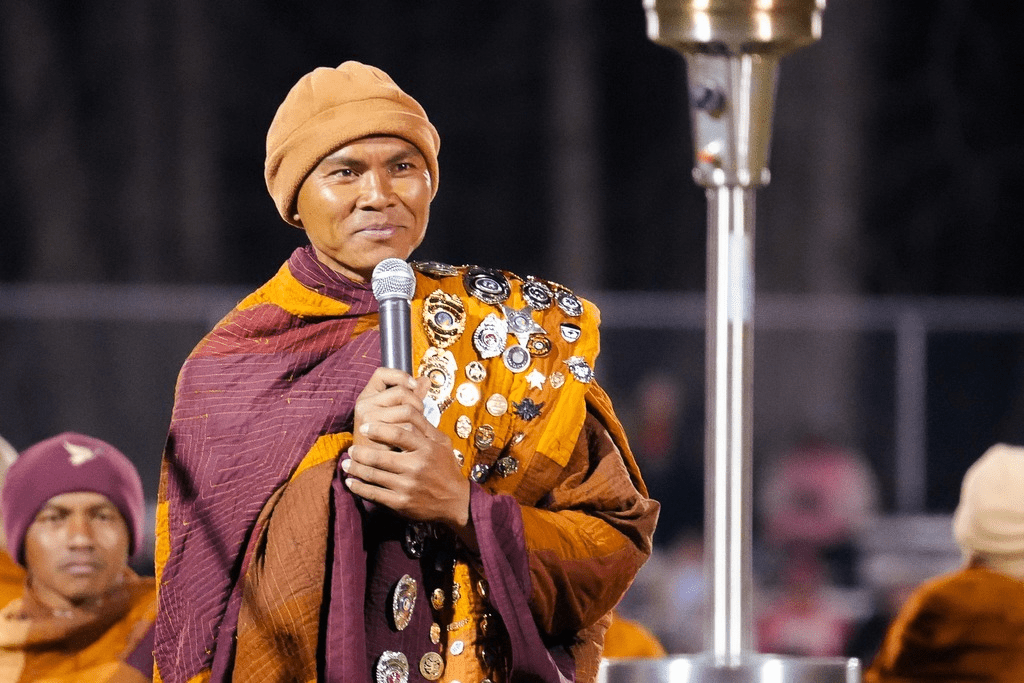
Siler City, NC – On Wednesday evening the “Walk for Peace” monks stopped for the day at Jordan-Matthews High School. This was an opportunity for one of the monks to speak to the crowd gathered at the football here. Below is a summary of the lessons he hoped to teach.
We fight a battle every day, but the enemy isn’t external. It’s the relentless hum of our own minds—the constant wandering to past regrets and future anxieties, the endless scroll of digital distractions, and the crushing pressure to always be doing more. In this unwinnable war for a quiet mind, we often feel like we’re losing ground.
But what if the pursuit of peace wasn’t an epic battle at all? What if it was simply a series of small, counter-intuitive shifts in perspective? In a recent talk, a monk shared a path to peace that doesn’t require struggle, but instead invites awareness and acceptance. This post shares the four most surprising and impactful lessons from that talk—practical wisdom that can be applied to your life, starting right now.
1. To Connect With Your Kids, Stop Trying to Fix Them
As parents, our deepest instinct is to protect and guide. We want the best for our children, so we try to fix their mistakes and teach them the “right” way. But the monk pointed out a painful paradox: the more we try to “fix” or “change” them, the more we inadvertently build a “war” between us, pushing them further away.
His surprising solution was to shift our role entirely: stop trying to teach and start sharing. By approaching a child as a friend, we transform the dynamic from a top-down lecture into a shared conversation. This shift is the key to getting them to listen, and more profoundly, it creates the safety for the ultimate connection. The monk explained that when children see you as a friend, “whenever obstacle when they run into trouble they will come back to you and lean on your shoulder and cry and ask for help… that is when your chance come to teach them.”
unless you make friend with them you see them as your friends not mother not the father but a friend A friends means the different way of talk, different way of teaching, sharing… and that is when they listen.
In a world of high-pressure, achievement-oriented parenting, this advice is a radical act of trust. It asks us to let go of micromanagement and have faith that building a foundation of friendship is the most effective way to stay connected, especially when our kids are more influenced by peers and technology than ever before.
2. The Enemy of Peace Isn’t Chaos—It’s Multitasking
The monk observed that in our modern world, a distracted, wandering mind has become the “normal” condition. Very few people, he noted, can truly focus. He then offered a memorable metaphor for the primary source of this distraction: our smartphones.
And now that we all all have our lovers along with us every single second, you know who is your lover is your cellphone…
His solution is profoundly simple yet radically counter-cultural: stop multitasking. He framed this not as a mere productivity hack, but as the fundamental practice for purifying the mind. Without concentration on a single task, he explained, there can be no real peace.
This advice directly challenges the modern glorification of being busy. We multitask because we treat busyness as a proxy for importance and self-worth. To single-task is therefore an act of rebellion against the “cult of productivity.” It’s a way to reclaim our presence and discover that true effectiveness and inner calm are found not in doing more, but in giving our full attention to one thing at a time. This practice of single-pointed concentration is the very tool we need for the next lesson: dealing with the internal chaos of our own minds.
3. Don’t Fight Your Anxious Thoughts. Just Look at Them.
When we try to find a moment of quiet, the mind inevitably rebels. Thoughts of the past and worries about the future “pop up” and disrupt our focus. But the monk’s wisdom extends beyond just anxious thoughts—it applies to every distraction, internal and external. The itch on your nose, the sound of a distant siren, a sudden memory—our common reaction is to fight these intrusions and scold ourselves for getting distracted.
The monk’s instruction is to do the exact opposite. The goal is not to create a blank, empty mind. The practice is to simply add awareness to your breath, and when any thought, sound, or physical sensation appears, you acknowledge it without judgment. You observe it for a moment, and then gently guide your attention back to your breathing.
When that thought pop up, instead of trying to eliminate or push it away, just acknowledge it, observe that thought and then come back to this breathing.
He warned that this requires immense patience because “we will fail over and over.” This insight is liberating. It reframes “failure” as a completely normal and expected part of the process. Each time you notice your mind has wandered and you gently bring it back, you are succeeding.
4. Learn to Shed Your Leaves Like a Tree
To illustrate the art of letting go, the monk shared a powerful analogy from nature. In the autumn, trees shed their leaves. They don’t do this because they are weak; they do it as a brilliant survival strategy to conserve energy through the winter, preparing for new growth in the spring.
He explained that humans, however, often do the opposite. We spend our lives collecting and holding onto our mental “trash”—bad habits, unhappy memories, stress, and anxiety. We cling to these dead leaves until we are completely overwhelmed by their weight.
We have collected all kind of trash in our mind. Bad habit, unhappy thing, undesirable, all those things happening in our life that we suffered. We collected it so many and we recorded in here and we didn’t know how to let it go. We don’t know how to shut it off just like those trees.
This metaphor recasts “letting go” not as a passive act of giving up, but as an active, wise process of conserving our vital energy. In a world facing an epidemic of burnout, this lesson becomes a crucial survival strategy. It teaches us to release what no longer serves us in order to preserve our strength for what truly matters—for the new growth that awaits.
Peace is a Practice, Not a Destination
The war for a quiet mind ends the moment you stop fighting. As the monk’s lessons reveal, peace is not a distant state you arrive at, but the result of small, conscious actions. It’s found in the choice to single-task, the gentle observation of a thought, and the courage to let go of control—both in our own minds and in our relationships. Becoming a friend to our children and a non-judgmental observer of our thoughts are both practices in releasing the need to fix everything. Single-tasking is the foundation that makes this awareness possible.
He offered a simple starting point: each morning, write down the statement, “Today is going to be my peaceful day,” and live with that intention. But he also added a note of urgency. Many of us say we will do it “later,” but, as he warned, “that later that moment never comes.”
Don’t wait. Peace is a daily practice, and the work begins now. Looking at the “leaves” you’ve been carrying, what is just one you can choose to let go of today?
Thus have I heard. At one time the Buddha was in Vārāṇasī, at the Deer Park in Ṛṣipatana.
At that time, the Bhagavān said to the bhikṣus, “Would a lady, said to be the most beautiful in the world, cause many people to gather together to see her?” The bhikṣus replied to the Buddha, “Certainly, Bhagavān.” The Buddha said to the bhikṣus, “If that lady, reputed to be most beautiful in the world, could perform all kinds of music, song, and dance, would many people gather together to watch?” The bhikṣus addressed the Buddha, saying, “Certainly, Bhagavān.”
The Buddha said to the bhikṣus, “Suppose there were a lady said to be the most beautiful in the world, and in this place there would be all kinds of entertainment with music, song, and dance. Moreover, a great crowd would converge upon this one place. Suppose there would be a gentleman, not foolish or stupid, preferring happiness to suffering, valuing life and fearing death. A person would say to him, ‘Sir, you should carry this bowl of oil, filled to the brim, and pass in between this world beauty and the crowd. There is a killer who will draw out his blade and follow you. If a single drop of oil is lost, he will cut off your head.’
“What do you think, bhikṣus? Would that man carrying the oil bowl be able to forget about the oil bowl, and forget about the killer, and watch that skillful lady and the large crowd of people?” The bhikṣus addressed the Buddha, saying, “No, Bhagavān. Why? Bhagavān, that man would be concerned about the man with his blade drawn out. He would think, ‘If I spill even one drop of oil, that man with his blade drawn will cut off my head.’ With that only thought, his mind would be fixated on the oil bowl. He would walk between the world beauty and the crowd and go past them, not daring to catch a glimpse.”
“Thusly, bhikṣus, if there is a śramaṇa or brāhmaṇa who is dignified in body and resolute in mind, not regarding voice and beauty, skillfully regarding all dharmas of the mind, abiding in mindfulness of the body, then this is my disciple who is in accordance with my teaching.
“What does it mean for a bhikṣu to be dignified in body and resolute in mind, not regarding voice and beauty, persevering in all dharmas of the mind, abiding in mindfulness of the body? Thusly, bhikṣus: mindful of the body, observing the body: ardent, correctly aware and mindful, setting aside worldly craving and sorrow.
“Abiding in the mindfulness of sensations… and of the mind… and of dharmas, observing dharmas, are also such as this.
“This is called a bhikṣu who is dignified in body, resolute in mind, not regarding voice and beauty, and skillfully regarding dharmas of the mind, abiding in the Four Bases of Mindfulness.”
At that time, the Bhagavān spoke a gāthā:
Focused and well-mindful, As if protecting an oil bowl: The mind protected this way Reaches the unprecedented— What is extremely difficult to reach, Supremely wondrous and subtle. Those things the Buddha speaks: That teaching is a sharp sword. With a resolute mind, Focusing and persevering— Not like an ordinary person, Negligent in affairs— One is able to enter thusly, Not neglecting the teaching.
After the Buddha had spoken this sūtra, the bhikṣus heard what the Buddha had said, and joyfully practiced in accordance.
There are moments in life when, despite our best intentions and most sincere efforts, things still feel profoundly unfair. Right and wrong seem reversed. The ground beneath us shifts, and our inner balance begins to tilt toward chaos. In those moments, our first instinct is often to react—to defend, to argue, to strike back.
Before you do, pause.
Take a breath. Return to your body. Listen to what is happening beneath the noise.
When we step into conflict fueled by “righteous anger,” wounded pride, or a desire for revenge, we rarely restore balance. More often, we simply exchange one form of turmoil for another. Peace quietly slips away.
Holding onto resentment or remaining lodged in the role of the victim keeps us circling the same pain, replaying the same arguments, long after the moment has passed. Whether we choose to walk away with a clear conscience or feel called to stand up for what feels just, one truth remains: every action—and every silence—creates ripples. They shape who we are becoming and touch the lives of those around us.
At first glance, the phrase Peaceful Warrior seems contradictory. Yet a life rooted in peace and integrity demands precisely this paradox.
To be peaceful does not mean to be passive. To be a warrior does not mean to be aggressive.
True strength lies in seeing beyond illusion and surface drama. It lies in choosing awareness over reflex, clarity over emotional momentum. A Peaceful Warrior does not drift from one reaction to the next; they choose their response with care.
Such a warrior knows how to step back and observe themselves in the heat of the moment. They are capable of decisive action, but their actions are guided by wisdom and oriented toward the greater good. Only genuine courage allows us to respond from the heart, rather than from outdated conditioning and habitual fear.
The next time you find yourself facing opposition, remember this: you can remain present. You can maintain your inner edge without surrendering to fear or hostility. You can stand firmly without hardening your heart.
You can be a Peaceful Warrior.
When life confronts us with injustice, it becomes a quiet test of our spiritual maturity. These reflections may help illuminate the path:
1. Discern Reaction from Response A reaction is automatic—rooted in survival, memory, and past wounds. A response is conscious, grounded in the present moment. When you feel that surge of heat in your chest, pause and ask: Is this my deeper wisdom speaking, or is it my ego defending its image?
2. Release Attachment to Outcomes The Bhagavad Gita teaches action without attachment to results. Spiritually, this means doing what is right not for victory or validation, but because it aligns with truth. When the need to “win” dissolves, a quieter, more enduring power emerges—one that cannot be taken from you.
3. Receive the Mirror Those who unsettle us most often reveal where we are still tender or unhealed. This does not excuse harmful behavior, but it offers insight. Let the discomfort become a question: What within me is asking for strength, clarity, or compassion?
You might not realize it, but this is the true power of prayer—it’s not just asking for blessings; it is awakening an internal system within you that says, “I can keep going.”
Every sincere moment of prayer leaves an imprint on the mind. This is not spiritual poetry or wishful thinking; it is a pattern repeatedly observed through MRI scans, neuroimaging, and psychological research. Each second spent in focused, quiet prayer is an opportunity to “turn on a light” in the brain—helping us become steadier, clearer, and more resilient.
Scientists were once skeptical. But the evidence surprised them.
When a person enters a state of deep, focused prayer, activity in the prefrontal cortex increases. This is the part of the brain responsible for attention, judgment, emotional regulation, and self-control—the “driver’s seat” of the mind. Prayer helps us return to that seat, especially when life feels overwhelming.
At the same time, activity in the amygdala—the brain’s alarm system—tends to decrease. This region governs fear, anxiety, and the fight-or-flight response. When it is overstimulated, we feel tense, reactive, and out of control. Prayer appears to gently quiet this system, creating inner space to breathe, reflect, and choose more wisely.
This is not merely a mental effect—it is a physical response of the nervous system.
Research also suggests that heartfelt prayer—prayer infused with sincerity and emotion—is especially powerful. Compared to mechanical repetition, it more strongly activates brain regions associated with language, empathy, connection, and self-awareness, including the temporoparietal junction, anterior cingulate cortex, and medial prefrontal cortex. These areas shape how we relate to ourselves, to others, and to life itself.
In simple terms, honest prayer becomes a process of emotional clearing and inner reorganization.
When practiced regularly, these brain responses do something remarkable: they form new neural pathways. Like carving a well-worn trail through a forest, prayer creates a reliable inner path—a place of stability we can return to during moments of fear, grief, or confusion. The more often we walk this path, the easier it becomes to find our way back to calm.
Prayer is not the same as meditation. While both reduce stress and sharpen focus, prayer carries an added element: relationship. Prayer involves trust, dialogue, and the felt sense that we are not alone. This activates neural systems related to connection, attachment, and belonging—deep human needs that meditation alone does not always engage.
This may explain why, at the edge of emotional collapse, a simple, sincere prayer can sometimes bring someone back from the brink. The problem may not disappear—but the mind, heart, and body momentarily realign. A quiet strength returns. I can get through this.
What Prayer Does—Inside and Out
Activates the Prefrontal Cortex Strengthens clarity, emotional balance, and self-control.
Calms the Amygdala Lowers fear and stress responses, restoring inner quiet.
Builds Emotional Resilience Repeated prayer forms neural pathways that support stability over time.
Fosters Connection and Trust Engages social and emotional brain systems through relationship and sincerity.
Sincere prayer may be one of the most gentle, natural, and powerful “built-in reset systems” we possess.
So when was the last time you prayed—not out of habit, but from the heart? Have you ever noticed how your body softened afterward, how tension quietly released?
That wasn’t imagination. That was your mind and nervous system responding to something deeply human—and deeply real.

































 Peace LiLy