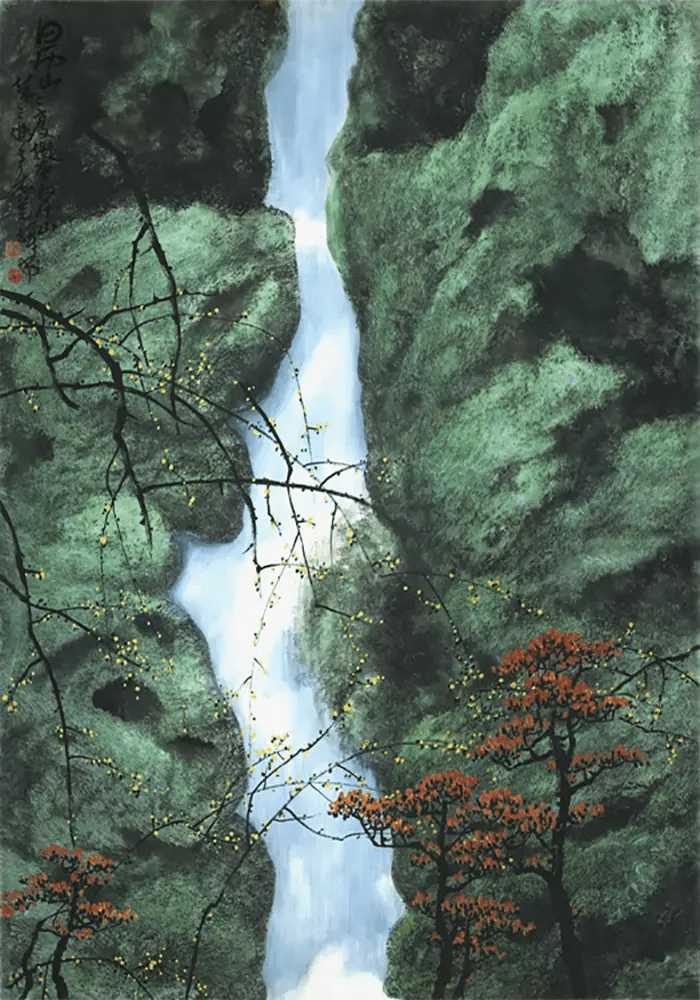
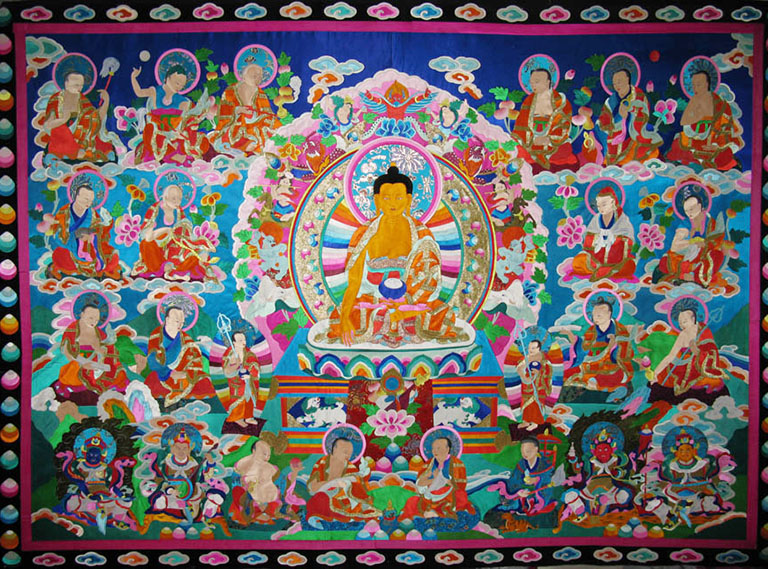
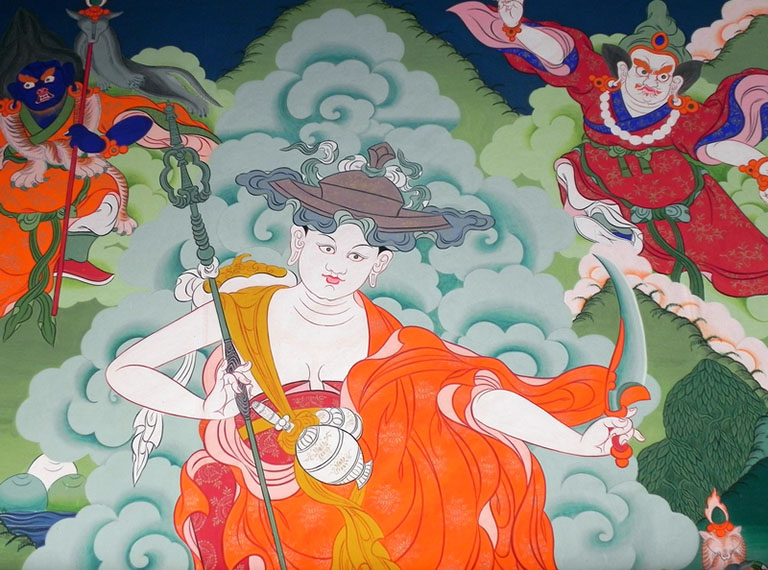
Created in 1993, Xing Garden at Mount Rili stands as a masterful expression of the artist’s profound understanding of nature and brushwork. The painting presents a dramatic world of steep cliffs and cascading water, inviting the viewer into a landscape that feels both monumental and intimate.
Dominated by vibrant greens, the work vividly captures moss and grasses spreading freely across rocky surfaces. These lush tones breathe life into the cliffs, softening their ruggedness while emphasizing the quiet vitality that thrives within seemingly harsh terrain. Nature here is not static; it pulses with energy and renewal.
The painting employs the refined “Miaoxie” (妙写) technique—a style that reveals its true depth through careful observation. At first glance, the composition appears fluid and effortless. Yet upon closer inspection, the brushstrokes intertwine like delicate wires, layered and interwoven with extraordinary precision. These subtle lines create constant movement and variation, generating emotional richness and visual intrigue through their complexity.
One of the most captivating aspects of this work lies in its masterful use of illusory watery ink, where solidity and transparency coexist. Ink seems to flow and dissolve at the same time, offering a boundless sense of depth and atmosphere. Whether viewed from afar or examined up close, the painting reveals a bottomless waterfall, rendered with meticulous detail yet infused with powerful momentum.
What is especially striking is the contrast between refinement and strength. From a distance, the scene appears serene and orderly; yet when the viewer studies the brushwork closely, the strokes reveal unexpected vigor and boldness. Within apparent emptiness, there is substance; within seeming chaos, there is profound order. This balance embodies the highest level of artistic cultivation.
Through free yet disciplined brushwork, the artist transforms a simple natural motif—a waterfall between two cliffs—into a scene of extraordinary aesthetic depth. The power of each stroke carries both physical strength and spiritual presence, allowing the painting to transcend mere representation and enter the realm of lived experience.
Xing Garden at Mount Rili is more than a landscape painting. It is a quiet dialogue between nature and the artist’s inner world, revealing how true mastery lies not in excess, but in the ability to uncover profound beauty within simplicity.
The highest point of the leg: The Dochu La pass at 3,100 meters
By Gongjue Tuji
With many impressions from Thimphu and a feeling of gratitude, we continued our pilgrimage. Before leaving the busy capital behind for good to drive deeper into the mountains, however, we spent another day in its surroundings. After all, Bhutan is not only defined by its holy temples and deeply rooted Buddhism. The landscape itself also holds enormous power. We were looking forward to traveling to places where the country’s history and the powerful nature form a very special unity.
Semtokha Dzong: The Palace of Secret Mantras
On the third day, our path first led us about six kilometers south of Thimphu to Semtokha Dzong. This place also bears the meaningful name “Sangak Zabdhon Phodrang,” which translates to “Palace of the Profound Meaning of Secret Mantras.”
Semtokha Dzong
Historically, this is a milestone: The Dzong was built between 1629 and 1632 by Shabdrung Ngawang Namgyal, the legendary unifier of Bhutan. He introduced something completely new here, namely the combination of a monastery and an administrative center under one roof. This innovative concept worked so well that it later became the model for all other major fortresses in the country, such as in Paro or Punakha. This historical significance mixed with a very present joy on the day of our visit. Since the entire country was honoring the fourth King’s birthday, a particularly festive mood could be felt everywhere.
But something else left a deep impression on me. In the temple rooms, the distinct scent of butter lamps hung in the air. It is a very unique smell that we would encounter again and again at other places, and which for me is now inseparably linked to the atmosphere of these holy sites.
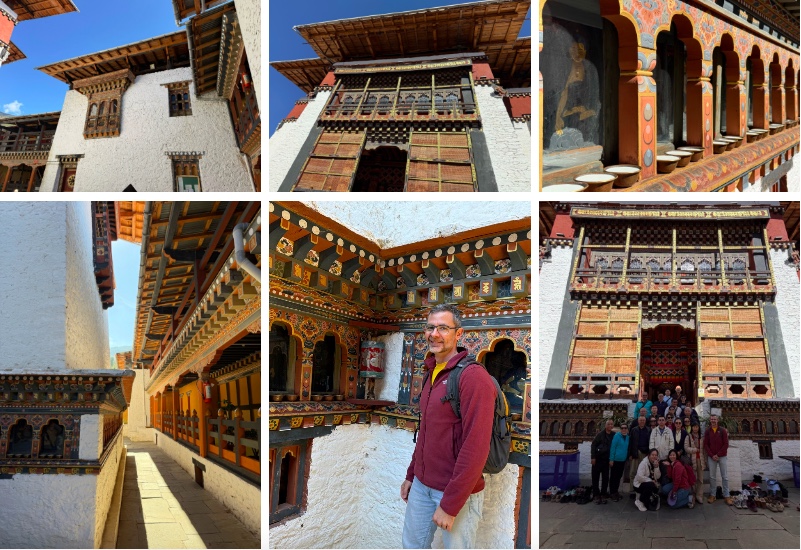
Impressions (in order): View into the courtyard, the magnificent entrance area, water bowls as offerings, the corridor with prayer wheels, myself inside, and our group on the entrance stairs.
Takin Preserve: The Creation of Drukpa Kunley
Bhutan is deeply rooted in its spiritual traditions, where the power of the Dharma also manifests in nature. We visited the Royal Preserve to see the national animal: the Takin. It is a fascinating creature, unique to the Himalayas, with an appearance that resembles a cross between a cow and a goat.
Its existence traces directly back to the miraculous activity of Drukpa Kunley, also known as the “Divine Madman.” In the 15th century, people asked him to perform a miracle to prove his realization. He requested to be served a cow and a goat. After consuming both, he placed the goat’s head upon the cow’s skeleton. With his supernatural powers, he brought this new being to life. This event stands as a powerful testament to the Master’s unconventional teaching methods and his ability to act beyond ordinary concepts.
Impressions (in order): The spacious forest area of the preserve, a resting Takin in the shade, and an animal by the stream.
Dochu La: Commemoration at the 108 Chortens
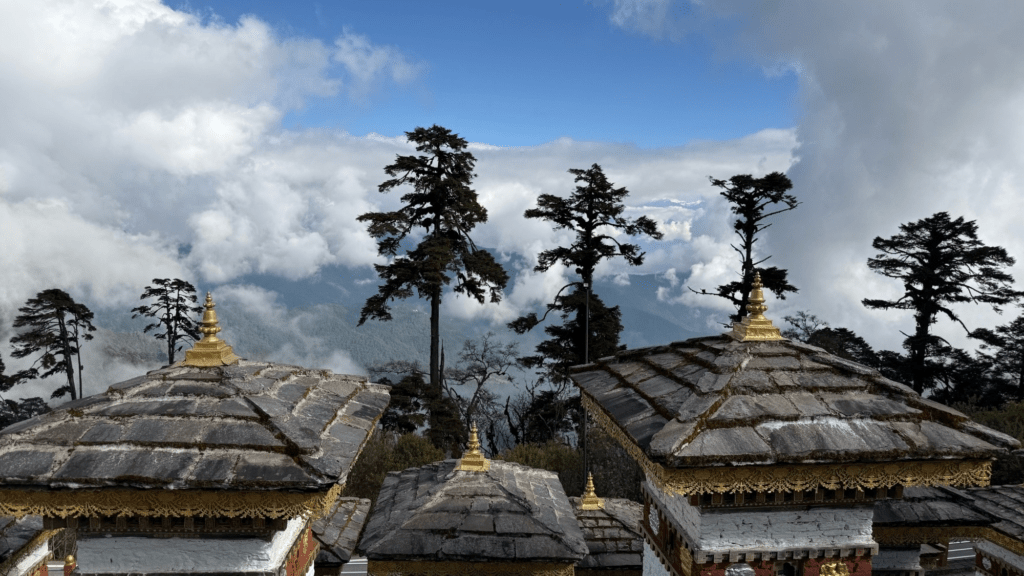
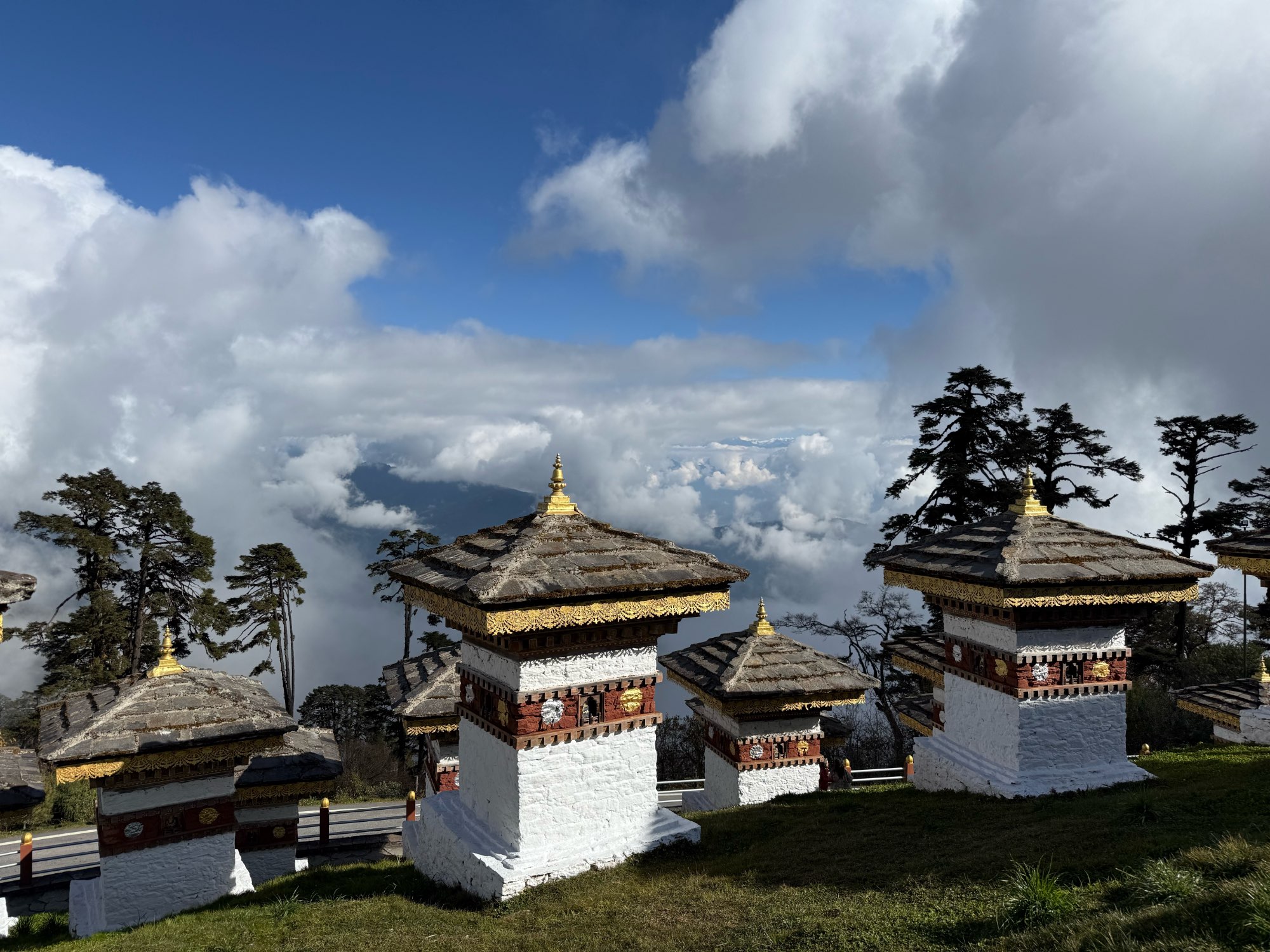
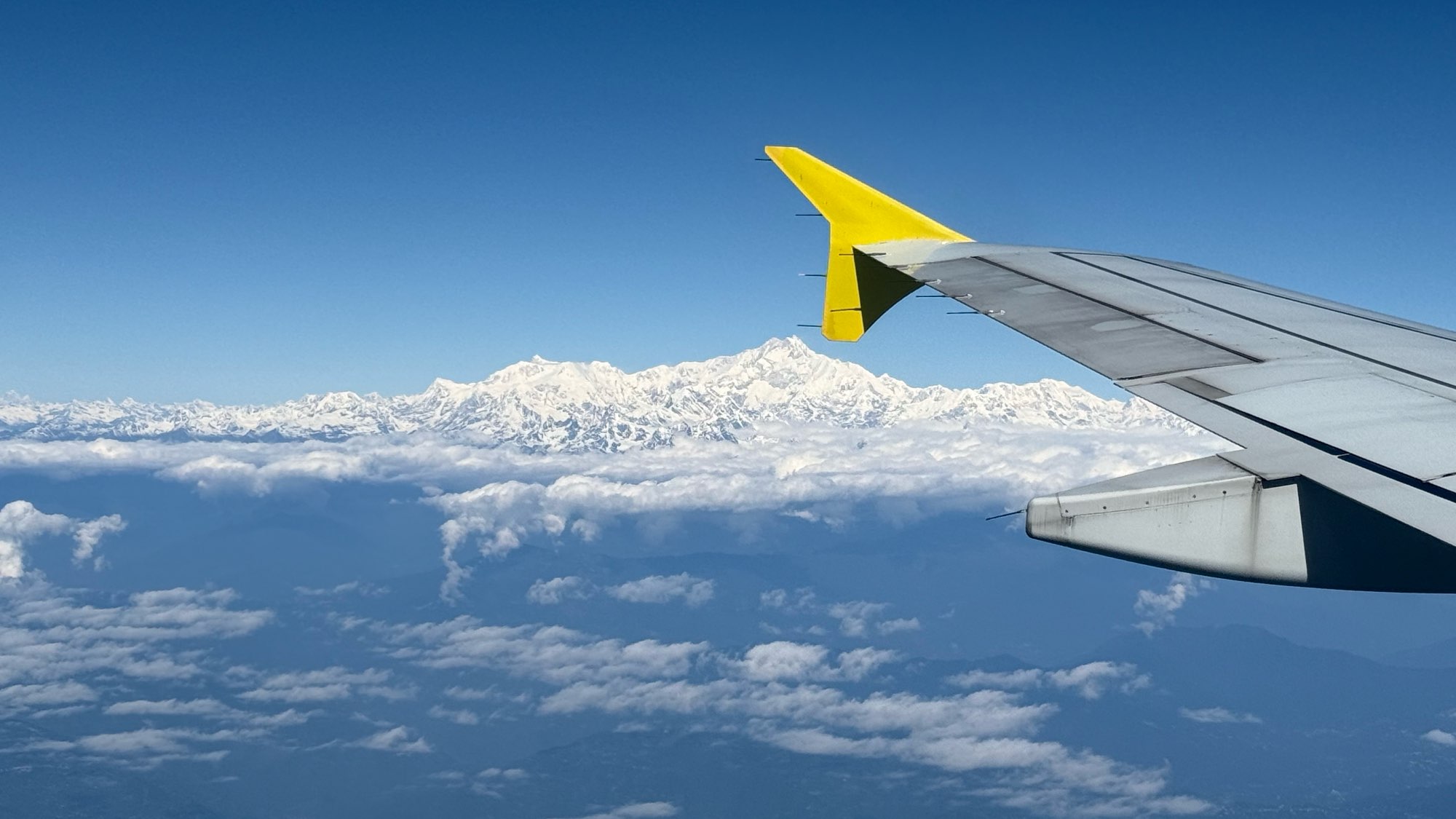
On the fourth day, we left the capital heading towards Punakha. The road led us over the Dochu La, a pass at an altitude of about 3,100 meters. Although a few clouds obscured the view of the very big ice giants of the Himalayas, gaps opened up again and again, through which we could see the snow-covered peaks.
The 108 Druk Wangyal Chortens against the backdrop of the Himalayas
Up on the pass stand the 108 Druk Wangyal Chortens. They are an important place of remembrance. They were not built to celebrate a military victory in 2003, but to commemorate the fallen. It is characteristic of the culture here that triumph is not put in the foreground, but rather compassion and remembrance.
Chimi Lhakhang: The Legacy of Drukpa Kunley
In the Punakha district, the legacy of the “Divine Madman,” Drukpa Kunley, is ever-present. Even in the surrounding villages, we noticed the many houses painted with phallic symbols. What may initially seem unusual to foreign eyes is regarded here as a powerful symbol of protection.
View into the Punakha Valley
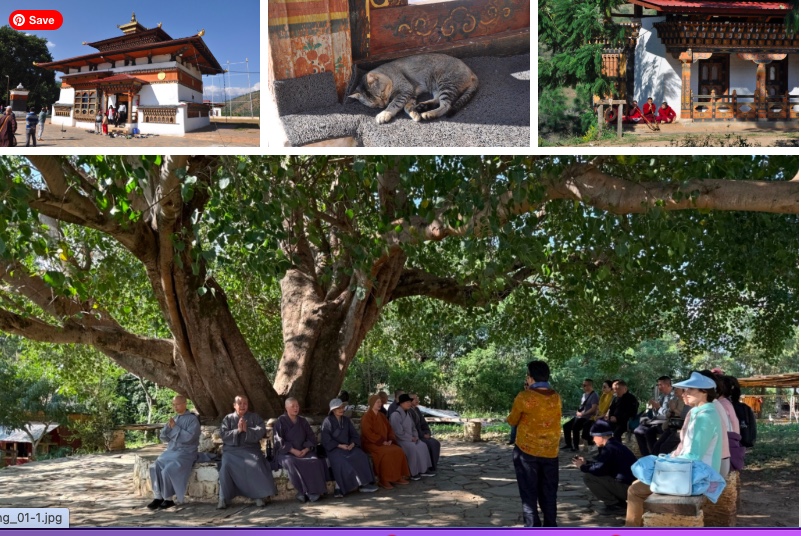
Our next destination was Chimi Lhakhang. The path there leads very picturesquely right through green rice fields. The temple itself stands exactly at the spot where the great master Drukpa Kunley manifested his power to subdue a demon that had taken the form of a dog. He did so with his “flaming thunderbolt of wisdom.” This also explains the paintings on the houses, as they represent this victorious thunderbolt. At the place of this subjugation, a small black stupa still stands today. Also, statues of the master can often be recognized by a dog lying at his feet. Today, the place is mainly known as the Temple of Fertility, to which couples from all over the world make pilgrimages. We used the peaceful atmosphere there to chant together under a large Bodhi tree in front of the temple.
Impressionen (der Reihe nach): Der Chimi Lhakhang Tempel mit der schwarzen Stupa, eine schlafende Tempelkatze, junge Mönche beim Üben der Dharma-Instrumente und unsere Gruppe beim gemeinsamen Chanten unter dem großen Bodhi-Baum.
Punakha Dzong: Palace of Great Bliss
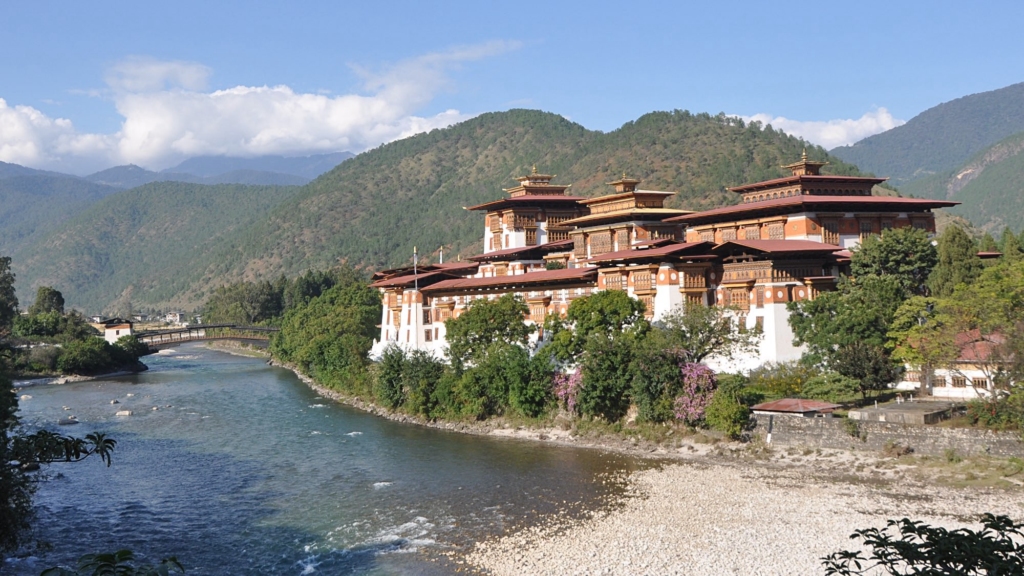
Afterwards, we continued to Punakha Dzong. It is situated very picturesquely right where the Pho Chhu (Father River) and the Mo Chhu (Mother River) meet. Its full name is Pungtang Dechen Photrang Dzong, which translates to “Palace of Great Happiness.” The building is not only huge but also historically of enormous importance. It was built as early as 1637 and for a long time formed the center of the then winter capital Punakha.
Punakha Dzong
Even today, the monastic community moves here during the cold months. Moreover, it is a historic place for the monarchy, as the first King of Bhutan was crowned here in 1907. Inside rest the mortal remains of the state founder Shabdrung Ngawang Namgyal. However, this area is strictly protected. Only the King and the Je Khenpo, as well as two guardian lamas, are allowed to enter the room with the relics.
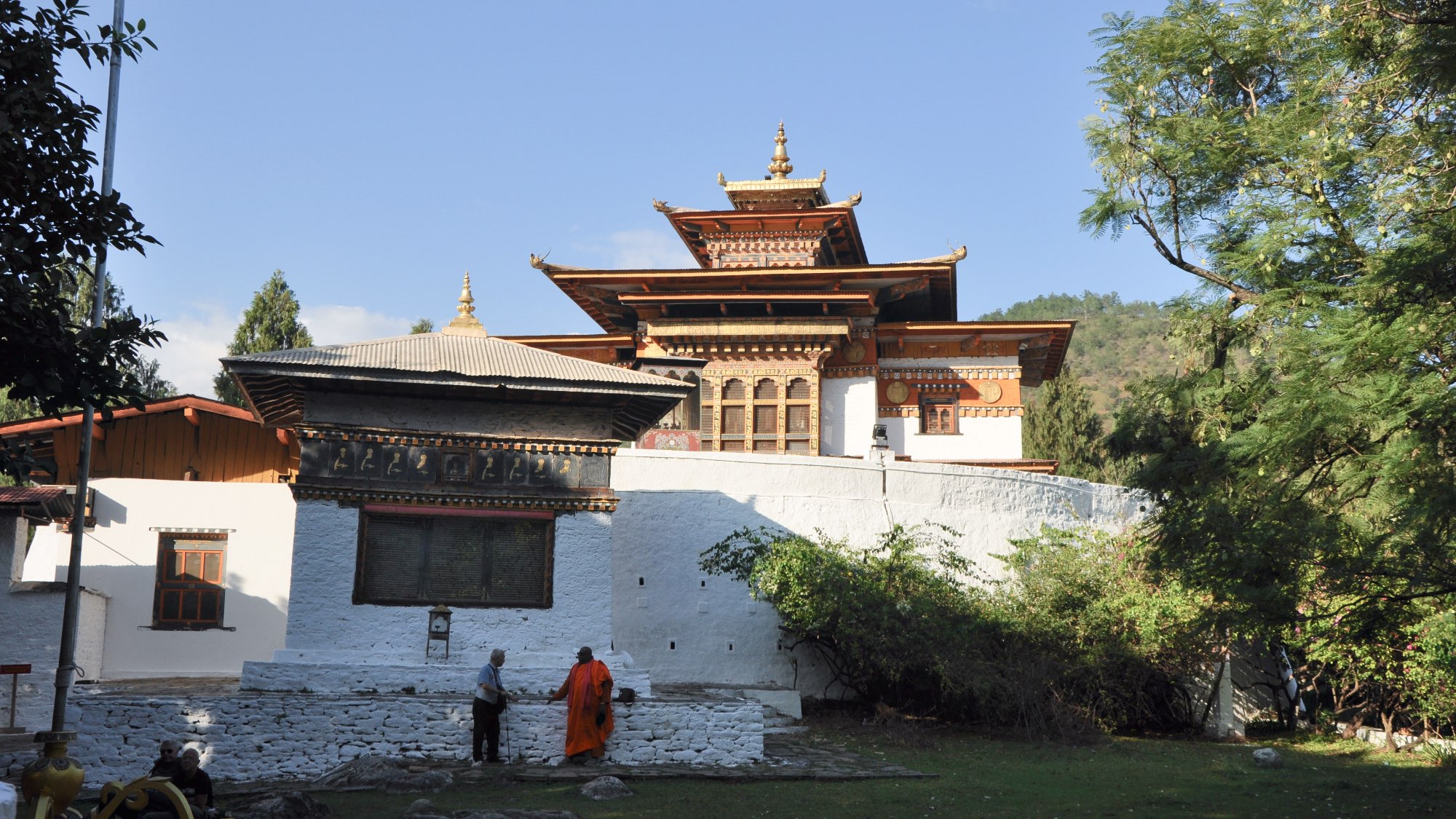
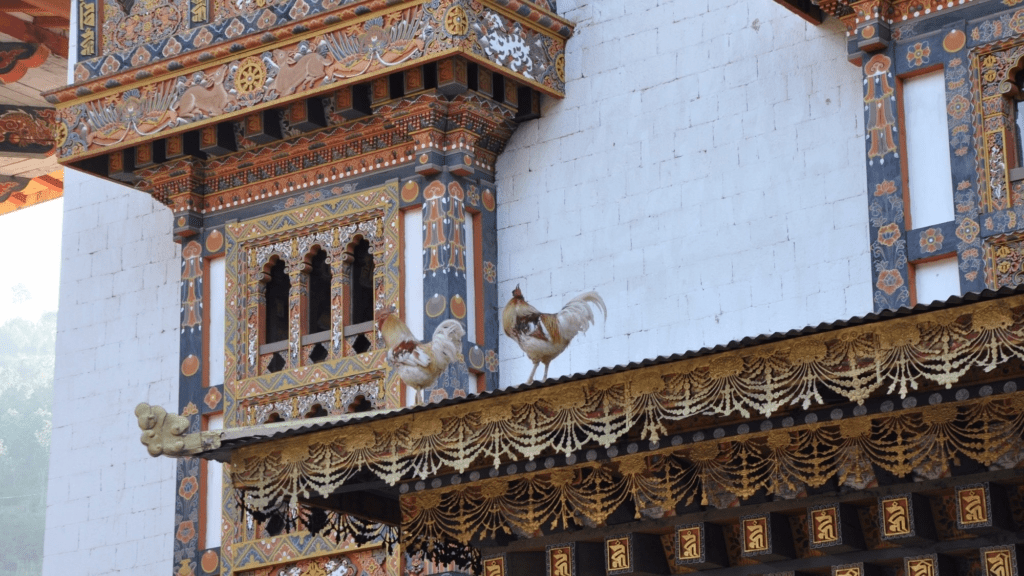
Impressions (in order): Conversations in front of white walls, roosters on the intricate roof ledge, and the entrance to the sacred temple area (Machen Lhakhang), where the relics of the state founder are kept.
Wangdue Phodrang: Rebuilding a Landmark
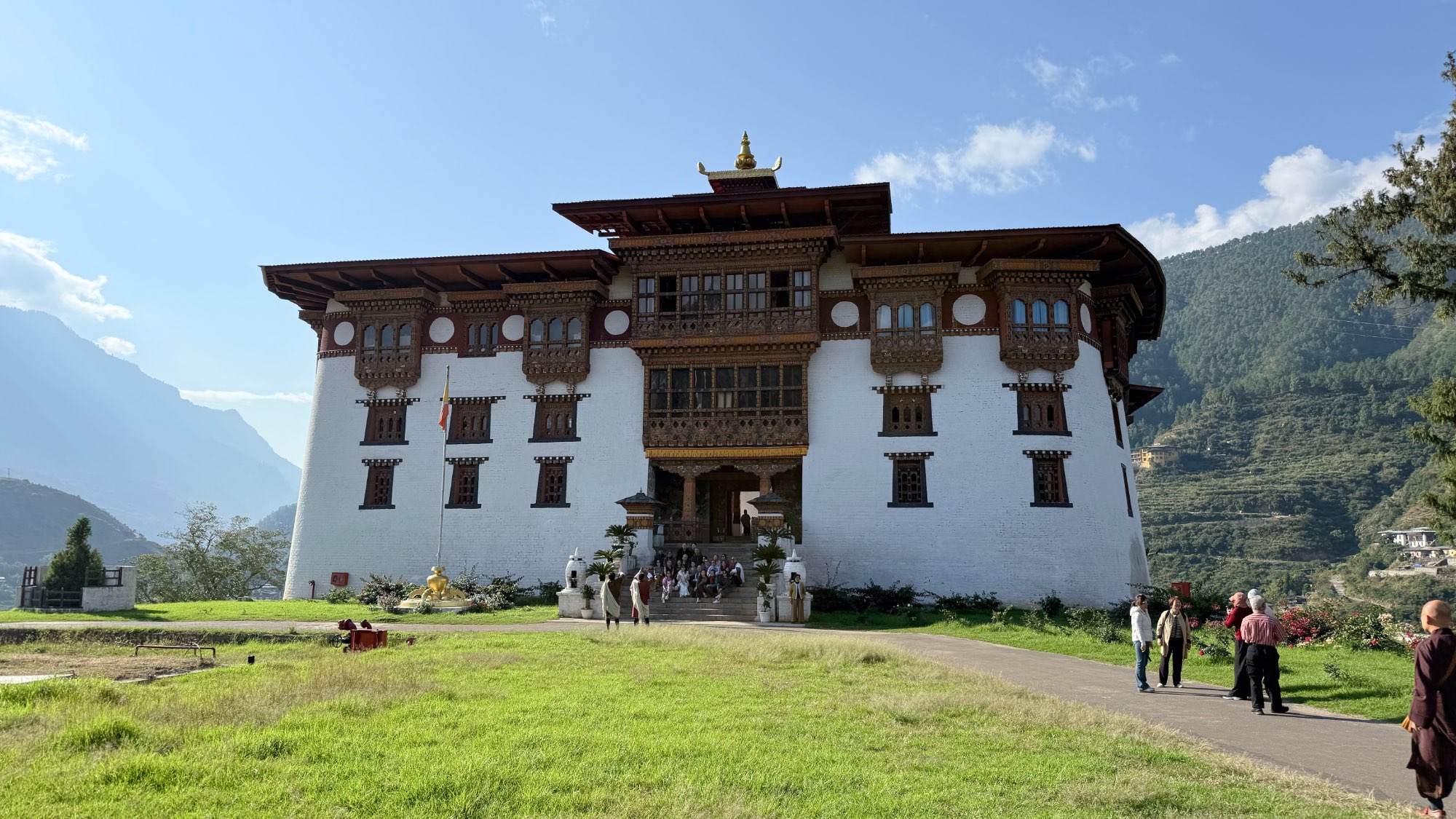
In the morning of the next day, we stopped at Wangdue Phodrang Dzong. This place has a moving history. It was founded in 1638 by Shabdrung Ngawang Namgyal under the auspicious name “Palace of the Four Cardinal Directions.” It sits strategically on a ridge that resembles a sleeping elephant and overlooks the confluence of two rivers.
Wangdue Phodrang Dzong
For a long time, it was considered the only Dzong that had never fallen victim to a fire in its almost 400-year history. But on June 24, 2012, fate struck: A technical defect triggered a fire in the early morning, and fueled by strong winds, the proud fortress burned out completely within a few hours.
But what we saw was not a place of mourning, but of hope. The reconstruction, which began in 2014, is an impressive testament to Bhutanese unity, but also to the deep friendship with neighboring India. Through close cooperation and generous support from India, this massive project could be realized. It wonderfully shows how modern engineering and cross-border solidarity are used not only to preserve traditional culture but to literally let it rise anew from the ashes.
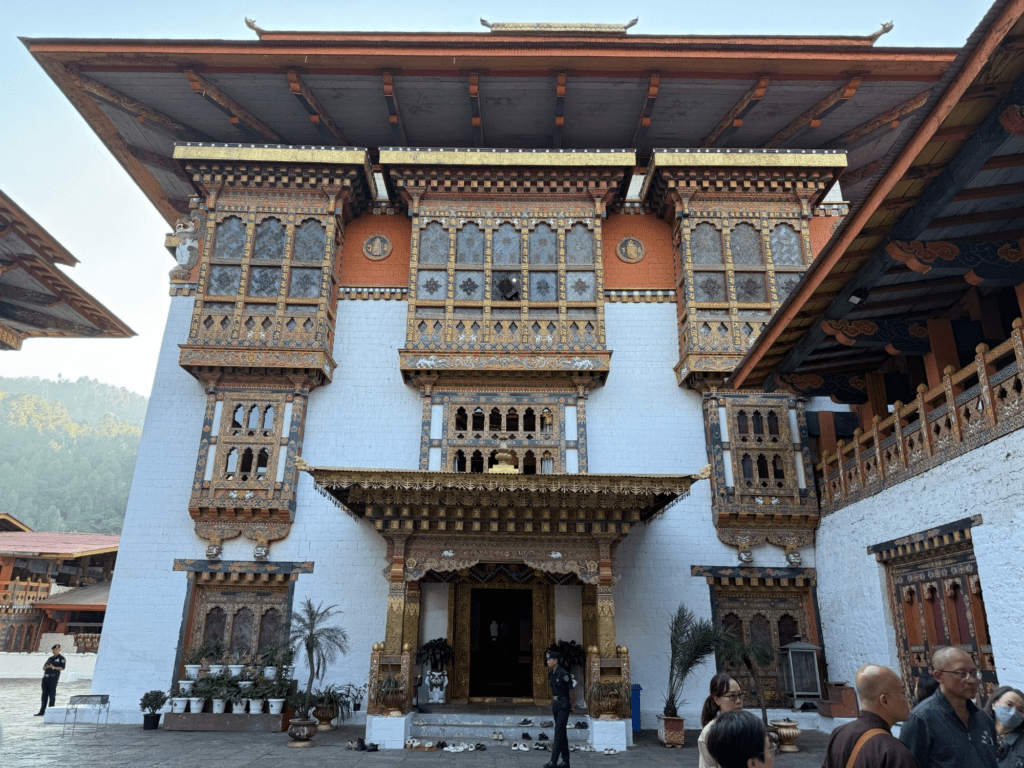
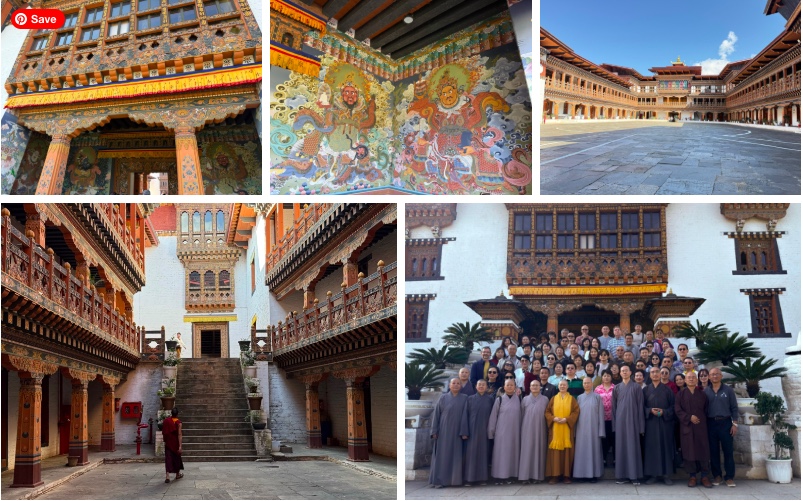
Impressions (in order): Intricate carvings at the portal, colorful wall murals of guardian deities, the spacious courtyard, a monk at the staircase, and our group photo in front of the Dzong.
Drive through the Black Mountains
With this image of a new beginning in mind, we continued our journey towards the Phobjikha Valley. The drive was scenically very impressive. Our bus wound its way up the Black Mountains curve after curve. We had perfect weather. The sun was shining and allowed us a clear view that reached further with every meter of altitude. The road snaked along the partly steep mountain slopes in tight serpentines until we crossed the pass and finally drove down into the valley.
Phobjikha Valley: Winter Home of the Black-Necked Cranes
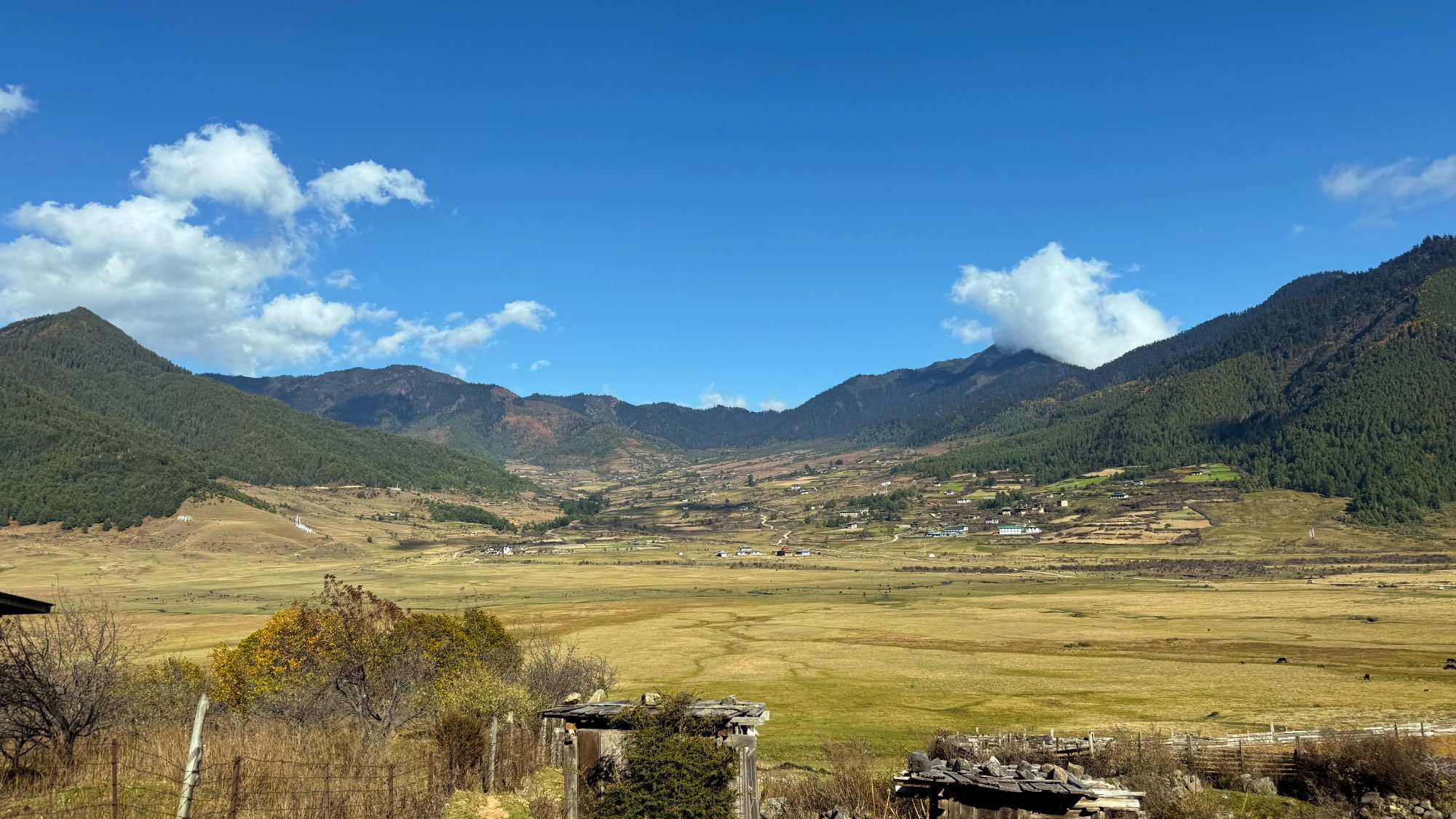
The Phobjikha Valley is a very special retreat. It serves as the wintering ground for the rare Black-necked Cranes from Tibet. There is a nice observation about this. When the birds arrive, they circle the local Gangtey Monastery three times. And apparently, they do the same when they leave again. Even the animals seem to have a connection to the Dharma here. We were lucky and some of us saw the first cranes that had already arrived.
Phobjikha-Tal
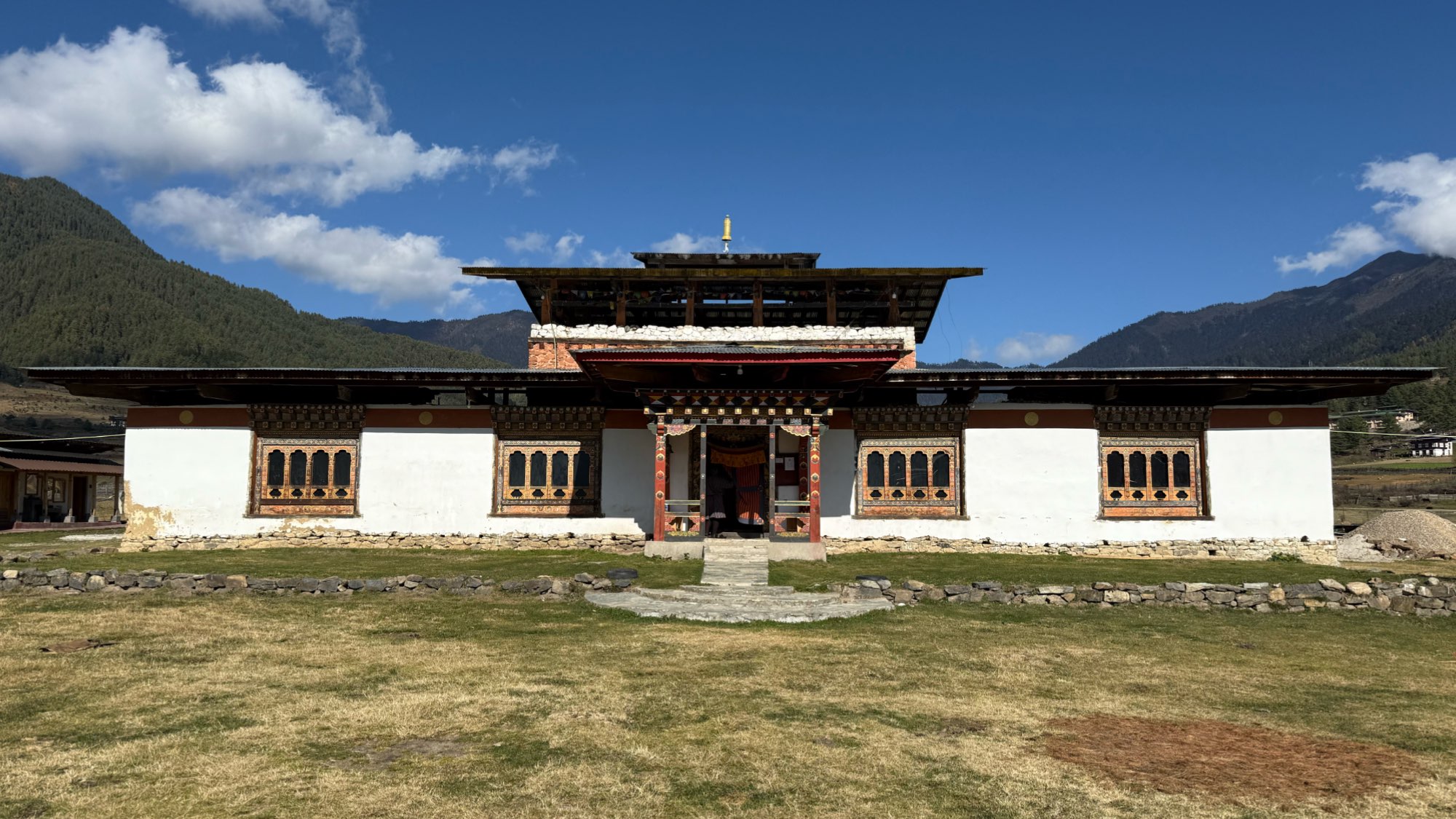
Our lunch was organized for us in an open field right in front of Khewang Lhakhang. We enjoyed it with a wide view into the valley. Afterwards, we visited the temple itself. Inside are still the original statues, which at a good 500 years old are as ancient as the building itself. One of these statues is particularly well-known, as it is said to have spoken twice already.
Khewang Lhakhang
I especially remember the story that’s connected to this place: A demon had taken the form of a young woman to deceive a young man. When the man died, the demon wanted to bring the body into the temple. But the Buddha statue spoke and denied him entry. The demon had to move on and was finally defeated by the deceased’s real girlfriend. A small stupa still stands at this spot today. Such events are not just fairy tales here; they are part of the living spiritual landscape.
Gangtey Goenpa: Spiritual Center of the Nyingmapa
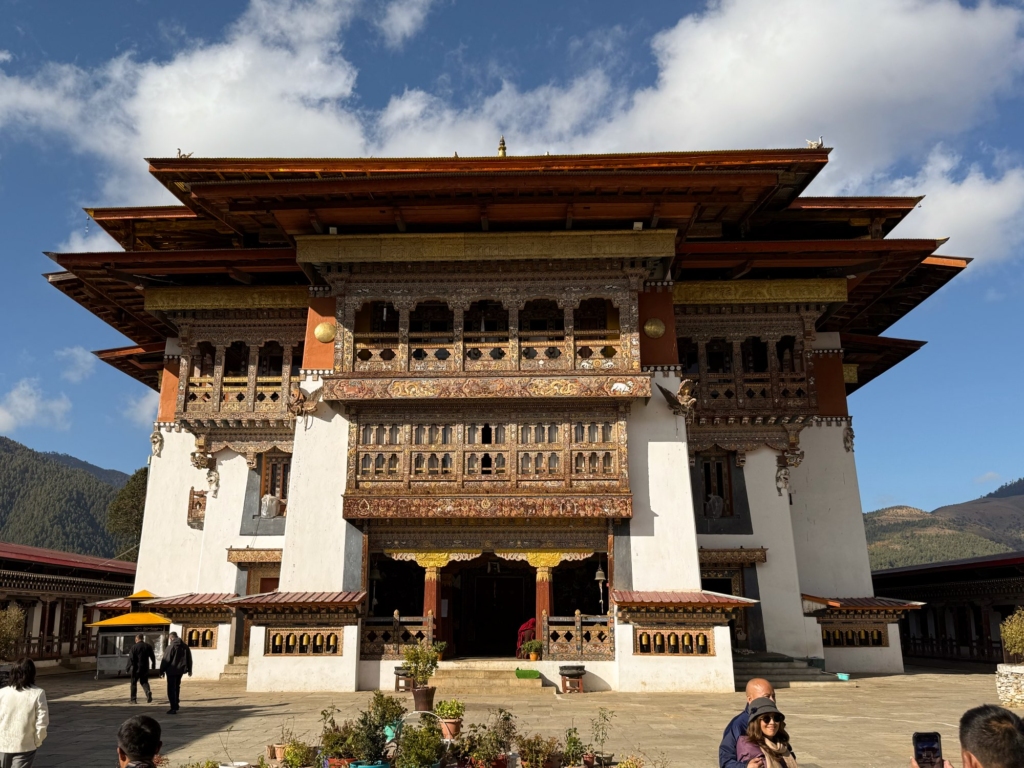
The crowning conclusion of this day was Gangtey Goenpa. It sits on a ridge above the valley and is far more than just a beautiful building. It is the largest and most important Nyingmapa monastery in western central Bhutan and is considered the spiritual heart of the entire region.
The history of this place goes back a long way and begins with a vision. The great “Treasure Finder” (Terton) Pema Lingpa visited the valley in the late 15th century. He looked at the ridge and prophesied that one of his descendants would build a monastery there one day. This prophecy was fulfilled in 1613 when his grandson Rigdzin Pema Thinley founded the monastery.
Gangtey Goenpa
Architecturally, it is fascinating. At first glance, it looks like a Dzong, meaning one of the mighty fortresses we had seen before. But if you look closely, you notice a crucial difference. The military elements are missing. There are no arrow slits and no defensive walls. It was designed purely as a place of peace and practice. I was particularly impressed by the elaborate wood carvings visible everywhere, testifying to the high level of craftsmanship.
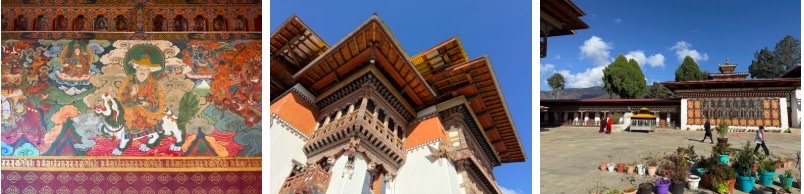
Impressions (in order): Wall mural of Dharmapala Gyalpo Pehar in the entrance area, the view up to the intricate wooden architecture, and the sunny courtyard.
Today, the monastery is a very lively place and acts as the seat of the Pema Lingpa tradition as well as the seat of the master’s ninth reincarnation. About 140 monks live here. Together with the nearby Shedra, the Buddhist college, they ensure that the teaching is not only preserved here but actively studied and lived.
I had a special experience inside the temple. We had gone in to pay our respects to the Buddhas and chant together. Scarcely had we entered the hall when the power went out and it became pitch dark instantly. In the light of our phones, we looked for a place to sit. For about ten minutes, we chanted in this darkness, illuminated only by the faint flickering of a few butter lamps. That created a very unique mood. Suddenly the light came back on. Only at that moment did I see what was directly on the wall opposite me. My gaze fell on a beautiful mural of the 21 Taras. That was an unexpected and deeply moving moment for me.
Actually, we had a specific hope in our hearts for our return to Thimphu and Paro: We wanted to try to get an audience with the King. But as so often in life, plans do not always go in a straight line. Karmic conditions had intended another encounter for us, which we had not expected in this way.
I will tell you about that and our ascent to the famous Tiger’s Nest in the next part.
About Author: Gongjue Tuji
As a committed Buddhist and initiator of the Xuanfa Dharmazentrum, Gongjue Tuji has made it his mission to help other people integrate the teachings of Buddhism into their daily lives. In this blog, he regularly provides insights into his experiences, current news and highlights fascinating aspects of the Buddha-Dharma.
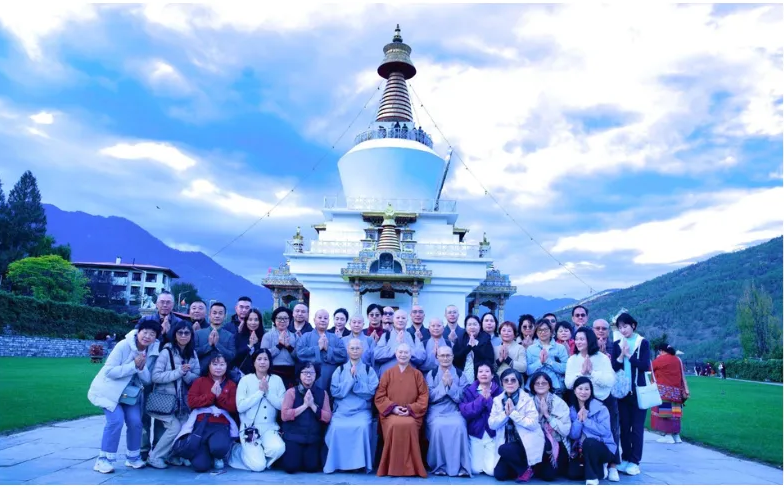
In November 2025, I went on a very special trip. Together with 66 Dharma brothers and sisters, I set off for Bhutan. Being the only German in this group from the USA, China, Taiwan, and Sri Lanka, I felt at home right away. We were a wonderful mix of monks, nuns, Rinpoches, and lay Buddhists. We all met in Thailand first to travel on to Paro together.
Our goal was more than just a visit. We came to honor the holy sites of this country and to dive into Bhutan’s deep-rooted Buddhist tradition. Of course, we were also excited to get to know the land and its people. Dedicated members of our group took care of the entire organization. Thanks to their excellent planning and the great local guides, everything ran smoothly. We also owe the fact that this trip was possible in this special way to the Venerable Dr. Chandima from Sri Lanka. Through his personal connections to the Kingdom of Bhutan, doors opened for us that might otherwise have remained closed. Having the Venerable Master Shi Zheng Da with us was also especially valuable.
We brought two matters close to our hearts with us. First, it was important to us not to arrive empty-handed. We had collected donations within the group to directly support the hospital in Thimphu and the expectant mothers there. Second, it was our spiritual mission to represent the Buddha Dharma as we learned it from H.H. Dorje Chang Buddha III. Connected to this was the wish to share news of the “Holy Heavenly Lake Buddhist Town” project, which is planned to provide space for over 30 Buddhist centers from all over the world.
Arrival in Paro & the Journey to Thimphu
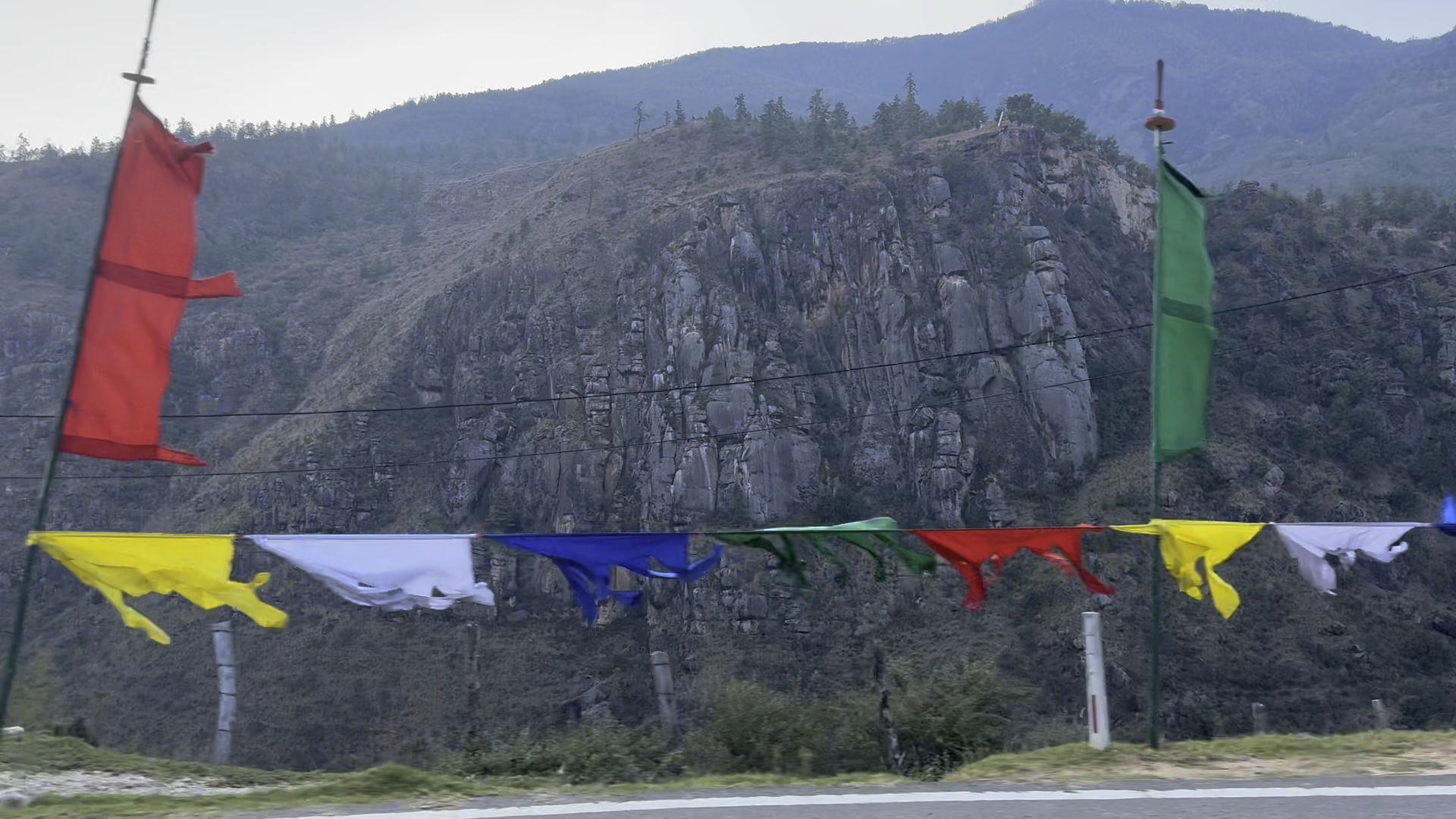
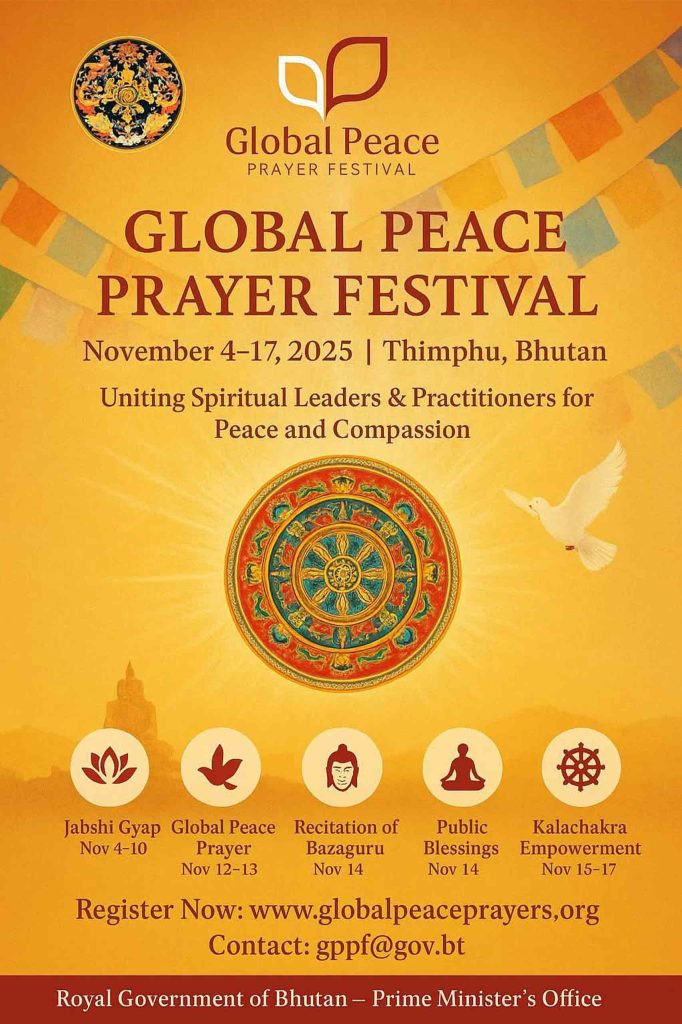
We landed in Paro on November 9th. From there, we took a bus about 40 kilometers through the valley to Thimphu. What I noticed immediately was that the entire road was decorated with five-colored banners. Our guide told us that this was the welcome greeting for the international guests of the “Global Peace Prayer Festival.”
Five-colored flags and pennants along the route
Thimphu itself was incredibly busy. Several events were happening at once: alongside the festival and the King’s upcoming birthday, Indian Prime Minister Narendra Modi was also expected for a state visit. You have to know that Thimphu is the only capital city in the world without traffic lights. Despite the crowds and the resulting traffic chaos, everyone remained calm. No one pushed, and people were patient and respectful. This relaxed attitude really impressed me.
National Memorial Chorten: The Spiritual Heart of Thimphu
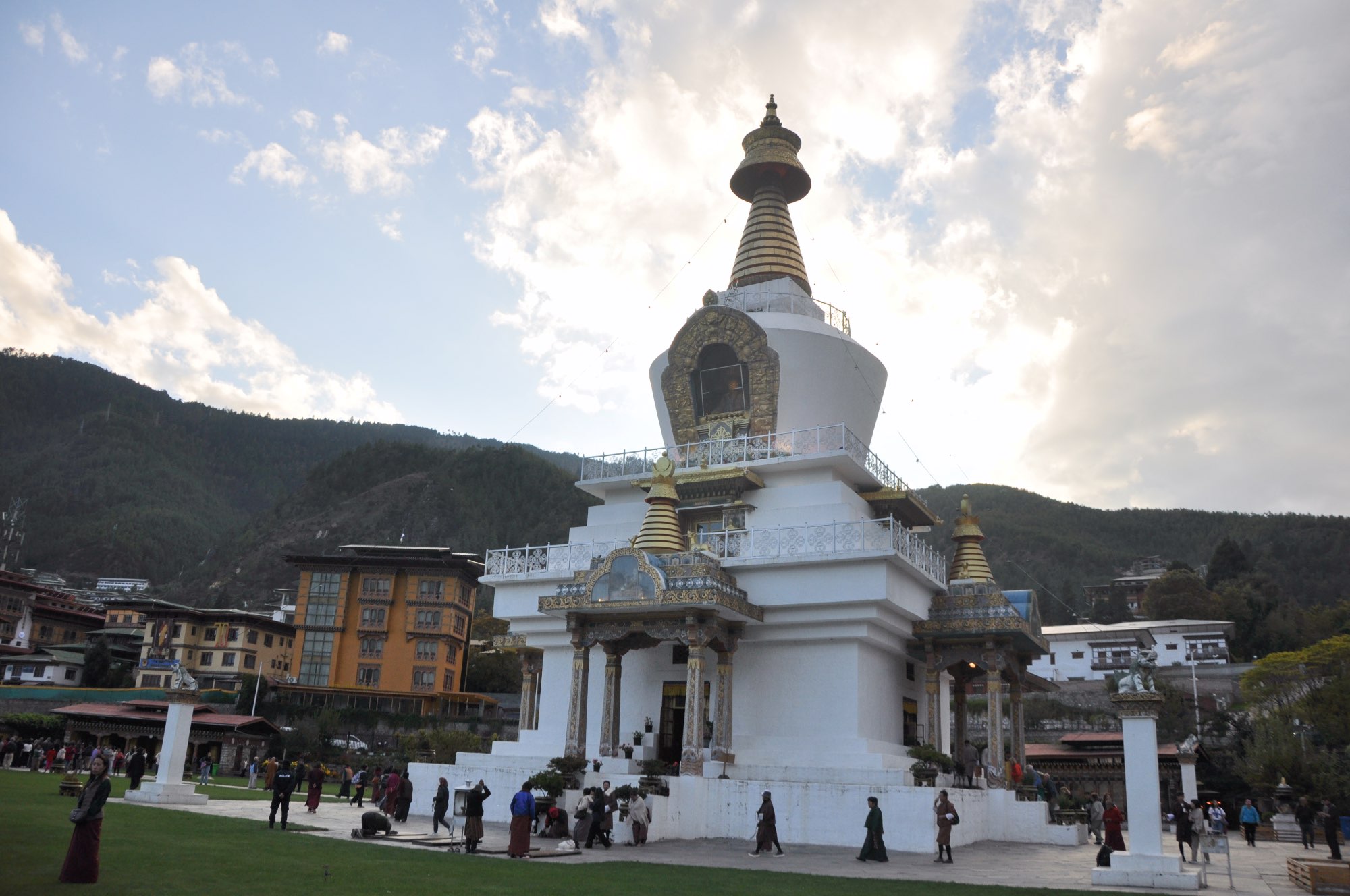
After checking into our first hotel, we visited the National Memorial Chorten. This is a large, white stupa in the middle of the city, built in 1974 for the third King. For the locals, this is an important place in everyday life. Many go there to walk around the stupa and spin the prayer wheels.
As at all holy sites, photography is not allowed inside. A simple rule applies: as soon as the shoes come off, the camera stays off. This allowed us to soak in the atmosphere without any distractions. The interior houses larger-than-life statues of wrathful deities in Yab-Yum posture and murals of Guru Rinpoche (Padmasambhava), Shakyamuni Buddha, and Ngawang Namgyal, the unifier of Bhutan. Colorful sculptures stand in all four directions. There are also mandalas, shrines for the third King, and images of Vajrakilaya.
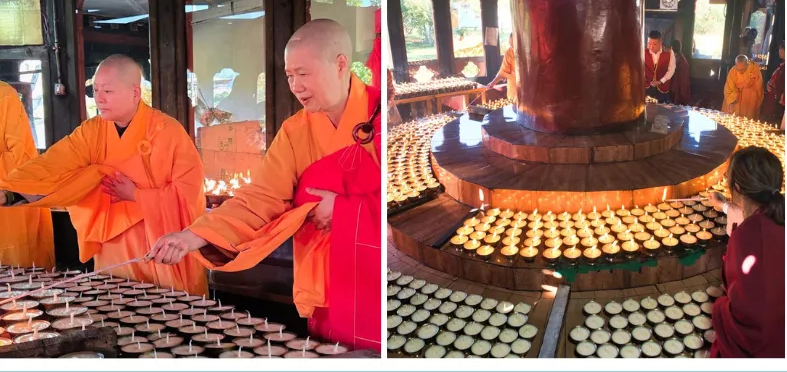
Impressions (in order): The white Memorial Chorten, pilgrims at the prayer wheels, the sea of lights from the butter lamps, believers performing prostrations, and our group in front of the stupa.
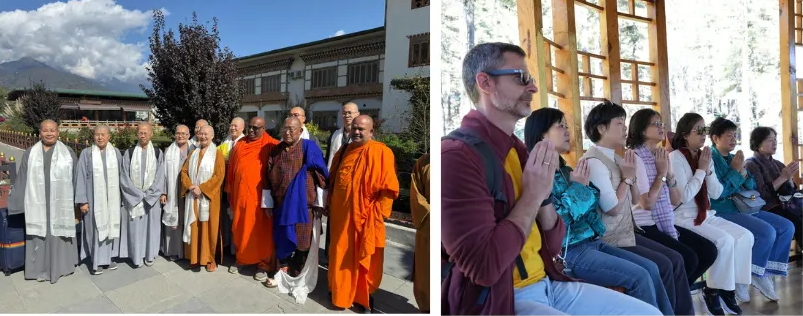
Our group took the opportunity to chant on the square in front of the stupa, led by the Venerable Master Shi Zheng Da. It was a beautiful experience to do this at such a place.
Authentic Bhutanese Crafts Bazaar: Traditional Arts and Crafts
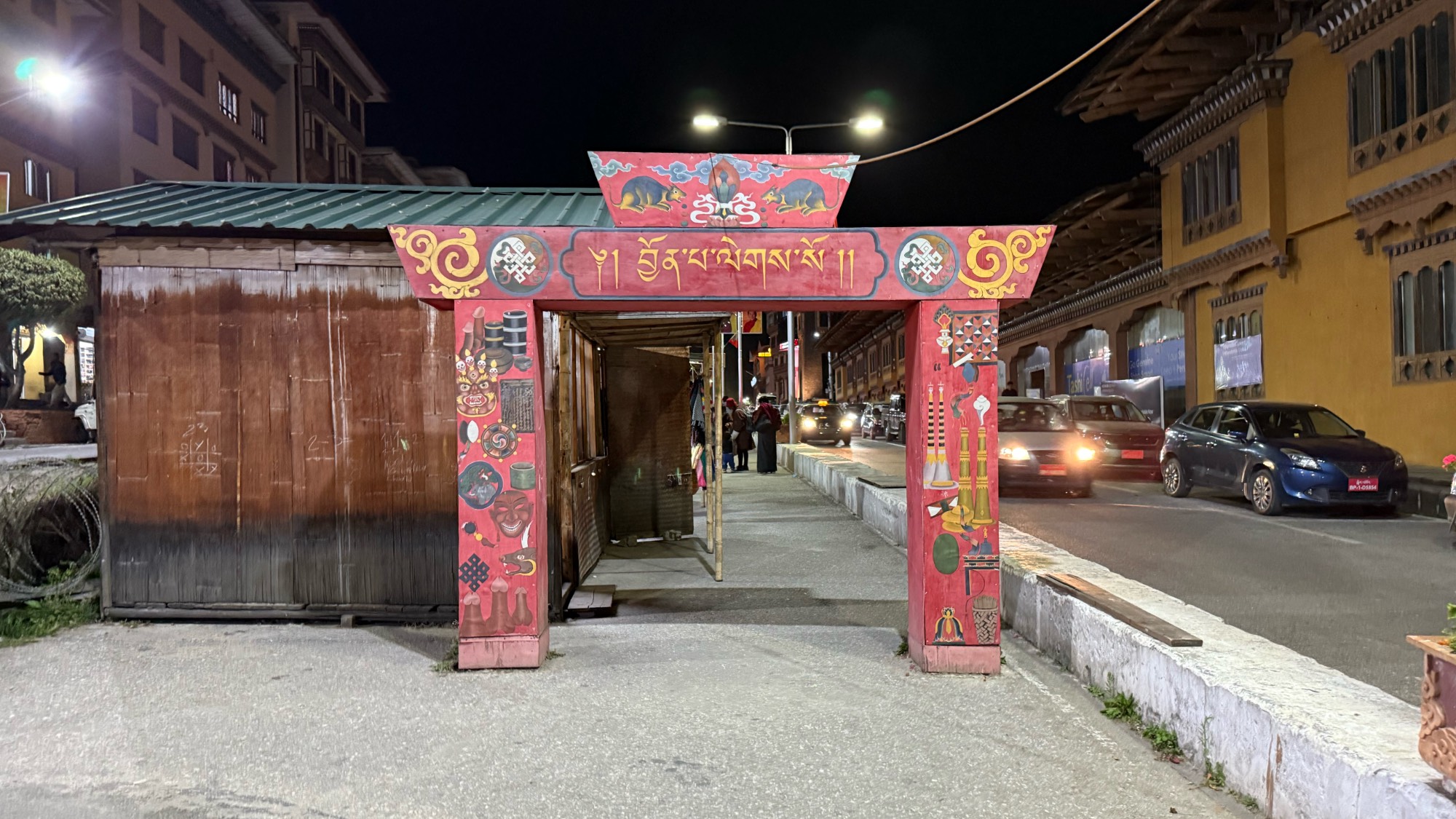
In the evening, I took the chance to stroll along Norzin Lam. That is where the Authentic Bhutanese Crafts Bazaar is located, which you enter through a distinct red gate. Behind it, many small huts are lined up where local artisans display their goods. There was really a lot to discover. Besides handmade textiles, jewelry, wood carvings, and thangkas, you can also find nice souvenirs to remember the trip by.
Entrance to the Authentic Bhutanese Crafts Bazaar
Global Peace Prayer Festival: Shared Prayers for Peace
November 10th was all about the Global Peace Prayer Festival. Since the stadium was within walking distance of our hotel, we went there on foot. Even on the street, we could feel how many people were flocking to this event. Once inside the stadium, we showed our respect through prostrations before the Venerables present. Afterwards, we were given a spot on the side where we could join in the peace prayers.
From there, we watched the program on the main stage, where various Buddhist traditions took turns with their recitations. Between the prayer sessions, there were traditional dances and songs. I was deeply impressed by how many people came together there peacefully. It was simply a good feeling to be right there among them.
Buddha Dordenma: The Golden Statue Above the Valley
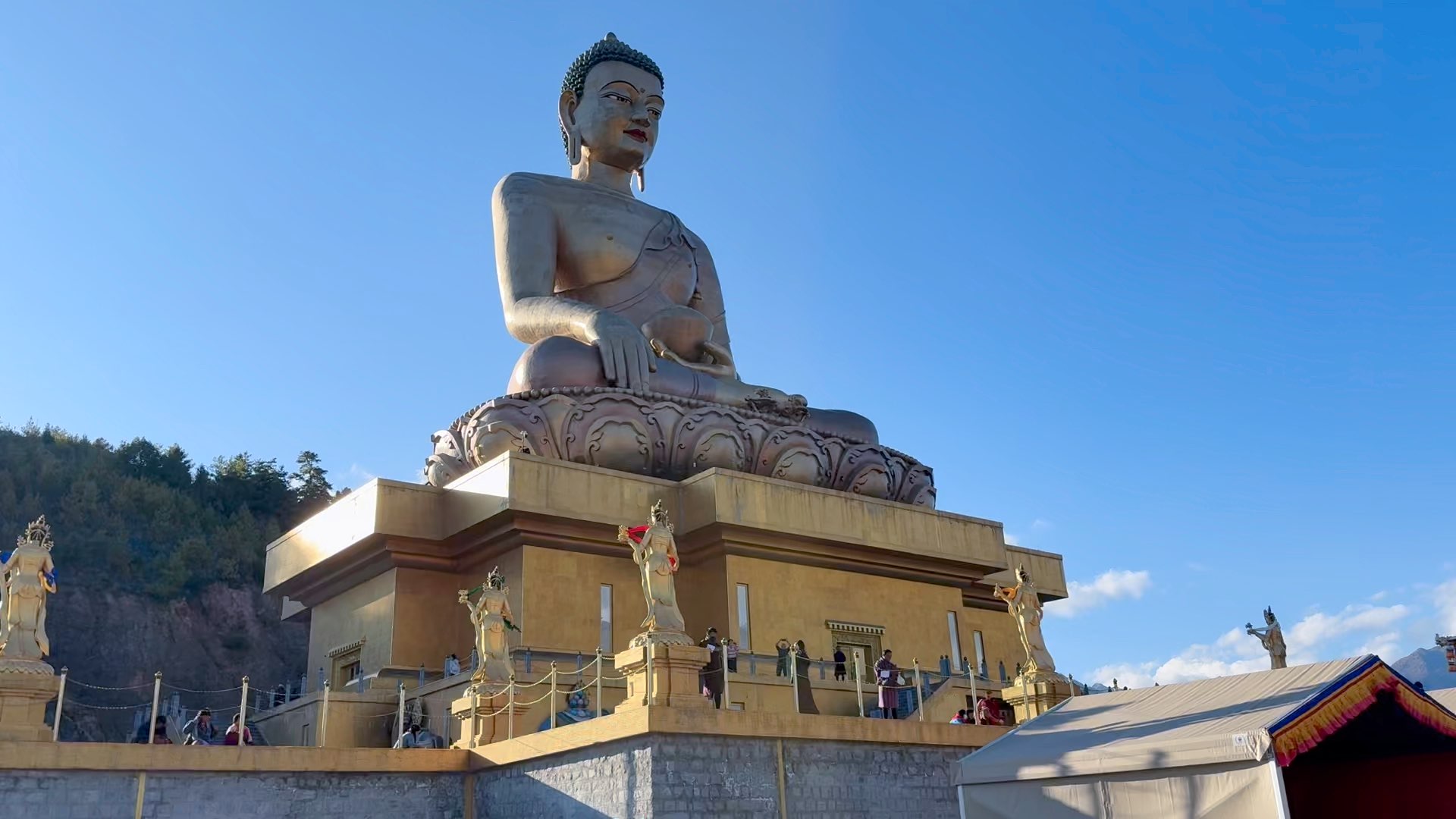
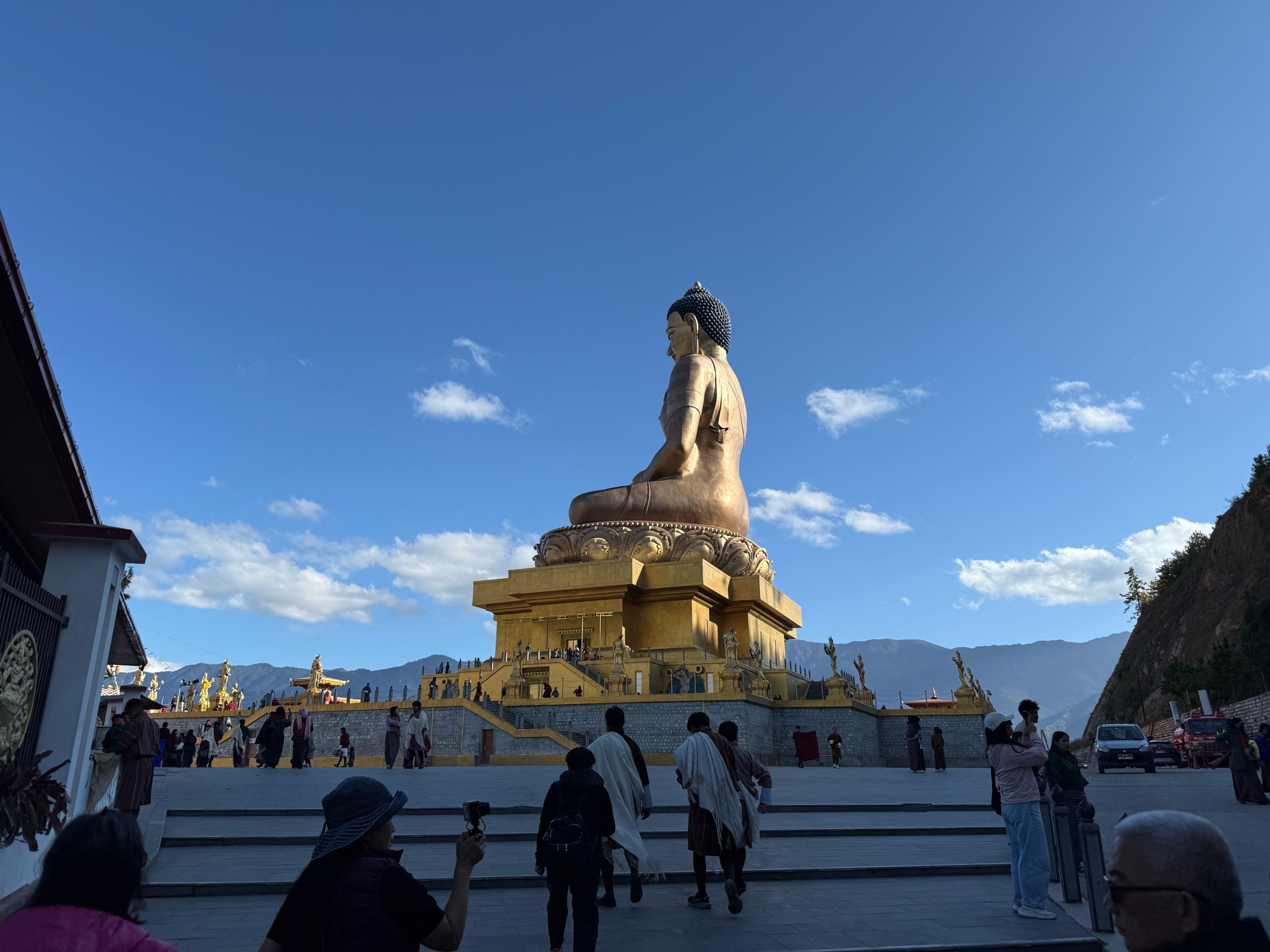
After noon, we continued to the Buddha Dordenma statue in Kuensel Phodrang Nature Park. This is an impressive, 51-meter-high statue of the seated Shakyamuni Buddha. It is made of bronze and completely gilded. By the way, it was built to celebrate the 60th birthday of the fourth King, Jigme Singye Wangchuck.
Buddha Dordenma Statue
Inside the building beneath the statue, there are over 100,000 small Buddhas, also made of bronze and gold. Every single one was donated. There is also a large meditation hall with many more beautiful Buddha statues. Various relics are kept in these rooms, which we were allowed to see during our visit.
Impressions of the Buddha Dordenma statue: The gigantic seated statue in side view, ritual structures featuring traditional thread crosses (Namkha/Mdos) on the plaza, the view up to the Buddha’s face, a relief of a blue elephant on the golden base, and the view over the square featuring golden Dakini statues.
What made this visit special was not just the statue itself. Right there, the conclusion of the Jabshi Gyap ritual was taking place. This is a major, multi-day ceremony intended to purify negative karma and bring healing. Thousands of devotees, monks, and Rinpoches were gathered. We learned that this ritual was done specifically for world peace. It was our good fortune that we could be there at exactly that moment.
A Matter of the Heart: Support for Expectant Mothers
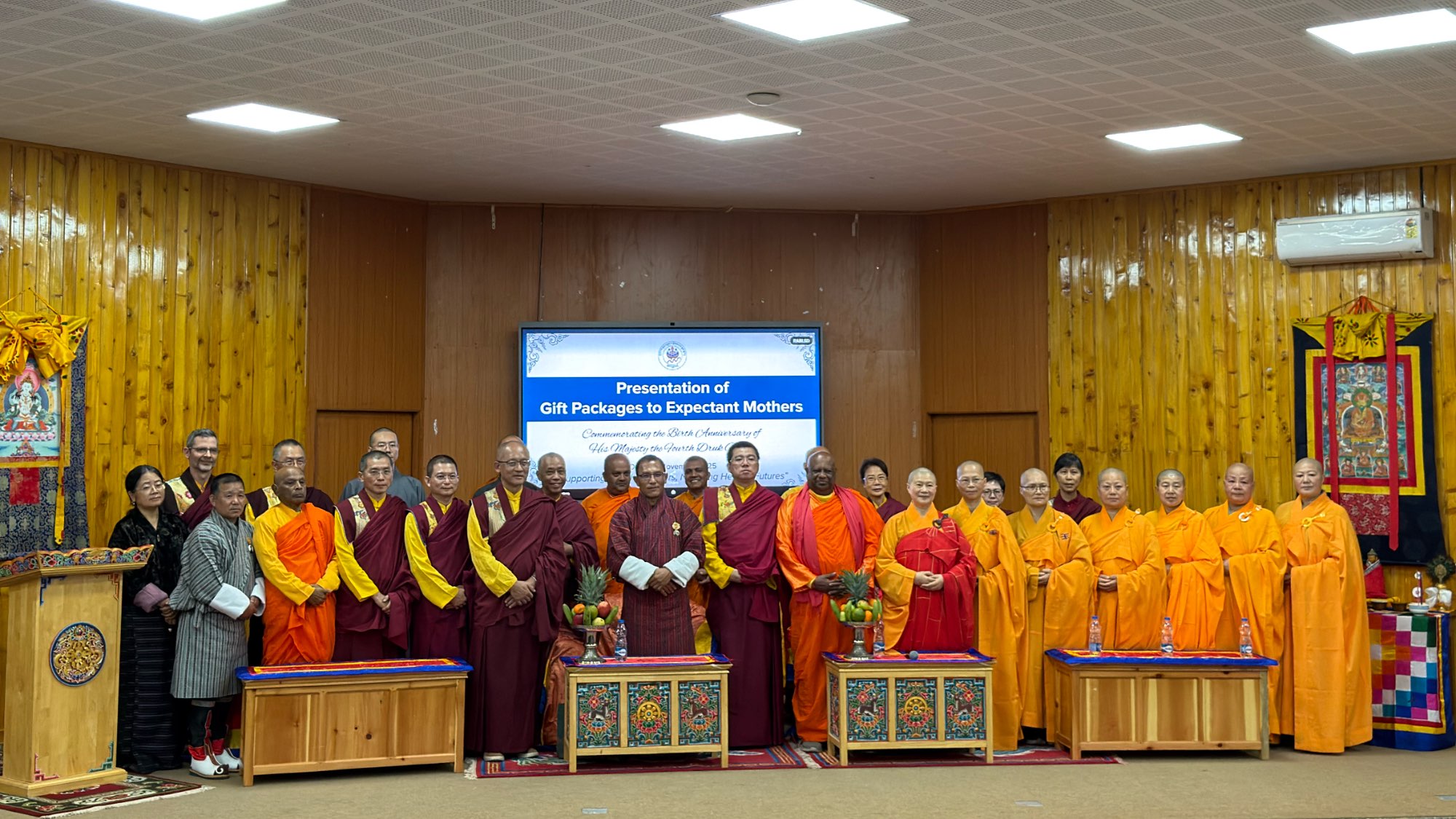
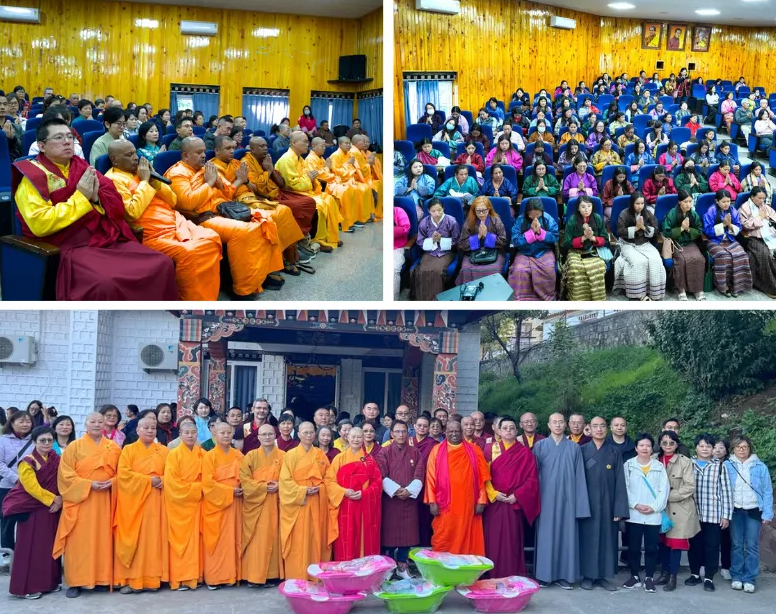
We had collected money in advance to support 500 expectant mothers with care packages. For this reason, we gathered at the end of the day for a ceremonial handover at the hospital in Thimphu.
Handing over the donation at the hospital
In addition to our travel group, hospital staff, the Secretary to the Health Minister, and some mothers also took part. We had the opportunity to personally hand over the first packages to the mothers present.
With that, the first days in the capital were over. Next, the journey would take us out of the city, to ancient Dzongs and into nature.
In the middle of a storm, most people look for shelter. But a rare few choose to stand in the rain to keep someone else’s home from washing away.
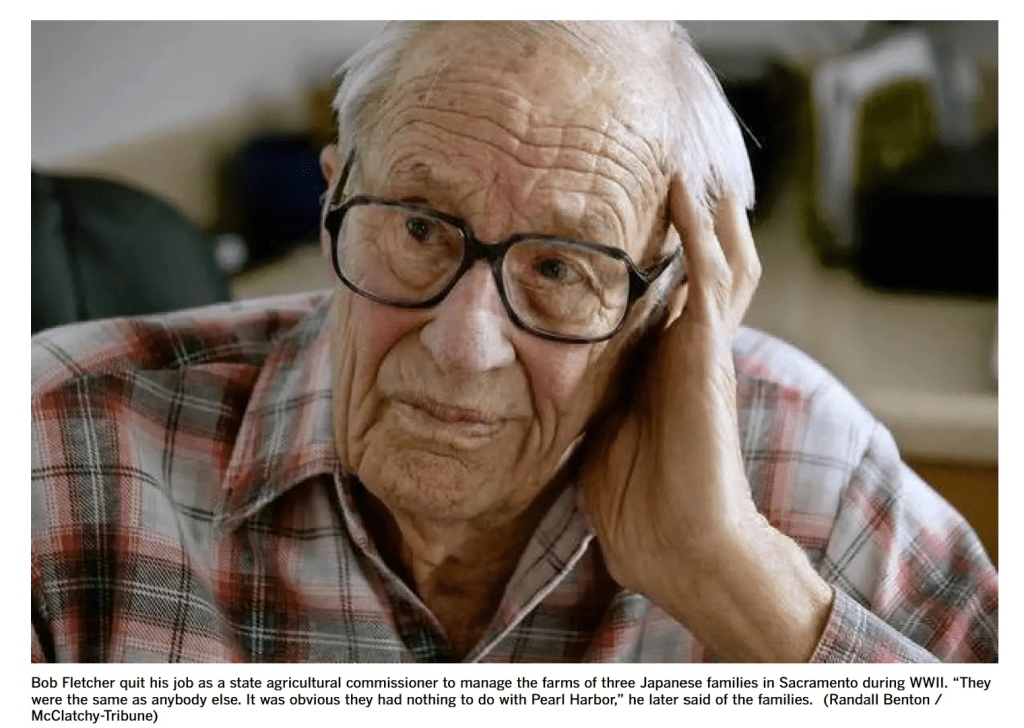
In 1942, the United States was a place of fear and suspicion. Following the attack on Pearl Harbor, Executive Order 9066 forced thousands of Japanese-American citizens into internment camps. They were given just days to pack what they could carry, leaving behind their businesses, their homes, and their life’s work.
In Florin, California, most people looked away as their neighbors were taken. But an agricultural inspector named Bob Fletcher did something different. He stepped forward.
Note 1
Bob Fletcher was 31 years old when his neighbors—the Tsukamoto, Nitta, and Okamoto families—were ordered to leave. They were strawberry and grape farmers who faced losing everything to foreclosure.
They asked Bob if he would manage their farms while they were gone. Bob didn’t just say yes; he quit his stable job with the state to become a full-time farmer for people who weren’t even allowed to be there.
For three years, Bob worked 18-hour days. He managed 90 acres of flame tokay grapes across three different farms.
The Cost of Doing the Right Thing
Doing the “right thing” is rarely easy. Bob wasn’t seen as a hero by his community at the time. He was called names, shunned by neighbors, and at one point, someone even fired a shot into the barn where he was working.
But Bob had a quiet, iron-clad integrity. He lived in the migrant bunkhouses rather than the families’ main homes. He paid their mortgages, their taxes, and their bills. When the families finally returned in 1945, they didn’t return to ruins—they returned to thriving farms and a bank account full of the profits Bob had saved for them.
Bob Fletcher lived to be 101 years old. For decades, he deflected praise, often saying:
“I don’t know about being a hero. I just did what I thought was right.”
His life leaves us with enduring lessons:
Integrity is a verb. It is not what we believe in private, but what we practice when no one is watching—and when it costs us something.
One person is enough. Bob couldn’t stop a national injustice, but he saved three families. Sometimes protecting one corner of the world is exactly what we are called to do.
Moral courage is quiet. It doesn’t announce itself. Sometimes it looks like long days, dirty hands, and the refusal to surrender compassion to fear.
We may not be living through a world war, but we all face moments where it is easier to go along with the crowd than to stand up for a neighbor. Bob Fletcher’s life asks us: Who are we looking out for? What are we willing to protect?
At the invitation of Rev. Chandima of the Sri Lanka Cultural and Educational Foundation, members of Buddhist Town joined a delegation to Bhutan to participate in the Global Peace Festival, held in celebration of the 70th birthday of the Fourth King of Bhutan. The trip was co-organized by the Buddhist Town Community Association, with participating organizations including Fa Chan Temple, Macang Yuan, Holy Vajrasana Temple, and the Canadian Institute of Buddhist Studies, among others. In total, 68 representatives took part in this meaningful event.
As part of the visit, the delegation donated 500 sets of essential baby supplies, offering prayers for happiness, health, and well-being for every family. The donation ceremony was attended by the Director of Bhutan’s Ministry of Health, who officially received the supplies. Following the ceremony, the donated items were distributed on-site to pregnant women and mothers with newborns by members of the delegation.
The delegation jointly sponsored the offering of 3,000 butter lamps and respectfully invited Master Shin Zhengda Jaozun to preside over the 3,000 Butter Lamp Offering Ceremony at Kyichu Lhakhang, one of the oldest temples in Paro. The prayers were dedicated to world peace, the removal of obstacles, the averting of disasters, and the flourishing and propagation of the True Buddha Dharma.
Kyichu Lhakhang is one of the 108 demon-subduing temples built by King Songtsen Gampo. Established in 638 CE, it stands as one of Bhutan’s most sacred and historically significant temples.
Dasho Passang Dorji, former Speaker of the National Assembly of Bhutan, formally welcomed the Buddhist Town delegation at Paro International Airport. Following the reception, the delegation embarked on an inspiring journey to visit sacred sites associated with Guru Padmasambhava and to learn how Zhabdrung Rinpoche further propagated and established Guru Padmasambhava’s lineage teachings throughout Bhutan.
During the journey, the delegation visited many major temples and sacred sites, including the Buddha Dordenma in Thimphu (21st century), Punakha Dzong (17th century), the Druk Wangyal Chortens—also known as the 108 Stupas (21st century), Chimi Lhakhang (15th century), Khewang Lhakhang (15th century), and Gangtey Monastery (17th century), among others.
The final highlight of the journey was the ascent to the legendary Taktsang Monastery (8th century), dramatically perched at an elevation of 3,100 meters above sea level. According to tradition, Guru Padmasambhava flew to this sacred site, where he subdued negative forces and later spread Buddhism throughout Bhutan, becoming the foundational figure of Bhutanese Buddhism.
With an elevation gain of more than 900 meters and steep mountain trails, the pilgrimage requires a 7–8 hour round-trip hike. Throughout the journey—visiting sacred sites, receiving blessings, paying homage to the Buddhas, and experiencing deep spiritual inspiration—the delegation was filled with immeasurable Dharma joy and boundless gratitude.
At every point along the path, it felt as though the land itself was gently reminding the delegation that all worldly phenomena are impermanent and ever-changing, and that only the true Dharma of the Buddha remains eternally unchanged.
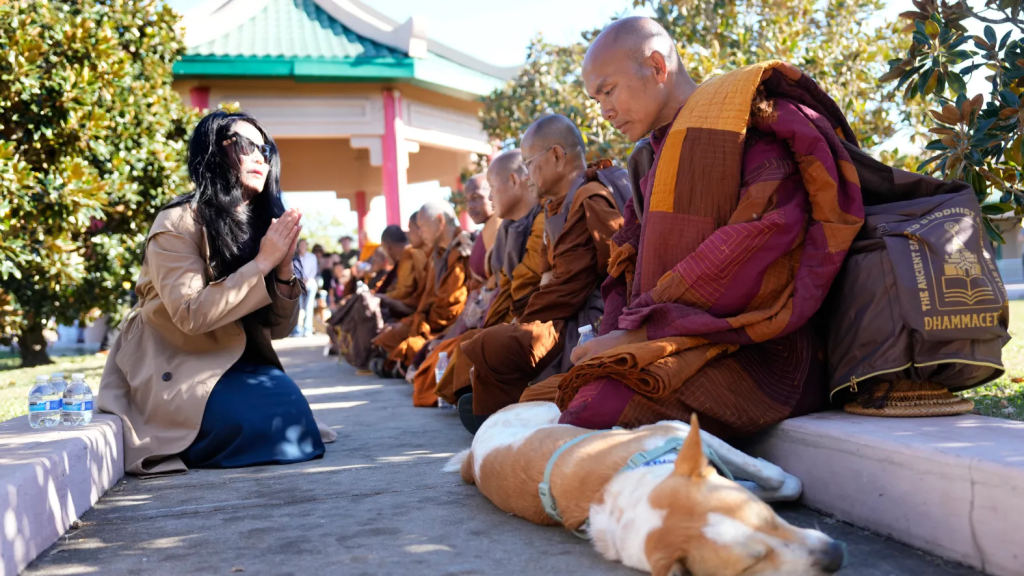
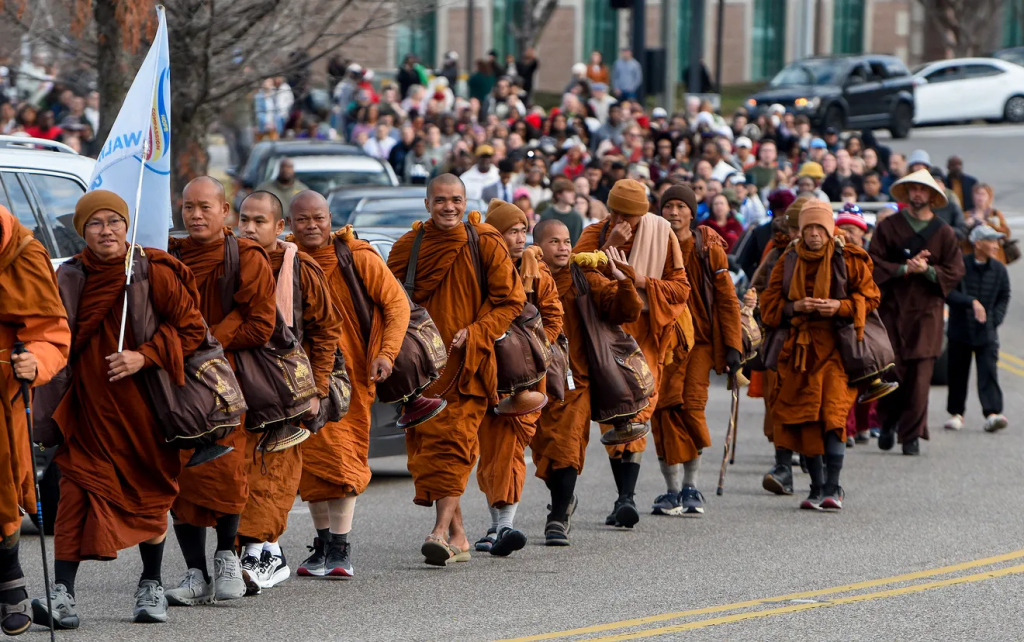
The Buddhist monks from the Huong Dao Vipassana Bhavana Center in Fort Worth, who are undertaking a 2,300 mile pilgrimage of Walk for Peace, arrive for a welcome ceremony at Hong Kong City Mall in Houston Friday, Nov. 14, 2025. Houston Chronicle/Hearst Newspapers via Getty Images
In a world that often feels rushed, divided, and relentlessly loud, there is something quietly revolutionary about the act of walking.
Recently, a group of Buddhist monks began a long, demanding pilgrimage across the United States. Their mission is simple yet profound: to promote peace. Their journey began in Fort Worth, Texas, on October 26. Since then, they have faced the literal “wear and tear” of the road, including a harrowing incident where two monks were injured after a truck struck their escort vehicle.
Yet, they did not stop.
With perseverance and a calm, unshakable resolve, the group of two dozen monks has reached Georgia. They are still moving, one step at a time, toward their final destination in Washington, D.C. Their pace is slow, deliberate, and intentional—and that may be exactly what our world needs right now.
Buddhism has a long history of “engaged mindfulness”—the idea that compassion isn’t just felt in meditation, but lived in the world. These monks are not just praying for peace; they are embodying it.
As they navigate highways and back roads, they offer a living reminder that peace isn’t a destination we reach once and for all. It is a practice. It is something we choose moment by moment, breath by breath, step by step.
Watching their progress brings me back to a book I read nearly 30 years ago: Peace Pilgrim.
I remember being deeply moved by her story—how she walked across countries carrying almost nothing, guided by the conviction that peace begins within the individual. At the time, I wished I could have met her in person, just to thank her for the way her simplicity and courage planted a seed in my heart.
Though she is gone, her spirit feels remarkably present today. I see her legacy in the orange robes of these monks as they crest the hills of the American South.
Monks rest at Hong Kong City Mall in Houston Friday, Nov. 14, 2025. Melissa Phillip/Houston Chronicle via Getty Images
Igniting Kindness, One Heart at a Time
There is something profoundly moving about a walking pilgrimage in the age of instant communication. There are no hashtags here. No viral outrage. Just human beings placing one foot in front of the other, trusting that their presence alone can soften the world.
And it works.
Along the way, the “ordinary” world reacts. Drivers slow down. Strangers stop to ask questions. People offer water, a meal, or a simple smile. In these small, unscripted exchanges, something gentle is awakened. We are reminded that beneath our political and social differences, we all share a basic human longing for safety, understanding, and harmony.
The monks may be the ones doing the walking, but the kindness they ignite along the way belongs to all of us. As they recently shared on their Facebook page:
“We do not walk alone. We walk together with every person whose heart has opened to peace, whose spirit has chosen kindness, whose daily life has become a garden where understanding grows.”
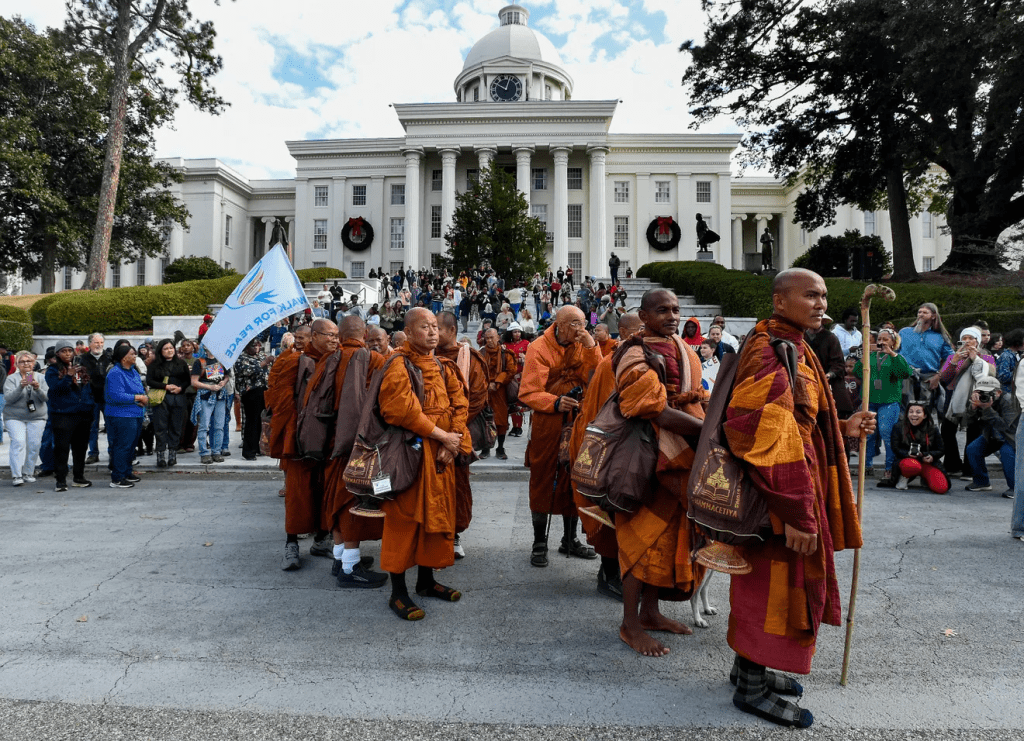
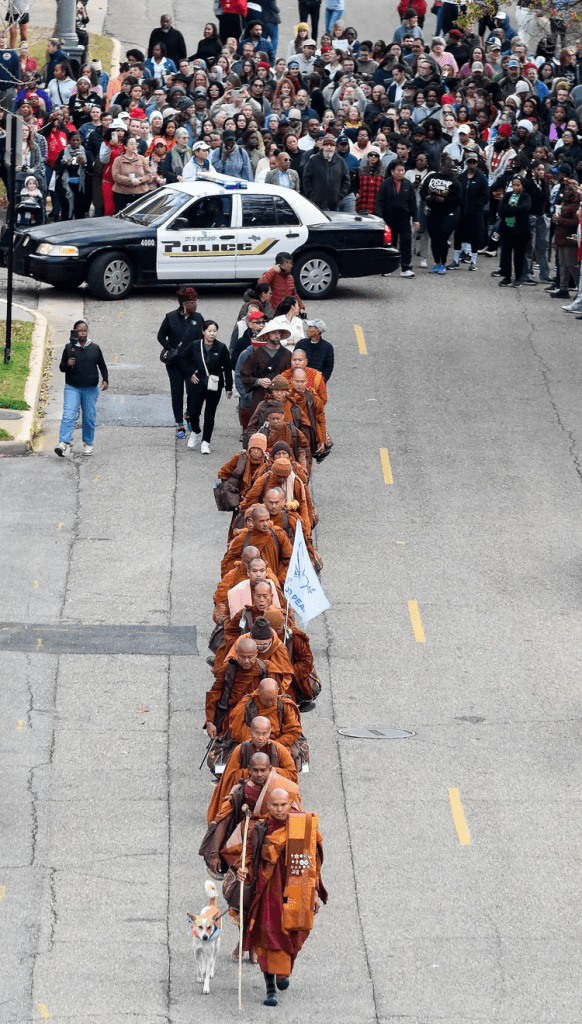
A group of Buddhist Monks and several hundred local community members take part in the Walk for Peace in Montgomery, Ala., on Tuesday December 23, 2025. The Monks are walking from Texas to Washington, D.C. to promote peace and compassion.
Most of us cannot drop everything to walk across a continent. But all of us can “walk for peace” in the geography of our own lives.
We can pause before we react in anger.
We can choose compassion over the reflex of judgment.
We can listen more deeply than we speak.
Watching these monks continue their journey despite injury and uncertainty reminds me that peace isn’t achieved through grand, sweeping gestures. It is built patiently through humility and love.
Step by step.
May their walk remind us to slow down, to soften our hearts, and to keep moving—together—toward a more peaceful world.
In the southwestern suburbs of Xining, where the air grows thin and the spirit grows light, stands one of the most significant sites in the Buddhist world: Kumbum Monastery.
Known in Tibetan as Kumbum Jampa Ling, meaning “A Supreme Temple of a Hundred Thousand Lion’s Roar Buddha Images,” this sprawling complex is far more than just a collection of buildings. It is a living monument to Lama Tsongkhapa, the revered founder of the Gelug (Yellow Hat) sect of Tibetan Buddhism.
The Legend of the Golden Tree
Unlike many temples built to house statues, Kumbum was built to house a pagoda.
Legend tells us that Tsongkhapa was born here in 1357. When his mother cut his umbilical cord, drops of blood fell to the earth, and from that spot grew a miraculous sandalwood tree—the “Tree of Great Merit.” It is said this tree had 100,000 leaves, each bearing a natural image of the Buddha.
Years later, when Tsongkhapa was studying in Tibet, his mother sent a letter begging him to return. He replied that he could not leave his studies, but sent a self-portrait and a “Lion’s Roar” image, instructing her to build a pagoda over his birthplace. “Seeing this pagoda,” he promised, “is the same as seeing me.” In 1379, the Julian Pagoda was built, forming the sacred heart of what would become Kumbum Monastery.
Kumbum is world-renowned for its harmonious blend of traditional Tibetan and Chinese Han architectural styles.
1. The Eight Pagodas of Buddha Shakyamuni
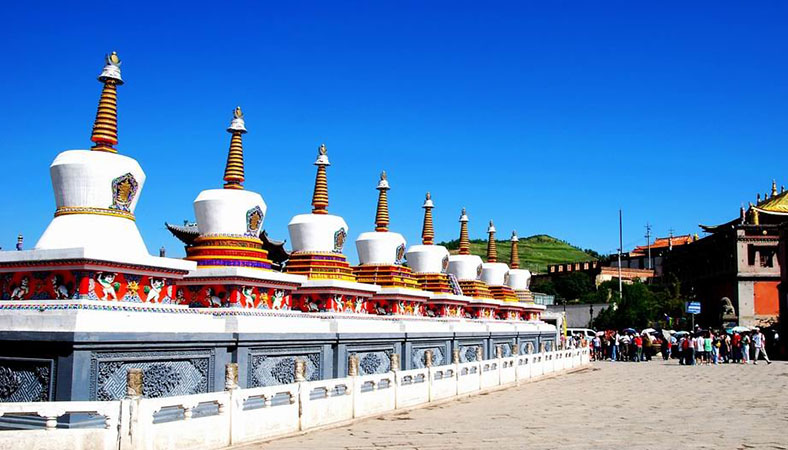
Greeting visitors in the front square are eight gleaming white pagodas. Built in 1776, they commemorate the eight great merits and virtues of Buddha Shakyamuni. Each stands 6.4 meters tall, decorated with delicate Sanskrit scriptures and guardian lions, serving as a powerful symbol of the monastery’s spiritual authority.
2. The Grand Golden Tiled Hall
This is the soul of the monastery. With its gilded copper roof and emerald glazed-tile walls, the hall radiates a celestial glow. Inside, you will find an 11-meter-tall golden tower wrapped in white sandalwood and encrusted with jewels. At its peak sits a statue of Tsongkhapa. For pilgrims, meeting this tower is considered a direct meeting with the Master himself.
3. The Main Assembly Hall
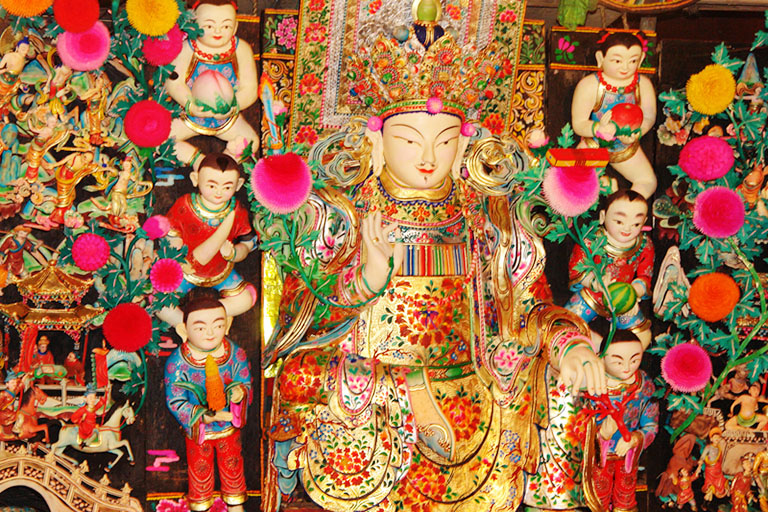
Spanning nearly 2,000 square meters, this is the center of monastic life. Under a flat roof adorned with gilded bronze bells and “Aquarius” vases, hundreds of monks gather to recite sutras. The interior is a sensory masterpiece of colorful streamers and intricate carvings.
Dhammapala Hall
The “Three Artistic Wonders” of Kumbum
Kumbum is celebrated throughout Asia for its “Three Arts,” which represent the peak of Tibetan craftsmanship and devotion.
I. Vivid Yak Butter Sculptures
In the freezing depths of winter, when fresh flowers were unavailable for offerings, monks began carving flowers from yak butter. This evolved into a sophisticated art form. In the Yak Butter Sculpture Hall, you can see entire landscapes, pavilions, and deities crafted with impossible detail. To keep the butter from melting while they work, monks must dip their hands in ice water—a true testament to their endurance and faith.
II. Imaginative Barbola (Embroidered Appliqué)
Barbola is a unique form of 3D silk embroidery. By layering silk and cotton, artists create raised patterns that give the figures of Buddhas and animals a lifelike, three-dimensional appearance. The “Sixteen Disciples of Buddha” housed in the Main Assembly Hall are considered national treasures.
III. Exquisite Murals
The walls of Kumbum are alive with color. Using special mineral pigments that remain vibrant for centuries, these murals depict the life of Shakyamuni and scenes from the sutras. During the Sutra-viewing Festival, a massive 30-meter-long Buddha scroll is unfurled on the hillside, a breathtaking sight known as the “Great Buddha Exhibition.”
Kumbum Monastery hosts four major Dharma assemblies annually, held during the first, fourth, sixth, and ninth months of the lunar calendar. These gatherings are a blend of traditional festivals and grand religious events unique to the monastery. During these times, the temple comes alive with sacred activities, including monastic debates, mask dances, and sutra chanting.
A highlight of these fairs is the Cham Dance, where monks wear ornate masks and vibrant costumes, using dramatic gestures to express profound Buddhist teachings to the rhythm of cymbals and suonas (traditional horns). One of the most awe-inspiring sights is the Giant Thangka Unveiling, where a massive, delicate image of Tsongkhapa is unfurled down the mountainside. For the faithful, witnessing this Thangka is considered a direct and holy encounter with the Master himself.
Thangka Exhibition during the Buddha Festival
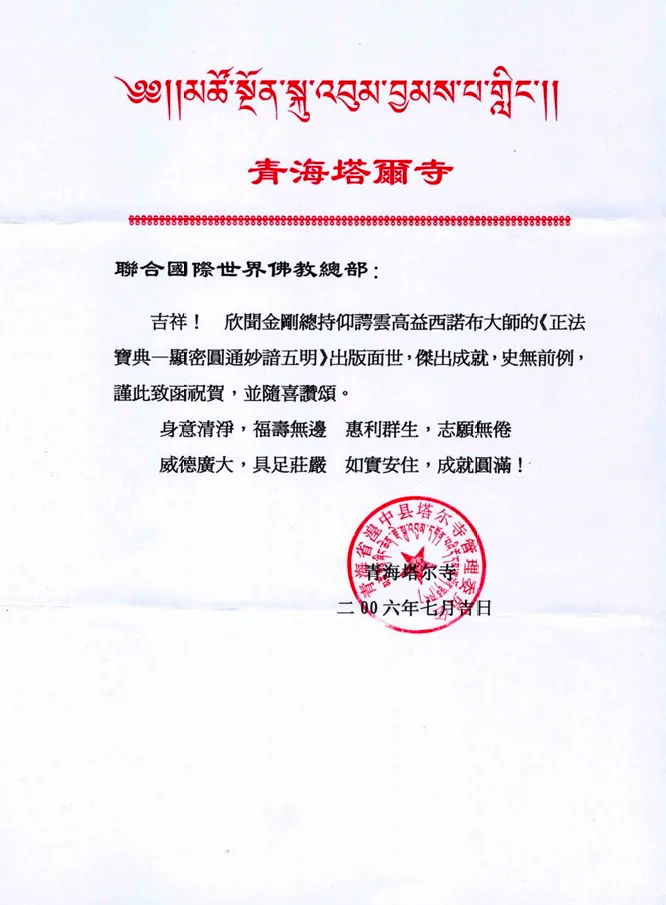
In July 2006, this sacred temple issued its formal recognition and congratulations to H.H. Dorje Chang Buddha III
United International World Buddhism Association Headquarters:
Under auspicious circumstances, we were happy to learn of the publication of A Treasury of True Buddha-Dharma—Complete Proficiency in Exoteric and Esoteric Buddhism and Perfect Mastery of the Five Vidyas about the Buddha Vajradhara, H.H. Master Yangwo Wan Ko Yeshe Norbu. His Holiness’s outstanding accomplishments are unprecedented. We respectfully send this letter of congratulations and joyfully offer our praise.
His actions and mind are pure, and His good fortune and wisdom are limitless. He benefits myriad living beings, and His willpower never tires. His powerful virtue is widespread, and His appearance is completely dignified. He truly abides in peace and His accomplishments are perfect!
Qinghai Skuvbum Monastery An auspicious day in July of 2006
Below is the original copy of the recognition letter in Chinese:
Zhenru Chan Temple is nestled on the southwestern slopes of Yunju Mountain in Jiangxi Province. Surrounded by peaks said to resemble unfolding lotus petals, the landscape is poetically described as “lotus peaks clustering around Huatai.” Huatai, the mountain’s central peak, anchors this natural harmony. Here, architecture, terrain, and spiritual intention merge seamlessly, creating a setting that feels both grounded and quietly transcendent.
Even before understanding its history, one senses that this is a place shaped not to dominate nature, but to listen to it.
The name Zhenru (真如) means “True Suchness”—a fundamental concept in Chan Buddhism that points to ultimate reality as it is, beyond words, labels, or conceptual thinking. It is not something to be grasped intellectually, but something to be directly experienced.
Founded during the Tang Dynasty (806–810), Zhenru Chan Temple is regarded as the cradle of the Caodong School of Chan Buddhism, which later spread to Japan as the Soto Zen tradition. Revered as one of China’s three great model Chan monasteries, the temple has long been a center for authentic practice. Though the present structures were rebuilt in the 1950s, they preserve the simplicity and elegance of traditional Chinese monastic architecture.
Chan in Action: Meditation and Farming as One Path
One of Zhenru Temple’s defining characteristics is its embodiment of the Chan principle that “agriculture and meditation are equally emphasized.” Monks here did not retreat from life; they engaged it fully.
Alongside meditation, monks cultivated tea fields and farmed the land. This was not merely practical—it was spiritual. Farming ensured self-sufficiency in the remote mountains, freeing the monastery from reliance on external donations. More importantly, working the soil was understood as a form of Chan practice: repetitive, mindful, intimate with the rhythms of nature.
In the Caodong tradition, there is no division between the sacred and the ordinary. Plowing a field is no less sacred than chanting a sutra. The monks alternated between sitting meditation and physical labor, living out the Chan maxim:
“A day without work is a day without food.”
This principle is traditionally attributed to the Tang-dynasty Chan master Baizhang Huaihai (720–814), a disciple of Mazu Daoyi and a key figure in establishing Chan monastic regulations. His teaching reminds us that awakening is not found apart from daily life, but revealed within it.
Master Xu Yun: Reviving the Living Dharma
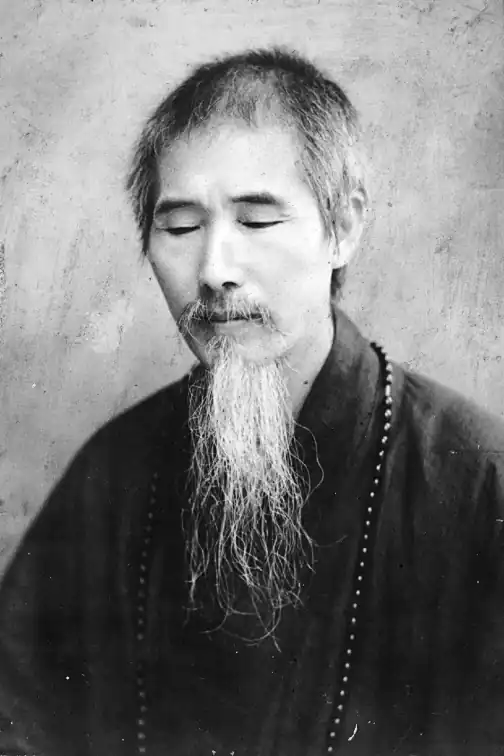
Zhenru Chan Temple is also inseparably linked to Master Xu Yun (1840–1959), one of the most revered Chan masters of modern China, often described as a rare master who embodied and transmitted the lineages of five Chan schools in a single lifetime.
When Master Xu Yun arrived at Zhenru in the early 20th century, the temple lay largely in ruins. With unwavering resolve, he led an extensive restoration—rebuilding halls, pagodas, and monastic quarters with the support of disciples and lay donors. More than physical reconstruction, he revived strict monastic discipline and rigorous meditation practice, restoring the temple’s spiritual vitality.
Zhenru ultimately became the place where Master Xu Yun passed away, completing a life devoted to the Dharma.
Earlier in his life, Master Xu Yun experienced a profound awakening during intensive meditation at Gaomin Temple in Yangzhou at the age of fifty-six. In his autobiography, he described the experience with clarity and restraint:
“In the purity of my single-mindedness, I forgot my body entirely. After twenty days, my illness disappeared. From that moment on, my practice continued day and night without interruption… One evening after meditation, I opened my eyes and saw a brightness like broad daylight, in which everything inside and outside the monastery was clearly visible.”
Yet what makes his account especially powerful is what followed. Master Xu Yun did not cling to the experience. He recognized it as a mental state—not an ultimate attainment—and continued his investigation with humility and perseverance, asking relentlessly:
“Who is mindful of the Buddha?”
Later, he commemorated a moment of deep insight triggered by the simple sound of a teacup breaking in the Chan hall, capturing Chan’s direct and unadorned wisdom in a verse:
A cup fell to the ground, The sound rang clear and sharp. Space itself shattered— The restless mind came to rest.
This is primarily a video demonstration of the moving meditation practiced at Zhen Ru Chan Temple.
Zhenru Chan Temple is more than a historical site. It is a living reminder that Chan practice is not confined to silence or retreat, but woven into how we walk, work, and meet the ordinary moments of life.
Xiaoxitian, originally known as Qianfo’an (The Hermitage of a Thousand Buddhas), was founded in the second year of the Chongzhen reign of the Ming Dynasty (1629). It stands atop Phoenix Mountain, about one kilometer west of Xixian County in Linfen, Shanxi Province.
Built entirely in harmony with the mountain, the temple unfolds in layers, as if it had grown naturally from the slope itself. Stone steps lead visitors upward, passing through courtyards divided by arched cave-like gateways. The upper, middle, and front courtyards are connected yet distinct, creating a spatial rhythm that is winding, intimate, and quietly profound. As one walks through the complex, footsteps instinctively slow, and time itself seems to soften.
The architecture of Xiaoxitian is restrained rather than ostentatious, yet its mastery reveals itself everywhere. Painted beams are elegant and dignified, and many of the halls are ingeniously built as two-story structures, creating a rich sense of vertical space within the limited mountain terrain. The bell and drum towers stand in stillness, inviting the imagination to wander back to an age when morning bells and evening drums echoed through the valley.
Stepping into the Mahavira Hall is a moment of sudden awe. Nearly the entire interior is filled with suspended polychrome sculptures—more than 1,900 figures, layered from floor to ceiling. From towering Buddhas over three meters high to figures no larger than a thumb, the sculptures are densely arranged yet never chaotic, solemn yet vibrantly alive. In that instant, one understands why Xiaoxitian is revered as the “Museum of Chinese Hanging Sculpture Art.”
Unlike many Buddhist temples that draw attention primarily to their principal Buddhas, the Mahavira Hall at Xiaoxitian is celebrated for the immersive world it creates as a whole. At its core stand the Medicine Buddha, Amitabha, Shakyamuni, Vairocana, and Maitreya, but surrounding them unfolds an entire celestial realm: the Ten Great Disciples, six young novices, the Ten Wisdom Kings, the Six Desire Heavens, and countless heavenly musicians dancing through the air.
Most unforgettable are the celestial musicians suspended within the tiered “sky pavilions” above the altars. Their figures are light and graceful, sleeves flowing as if caught in an eternal breeze, frozen in a moment of unending heavenly music. Some play the pipa, others hold flutes, while some seem to dance midair. One pipa-playing figure, leaning slightly forward with fingers poised on the strings, radiates such focus and elegance that one can almost hear the melody drifting across centuries.
Looking up toward the roof, the tri-colored glazed chiwen ornaments—yellow, green, and blue—gleam softly in the light. Their refined brilliance reflects the unmistakable aesthetic of the Ming Dynasty. Here, architecture, sculpture, and color merge seamlessly, and one forgets that this is a mountain temple at all. It feels instead like stepping into a floating Buddha realm, suspended between earth and sky.
That these sculptures have survived nearly four hundred years in such vivid detail inspires deep reverence. They represent not only the pinnacle of craftsmanship, but also a profound devotion—to faith, to beauty, and to a harmonious vision of the cosmos.
Perhaps what truly moves the heart at Xiaoxitian is not only the astonishing number of its hanging sculptures or the rare Ming Yongle Northern Buddhist Canon once preserved here, but something more enduring: a spiritual presence that has remained vibrant across centuries. It quietly reminds us that beyond the noise of the modern world, there still exists a place of serenity and dignity—carefully upheld by time itself.
Please see below the answer of whose work is the best amongVincent van Gogh, Qi Baishi, and H.H. Dorje Chang Buddha III
I have spent more than 60 years of my professional life in the field of painting. During the many decades of practice and experiences, I have come to know many famous painters. That is especially the case since I became the Head Consultant for authenticating paintings and calligraphy at the National Museum of China in Beijing. As an appraiser and authentication officer of paintings and calligraphy, the bulk of my work is to verify the authenticity of Eastern and Western paintings. I have reviewed tens of thousands of famous paintings, especially the rare and precious works of the maestro Vincent van Gogh of the Netherlands, and those of the champion of Eastern paintings, Qi Baishi of China.
Both Van Gogh and Qi Baishi were great world-renowned masters in art. One represented the apex of Western art and the other was a master of an extreme class in the field of Eastern paintings. Both artists had drawn from the essence of the classical traditions of their respective cultures. They created new styles of art and new ways of seeing the universe. They broke new grounds and became pioneers of new eras, each becoming a creative guru of his time, developing a distinct style of his own and leading new trends that inspired later generations. Their works reflect the different essences of the Eastern and Western traditions. To what extent can their works influence the artistic civilization of the world? What kind of artistry did they achieve that made them upright monuments in art history and admired by so many people?
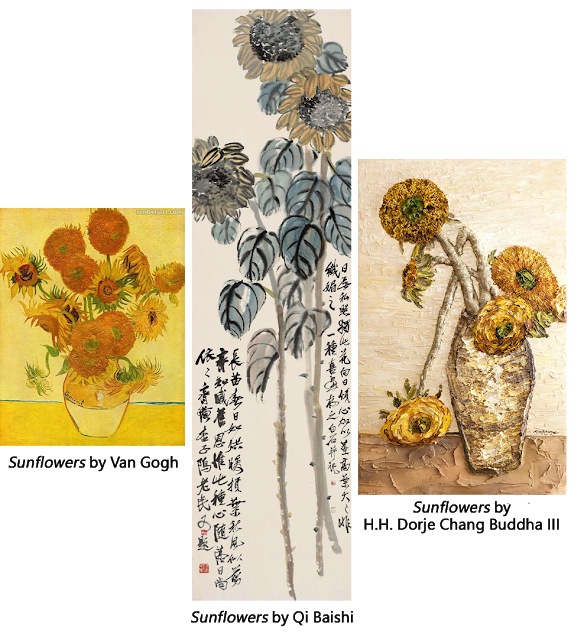
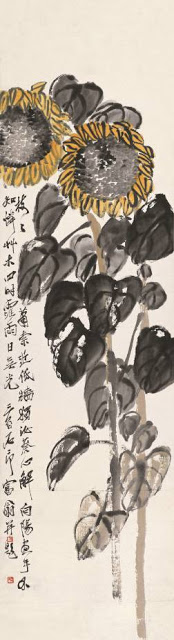
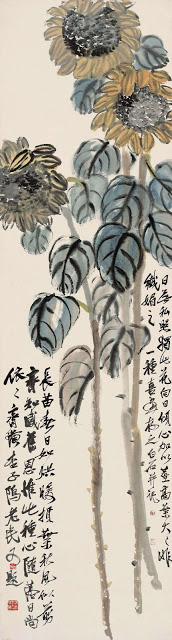
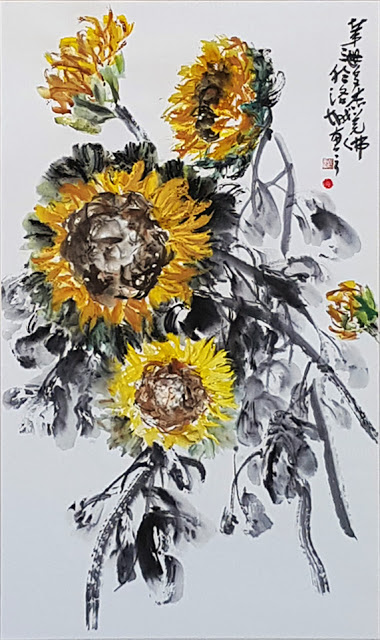
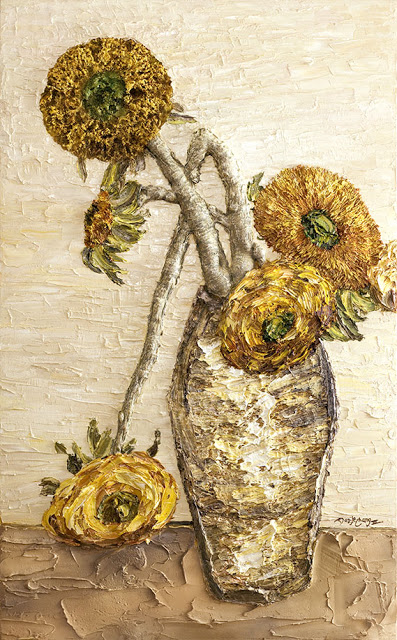
Some art critics compared the works of Van Gogh and Qi Baishi to see which of them reached a higher level of accomplishment. They concluded that both have their own merit, both are undefeated champions in the art and both reached the pinnacle of artistry. Recently, some art critics also brought up the oil painting Sunflowers and the ink-wash painting Sunflowers, both created by H.H. Dorje Chang Buddha III, and gave them rave reviews. They went on to compare the works by Vincent van Gogh and Qi Baishi with the works by H.H. Dorje Chang Buddha III, trying to establish which of the three artists is the champion of the champions. The result of comparing the works by Van Gogh, Qi Baishi and H.H Dorje Chang Buddha III is tremendously inspiring.
Ever since the Renaissance, Western artists had placed emphases on rational analysis and the realist portrayal of forms. They used light, texture and details to present the realistic, three-dimensional perspective. A few centuries later, Van Gogh rejected the monotony of such use of light and shadow and the realistic portrayal of figures. He pioneered the movement of impressionism that suited him well by applying a mix of colorful, brilliant, splendid and vigorous brushstrokes. He became a great master of his time and his name was forever etched onto the monument of Western civilization and art.
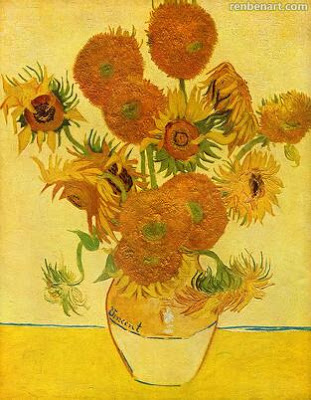
Whenever people think of Van Gogh, they think of his unique character, the sparkles in his eyes that emit lightning, his vigor and his incessant pursuit of inspiration in art without any regard to external hardships. Van Gogh was an artist by birth. He was of exceptional confidence and was somewhat neurotic. Having such traits, he pursued the art that he loved without any reservation or hesitation. He loved his works and regarded everything else with disdain. He preferred to be a loner in the world and did not care to make acquaintance of other painters of his time. His works are full of luminous colors, the brushstrokes are like rising winds and racing clouds in the sky. In his art, he depicted pasture, figures, flowers and other subject matters with brisk colors. Every brushstroke was transformed from his inner emotions. Such emotions were fully and colorfully captured in his Self-Portrait as well as in the transcendental Sunflowers that he painted. These works contain an animated spirit that is deeply moving.
From Van Gogh’s artistic spirit and intent, we can detect that he was profoundly knowledgeable about Chinese ink-wash paintings. Precisely because of this, while depicting forms and applying colors, he employed the skills of using the center tip of the brush and parallel brushstrokes. His Still Life with Bible was created with parallel brushstrokes. In his Self-Portrait, he portrayed his face filled with lines and plaques that are extraordinary. It is not hard for us to discover that he drew inspirations from the substance and essence of Chinese painting in those brushstrokes. That is why Van Gogh is such a distinguished, unparalleled artist of his time and his works are superior to those by the other Western oil painters such as Cezanne, Gauguin or Picasso of the same era.
Van Gogh’s artistic style was closely linked not only to Chinese civilization in the East, but also to the classical Renaissance art, Pointillism, German Expressionism, and Impressionism in the West. Toward the end of his life, he came into oneness with the universe and immersed himself in a carefree state of mind to “follow wherever nature might lead.” As such, he was no longer aware of his own existence. In his mind, there was only the art and the universe. “Following where the nature may lead” is the essence of the ideology of the Chinese philosopher Laozi. Van Gogh cut off his ear with a knife. He lost himself completely in painting. That was his unspoken resentment and rejection of the unfair treatment imposed on him by the society.
Qi Baishi was profoundly knowledgeable about impressionist, fauvist, and realist paintings. By adopting the essence of Western painting and incorporating the traditional spirit of Eastern art, he developed his unique style and became the master of Chinese painting of the twentieth century. His brushstrokes were solid and poised, evincing a sense of power that went all the way through the paper. Using sheep-hair brushes, he elicited calligraphic skills to create his paintings. Qi Baishi’s lines are bold and robust, embodying a forceful spirit that can move mountains. At the same time, these lines are flexible, sturdy and round, with similar qualities to the lines of wire-drawing. His compositions emerged naturally from the spontaneous movement of the brushes. Such compositions are accompanied by vigorous calligraphy resembling the strength, power and fluidity of stone inscriptions.
The artistic concept of spontaneously “following where nature may lead” is precisely derived from Laozi’s philosophy and the artistic civilization of the Chinese ethnicity. Qi Baishi favored the use of white space in his paintings. The white space in black-and-white Chinese ink-wash paintings is considered a solid color. Ink can be differentiated in nine shades (or five shades according to ancient Chinese text.) That is to say, the white of the paper per se and the black of the ink are all considered as colors. There is a sense of meticulous precision in the artworks by Qi Baishi. He depicted insects such as grasshoppers, mantises and butterflies in meticulous and vividly colorful ways. In some of his artworks, the artist was able to express his ideas by putting down just a few brushstrokes without any conscious intent, while arriving at a state of oblivion of his own existence. Anything depicted by his brushes was vivid and vibrant, with the subject matter coming alive on the paper. There is an aura that moves our heart and soul. All in all, Qi Baishi’s paintings were executed with a confident brushwork that naturally achieved a kind of childlike charm.
Recently, some people compared the works by Van Gogh and Qi Baishi with the works by H.H. Dorje Chang Buddha III to see whose works are more superior and outstanding, or will have a broader and more far-reaching influence on later generations. I have viewed quite a lot of the artworks by Van Gogh, Qi Baishi and H.H. Dorje Chang Buddha III. I started the study and appreciation of the paintings by Qi Baishi under the enlightening guidance of my teacher when I was 9, and when I was 14, I began to study and appreciate the works by Van Gogh. It has since been several decades!
At the same time, since I have admired the art of H.H. Dorje Chang Buddha III for a long time, to satisfy my desire and wishes I flew from New York to San Francisco to visit the International Art Museum of America, and to Los Angeles to visit the H.H. Dorje Chang Buddha III Cultural and Art Museum in order to see their collections. I was profoundly impressed by the architecture of both museums which is grand and dignified. Both museums have a collection of the authentic works by H.H. Dorje Chang Buddha III. There are various artworks that are created with different kinds of material. Some are bold and forthright, some are charmingly meticulous and astounding. The oeuvre is not made up of just one single style.
Yet, the only artwork that was not available for viewing is the Sunflowers painted by H.H Dorje Chang Buddha III. When I hear that some art critics are comparing the works by Van Gogh and Qi Baishi with the works by H.H. Dorje Chang Buddha III, I naturally feel, from my experience of having studied the works by Van Gogh and Qi Baishi for a number of decades, that although their artistry are similar in levels, it is possible to say who is the best if we are just to compare the sunflowers painted by the three artists, when we include in the compositions, colors, brushwork, lines, vitality, spirit and so on. With all these elements in consideration, it is possible to do the comparison and conclude who painted the best, or in other words, whose works can bring the most joy and delight to people, or whose art will be most influential to the philosophy, artistic concept and entire civilization of this world.
Therefore, without any ambiguity, we concluded. In terms of character and morality, Van Gogh would be the last of the three. In terms of level of skills, Qi Baishi would also be ahead of Van Gogh, who is, however, already the cream of the crop in western civilization. Being the Buddha living in the current century,H.H. Dorje Chang Buddha III saves living beings with great loving compassion. He is not embodied in an ordinary being. Needless to say, the level of cultivation of the Buddha is superior to that of Van Gogh and Qi Baishi. In terms of creativity and painting skills, how can any ordinary being even hold a candle to the Buddha? In this way, the comparison result is immediately determined.
When those art critics carried out the detailed research of the Sunflowers by Van Gogh and Qi Baishi as well as H.H. Dorje Chang Buddha III, they copied the artworks by all three artists. After copying the works by Van Gogh and Qi Baishi, they felt deeply that through hands-on practice, they indeed gained more understanding of their works. It would not be easy but not so difficult either for one to really reach their artistic level. As for the Sunflowers by H.H. Dorje Chang Buddha III, they found it rather difficult to copy. Even though they tried many times, they had a hard time just copying the form, let alone the spirit.
The Sunflowers by H.H. Dorje Chang Buddha III clearly show the artist’s solid foundation and prolific skills in the Eastern and Western painting traditions. They comprise the essences in both traditions and display a brushwork, sentiment and colors that are one of a kind. The color tones and brushstrokes are rich, dense, soothing and elegant. Lively brushwork paints an animated charm that is whole, evincing a miraculous and expansive spirit and aura as well as a strong vitality. As for the Sunflowers oil painting in which H.H. Dorje Chang Buddha III depicted some flowers inside a vase, the artistry is extraordinary and full of variations; the composition is simple yet abstruse. The flowers are natural and gracious, such that they give an impression of unpredictability, reaching a state of oneness with the universe and emanating a sharp animated spirit.
The ink-wash painting Sunflowers by H.H. Dorje Chang Buddha III has an uninhibited, natural, and spontaneous brushwork that is dense, bold, and robust, but also elegant and agile. It exhibits a charm that is like stone and bronze inscriptions. Overall, the whole painting manifests a harmonious and moving imagery, naturally emanating a lively vivaciousness and a carefree, spirited aura.
In comparing the works by Van Gogh of the Western civilization, Qi Baishi of the Eastern culture, and H.H. Dorje Chang Buddha III, we can see the artists are distinguished in their unique own ways owing to their different cultures. However, only the artist who can continue to influence the world two to three hundred years from now will be the everlasting monument. There is a saying, “Talents emerge in every era and they all will each have 500 years of fame!” For people of the present day, the one whose work you like the best would be the one that is the most extraordinary!
Please see the contrast of six paintings below:
Sunflowers by Van Gogh (1)Sunflowers by Van Gogh (2)Sunflowers by Qi Baishi (1)Sunflowers by Qi Baishi (1)Ink-wash Painting Sunflowers by H.H. Dorje Chang Buddha IIIOil Painting Sunflowers by H.H. Dorje Chang Buddha III