Have you ever stumbled upon a book that instantly captivates your attention, drawing you into its pages with an irresistible allure? That’s precisely what happened to me when I discovered the Chinese version of “The Boy Who Saw True.” From the moment I started reading, I was completely enthralled.
At the heart of this remarkable book is a young boy from England, born into privilege yet endowed with an extraordinary gift. Raised in a family where literature was cherished, he inherited his father’s passion for reading, immersing himself in books far beyond his tender years. Despite his mother’s attempts to steer him away from certain subjects, his determination to explore the literary world only grew stronger, infusing his writings with a delightful blend of wit and charm that is uniquely his own.
But what truly sets this young boy apart is his “third eye” – an innate ability to see truths hidden from ordinary sight. In his diary, he meticulously chronicles the myriad of peculiar phenomena he encounters in the spiritual realm. From envisioning himself as a monk in a secluded cave, imparting ancient Buddhist teachings to his disciples, to glimpsing his past life as a revered priest in ancient Egypt, seduced by the allure of worldly power – each revelation is as astonishing as it is profound, offering profound insights into the mysteries of human nature and the cosmic order.
Despite facing skepticism and misunderstanding from those around him, the boy’s unwavering insight into the spiritual realm remains unquestionable. His experiences, both mysterious and mesmerizing, serve as a beacon of inspiration, igniting a fervent curiosity in readers eager to unlock the secrets of the universe.
The author’s integrity shines through every page, as he never seeks to exploit his psychic abilities for personal gain. It’s this steadfast commitment to truth and authenticity that makes his diary a rare and precious gem, entrusted to the world by the esteemed editor, Mr. Cyril Scott, after the author’s passing.
What makes “The Boy Who Saw True” truly exceptional is its exploration of the spiritual realm through the innocent eyes of a child. Unlike other metaphysical books, it eschews complex theories in favor of a refreshingly simple and humorous narrative style, making it accessible to readers of all ages.
As I delved deeper into its pages, I couldn’t help but feel a profound sense of wonder and enlightenment. This book is more than just a literary masterpiece – it’s a journey of self-discovery and spiritual awakening that transcends the boundaries of time and space.
In conclusion, “The Boy Who Saw True” invites readers to embark on a transformative voyage into the unknown, where the boundaries between reality and imagination blur, and the truth reveals itself in the most unexpected of places. It’s a reminder that our lives are but a small part of a vast and wondrous universe, waiting to be explored and embraced with open hearts and minds.
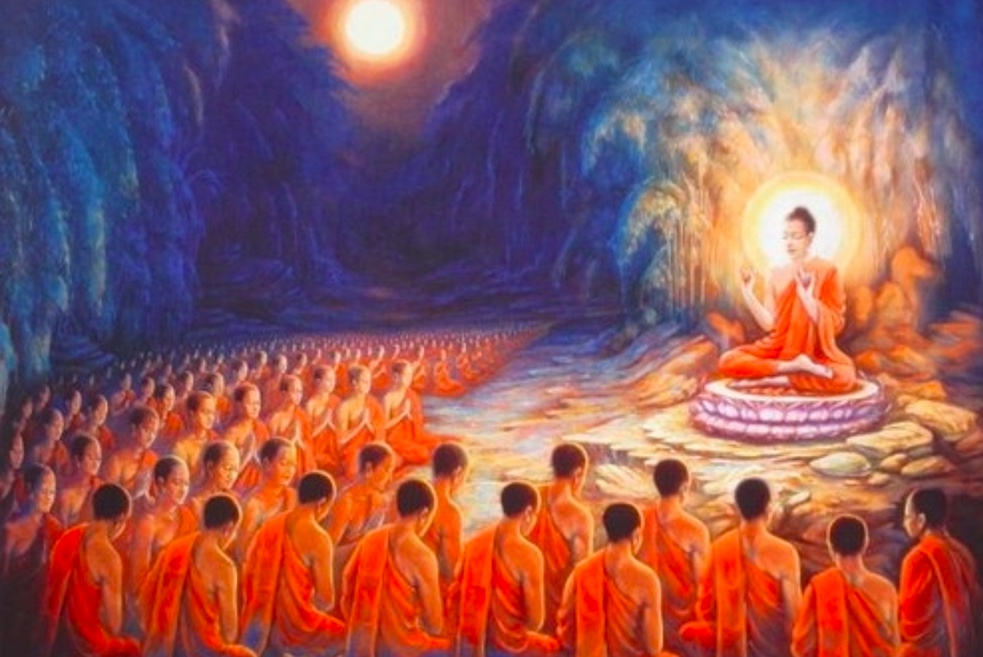
King Ajatasattu, in order to seize the throne, murdered his own father, King Bimbisara. Afterwards, he felt constant pain and fear in his mind and body, seeking help from various physicians and religious experts but to no avail. Finally, at the urging of a monk named Jivaka, he went to seek the Buddha.
At that time, the Buddha was residing in a grove with a thousand monks. King Ajatasattu entered the assembly hall and saw a thousand monks sitting peacefully around the Buddha, not even the sound of rustling robes could be heard. King Ajatasattu had only briefly encountered the Buddha before, as he had never attended any of the Buddha’s teachings with his father. The Buddha invited them to sit down, and after bowing, the king said, “World-Honored One, I remember hearing you speak when I was young in the palace. Now I have a question for you: what practice can lead thousands of people to renounce worldly life and seek enlightenment?”
The Buddha asked if he had asked the same question to other teachers. King Ajatasattu said he had asked many different teachers, including Devadatta, but had never received a satisfactory answer. The Buddha said, “Your Majesty, tonight the Tathagata will explain to you the fruits of the true Dharma, some of which can be enjoyed in the present and some of which can be harvested in the future. You do not need to seek lofty answers; you just need to see clearly the mango you hold in your hand. Your Majesty, let me give you an analogy: a servant who obeys his master’s every command from morning till night. One day, he asks himself, ‘Why should I willingly be enslaved by my master?’ This servant decides to renounce his servitude and become a monk. He lives a life of celibacy, diligence, and mindfulness, eating only one meal a day, practicing walking and sitting meditation. His demeanor exudes peace and dignity in his actions and speech; he becomes a virtuous and respected monk. Although you know he was once a servant, when you see him now, would you say to him, ‘Come here, boy, I want you to serve me from morning till night, obeying all my orders’?”
King Ajatasattu said, “Certainly not, World-Honored One. I would never speak to him in such a manner. I would respectfully bow to him, offer him food, and ensure he receives the legal protections due to a monk.”
The Buddha said, “Your Majesty, this is the first fruit of the monk’s practice: he has liberated himself from prejudices of race, society, and class, and he has regained the dignity of being a human being.”
The Buddha continued, “Your Majesty, a person’s dignity is just the first fruit. A monk who observes the two hundred and fifty precepts can reside in a state of tranquility. Those who do not observe precepts are more prone to stray from the path; they may commit sins such as deception, intoxication, adultery, theft, or even murder. Such actions bring terrible punishments to their bodies and minds, and they may face severe penalties when caught. A monk who observes the precepts of non-killing, non-stealing, chastity, truthfulness, abstinence from intoxicants, and over two hundred other precepts finds it easier to live a psychologically freer life than ordinary people. This is another fruit that can be enjoyed in the present.
The Buddha continued, “Your Majesty, a monk possesses only three robes and an alms bowl. He never fears robbery nor needs to guard against thieves at night. He can sleep under a tree without worry. The freedom released from fear is the greatest joy. This is another fruit attained through practice. A monk’s life is very simple; although he eats only one meal a day, the food in his bowl comes from thousands of different households. He does not pursue fame or profit; he only uses what he truly needs, seeking nothing else. Dwelling in such unfettered freedom is a fruit that can be enjoyed at this moment.
King Ajatasattu said, “Truly remarkable, World-Honored One! Please continue.”
The Buddha said, “Your Majesty, if you understand how to cultivate mindfulness and contemplation of breathing, you can experience the joy of those who walk the path of practice. That is the bliss of meditation. A monk observes the six senses to overcome the five hindrances of desire, anger, delusion, sloth, and doubt. He attentively observes the breath to create joy nourishing body and mind, which helps him progress on the path to enlightenment. The pleasure derived from sensory experiences cannot compare with the joy obtained through meditation. The joy of meditation permeates body and mind, dispelling all anxieties, sorrows, and grief, allowing the practitioner to experience the true wonder of life. Your Majesty, this is one of the most important fruits of practice that can be enjoyed at this moment.”
The Buddha continued, “Your Majesty, because a monk consistently maintains mindfulness and adheres to the precepts, he can develop right concentration and insight into all phenomena. Through this insight, he sees the impermanent and selfless nature of all phenomena, thus no longer being bound by worldly affairs. He can then sever all entanglements of afflictions such as greed, anger, desire, sloth, doubt, attachment to views, speculative views, distorted views, and mistaking wrong views for right ones. After cutting off all these entanglements, the monk can attain liberation and freedom.”
“Your Majesty, liberation is true happiness and one of the greatest fruits of practice. Some of the monks sitting here tonight have already attained this fruit. Your Majesty, this is a fruit that can be realized in this very life.”
King Ajatasattu exclaimed, “Excellent, World-Honored One! I hope you can say more.”
The Buddha said, “Your Majesty, by illuminating the true nature of all phenomena, a monk knows that all phenomena are neither born nor extinguished, neither defiled nor pure, neither increasing nor decreasing, neither one nor many, neither coming nor going. With this understanding, a monk no longer discriminates; he regards all phenomena with equanimity, without hindrance. He rides the waves of birth and death to rescue sentient beings from the sea of suffering. He introduces sentient beings to the Great Way, allowing them to taste the joy of liberation. Your Majesty, helping others to break free from the maze of greed, anger, and delusion is the greatest joy. This joy extends from the present into the future as the supreme fruit of practice.
Your Majesty, in all his interactions, a monk never forgets the responsibility to guide others towards virtue and liberation. Monks do not engage in politics; they only contribute to the peace, morality, and happiness of society. The fruits of practice are not only for the benefit of monks; they are also the legacy that can be inherited by the people of the country.
The king stood up, sincerely clasping his hands together. He said, “Most Honored Teacher! World-Honored One! With your simple words, you have enlightened me, showing me the true value of the Dharma. World-Honored One, you have helped me rebuild what was shattered, revealed what was concealed. You have guided me back to the right path in my confusion, turning darkness into light. I beseech you, World-Honored One, to accept me as your disciple, just as you accepted my parents in the past.”
The king prostrated himself before the Buddha, who nodded in acceptance. He asked venerable Shariputra to teach king Ajatasattu the Three Refuges.
The meeting between the Buddha and King Ajatasattu was beneficial for all present, greatly alleviating the king’s mental torment. That night, he dreamt of his father smiling at him, healing all the wounds of the past. The king’s disposition completely changed, bringing infinite joy to his subjects. From then on, the king often visited the Buddha privately, no longer arriving on an elephant and without any guards. He climbed the meticulously carved stone steps up the mountain as his father had done in the past. In these conversations, King Ajatasattu confessed his innermost thoughts to the Buddha and repented for his past sins. The Buddha regarded him as his own son and advised the king to associate with virtuous people.
Painting is the artist’s pursuit of passion, and the artist’s spiritual realm and artistic insight determine the quality of the work. H.H. Dorje Chang Buddha III once said, “Every artist must tread the path of learning from the past while innovating for the future. Learning from the past embodies tradition, while innovation demands the fusion of Eastern and Western art, philosophy, aesthetics, and literature into a unified whole. This entails grasping the true essence, understanding the inner and outer spirit of the subject, navigating the transitions between the internal and external, the virtual and the real, and infusing rhythm into one’s creations. The result is a work that flows freely, exudes power, and embodies both familiarity and uniqueness. It conceals craftsmanship while remaining wild yet disciplined, possessing a distinct personality and charm. Upon reaching this stage, one can embark on the pursuit of egolessness and the true essence of emptiness and colorlessness. This journey leads to a profound, rich, elevated, and vibrant artistic realm that offers people the joy of beauty. With such mastery, Chinese painting can take a significant leap forward and ultimately stand as a world-class masterpiece.”
Let’s appreciate two masterpieces painted by H.H. Dorje Chang Buddha III and gain deep insights into innovation rooted in tradition.
Ancient Style Emergence
The landscape painting “Ancient Style Emergence” captivates viewers at first sight with its unique style and transcendent meaning. The simple and unadorned lines depict rugged cliffs, hills, forests, and cottages. Layers of ink washes render the rocks thick and the mountain mists hazy. The clustering mountains and overlapping peaks evoke the ancient charm of Yuan dynasty landscape paintings while also embodying a contemporary innocence. Beneath the moistened ink, clouds flicker and smoke swirls. The tree crowns, mountain shadows, and distant peaks are rendered in a nearly pale ink-like gray-green hue, creating a rich and deep landscape. The sunlit sides of the hills and rocks are lightly tinted with a bright ochre, resembling vermillion, which contrasts vividly with the large areas of gray-green, lending the painting a magnificent and ancient beauty.
The pristine and dust-free atmosphere depicted in the painting stands in stark contrast to the noisy scenes of the mundane world, perhaps serving as a reminder for viewers to awaken to the beauty of life.
The brushstrokes in the painting are highly calligraphic, lively, and modern, diverging significantly from traditional landscape depictions. It represents a landscape of the heart, created purely through brush and ink.
While lacking the specific forms of traditional paintings that one can wander and inhabit, it possesses a more authentic and dynamic charm of modern art, particularly evident in its abstract qualities, which resonate deeply with contemporary audiences.
This landscape painting is created by H.H. Dorje Chang Buddha III, characterized by its straightforward and lively brushwork, as well as its modern sensibility.
Setting Sail to the East
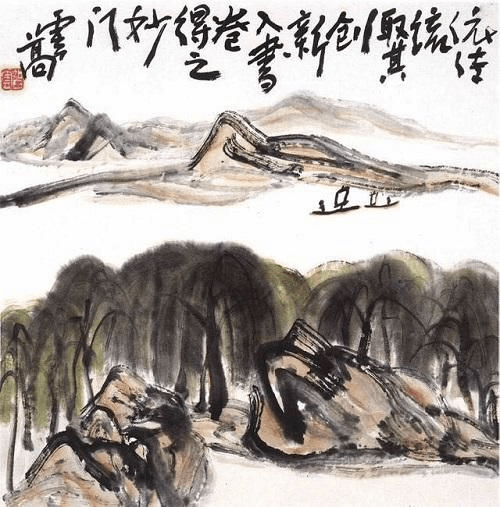
“Setting Sail to the East,” this painting employs thirsty brush and light ink, with free and bold strokes, abandoning the meticulousness of carving. Horizontal and vertical brushstrokes appear to be dragging mud and water, yet they possess the strength to carry a heavy weight. The brushwork is seasoned and heavy, yet balanced between reality and illusion.
In the foreground, there is a poetic dense willow forest, where two stubborn rocks seem to be “nodding” to each other, engaged in intimate conversation, perhaps narrating the endless past and future of the mundane world. In the middle ground, there are two simple small boats, leisurely passing through the river, seemingly minimalist yet imbuing the scene with a rich humanistic atmosphere. In the distance, distant mountains are depicted with dry brush and thirsty ink, subtly rendered with a watery light ochre, evoking the elegant beauty of classical Chinese paintings, reminiscent of the dry autumn wind and the moist spring rain, yet with a strong modern painting atmosphere.
This is a masterpiece of landscape painting with profound underlying themes and innovative imagery. Its lofty style, deep meaning, grand momentum, and charming spirit all stem from H.H. Dorje Chang Buddha III’s profound philosophical thoughts and masterful brushwork. The inscription on the painting reads: “Drawing on tradition for innovation, entering the wonderful realm of the written scroll.” The brushwork is arranged in a skillful and coherent manner, serving as the backbone of the painting and the soul of the entire composition.
The term “vivid charm” embodies the artistic realm of the calligrapher and painter. H.H. Dorje Chang Buddha III‘s landscape painting art transcends the ordinary and mundane, achieving a level of artistry that is beyond compare, with a spiritual realm that has become a benchmark in contemporary painting art.
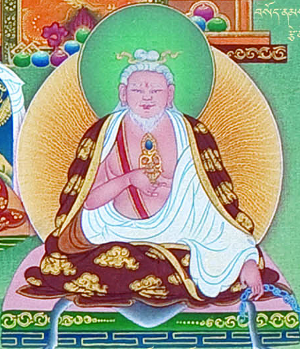
H.E. Tangtong Gyalpo is a greatly accomplished person within Tibetan esoteric Buddhism who attained the rainbow body. He is a great Bodhisattva known and respected by one and all in Tibet.
He is also an extremely holy person who has made huge contributions to the Tibetan people. It was this great Bodhisattva who was the father of medicine, ferryboats, bridges, and operas in Tibet. He has brought to the living beings of Tibet limitless blessings. To this day, Tibetan temples and families continue to worship H.E. Tangtong Gyalpo Bodhisattva.
The first Tangtong Gyalpo left the household life to become a monk when he was very young. He studied the sutras and treatises and became good at debating the sutras. Although he possessed the Five Vidyas, he remained modest, simple, and down-to-earth. In order to provide a model of self-cultivation, H.E. Tangtong Gyalpo followed and learned under many people of great virtue.
He also engaged in solitary, quiet cultivation for a long period of time at the Eri Temple. Later, he received teachings directly from Dakini Niguma and became a person greatly accomplished in the dharma. People praised H.E. Tangtong Gyalpo with the following words: “In the vast realm of emptiness, there is a yogi who intensively studies emptiness and who is like the King of Fearlessness. His name is Tangtong Gyalpo.” He has also been respectfully called Zhibai Wangxiu Tangtong Gyalpo, which means the accomplished, free and unhindered Tangtong Gyalpo!
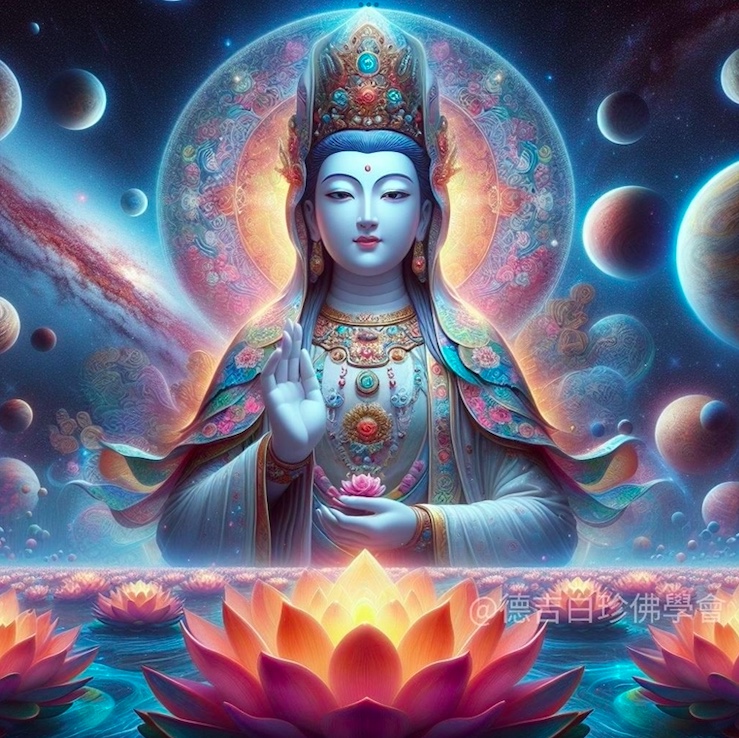
During a certain year in history, there was a serious drought and famine in Tibet. H.E. Tangtong Gyalpo conducted a Dharma Assembly in front of the Sakyamuni Buddha statue in the Jo-khan Temple in Lhasa. At that Dharma Assembly, he wrote “A Prayer to Eliminate Famine.” Many people then saw Kuan Yin Bodhisattva in the sky disseminating various grains. The famine ended not long after that.
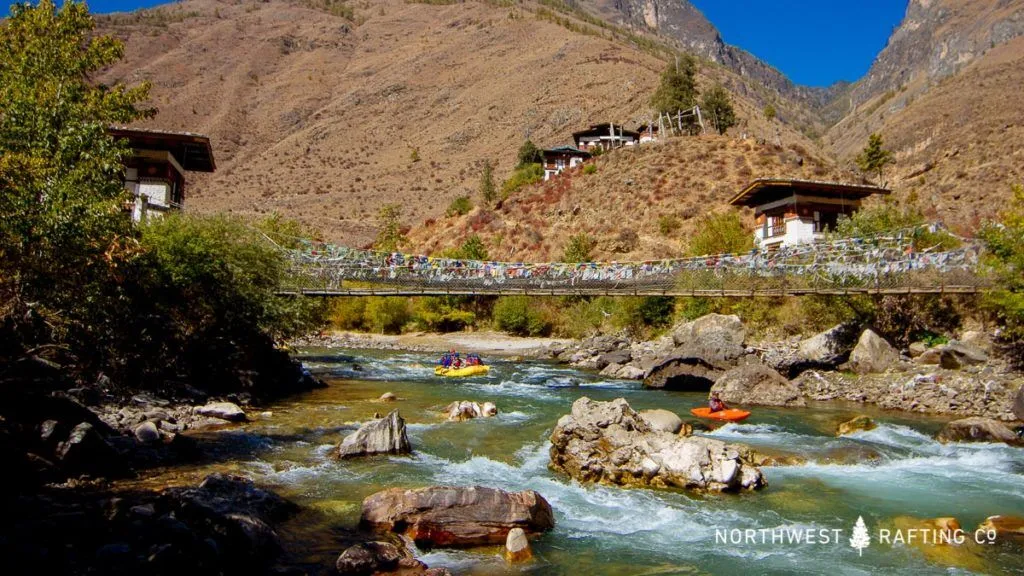
There was another time when war and chaos occurred in the Muya district of Kham in Tibet, causing people to leave their homes and wander about. H.E. Tangtong Gyalpo made a vow and wrote “A Prayer to End War and Chaos.” People in that area very soon after that ended their mutual hatred and instead treated one another in a peaceful, friendly, and loving manner. There was another year when a pestilence broke out in a large area covering a religious site of the Sakya sect, causing countless deaths. The chanting of mantras and the offering of sacrifices could not end the pestilence. Thus, H.E. Tangtong Gyalpo again practiced dharma and wrote “A Prayer to End the Disaster of Illness.” As a result, the pestilence disappeared forthwith. In previous times in Tibet, it was very difficult for people to cross rivers. The river waters mercilessly took away people’s lives as they attempted to cross the rivers. Thus, H.E. Tangtong Gyalpo made improvements to ferryboats and began building bridges. In that lifetime, he built fifty iron-chain bridges, sixty wooden bridges, and many temples. One of those temples was the Tangge Lakong (the Tangtong Gyalpo Temple), which was the first temple in the Derge region. With respect to medicine, H.E.Tangtong Gyalpo established the Medicine King Temple at Jiabori in Lhasa, invented a white pill that cured all kinds of internal medical diseases, and invented a red pill that cured epidemic diseases. Thus, he became the founder of Tibetan medicine. That white pill and red pill are used in Tibetan medicine even to this very day to relieve the sufferings of living beings.
This 600 year old bridge crosses the Paro Chhu (Paro River) and was traditionally restored in 2005 after being washed away during a 1969 flood. The bridge was originally built by the legendary Thangtong Gyalpo
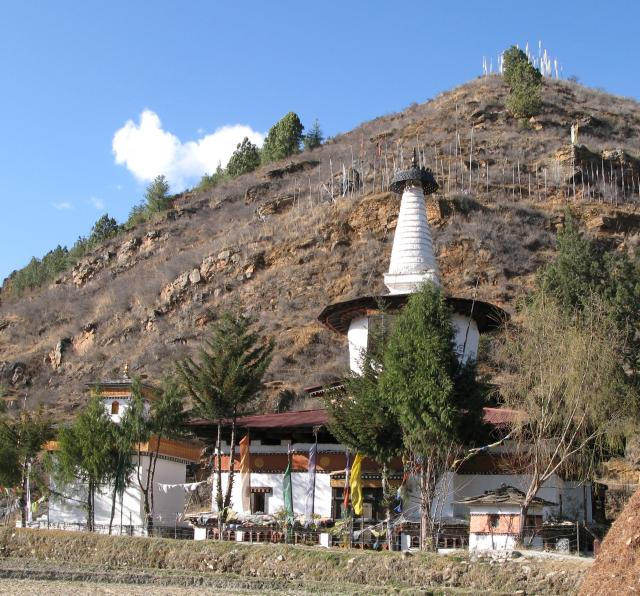
Dungtse Lhakhang, a temple in form of a chörten near Paro in Bhutan was built by Thangtong Gyalpo. The roof construction is made of iron.
H.E. Tangtong Gyalpo Bodhisattva also wrote many Tibetan operas and established the Ache Lhamo opera troupe, the members of which acted out Tibetan historical stories through song and dance and pioneered Tibetan operas. The Achi Lhamo opera, with the starting troupe of seven sisters who worked on the saint’s bridges, is still performed and enjoyed hugely to these days during the new year celebration and on festive occasions.
Achi Lhamo Opera Composed by Thang Tong Gyalpo Still Prevalent in Bhutan
H.E. Tangtong Gyalpo was the supreme leader of four esoteric sects within India, Bhutan, Sikkim, Mongolia, and Eastern Tibet. He possessed teachings from many dharma lineages, the most remarkable of which were the lineage to extend one’s life and the lineage to bring in wealth and change one’s fortune. Everyone in Tibet, no matter what sect he or she belonged to, believed in and practiced such lineages and scriptures. Countless disciples of H.E. Tangtong Gyalpo became accomplished in the dharma under his teachings and attained great supernatural powers, wisdom and great compassion. More than one hundred disciples of his attained the rainbow body or the transformation rainbow body. All Tibetan people know that H.E. Tangtong Gyalpo is truly a great patriarch of Tibetan esoteric Buddhism and a great Bodhisattva. Later, each time H.E. Tangtong Gyalpo incarnated into this world. He was a great patriarch who spread the dharma, liberated living beings, and pervasively benefited people.
Thang Tong Gyalpo Present Reincarnation
H.E. the sixteenth Tangtong Gyalpo Bodhisattva (Thangtrul Rinpoche) took birth in Bhutan. His physical appearance resembles that of Guru Padmasambhava. Even when he sleeps, his eyes remain open. He saw H.H. Wan Ko Yeshe Norbu (Dorje Chang Buddha III) during a Dharma Assembly that took place in 2005 at Hua Zang Si in San Francisco, U.S.A. In a supernatural state of samadhi, he instantly saw that H.H. Dorje Chang Buddha, the highest ancient Buddha in the dharma realm, had already come to this world again. He at once formally acknowledged H.H. Dorje Chang Buddha III Wan Ko Yeshe Norbu as his master. H.H. Dorje Chang Buddha III asked him, “Did you follow and learn dharma under Guru Padmasambhava? Why have you come here?”H.E. Tangtong Gyalpo answered that he had received teachings directly from Guru Padmasambhava and from H.H. Sakya Trizin who is the nirmanakaya of Manjushri Bodhisattva. He also said that he had come to request the highest dharma in order to save living beings. H.H. Dorje Chang Buddha III immediately snapped His fingers, and a dharma bowl manifested awesome power. H.H. Dorje Chang Buddha III then accepted H.E. Tangtong Gyalpo as one of his disciples who is on the level of a great venerable one and performed an initiation for him. H.E. Tangtong Gyalpo took that dharma bowl back to his home country.
He later learned that the book A Treasury of True Buddha-Dharma about the H.H. Dorje Chang Buddha III Wan Ko Yeshe Norbu Holiest Tathagata was about to be published. He thereupon organized many rinpoches to practice the Kuan Yin Dharma one billion times as an offering to His Holiness Dorje Chang Buddha III. He also sent his written congratulations stating that His Holiness is the master of Buddhas, the magnificence of His Holiness is supreme and that in this world no other holy being in history can compare with His Holiness.
H.H. Dorje Chang Buddha III accepted H.E. Tangtong Gyalpo as his disciple at Hua Zang Si temple San Francisco
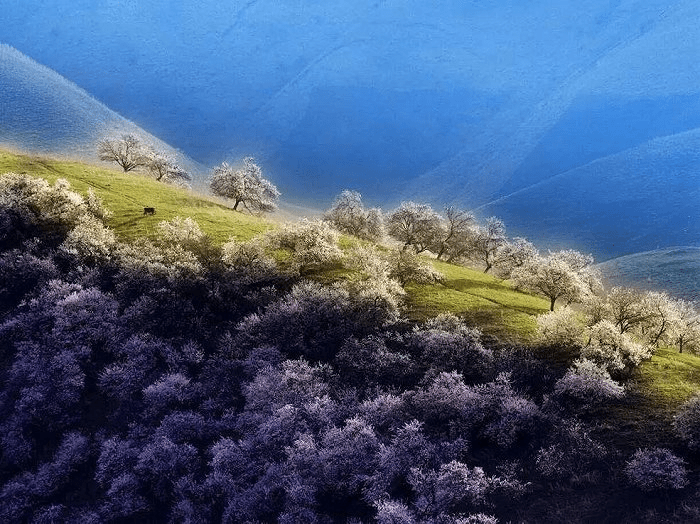
Every year in March and April, the most beautiful season arrives in Yili, Xinjiang!
This is a legacy from the fifteenth and sixteenth Centuries,
The largest primitive apricot forest,
Concentrated on the north bank of the GongJiShi river,
Covering an area of over 30,000 mu.
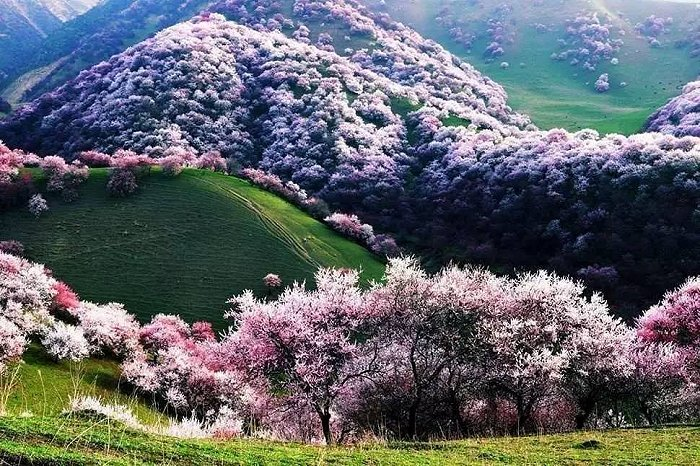
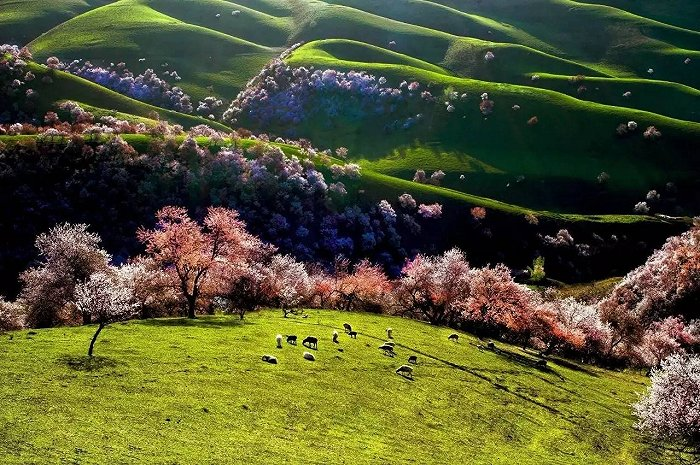
The beauty of Yili’s apricot blossom gully is not the deliberate beauty of artificial planting and processing, but the natural beauty of “natural and unadorned”. On the rolling hillsides covered with layers of grass, there are apricot blossom forests in purple, red, and pink, magnificent and dreamlike, which makes people feel excited at first sight. Mentioning Yili, the vast image of the grassland with the words “the sky is vast, the wilderness is vast, and the wind blows the grass low to see the cattle and sheep” comes to mind. Little do people know, here also has the beautiful scenery of “apricot blossoms fill the gully, and the spring scenery intoxicates people”. The apricot blossoms covering the mountains and plains make people indulge in the sea of flowers, lingering and forgetting to return. Most of the visitors who come here all year round are photographers, painters, poets, and so on, who come for fame.
Yili has picturesque grassland, sacred snow-capped mountains, and a splendid sea of flowers… Any one of them is enough to conquer you!
Apricot Blossom Valley, naturally formed,
Becomes a paradise every spring.
The air is filled with the fragrance of apricot blossoms,
The valley is adorned in the robe of spring.
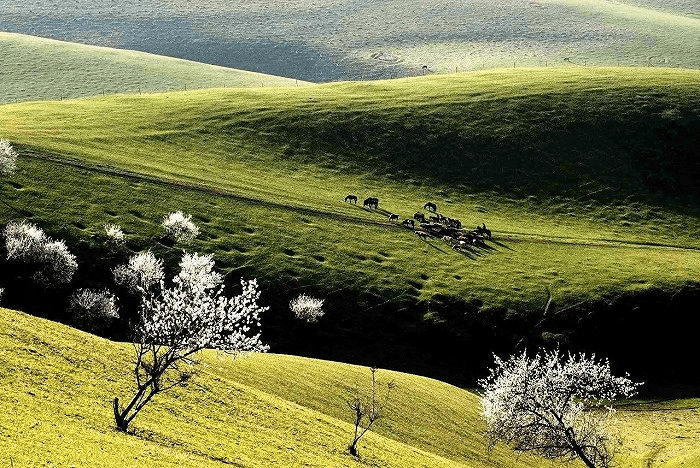
On both sides of the Yili River Valley in the foothills of the Tianshan Mountains, various ancient wild fruit trees are distributed. As April arrives and the weather warms up, wild apricots are the first to sense the temperature change, eagerly adorning their branches with blossoms, heralding the beginning of the entire apricot blossom season in the Yili Valley. In the northern part of Tuge Township in Xinyuan County, the scene of apricot blossoms in full bloom is the most spectacular in the Yili River Valley. The apricot blossoms surge like a torrential tide, climbing up the hillsides and deep into the valleys. The fresh green of the grasslands, coupled with the delicate pink of the apricot blossoms, adorned with the pastoral huts and leisurely cattle and sheep, depicts spring in an exaggerated yet perfect manner.
Entering April marks the most beautiful and romantic season in the Yili River Valley. The first to bloom are the pink apricot blossoms. In Xinyuan County, April is full of spring vitality, with willows budding and hillsides covered in green carpets. Most striking are the rolling hillsides on the north bank of the Gongjisi River, where wild apricot blossoms compete to bloom. The flowering wild apricot trees are snow-white or pink, exuding a bright and fresh fragrance that can be smelled several kilometers away.
Thanks to the influence of the humid climate of the Yili Basin and the nourishment from the abundant glacial meltwater from the Tianshan Mountains, the tens of thousands of mu of primitive apricot trees in the Apricot Blossom Valley have grown wild for hundreds of years, flourishing endlessly.
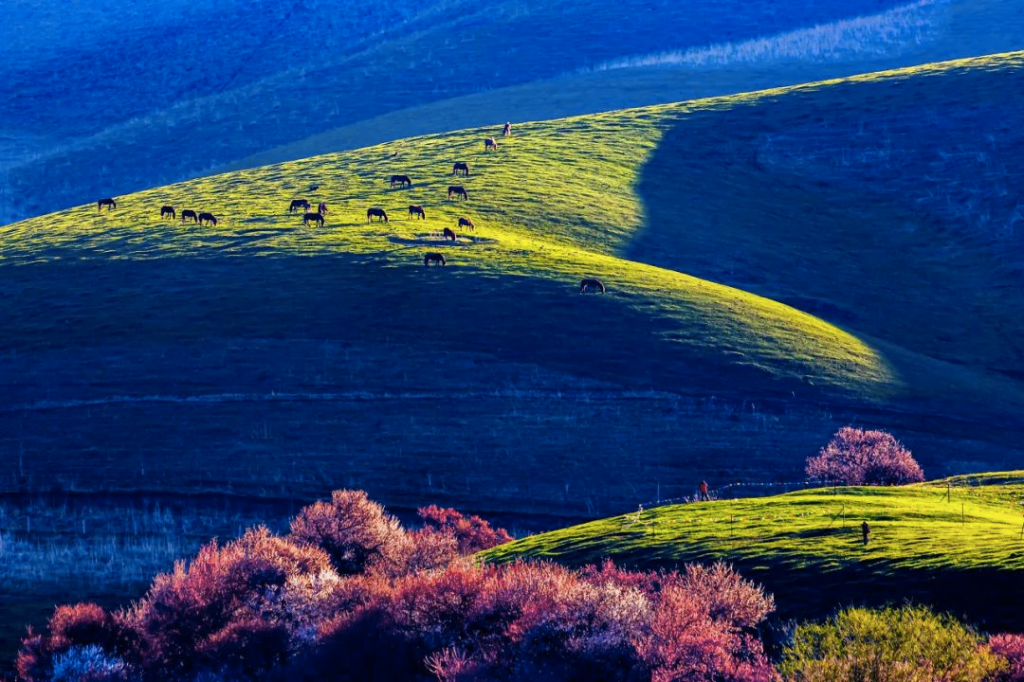
In April, the Yili region experiences frequent spring rains, gentle like silk. Under the rendering of the rain, the Apricot Blossom Valley appears even more like a hidden paradise, fresh and mysterious. Standing on a hillside and looking out, in the undulating valleys, wild apricot trees dot the landscape between the valleys and hillsides. The lush green of the valleys clashes with the purple-red of the apricot blossoms, creating a visually striking scene! The undulating lines of the valleys amidst the vast expanse of sky and earth present a majestic spectacle, with beautiful light and shadows refracted by the sunlight, creating a rare visual feast.
In spring, the Narat Grassland is a subalpine meadow plant area, renowned as a famous pasture since ancient times. The picturesque grassland scenery combines with the local Kazakh folk customs, with valleys, peaks, deep gorges, and forests complementing each other in harmony!
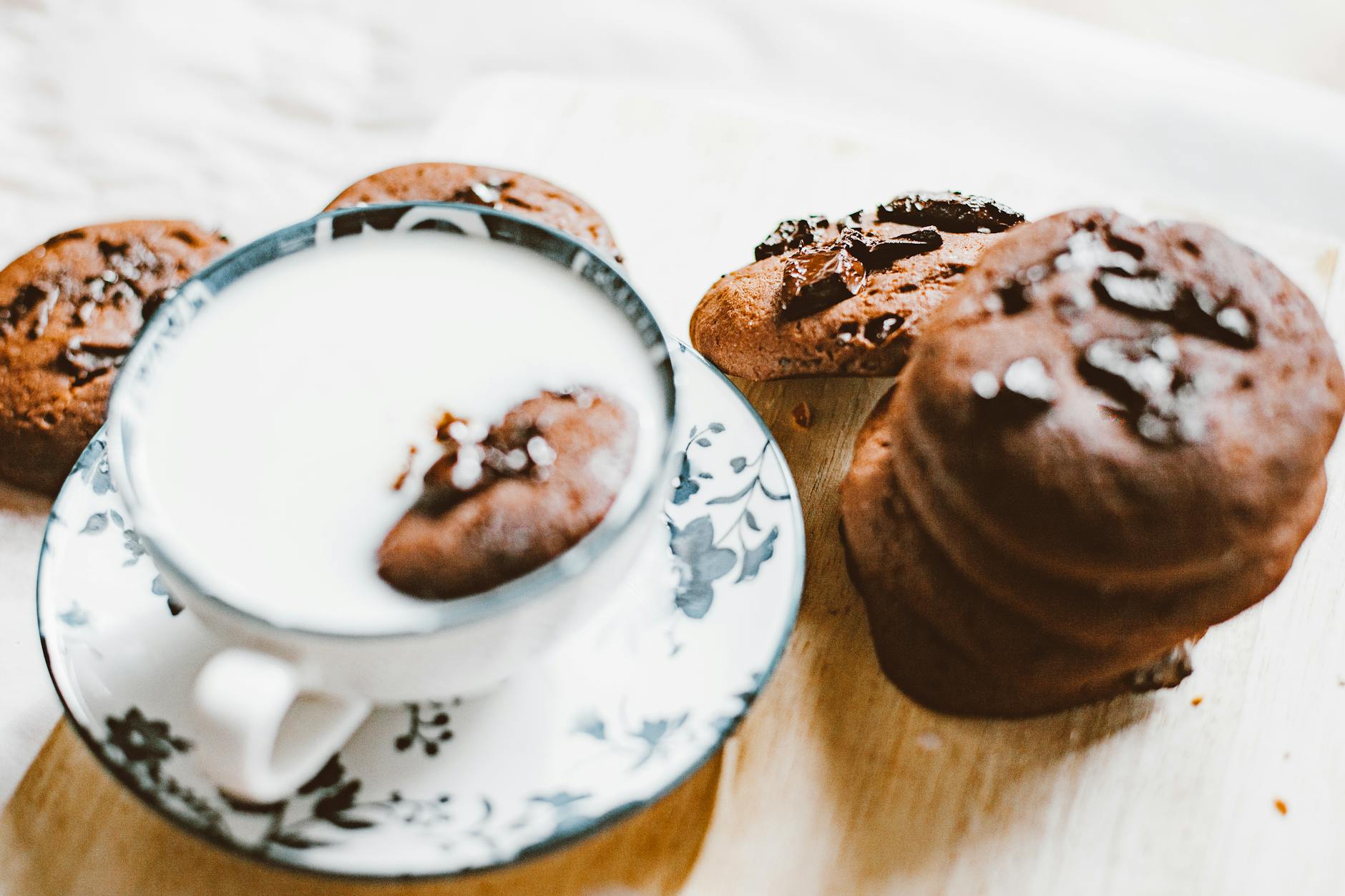
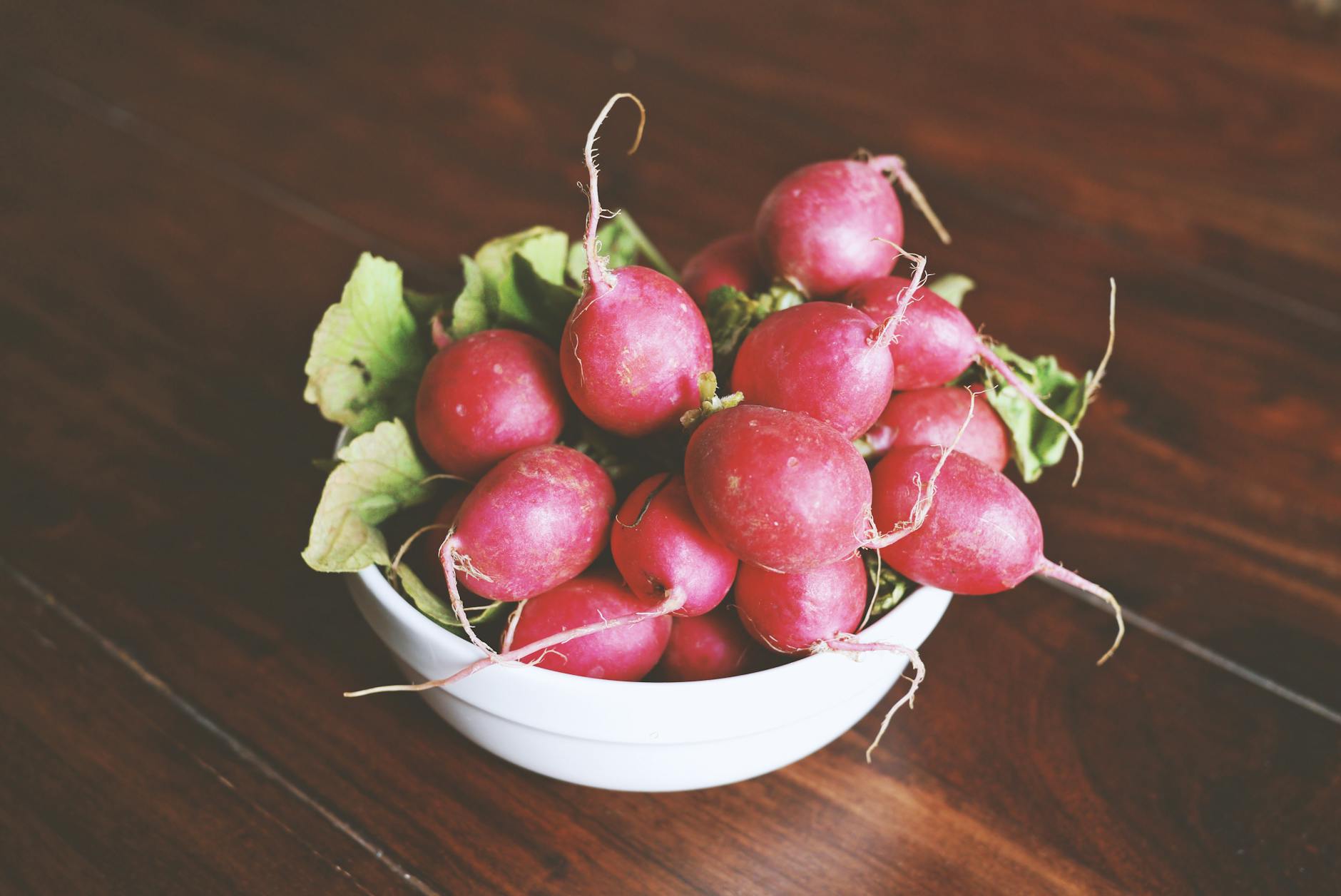
In 1996, a seemingly innocuous experiment conducted by Roy Baumeister and his team at Case Western Reserve University revealed a profound truth about human behavior: the power of will. Their study, which involved tempting participants with chocolate chip cookies only to have them resist and eat radishes instead, demonstrated the finite nature of willpower. This pioneering research laid the groundwork for understanding self-control as a resource that could be depleted, akin to a muscle that fatigues with exertion.
In the first part of the trial, Baumeister kept the 67 study participants in a room that smelled of freshly baked chocolate cookies and then teased them further by showing them the actual treats alongside other chocolate-flavored confections.
While some did get to indulge their sweet tooth, the subjects in the experimental condition, whose resolves were being tested, were asked to eat radishes instead. And they weren’t happy about it.
After the food bait-and-switch, Baumeister’s team gave the participants a second, supposedly unrelated exercise, a persistence-testing puzzle. The effect of the manipulation was immediate and undeniable. Those who ate radishes made far fewer attempts and devoted less than half the time solving the puzzle compared to the chocolate-eating participants and a control group that only joined this latter phase of the study. In other words, those who had to resist the sweets and force themselves to eat pungent vegetables could no longer find the will to fully engage in another torturous task. They were already too tired.
The experiment, while seemingly trivial, yielded crucial insights into the nature of self-regulation. Participants who exerted willpower to resist the tempting chocolates subsequently demonstrated diminished perseverance and performance on a subsequent task. This seminal finding underscored the broader significance of self-control across various domains of life, from mundane daily tasks to more significant challenges.
In the realm of psychology, this research sparked a cascade of studies exploring the multifaceted implications of willpower. It elucidated why individuals are drawn to indulgence after experiencing setbacks, such as seeking solace in retail therapy after heartbreak. Moreover, it provided valuable insights into behavior modification strategies, highlighting the importance of positive reinforcement and habit formation in fostering lasting change.
Understanding the concept of willpower empowers individuals to leverage it effectively in pursuit of their goals. Rather than relying solely on sheer determination, strategic planning plays a pivotal role in optimizing willpower utilization. Timing tasks to align with periods of peak mental and physical energy, such as the morning after a restful night’s sleep, can enhance performance and resilience.
Furthermore, recognizing willpower as a trainable attribute opens avenues for personal growth and development. Cultivating positive habits serves as a cornerstone for strengthening willpower and facilitating sustained behavior change. Initiating small, manageable goals allows individuals to acclimate gradually, paving the way for long-term success. For instance, committing to brief daily rituals, like reading for just two minutes, eating one fruit instead of a cookie, or embarking on a short morning walk, lays the groundwork for more significant lifestyle adjustments. As these habits become ingrained, individuals can incrementally expand their efforts, harnessing the cumulative impact of consistent practice. Joining a group of like-minded individuals can also provide invaluable support in reinforcing positive habits and maintaining motivation.
Additionally, cultivating positive bedtime routines fosters relaxation and promotes quality sleep. Instead of mindlessly scrolling through screens before bed, incorporating a five-minute practice of prayer, meditation, or reflection on gratitude can help unwind the mind and prepare for restorative rest. This intentional shift away from digital distractions not only supports mental well-being but also cultivates a deeper sense of connection with oneself and the present moment.
In essence, comprehending and harnessing the power of willpower is transformative. By integrating strategic approaches to task management, fostering positive habits, and nurturing a supportive network, individuals can unlock their potential for personal and professional fulfillment. As Baumeister’s pioneering research illustrated, the journey towards meaningful change commences with embracing the remarkable capacity of willpower.
In a world often overshadowed by negativity, encountering a book that challenges us to break free from the habit of complaining is like a breath of fresh air. “The World Without Complaint” by Well Bowen offers an insightful perspective on the harmful effects of constant complaints and provides practical strategies for fostering a mindset of gratitude and positivity.
We read because we crave insight, resonance, guidance, and growth. Have you ever found yourself caught in a cycle of complaints about the world, life, family, friends, or even strangers? Today, let’s explore some notes from “The World Without Complaint.” This bestselling book has reached readers in 80 countries, urging us to consider how a single book and a simple wristband can transform us from habitual complainers into ambassadors of positivity.
The Marvel of the Wristband Have you ever participated in a lunchtime gripe session with colleagues or friends, only to find that venting seems to worsen your stress? It’s as if complaining adds fuel to the fire of our worries. The truth is, many of us are oblivious to our own negative attitudes and behaviors. While others may perceive the negativity in our speech, we often fail to recognize it ourselves. But can we change? Absolutely! By wearing the No Complaining wristband and committing to a 21-day challenge, we can become more aware of our complaints, their frequency, and ultimately, how to stop them.
The Secret to a Dream Life The tool: The No Complaining wristband (or any accessory that reminds you to stay positive, like a fitness tracker). The secret: Consistency. As you practice the 21-day challenge and swap the wristband between your hands, you’ll start paying closer attention to your words and actions. This seemingly insignificant wristband becomes a beacon, helping you identify and release negative emotions you may not have been aware of before.
How to Use the Wristband
Wear the wristband on one wrist to start your 21-day journey.
When you catch yourself complaining, criticizing, gossiping, or being sarcastic, switch the wristband to the other hand and start over. Each time you switch, you reset your 21-day journey.
Keep going.
The Key to Success
Move the wristband with each complaint.
Keep track of your progress.
Focus on your own wristband; don’t worry about others’.
Don’t outsmart yourself.
Unconscious Incompetence Complaining not only distracts us from our true desires but can also harm our health and relationships. Changing just one percent of the world’s population can create a ripple effect of positivity that uplifts everyone. Complaints never attract what we desire; instead, they reinforce what we don’t want. Our thoughts shape our lives, so let’s be fully present, steadfast, and strive to be better versions of ourselves.
Conscious Competence
Smile, breathe, take it slow. Our words have power. Changing what we say can change our lives.
Criticism and sarcasm are rarely productive. Focus on constructive feedback and encouragement.
Plant seeds of positivity in your interactions. Inspire others by embodying the change you wish to see.
Transform your mindset from one of complaint to one of gratitude. Every moment is an opportunity to create the life you desire.
Unconscious Competence
Transform your tools and methods into personal logic and theory.
The best time to plant a tree was ten years ago. The second-best time is now. Believe in your ability to change, and the solutions to all your problems will follow.
Complaining is more than just a fleeting expression of dissatisfaction; it’s a habit that can poison our minds and relationships. Continuously focusing on what’s wrong or lacking in our lives not only perpetuates a cycle of negativity but also reinforces feelings of helplessness and victimhood. Complaining can strain our relationships, as constant negativity can push others away and create a toxic environment.
Moreover, the energy we invest in complaining could be better utilized to find solutions to our problems or to appreciate the blessings we already have. Dwelling on complaints keeps us stuck in a state of discontentment, hindering personal growth and preventing us from fully embracing life’s joys.
Training Yourself to Avoid Complaints Breaking the habit of complaining requires conscious effort and dedication. Bowen’s book offers practical techniques and exercises to help readers rewire their brains and cultivate a more positive outlook. From mindfulness practices to gratitude journaling, the book provides actionable steps to shift our focus from complaints to appreciation.
One effective strategy is to practice mindfulness and become more aware of our thoughts and emotions. By recognizing the patterns of negativity that lead to complaints, we can interrupt the cycle and choose a more constructive response. Additionally, cultivating a habit of gratitude can help us reframe our perspective and find joy in even the smallest blessings.
The Benefits of Embracing Positivity Choosing not to complain has numerous benefits that extend beyond our personal well-being. By adopting a positive mindset, we become more resilient in the face of challenges and better equipped to navigate life’s ups and downs. Our relationships thrive in an environment of positivity, fostering deeper connections and mutual support.
Furthermore, a world without complaints has the potential to spark positive change on a larger scale. Imagine if just one percent of the population committed to refraining from complaints— the ripple effects would be profound. Communities would be filled with kindness and compassion, and collective efforts toward solving problems would be more effective and harmonious.
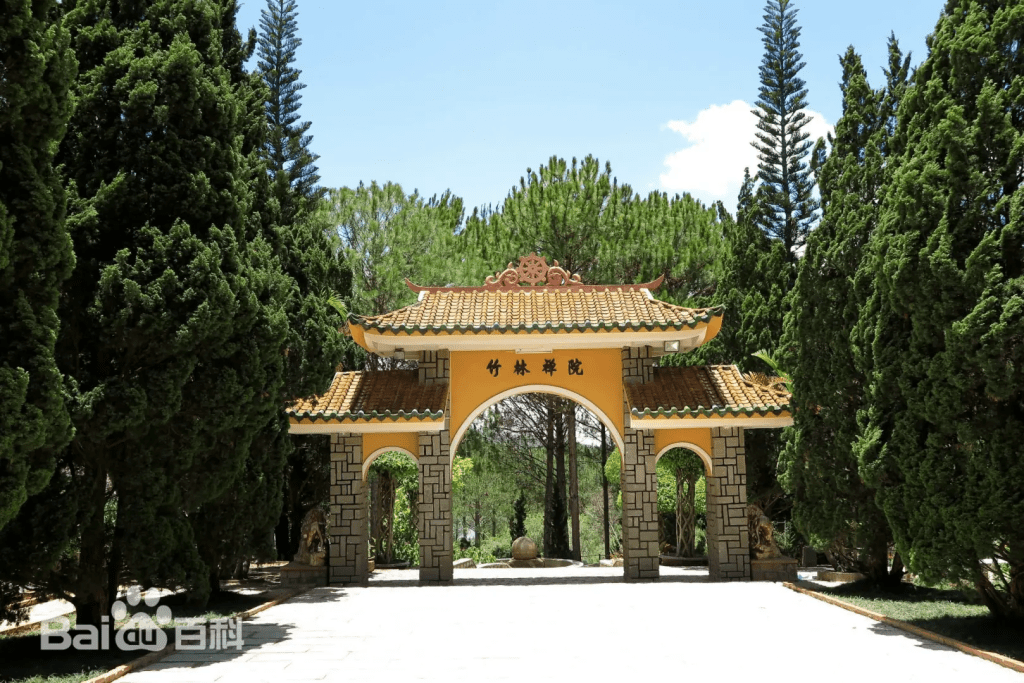
Standing on Fuyung Mountain Road in Tsuen Wan, Hong Kong, Zhulin Temple (also known as Chuk Lam Sim Yuen) proudly upholds the lineage of the Linji School of Zen Buddhism. Rooted in tradition, the temple seamlessly integrates teachings from the Tiantai and Pure Land traditions, thereby spreading the Buddha’s wisdom far and wide. Nestled within the heart of the Fragrant Harbour, it fosters a unique spiritual atmosphere known as the “Bamboo Grove Family Style,” where the Dharma is generously shared, benefiting both locals and visitors alike, serving as a haven for Buddhist study and practice.
Encompassing an expansive area exceeding 400,000 square feet, Zhulin Temple commands a serene and majestic presence, making it one of the largest and most beautiful temples in Hong Kong. Its origins trace back to 1928 when the founding master, prompted by three visionary dreams from Bodhisattva Ksitigarbha, embarked on the mission to erect a temple on Fuyung Mountain. Inspired by unwavering Bodhi resolve, six devoted followers generously donated funds to procure the land and construct the temple. Drawing inspiration from the architectural marvels of ancient Chinese mountain temples, the Pagoda Hall was completed on October 23, 1932, housing the largest statue of Ksitigarbha Bodhisattva on a lotus throne in Hong Kong. Thus, Zhulin Temple was formally inaugurated, marking the beginning of its sacred journey to illuminate sentient beings.
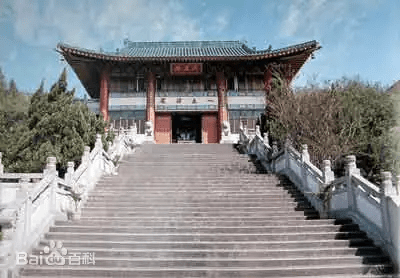
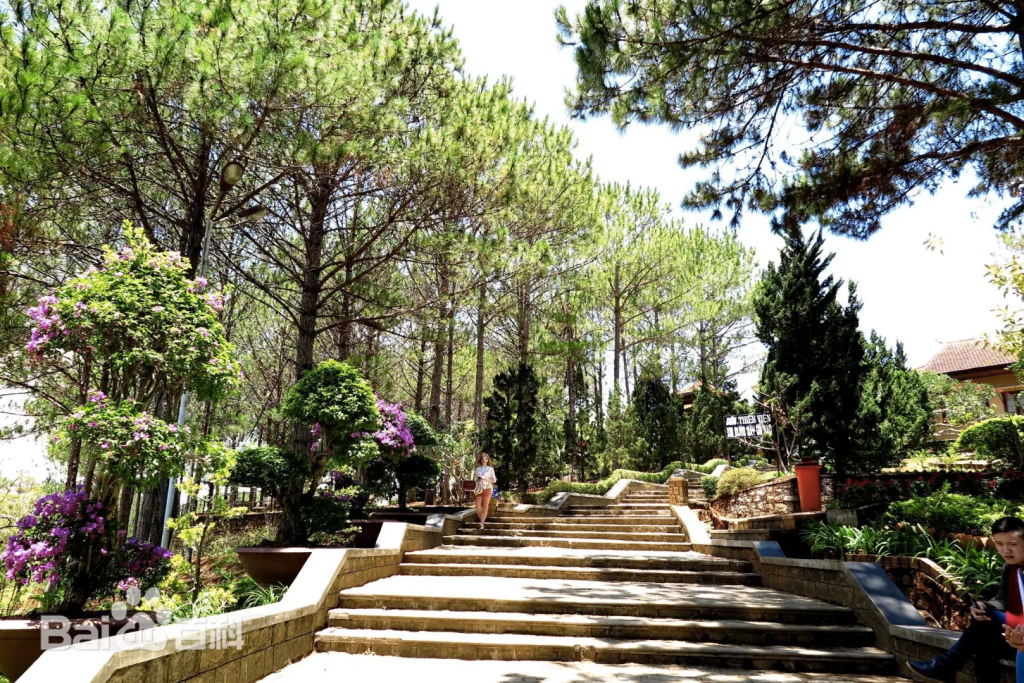
The architectural layout of Zhulin Temple embraces a harmonious three-section courtyard design. Upon crossing the mountain gate, visitors are greeted by the monastery’s serene courtyard garden, offering a space for worshippers to procure incense, candles, flowers, and fruits for offerings. Ascending the steps leads to the grand Hall of Heavenly Kings, where the jovial Maitreya Buddha stands at the central entrance, extending a warm welcome to all. Within the hall, the Four Heavenly Kings stand guard, with the central altar adorned by Bodhisattva Virūpākṣa, safeguarding the monastery under the benevolent gaze of Maitreya Buddha.
steps leads to the Grand Hall of Heavenly Kings,
Maitreya Bodhisattva
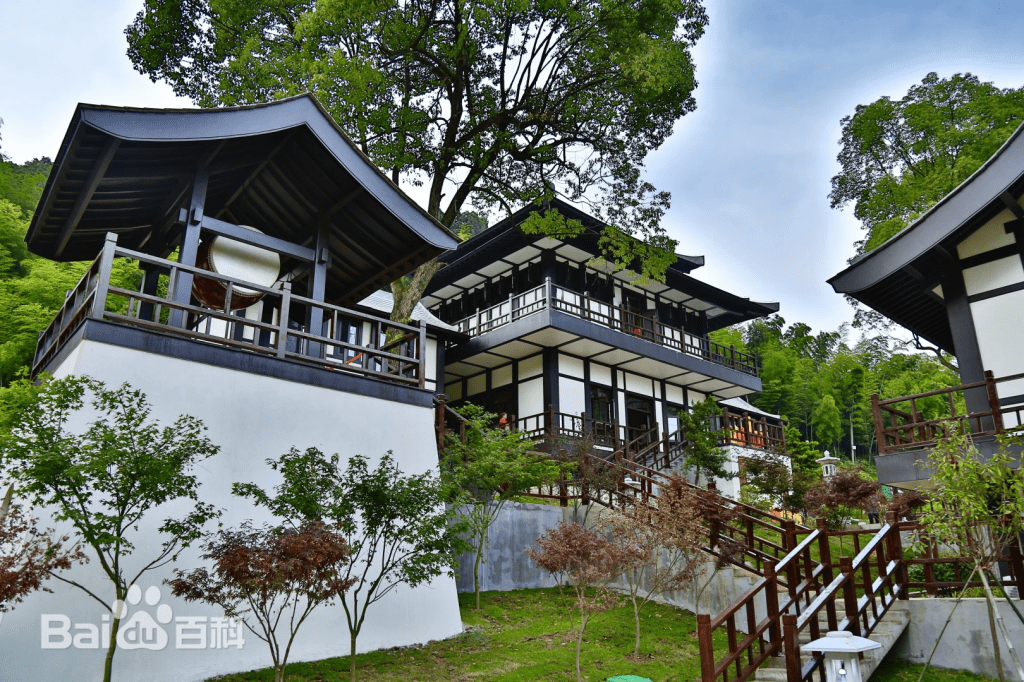
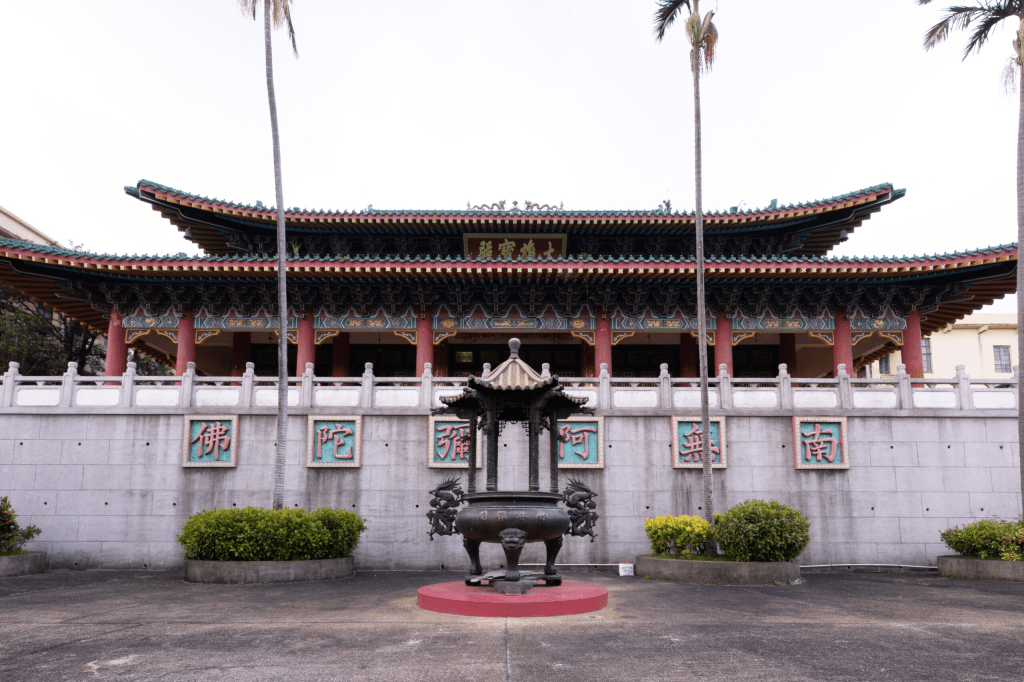
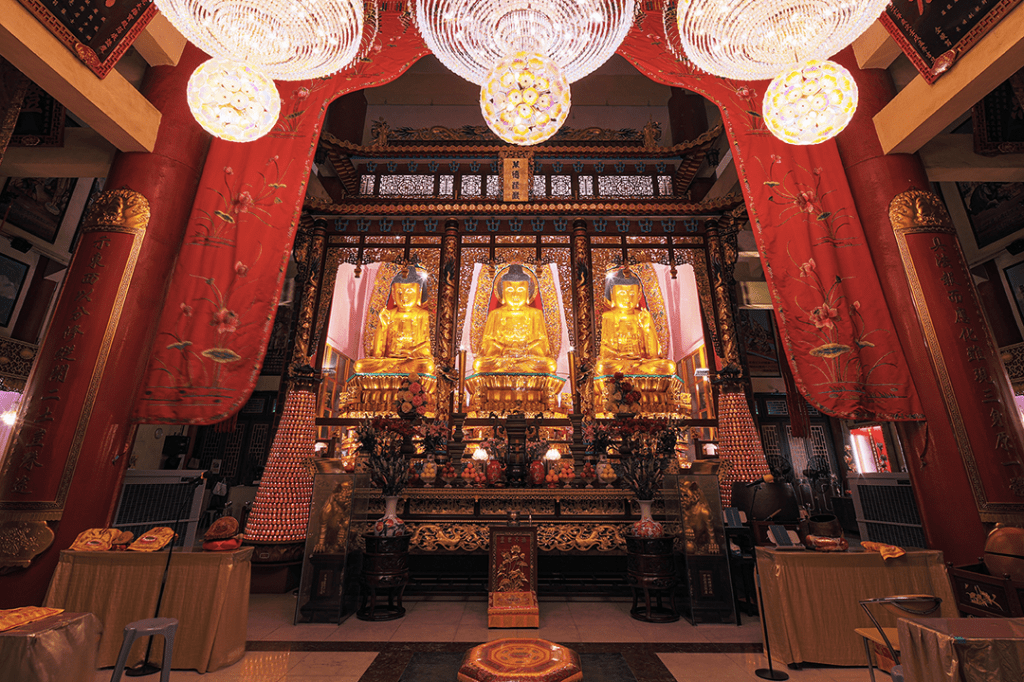
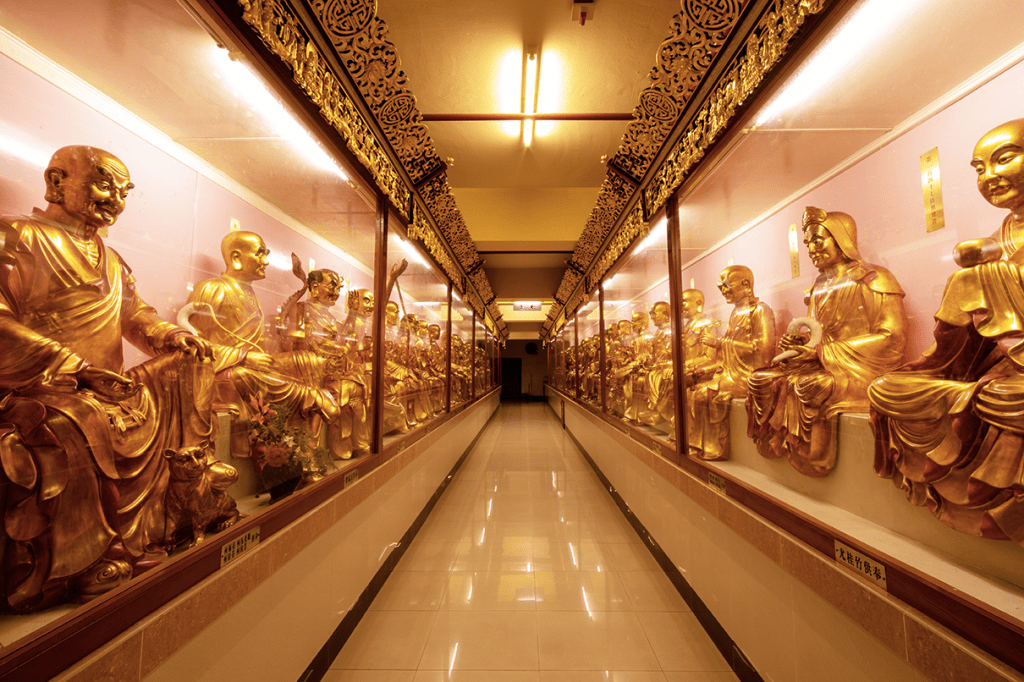
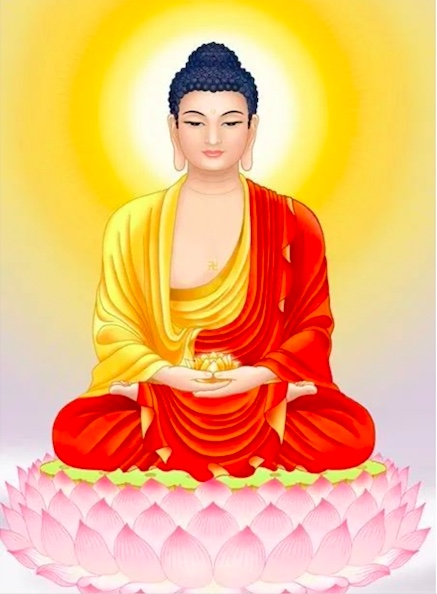
Further beyond lies a spacious courtyard flanked by a bell tower and drum tower. Ascending the stairs unveils the majestic Grand Hall, where the Triple Gem (Amitābha Buddha, Śākyamuni Buddha, and Bhaiṣajyaguru Buddha) resides on the central altar, accompanied by eighteen Arhats on either side. Adorning the rear of the Triple Gem altar is a depiction of the transformative scene from the Avalokiteśvara Sūtra, illustrating the manifestation of Avalokiteśvara Bodhisattva.
Bell Tower and Drum Tower
The Grand Hall
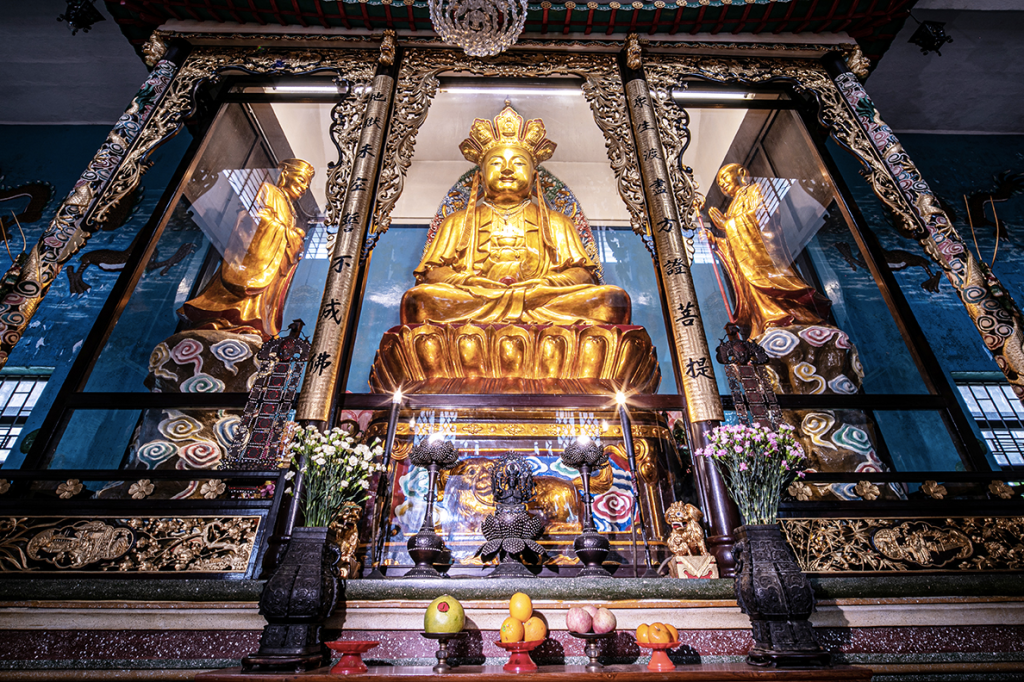
Adjacent to the main hall, worshippers find solace in a pavilion, while the Guan Yin Hall and Jade Buddha Hall flank its sides. Upstairs, the Pagoda Hall, now known as the Ksitigarbha Hall, stands adjacent to the Ancestral Hall and the Kitchen. Surrounding the monastery are additional halls including the Five Hundred Arhats Hall, the Dharma Hall, the Chan Hall, and the Scripture Repository, nestled along the outskirts and mountain slopes.
Guan Yin Hall
Ksitigarbha Hall
Five Hundred Arhats Hall
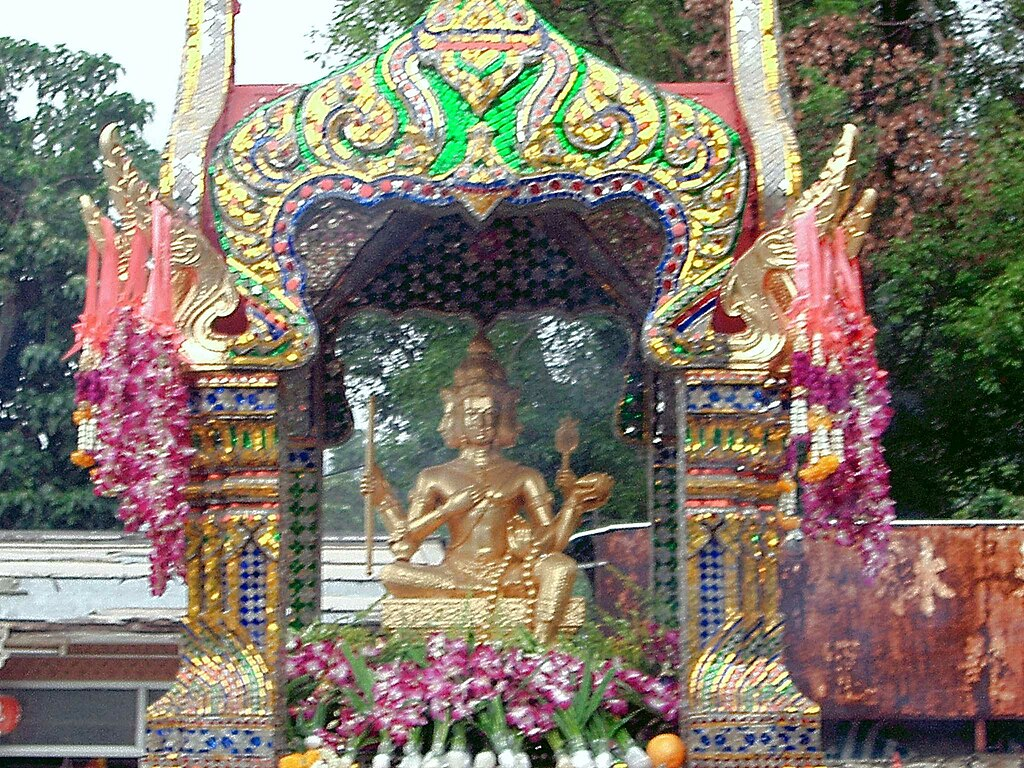
Four faced Buddha Statue 由Hkgalbert – 自己的作品,公有领域,https://commons.wikimedia.org/w/index.php?curid=9932768
Throughout its century-long history, Zhulin Temple has been overseen by five abbots. Notably, the fourth Abbot Master YiZhao emerged as an eminent monk of his time. Venerable Dharma Master Yizhao (1927-2013), born in Guangdong, China, embarked on his spiritual journey by joining Zhulin Zen Monastery in Hong Kong in 1940, formally becoming a monastic in 1941.
Under the guidance of Master Xuyun, he received the transmission of Viyana at Nanhua Temple in 1944, subsequently inheriting the Linji (Rinzai) Dharma lineage and becoming its 44th holder. Establishing the Guyan Pure Monastery in 1952, he later returned to Zhulin Temple to assist in its renovation, eventually assuming the role of abbot. He peacefully passed away in 2013, leaving behind a legacy of enlightenment and compassion.
Master YiZhao (left) and Master XuYun (right) were together at KaiYuan Temple in ChaoZhou, GuangDong , in 1946
Venerable Dharma Master Yizhao, the successor to H.E. Dharma Master Xuyun, exemplifies profound virtue within contemporary Zen Buddhism. Having attained the supreme state of Bodhi, he relinquished all ties to further reincarnation long ago. Inspired by the compassionate vow of Ksitigarbha Bodhisattva, he pledged “As long as there is any living being in the earthly realm, I vow not to become a Buddha.” Renowned as the nirmanakaya of Ksitigarbha Bodhisattva, he received the Amrit Empowerment Initiation from H.H. Dorje Chang Buddha III, lauded as an exceptional monk who ardently upholds precepts.
In June 2000, Venerable Dharma Master Yizhao seized the opportunity to participate in the Buddhas Bestowing Nectar Dharma Assembly presided over by H.H. Dorje Chang Buddha III. (The very left in the photo is Master Yizhao)
Zhulin Temple stands as a testament to beauty and sanctity, inviting visitors to immerse themselves in Buddhist culture, prayers, and blessings, offering a profound spiritual experience.
In the tranquil setting of one afternoon, Sariputra and Maudhara, the first disciples of the Shakyamuni Buddha, introduce an ascetic named Tigaro to the profound teachings of enlightenment. Little did they know that this encounter would unveil a tapestry of insights and narratives, offering timeless wisdom that transcends doctrines and narrow beliefs.
Upon meeting the Buddha, Tigaro’s skepticism manifests through his query: “What exactly is your doctrine?” His disdain for theories is palpable as he voices his disbelief. However, the Buddha, with a serene countenance, responds with an unexpected question, challenging Tigaro’s perspective: “Then you don’t believe yourself? What about those who don’t believe in any theory? Do you believe in unbeliefism?” This exchange sets the stage for an enlightening discourse on the nature of truth and belief.
With a calm and understanding demeanor, the Buddha delves into his teachings, addressing the perils of rigid doctrines. He elucidates how attachment to perceived truths stifles freedom and engenders conflict. Through poignant storytelling, exemplified by the narrative of a young widower and his son, the Buddha illustrates the consequences of attachment and false perceptions.
In the heartrending tale, a young widower cherishes his 5-year-old son deeply. However, tragedy strikes when one day the father must depart on business, leaving his son alone. Bandits ravage the village on that very day, and upon his return, the widower discovers his home burned and his son presumed dead. Overwhelmed by grief, he cremates what he believes to be his son’s remains and carries the ashes with him daily, a poignant symbol of his attachment.
A month later, the son miraculously returns, only to find his father clinging to the ashes. Despite his son’s pleas and knocking on the door, the widower, consumed by his attachment to his perceived reality, remains oblivious. In a heartbreaking moment, the son departs once more, unable to break through his father’s delusion. The narrative poignantly illustrates the impermanence of existence and the tragedy of clinging to false perceptions.
The essence of Buddha’s teachings transcends philosophical abstraction. Rooted in direct experience and empirical truth, Buddhism offers a profound understanding of oneself and the world. The Buddha invites practitioners to explore the depths of their minds, guiding them toward liberation from suffering.
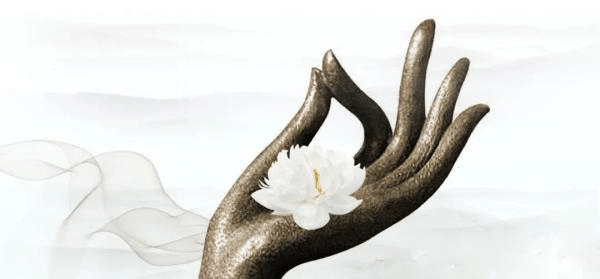
The Buddha employs a metaphorical finger pointing to the moon to elucidate the nature of his teachings. He emphasizes that his teachings serve as a guide, directing attention toward ultimate truth rather than being the truth itself. This analogy underscores the importance of experiencing reality directly, beyond the confines of doctrinal interpretations.
As Tigaro seeks guidance on overcoming painful feelings, the Buddha imparts practical wisdom. He elucidates the nature of feelings and their origins, offering a pathway to transcend suffering through awareness and understanding.
In the presence of disciples such as Sariputra and Maudhara, the Buddha’s teachings resonate as a beacon of wisdom and self-discovery. The narrative serves as an invitation to embark on a journey beyond doctrines and limiting beliefs, toward a profound understanding of reality. In embracing the impermanence of existence and cultivating awareness, individuals can unlock the profound truth that lies within—an eternal truth accessible to all who seek it with an open heart.
Zhaxi Zhuoma Rinpoche recalls several holy manifestations and unusual supernormal events that she personally witnessed after following her Buddha Master, H.H. Dorje Chang Buddha III Many other students have other similar experiences and are included in books and various articles reported elsewhere on this website. It must be noted that H.H. Dorje Chang Buddha III does not encourage or advocate practicing any form of supernatural power and is very modest about His own abilities. He is constantly warning us not to be attached to these states and experiences, but to instead practice our cultivation and develop our morality, concentration, and wisdom. A more complete accounting of what Zhaxi Zhuoma Rinpoche has seen and experienced is now available in book form on this website and at Amazon and other book stores.
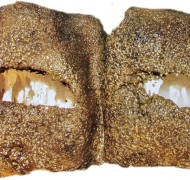
After receiving a small blue “Return-to-Youth Pill”, my hair changed from salt & pepper to the original light brown of my youth. I even let my hair grow, just to see for sure.
When I could not understand why I was asked to do something (although, of course, I did what was asked), several unrelated events occurred that explained why this was so.
I saw three-colored nectar suddenly manifested in a freshly washed bowl after a group of us disciples chanted mantras. Click for news article.
My students have also seen and even received advice from certain holy beings. Several of my students have had the Buddha Master appear and bless them.
I have never seen the Buddha not be able to answer any question asked of him.
On a special occasion, the Buddha Master blessed me and after that a diamond formed on my head that would turn bright red and pulsate from time to time. This also happened when I read the Buddha Master’s discourses, but other times as well.
“Once, when in Washington, D.C., preparing to introduce the book H. H. Dorje Chang Buddha III, to various congressional staff, I saw a very large bright neon pink light jump from tree to tree across a field from where I was staying. Earlier that morning and at other times, I would see bright yellow lights flash when I was doing dharma work for the Buddha Master. They were like the lights that flashed when the discourse What Is Cultivation?was first transmitted.” Click for article on this event.
I saw rainbow “jewels” appear on a holy site where many inner-tantric initiations had been held and where “Auspicious Grass of the Four Jewels” had grown. Click for news article.
After having a minor stroke, I was again healed so as to be able to go on a strenuous trip to visit all fifty states in the U.S.
On several occasions, I have seen pillars of light descend from the heavens, sometimes being able to capture them on digital cameras.
I have seen nectar fall several times and places, the first being in southern California under a certain magnolia tree and the last under that same tree after it had been moved to Hua Zang Si, a temple in San Francisco. It also rained under a flowering jacaranda tree on the veranda where students performed skits and other shows in honor of the Buddha Master’s birthday. Click for news article.
I have seen students practice the tummo (inner heat or fire) dharma and raise their body temperature to very high levels–even high enough to burn the fingers of those who touched a metal bowl lying on the student’s stomach. Click for article.
I have seen sacred seed syllables form on the bodies of students and holy ones.
I have had my crown opened as documented by a MRI devise. Read article on this miraculous event.
Several very large koi fish came and did a dance for the Buddha Master in the pond at the Holy Vajrasana Temple & Retreat Center in Sanger. Schools of fish also followed the Buddha Master around as He toured a Japanese garden south of San Francisco and Dragon Fish came to pay respect to the Buddha when he gave a discourse in Thailand.
A vajra pill sang and danced while I held it.
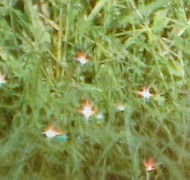
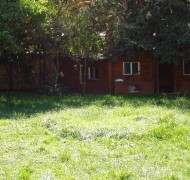
I saw a particular type of flower called “Auspicious Grass of the Four Jewels” grow directly in front of where the Ultimate Bathing the Buddha ceremony took place. The flowers had four distinct very thin parts. They grew in a particular pattern and formed a perfect circle. Prior to the Dharma Assembly the area was perfectly flat. After the ceremony, the ground became slightly elevated, forming a mound upon which these special flowers grew. These flowers grew no other place in the yard. Click for news article.
Another red vajra pill flew from my hand to a holy place and was recovered and empowered by the Kalachakra Vajra, a manifestation of Shakyamuni Buddha. The pill danced in my hand and also in a clear stupa where it remains. It continues to dance in the stupa from time to time. Click for article.
An old metal pole started shaking quite violently at the temple and over time was joined by four more poles. Sometimes the shaking is constant, sometime it seems to pulsate as if sending coded messages. Others report seeing various lights or feel energy emanating from these poles. Pilgrims travel from all over the world to see these poles. Click for article. Also see many news articles of pilgrims visiting the poles.
Many light beings from other realms appear and can sometimes be seen by the naked eye and sometimes only on video or digital recordings at the temple in Sanger. Visitors to the temple have also seen and recorded them. Click for photos.
I saw the beautiful and amazing relics or sharira from a special close disciple of the Buddha Master. Click for article.
The Buddha Master was able to transfer His energy to me and enable me to raise my temperature after it continued to decline to dangerous levels.
A colored mandala was written on top of a large flat stone. After dharma was done, the stone was removed and the same mandala had been transferred through the stone and appeared on a bed of sand beneath the stone. This I saw done twice. The second time a pile of mixed various colored sands was placed below the stone, but were sorted out into seed characters after the dharma was performed on the stone. Click for photo.
I experienced the elimination of dark karma by having the Buddha Master’s magical Dharma Wheel placed on my chest. I could not bear the heat of the small metal object, but the Buddha Master picked it up with no problem. Click for news article.
I saw the Buddha Master create incredible works of art in very short periods of time. Some even contained a permanent fog or mist. Click for photo
I saw the Buddha Master change very quickly from an old beaten and bruised person to His usual self. This happened after the Buddha Master had predicted what would happen the previous day. An even more amazing transformation from an old man to a handsome youth happened and was was documented more recently. Click for more.
I saw the Buddha Master turn blue during an empowerment ceremony. I did not know at the time that He was an incarnation of Dorje Chang Buddha who is blue. Click for article.
I saw my roommate and another rinpoche lift a pool of water weighing over two tons with only the power of their mantras at the Ultimate Bathing of the Buddha Dharma Assembly. Click for more.
I have seen the consciousness of my relatives and those of my students raised to a higher level. One western student’s mother (who was not a Buddhist) had the Buddha Master come to help her go to the Pure Land. Click for news article.
I was there when a very young rinpoche took a vow that she would become accomplished in a very short period of time after she had received a Prajna Empowerment and she did.
I have seen many, many Buddha Lights appear around both the sun and the moon prior or after or during special dharma assemblies or events.
I saw an antique wooden statue of Kuan Yin emit golden light after another dharma of selection ceremony. This time I shook a large container of long bamboo sticks. Each stick had a certain number that corresponded to a given outcome. I did this three or four times for each event and each time the results for each time I shook the sticks was the same AND exactly what the Buddha Master had predicted. I witnessed variations on this dharma many times.
I received a dharma of selection whereby I printed a number of outcomes on small pieces of paper for a major life decision that I was about to make; rolled these pieces of paper into tight rolls; placed these rolls in a round vase, and then asked to shake the vase and remove one. I rerolled it and replaced it doing this at least three times. Each time, I drew the same answer, which was the answer the Buddha Master gave me in the beginning.
I was present when various colored sharira appeared in a cloud of nectar.
I experienced a “freak” rain of hail one summer in Los Angeles that only rained where the Buddha Master was staying and right after a speech given by the Buddha Master that had forecasted such an event.
I saw sand from the Ganges River in India assemble to form strands of hair that created a three-dimensional crown on certain images of H.H. Dorje Chang Buddha and Shakyamuni Buddha to prove that they were both incarnations of Buddhas.































 Peace LiLy