In the Tang Dynasty, there lived a monk named Jian Kong (Venerable “Mirror-of-Emptiness”), who in his previous life had been a diligent spiritual practitioner. Yet after reincarnating, he was born not as a monk, but as a poor scholar—one who, despite twenty long years of effort, could not pass the imperial examinations. He had no money, no connections, and often struggled even to find a simple meal. Hunger followed him like a shadow.
One day, after days of near-starvation, he set out toward a nearby temple, hoping to find something—anything—to eat. But halfway there, by the side of a river, his strength gave out completely. Weighed down by exhaustion and despair, he collapsed on the riverbank and began to cry. He was already around forty-five years old, and life felt unbearably harsh.
As he wept, a Brahmin monk suddenly appeared before him, radiant and calm.
“Venerable Dharma Master,” the monk said, “are you satisfied with the taste of wandering through worldly life?”
The scholar was startled. “Satisfied? It has been nothing but suffering! But I am a layman—why do you call me “Dharma Master”? That title doesn’t belong to me.”
The Brahmin monk smiled gently. “You are starving and confused now, so you’ve forgotten everything.”
He reached into his bag and took out a large, fist-sized date. “This is a special fruit from my homeland. Eat it. Then you’ll understand.”
The scholar ate the date. Sleepiness washed over him at once, and he lay down beside the river. When he awoke, something astonishing had occurred— his entire past life came flooding back.
He remembered that he, the Brahmin monk standing before him, and three others had all been fellow practitioners in their previous lives. Filled with emotion, he asked:
“What about Monk Zhen? How is he doing in this life?”
The Brahmin monk replied, “In his past life he had not yet cut off worldly attachments, nor had he achieved realization. In this life, he has become a monk again in Sichuan. He has now completely severed his desire for fame and fortune. He will attain accomplishment in this very life.”
The scholar asked about another of their five companions. “And Master Shen? What about him?” “His wishes remain unfulfilled,” the monk answered.
Then he asked about the third companion, Master Wu. The monk sighed gently: “You know him. In our past life, he once joked before a stone Buddha statue: ‘If I cannot attain supreme enlightenment, then at least let me become a mighty nobleman.’ Well, his vow has come true. Just yesterday, I heard he was appointed a general. He has completely forgotten he was once a monk.*”
Finally, the Brahmin monk turned to him and said:
“Among the five of us, I alone have attained liberation. And you—of all of us—you alone have fallen to such a state that you cannot even find enough food to fill your stomach.”
The scholar was bewildered. “In my past life,” he said, “for decades I ate only one meal a day and wore one tattered robe for over thirty years. I practiced diligently and lectured on the Dharma tirelessly. I was a well-known Dharma Master. How could my karma now be so miserable?”
The Brahmin monk answered with unmistakable compassion:
“Yes, you cultivated hard. But when you taught the Dharma, you often mixed in ideas from Daoist and other non-Buddhist teachings. This confused your listeners. You also held back special teachings out of stinginess, unwilling to share them openly. And although you kept the precepts, you broke them in many subtle ways. Given all this, your current life’s hardship is already a fortunate result.”
Hearing this, the scholar felt deep remorse and sadness. But instead of despair, a new resolve arose within him.
He vowed to renounce worldly life and become a monk once more.
Seeing his sincerity, the Brahmin monk took out a mystical mirror from his bag. In it, the scholar saw with clarity:
his own past lives,
the karmic results of all beings’ actions,
even the future rise and fall of the Dharma.
The mirror was said to be like the Seven-Jewel Trees of the Pure Land, which reveal the karmic truths of the universe with perfect brightness.
With this profound vision, his conviction became unshakable. He immediately entered monastic life, practiced with genuine diligence, and in time became a highly respected and accomplished master.
Recognitions and Congratulations to H.H. Dorje Chang Buddha III
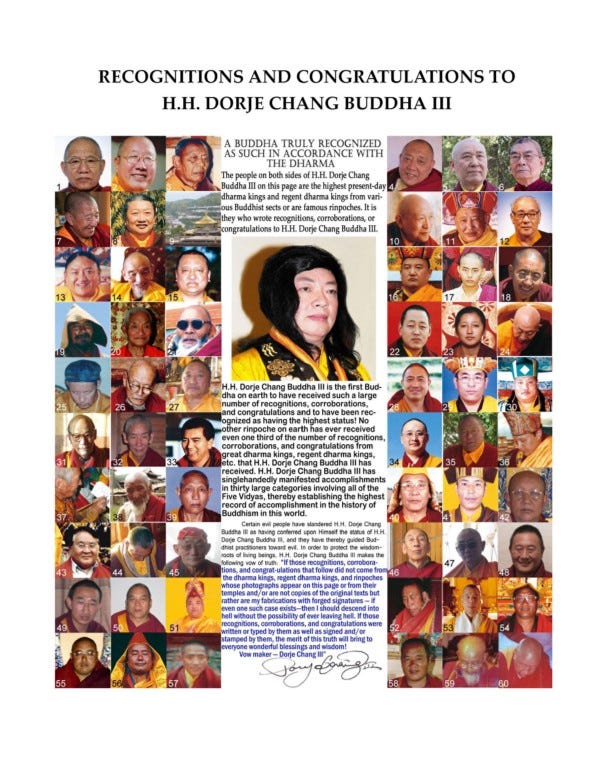
When over a hundred great Dharma Kings, Regents, and Rinpoches from various Buddhist traditions throughout the world lawfully recognized, in accordance with Buddhist precepts, that Namo H.H. Dorje Chang Buddha III is the reincarnation of the ancient Buddha, Buddhist disciples around the globe rejoiced in celebration. The descent of Namo H.H. Dorje Chang Buddha III brings to the beings of this Dharma-ending age the correct and unerring True Dharma of the Tathagata that leads to liberation from the cycle of birth and death. How fortunate living beings are to personally hear the teachings of the Buddha — there is now hope for attaining enlightenment in this very lifetime!
Online Slander and Misunderstanding of H.H. Dorje Chang Buddha III’s Holy State
However, some people on the internet refuse to face the legitimate recognitions, the holy realization, and the perfect mastery of theFive Vidyās and teachings of H.H. Dorje Chang Buddha III with reason or correct understanding. Instead, they fabricate rumors, spread insults, slander, defamation, and false accusations — maliciously twisting facts, inventing lies, and making baseless claims. They use vulgar words, forge fake documents, false notices, and false statements, and even create distorted images and mocking content — doing everything they can to attack H.H. Dorje Chang Buddha III. Through their own words and actions, they merely expose their ignorance and lack of virtue.
Some say, “A Buddha or Bodhisattva is realized through practice, not by ‘recognition.’” “Shakyamuni Buddha didn’t need a certificate of recognition.” But their purpose is clear — to stop more people from learning the true Buddha Dharma and attaining liberation!
So, does a Buddha need recognition when descending into the world?
A Practice for the Benefit of Sentient Beings.
A Buddha is one of unsurpassed, perfect enlightenment and complete wisdom. The reason one is a Buddha lies in their realization and enlightenment — not because of any recognition by others. No matter how great a Dharma King, Regent, or Rinpoche may be, their level of realization is far inferior to that of a Buddha; thus, any recognition they offer to a Buddha would be, in essence, just a piece of paper of no value to the Buddha.
However, because sentient beings in this world often lack the wisdom to discern between true and false saints, between genuine Buddha Dharma and false teachings that imitate Buddhism, they may easily be misled by superficial appearances and deviant views. Therefore, for the benefit of sentient beings, by following the Buddhist tradition of formal recognition, those virtuous masters issued such recognitions that help people give rise to faith and thus be saved. This is an act of right knowledge and right view.
The Example of Master Padmasambhava and the Importance of Recognition
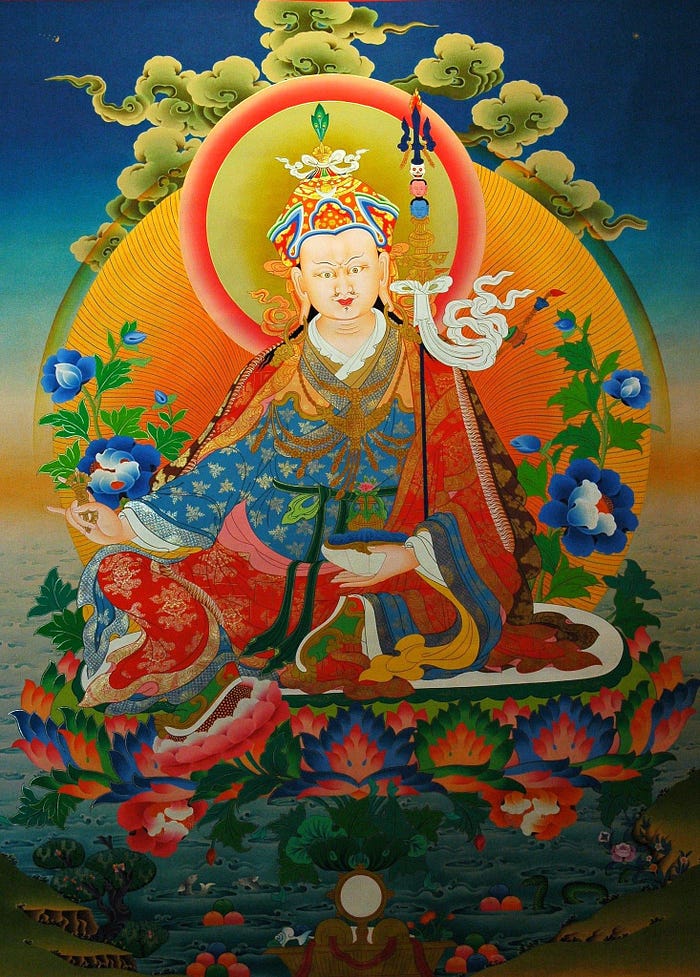
Master Padmasambhava
When Master Padmasambhava first went to Tibet to propagate the Dharma, he was not greeted with respectful welcoming crowds. Instead, the Tibetan people were terrified and shouted, “Quick! Drive out this sorcerer who performs strange magic without lineage transmission! Do not let him deceive us with his witchcraft!” They even lifted him up and threw him into a muddy pit. Later, Master Padmasambhava returned to India and asked two renowned masters to write letters of recognition. Only then did Buddhism begin to flourish in Tibet. In fact, those two masters later became Master Padmasambhava’s disciples.
Therefore, when Buddhas or Bodhisattvas reincarnate and manifest again in this world, undergoing recognition according to Buddhist rules is not for their own sake, but for the sake of helping sentient beings generate faith and thereby be liberated.
Indeed, the realization and attainment of a Buddha or Bodhisattva come from their own cultivation and enlightenment. The realization, virtue, and attainment of all Buddhas and Bodhisattvas are the manifestation of their supreme enlightenment. The pure and flawless conduct of Namo H.H. Dorje Chang Buddha III, His mastery of both exoteric and esoteric teachings, His perfect command of the Five Vidyās, and His countless acts of liberating sentient beings — all fully demonstrate the enlightenment and realization of a true Buddha!
Therefore, I sincerely advise those who slander: repent sincerely before the Buddhas and Bodhisattvas, or karmic retribution will not spare you! At the same time, I compassionately remind all who truly wish to learn and practice Buddhism: we live in the Dharma ending age, when confusion prevails, and the nature of the demonic offspring is to destroy the Dharma and obstruct sentient beings from learning the true path. Kind-hearted beings, please open your eyes of wisdom, discern the true from the false, and do not be deceived by demonic forces — lest you miss the supreme Dharma opportunity that can bring you liberation from birth and death in this very lifetime!
Ven. Junmai Baima Dorje Rinpoche is a nirmanakaya of Vajravarahi. He is the fourth Ven. Baima Dorje Rinpoche. Various auspicious signs manifested at the birth of the rinpoche. When the rinpoche was five years old, the national master of Bhutan, H.H. Dharma King Dilgo Khyentse, personally signed and issued a recognition certificate recognizing the identity of the rinpoche. H.H. Dharma King Penor and H.E. Dharma King Rabjam also personally wrote recognition certificates.
At the age of about three, the child rinpoche used two fingers to transform a small, thick Tibetan knife into the shape of a coil. After passing through many hands, that knife is now at Hua Zang Si in San Francisco, where a special place for that holy object has been established to display it for public worship and veneration. The rinpoche currently resides at the Shechen Monastery. He has received initiations from the esoteric lineage of H.H. the 10 th Panchen Lama and other persons of great holiness and virtue. The rinpoche benefits all living beings by applying the wisdom and realization of a Bodhisattva.
I respectfully honor the Three Bodies and Four Wisdoms of the Dharma King of the Three Spheres, H.H. Yangwo Wan Ko Yeshe Norbu: We were fortunate to be able to read the book about the Buddha Vajradhara Dharma King, A Treasury of True Buddha-Dharma — A Collection of H.H. Yangwo Wan Ko Yeshe Norbu’s Accomplishments Manifesting Complete Proficiency in Exoteric and Esoteric Buddhism and Perfect Mastery of the Five Vidyas . We cannot describe how deeply astonished and moved we were. Those thirty main categories of accomplishments present a splendid sight that includes the cikitsvidya (healing vidya), silpakarmasthanavidya (craftsmanship vidya), sabdavidya (sound vidya), adhyatmavidya (inner realization vidya), and hetuvidya (causality or Buddhist logic vidya) in their holy sense. Such accomplishments have never been seen before in the history of Buddhism. A Treasury of True Buddha- Dharma is the highest Buddha-dharma treasure and manifests H.H. Great Dharma King’s supreme realization and virtue. H.H. Great Dharma King is the first holy being who used true realization to display fully in the dharma realm the teachings of the Buddha! H.H. Great Dharma King is the true Buddha Vajradhara, the teacher of both humans and celestial beings! In this Dharma-Ending Age, we are deeply happy that living beings in the earthly realm have the guidance of H.H. Great Dharma King. May H.H. Great Dharma King forever live in the world and forever teach the dharma!
Most honorable H.H. Yangwo Wan Ko Yeshe Norbu Buddha Vajradhara Dharma King:
First, on behalf of all of the monks in our temple, I convey my warmest congratulations to H.H. Great Dharma King for the publication of A Treasury of True Buddha-Dharma — A Collection of H.H. Yangwo Wan Ko Yisinubu’s Accomplishments Manifesting Complete Proficiency in Exoteric and Esoteric Buddhism and Perfect Mastery of the Five Vidyas!
Since the time the world-honored Sakyamuni taught the dharma, there have been countless great Bodhisattvas and great masters who, having received the Buddha’s teachings, came to this earthly world of birth, aging, sickness, and death in order to expound and propagate the sutras and save living beings. However, a great wish of the Buddha was that accomplishments in the Five Vidyas be shown to living beings in order to lead living beings onto the path of Buddhist self-cultivation. In this regard, H.H. Great Dharma King is the greatest holy being in this earthly realm!
H.H. Great Dharma King possesses perfect compassion and wisdom. His Holiness does not shirk toil or hardship in the pursuit of teaching and edifying living beings. We should take H.H. Great Dharma King as our eternal model, forever propagate the dharma, and pervasively save sentient beings.
Among China’s many vibrant ethnic cultures, few festivals shine as brilliantly as the Miao New Year — the most important and joyous celebration of the Miao people. It marks the end of a year’s hard work and the beginning of a season filled with gratitude, reunion, and hope.
Since ancient times, the Miao people have followed their own lunar calendar, considering the tenth month of the traditional Chinese lunar year as the beginning of a new year. In Leishan County of Guizhou Province, the Miao New Year usually falls on the Mao Day during the first half of the tenth lunar month, which is roughly equivalent to Chinese New Year’s Eve. The festivities typically last from three to nine days, turning the Miao villages into a sea of song, dance, and laughter.
The Miao New Year carries deep layers of meaning. It is not only a celebration of the harvest but also a time to honor their ancestors and deities, and to commemorate Chi You, the legendary ancestor of the Miao people who perished in tribal wars over five thousand years ago. Through ceremonies and offerings to nature — sacred trees, bamboo groves, rocks, and wells — the Miao express their respect and gratitude toward the forces that sustain life.
In the valleys of the Qingshui River and Duliu River in Guizhou, the Miao New Year is the highlight of the year. The Miao calendar differs from the Han Chinese lunar calendar, and the beginning of the Miao year is determined through communal discussions so that different villages celebrate at different times. This ensures that every year, one village becomes the center of a grand regional celebration, while neighboring communities come to join in.
After the autumn harvest and the completion of farm work, the Miao New Year marks both an ending and a joyful beginning. During the festival, villagers visit relatives and friends, slaughter pigs, make sticky rice cakes, worship their ancestors, share reunion feasts, and exchange cups of homemade rice wine.
Traditional activities include bullfighting, bird fighting, and singing contests, each bringing a unique charm to the celebration. One village’s festivities flow seamlessly into another’s, creating a continuous wave of joy that sometimes lasts until the early spring “Drum-Turning Festival” in February.
The Grand Parade and Thrilling Bullfights
The opening day of the Miao New Year is marked by a spectacular parade. People from the eight main Miao branches put on their most elaborate traditional attire — shimmering silver headdresses, embroidered costumes, and ornaments that glisten in the sun. Through music and dance, they showcase their unique local traditions and the living heritage of Miao culture, offering visitors from across China and beyond an unforgettable feast of color and rhythm.
Among the most popular events is the bullfighting competition, a traditional custom symbolizing courage and vitality. Two strong water buffaloes face off, locking horns in a contest of strength and spirit. Thousands gather around the arena to cheer, and the air is electric with excitement. With generous prizes for the winners, the event attracts participants and spectators from far and wide, adding a thrilling edge to the festive atmosphere.
The Long Table Banquet: Sharing Joy, Building Connection
If there’s one experience that perfectly embodies the hospitality of the Miao people, it’s the Long Table Banquet. This grand feast, dating back to ancient times, is more than just a meal — it’s a powerful symbol of unity, friendship, and celebration.
In Danzhai County’s Wanda Town, whenever guests arrive from afar, locals line the streets with long tables stretching as far as the eye can see. Each table is filled with Miao specialties such as smoked pork, sour fish soup, and sticky rice. Hundreds of people sit together, strangers becoming friends over shared food, laughter, and conversation.
The air fills with the tangy aroma of sour soup and the joyful clinking of cups. Everyone, regardless of origin or language, becomes part of one big family — a living expression of the Miao New Year’s spirit: warmth, generosity, and togetherness.
The Miao New Year is far more than a festive occasion — it is a heartfelt tribute to life, nature, and ancestry. Through its rituals, music, and communal joy, it reflects the Miao people’s enduring gratitude for the land, their reverence for their roots, and their love of harmony.
As the lush hills echo with the sound of lusheng flutes and the silver ornaments sparkle under the sun, one realizes that the Miao New Year is not only the celebration of a people — it is a celebration of humanity itself, reminding us all of the beauty of connection, gratitude, and joy.
How Abraham Lincoln’s words remind us that perseverance begins within.
“Always bear in mind that your own resolution to succeed is more important than any other.” — Abraham Lincoln
Abraham Lincoln is remembered not only as one of America’s greatest presidents but also as a timeless symbol of perseverance, moral strength, and inner conviction. His life was marked by hardship and failure, yet through every setback, Lincoln never lost sight of his determination to rise above circumstance and serve a higher purpose.
Born in a humble log cabin in Kentucky in 1809, Lincoln’s path was anything but easy. He had little formal education, often studying by firelight after long days of farm work. Throughout his early years, he faced financial difficulties, career failures, and deep personal losses — including the death of his beloved mother and, later, two of his children.
He failed in business, lost several elections, and faced harsh criticism from both supporters and opponents. Yet each time, he stood back up. His perseverance was not fueled by ego or ambition, but by a steadfast belief in purpose — the belief that doing what is right matters more than comfort or success.
Lincoln’s life reminds us that greatness is not born of ease, but of endurance.
“Your Own Resolution Is More Important Than Any Other”
When Lincoln spoke these words, he wasn’t offering mere encouragement — he was revealing a universal truth about the power of inner determination.
In life, we will always face opinions, expectations, and pressures from the world around us. People may doubt us, situations may discourage us, and even our own fears may whisper that we are not enough. But Lincoln reminds us: what truly determines our path is not what others think, but what we resolve to do.
Our resolution — that unwavering inner decision to keep moving forward — becomes the compass that guides us through storms.
It is what pushes a student to keep learning after failing an exam, an artist to keep creating despite rejection, or a parent to keep loving and protecting despite exhaustion. It is what allows ordinary people to do extraordinary things.
In today’s world of instant gratification and constant comparison, Lincoln’s wisdom feels more relevant than ever. We often measure ourselves by the world’s standards — success, wealth, recognition — and forget that true strength comes from within.
When we cultivate resolution, we learn to stand firm in uncertainty. We begin to trust our purpose more than our fears. We stop seeking validation from others, and start building quiet confidence from persistence and integrity.
Lincoln’s life teaches us that no matter how dark the moment, perseverance can bring light. His story shows that success is not defined by how often we win, but by how often we rise after falling.
To live by Lincoln’s words is to live with courage — not the absence of fear, but the determination to act despite it. It means believing in our capacity to grow, to change, and to make a difference, no matter how small our beginnings.
When challenges arise — whether in our work, relationships, or personal goals — we can remind ourselves of Lincoln’s steady faith in resolution. The world may test us, but as long as we hold our own conviction close, we will find a way forward.
Lincoln’s words have always spoken deeply to me. Whenever I face uncertainty or moments of self-doubt, I remind myself of his quiet strength — how he stood tall not because life was kind, but because his heart was steady.
His quote, “Your own resolution to succeed is more important than any other,” reminds me that motivation is not something we wait for — it is something we choose, moment by moment. And in choosing it, we slowly build the courage to move forward again, with hope and purpose.
Photo Courtesy: Hua Zang Si (Community members unite across California to honor the Life Release Day Designated by Buddha, transforming compassion into action through ceremonies, education, and charitable outreach.)
Buddhist communities across California came together on October 29 to honor “The Life Release Day Designated by Buddha,” a global observance dedicated to compassion, the protection of life, and the collective aspiration for peace.
On the morning of October 29, 2025, the H.H. Dorje Chang Buddha III Cultural and Art Museum hosted a life release event at the Marina Del Rey harbor, drawing spiritual leaders and community members from across Southern California. The event was led by Venerable Master Ruzun Ruohui, Abbess of Hua Zang Si Temple and Hongfa Temple.
Participants gathered in unity to chant praises and recite the Great Compassion Mantra of Avalokiteshvara Bodhisattva. Venerable Master Ruzun Ruohui blessed the fish awaiting release with consecrated Dharma water, offering prayers that these sentient beings be freed from suffering and karmic obstructions. Upon release, the fish were returned to the ocean with the hope that they would find safety and live free from harm and predators.
The Life Release Day Designated by Buddha originated on October 29, 2009, when H.H. Dorje Chang Buddha III personally led His disciples in a life release ceremony following a significant Buddhist event. He compassionately declared this day as “Life Release Day” to promote the protection of life and the practice of compassion.
The H.H. Dorje Chang Buddha III Cultural and Art Museum upholds the compassionate teachings of H.H. Dorje Chang Buddha III. The museum urges all sectors of society to transform empathy into action—promoting the safeguarding of life, the cessation of killing, and the daily practices of kindness as a fundamental way of living. Venerable Master Ruzun Ruohui emphasized that life release practices are not confined to specific days or locations. Whenever a life is in danger, we are called to act—to return it to a suitable environment, to grant it freedom, and to relieve it from fear.
On October 29, 2025, San Francisco’s Hua Zang Si Temple also held a life release ceremony at San Rafael. Participants from diverse cultural backgrounds gathered to recite the Heart Sutra and the Great Compassion Mantra before gently releasing fish back to their natural habitat. Organizers emphasized that life release is not only a spiritual practice, but also a call to awaken society’s compassion and deepen our care for the sentient beings.
Photo Courtesy: H.H. Dorje Chang Buddha III Cultural and Art Museum Venerable Master Ruzun Ruohui blesses fish awaiting release with Dharma water during the Life Release Day ceremony at Marina Del Rey.
Photo Courtesy: H.H. Dorje Chang Buddha III Cultural and Art Museum Upon release, the fish were returned to the ocean.
To nurture compassion in the next generation, Hua Zang Si Temple held a Buddhist children’s story class on October 19. Through storytelling and interactive learning, the program guided young participants to understand the core values of “equality of all life” and “compassion without harm.” The initiative was warmly received by parents, who expressed deep appreciation for the temple’s commitment to meaningful and values-based education.
On October 26, Macang Monastery in San Francisco held a special “Life Release Day Blessing and Food Donation Ceremony” in honor of the Life Release Day Designated by Buddha. Following collective sutra recitation and prayers by both monastics and lay practitioners, the temple donated food supplies to unhoused individuals and low-income families—embodying the Buddhist spirit of compassion and service to those in need.
This year’s Life Release Day Designated by Buddha brought together Buddhist disciples and compassionate leaders from all walks of life through a range of activities—including life release ceremonies, prayer gatherings, educational outreach, and food donations. Participants were reminded that cultivation is not merely a slogan, but a continuous practice through every kind thought and virtuous deed.
Lately, I’ve noticed how many people — friends, colleagues, even myself at times — feel drained and uninspired. We wake up tired, scroll through our phones for quick hits of excitement, yet still feel empty inside. It’s as if our inner engine has lost its spark. But according to a 2025 review published in Trends in Neurosciences, there’s a scientific reason behind this: our brain’s dopamine release system may be getting stuck.
That could explain why so many of us today feel unmotivated or emotionally flat, even when life seems to be “going fine.”
Dopamine: Not Just the “Happy Chemical”
We often call dopamine the molecule of happiness, but that’s only part of the story. In reality, dopamine isn’t what makes you happy — it’s what gets you moving toward happiness.
Dopamine creates a sense of anticipation — that spark of “I want to try,” the energy that propels us to start something new. Whether you’re preparing for an exam, signing up for a new class, cleaning your room, or going for a run — it’s not satisfaction that moves you, but dopamine giving you direction and desire.
Think of dopamine as your internal GPS, guiding you toward what feels meaningful, hopeful, and worth pursuing.
Dopamine doesn’t just “fire” from one neuron to another like a light switch. Recent discoveries show that the brain also uses something called “volume transmission” — a gradual release process, more like a sprinkler or diffuser that spreads dopamine through nearby areas, affecting your overall state of mind.
This helps explain a familiar modern phenomenon: why short videos or instant rewards feel thrilling for a second — yet leave us empty moments later. Meanwhile, the slow joys — exercising regularly, nurturing a hobby, cooking, gardening, or spending time with loved ones — bring calm, sustainable satisfaction.
Fast stimulation burns us out. Slow joy builds us up.
When the System Breaks Down, The Brain “Runs Out of FuelSeveral key proteins, such as VMAT2, SV2C, and α-synuclein, regulate how dopamine is stored and released. They work like the warehouse managers of your brain, deciding when and how much dopamine to release, and whether there’s enough supply to restock.
When this system falters, it doesn’t just cause movement issues like Parkinson’s disease — it also leads to emotional flatness, loss of motivation, chronic fatigue, and social withdrawal.
This isn’t weakness or laziness. It’s your brain signaling that it’s running low on essential fuel.
Three Ways to Help Your Brain’s Motivation System Restart
1. Practice “Slow Joy” — Reconnect with Steady Dopamine Flow Reduce dependence on instant stimuli like scrolling through social media or bingeing short videos. These quick hits train your brain to expect constant flashes of excitement.
Instead, rediscover activities that bring gentle, lasting satisfaction: cooking, reading, painting, walking, gardening. These are the true dopamine recharge stations of life.
2. Move Regularly — Activate Your Natural Dopamine Circuit Moderate exercise — brisk walking, jogging, squats — done three times a week for 10–30 minutes can powerfully stimulate healthy dopamine pathways. You don’t have to push to exhaustion; what matters is rhythm and consistency. Your brain thrives on the expectation of movement, not punishment.
3. Nourish the System — Sleep, Nutrition, and Antioxidants Sleep is when your brain restores neurotransmitters and regenerates vesicles for dopamine storage. A lack of rest is like leaving your mental warehouse in chaos.
Eating antioxidant-rich foods such as berries, dark leafy greens, olive oil, and omega-3s helps reduce oxidative stress and support brain health. Simple, consistent habits are the quiet repair crew your dopamine system needs.
Real vitality isn’t a burst of fireworks — it’s a steady inner light that guides us through our days. Dopamine’s true gift isn’t the thrill of reward, but the strength to keep going.
When we gently adjust our daily rhythm, we can regain focus and energy without needing excessive caffeine or quick fixes. We can once again feel that grounded sense of, I’m back on my path. From “Chasing Highs” to “Finding Rhythm.”
The Truth About Drugs and False Freedom
Recently, we’ve seen more tragic news about drug-related crimes. This makes it even more urgent to talk about dopamine honestly.
Drugs artificially force the brain’s “stimulation gate” wide open — creating a short-lived high while devastating the system meant to sustain real joy. People chasing that artificial rush often lose direction, harming themselves and others.
Drugs don’t create happiness — they destroy the very system that makes it possible. That’s not freedom; it’s captivity disguised as pleasure.
When you feel tired, unmotivated, or emotionally numb, remember this: You’re not lazy. You’re not broken. Your brain simply needs care, rhythm, and nourishment.
We don’t need to be blinding LED lights burning out too soon. We can be warm, steady lamps — quietly lighting our own path and bringing comfort to those around us.
Reference: Redefining dopaminergic synapses beyond the classical paradigm, Trends in Neurosciences, 2025
At that moment, I felt as if I were rising from a cold, dark ocean or walking out of a long nightmare tunnel. The light before my eyes was so dazzling that it took me a while to recognize the blurred figures within it. Sitting beside me was my spouse, and standing there smiling was my daughter. As for myself—I was lying on a hospital bed.
My mind was completely blank. It felt as if my memory had been wiped clean; nothing remained but confusion and a faint, awkward sense of unease. I anxiously searched through my thoughts but found only helplessness and fear— until a familiar melody began to echo clearly in my mind — the holy name of H.H. Dorje Chang Buddha III, resonating like a chant from deep within my heart.
Gradually, my terrified heart began to calm. The holy name persisted—unyielding and unwavering—repeating again and again, washing over my pale and fragile memory. I thought to myself, This must be what people call a “near-death experience.”
My spouse and daughter helped piece together the fragments of my missing story.
We live in Shandong. I had come to Shenzhen to help my daughter take care of her child. One day, without any warning, I suddenly collapsed in silence. My family rushed me to the hospital, where I was diagnosed with a cerebral hemorrhage. The surgery was completed successfully. Upon hearing the news, my spouse immediately flew from Shandong to Shenzhen.
They continued to fill in the missing pieces of my story:
I had just taken refuge in May 2016 to become a Buddhist disciple. However, before I could properly begin my Buddhist studies, I went to Shenzhen in June 2017 to help my daughter. Fellow practitioners in Shandong kindly connected me with disciples in Shenzhen and encouraged me not to give up my practice.
Listening to the Dharma Discourses of H.H. Dorje Chang Buddha III
After arriving in Shenzhen, I actively reached out to my daughter’s neighbors, hoping to introduce them to Buddhism. My daughter and son-in-law supported me wholeheartedly; they even drove me and several neighbors to a Dharma center in Shenzhen to listen to the Dharma discourses of H.H. Dorje Chang Buddha III. Because that place was quite far, a Dharma sister later introduced me to another practitioner’s home nearby where I could listen to the teachings. Though we hadn’t known each other before, we grew close through our shared faith—everyone cared deeply about my practice and my health.
When I regained consciousness, I couldn’t remember anything from before. Strangely, the only thing that remained clear and loud in my mind was the sacred name:
Namo Dorje Chang Buddha III.
In the same hospital ward, other patients with similar conditions were not as fortunate. Many were left partially paralyzed, unable to walk steadily or care for themselves. Life had become fragile—so easily shattered.
Phrases like “Life is impermanent” and “Like a dream, like an illusion” surfaced in my mind. I was deeply afraid that I, too, would become disabled and burden my family. But thankfully, although surgery had taken part of my memory, my mind remained clear enough to hold onto that one holy name:
Like a beam of light, that name illuminated the dark and uncertain path ahead.
Miraculously Blessed by Buddha
That single remaining memory gave me unwavering faith. I believed the Buddhas and Bodhisattvas were blessing me, allowing me to survive and turn a great disaster into something small.
I felt truly blessed to have entered the Buddhist path and firmly believed that the Buddhas and Bodhisattvas would not abandon me. As long as I kept believing and continued to study diligently, I would recover—because I still had much to do. I wanted to help more people enter the Dharma and listen to the true teachings of the Tathāgata. Holding that faith in my heart, I kept reciting the only words I could still remember: Namo Dorje Chang Buddha III — again and again, without pause. Then, a miracle happened. I gradually recovered. About twenty days later, the doctor told me I could be discharged from the hospital.
The doctor said that in all his years of medical practice, he had never seen such a recovery. Patients with my condition almost always had some form of disability—but I could walk freely, with no trace of impairment.
After returning home to Shandong, I could even ride an electric bike to attend Dharma listening sessions and play ball again. My memory of the Dharma I had learned before also came back, and I rejoined my wonderful spiritual family with deep gratitude.
Awakening to Impermanence Through the Teachings of H.H. Dorje Chang Buddha III
After going through this life-and-death experience, I truly understood the impermanence of life. Now, whenever I listen to the Dharma discourses on Impermanence from my Buddha Master, I feel their truth penetrate deep into my heart. Every compassionate teaching from the Buddha Master is like nectar—healing medicine that saves lives.
Fellow practitioners, when illness strikes, we can only accept our karma; no matter how anxious our loved ones may be, there is little they can do. Yet when our bodies are healthy, we often waste our precious time in confusion, unaware that the chain of impermanence could seize us at any moment.
Do not waste this rare and precious opportunity to encounter the true Dharma of H.H. Dorje Chang Buddha III!
Cherish your blessings, study the Dharma diligently, and cultivate sincerely.
Liberation from life and death is attainable in this very lifetime!
In 1947, shortly after Japan’s surrender and withdrawal from China, the great Zen Master Xuyun (Empty Cloud) gave a profound speech at a middle school. The nation was still recovering from the devastation of war, and hearts were heavy with both relief and sorrow. With deep compassion, Master Xuyun used the timeless wisdom of the Buddha to explain the law of cause and effect (karma) — reminding people that wars do not arise by chance, but are the result of humanity’s collective actions.
He taught that true peace cannot be achieved through force or politics alone. Only by transforming our hearts and purifying our minds through virtue, compassion, and the practice of Buddhist teachings can we bring real and lasting peace to the world.
War does not arise by chance — it is the collective karma of all beings that brings it forth.
Dear friends, during the years of occupation, we endured immense suffering under the enemy’s oppression — our lives were steeped in water and fire, hardship and pain. Now that our nation has regained its light, we should feel endless gratitude and reflection. We must understand that the outbreak of war is not accidental; it is the result of the shared karma created by all individuals.
The ancient masters said, “If you wish to know the causes of your past lives, look at what you are experiencing in this life. If you wish to know the results of your future lives, look at what you are doing now.” They also said, “Even after hundreds or thousands of eons, the karma one has created will not disappear. When the conditions ripen, the results will be experienced by oneself.”
When people lose their moral compass and commit all kinds of evil, they plant the seeds for calamities such as war, floods, fires, and famine. If we wish to change the will of Heaven and eliminate disasters, we must begin by transforming human hearts — by restoring virtue and morality. When everyone practices the Five Precepts and the Ten Good Deeds, cultivates upright minds and pure conduct, and lives with benevolence, trust, and righteousness, then the hearts of men and the will of Heaven will naturally align.
But if people persist in wrongdoing and refuse to repent, how can hostility and suffering ever be dissolved? The Buddha said, “The sea of suffering has no end, but when one turns around, there is the shore.” This means awakening from delusion and returning to goodness — the essential path to liberation.
We must truly believe in the law of cause and effect. It is not fiction but reality. If everyone understood that good deeds bring good results, and evil deeds bring suffering — that when one plants melons, one harvests melons; when one plants beans, one harvests beans — then no one would dare to act against conscience or break the law. Out of great compassion for all beings, Shakyamuni Buddha renounced his royal life and underwent arduous practice to save the world from ignorance and suffering.
If we understand the principle of cause and effect and wish to avoid future suffering, we must now create good causes. The hardships we experience today are the results of past evil actions. Therefore, we should now sow good seeds, and in time, we will naturally reap good fruits.
The scriptures speak of “Anuttara-samyak-sambodhi,” meaning “unsurpassed perfect enlightenment.” In its essence, it transcends the distinction of self and others — there is no “you” and “me.” But this state must be cultivated from one’s own heart. If our minds remain filled with greed, anger, and ignorance, unable to abandon all evil and practice all good, the barriers of self and ego become like iron mountains, preventing us from reaching the Pure Land or true harmony. This is the most crucial point — one we must all remember well.
The Sanskrit word “Buddha” means “the Awakened One.” Enlightenment has three aspects: awakening oneself, awakening others, and perfecting both understanding and conduct.
To awaken oneself is to realize that all experiences of good and evil, joy and suffering, arise from cause and effect. Once a person truly understands this, delusion fades, the four attachments dissolve, and one becomes enlightened.
To awaken others means recognizing that all living beings — whether born from the womb, from eggs, from moisture, or by transformation — all possess Buddha nature. They are called “sentient beings” only because they are deluded and unaware. We should therefore cherish and respect ourselves, and in keeping with the Buddha’s great vow of compassion and universal salvation, share these truths with others, guiding them out of the sea of suffering.
As stated in the Śūraṅgama Sūtra: “Regard all men as your fathers and all women as your mothers.” If we cultivate such deep reverence and love, especially for widows, orphans, and those who are lonely or destitute, and show them kindness and compassion through giving and aid, we can realize true equality and the ideal of great harmony.
To perfect both understanding and conduct means to live according to the Buddha’s teachings and precepts until one’s virtue and merit are complete. After the Buddha’s passing, he left behind the Three Baskets of Scriptures — Sutra, Vinaya, and Abhidharma — as our priceless raft to cross the sea of suffering. All the rules and precepts should be faithfully practiced. When one fulfills them completely, that is the perfection of wisdom and conduct.
Thus, the Buddha is the awakened one, while sentient beings are the deluded. The distinction between delusion and enlightenment marks the boundary between beings and Buddhas. To turn away from delusion and return to truth — that is awakening, and that is Buddhahood.
To further illustrate the law of karma, there is a story from one of Shakyamuni Buddha’s past lives.
Long ago, in the city of Rajagaha, there was a fishing village with a large pond. One year, a great drought struck, and the pond began to dry up. The villagers caught and ate almost all the fish, until only one giant fish remained, which was finally killed and eaten. Only one eight-year-old boy refused to eat the fish; he simply watched and laughed.
In his later life as the Buddha, King Prasenajit of Kosala, a devoted follower of the Buddha, married a princess of the Shakya clan, and they had a son named King Virudhaka. After ascending the throne, Virudhaka led his army to attack the Shakya capital of Kapilavastu and slaughtered all its inhabitants.
During that time, the Buddha suffered a severe headache for three days. His disciples begged him to use his powers to save the Shakya people, but he refused. Even when Maudgalyayana repeatedly pleaded, the Buddha said no. Maudgalyayana tried to rescue some survivors with his alms bowl, but when he put it down, all he found was a pool of blood.
When the disciples asked why, the Buddha revealed the cause: in a past life, during a great drought in Rajagaha, the villagers had killed and eaten the fish in that pond. The giant fish was reborn as King Virudhaka, and the villagers were reborn as the Shakyas who were killed. The young boy who merely watched and laughed was reborn as Shakyamuni Buddha himself. Because this karma had matured, the outcome was unchangeable.
The Buddha fully understood this karmic connection and taught it to his disciples as a warning. Chan Master Yuan Yun wrote in verse:
“For hundreds of years, the soup in your bowl Is filled with deep hatred, hard to dissolve. If you wish to know why wars arise, Listen to the cries from the butcher’s gate at midnight.”
Reflect on this story and recite the verse, and you will awaken to the true causes of war and violence — and learn to guard your conduct with mindfulness.
If we wish to transform the world and move toward true harmony, everything must begin with our hearts. Students should study diligently, yet never forget the greater mission of saving the world. And the first step to saving the world is saving the heart — correcting one’s own wrong thoughts and firmly believing in the law of cause and effect, avoiding all evil paths.
By cultivating sincerity, righteousness, self-discipline, and harmony within the family, one can extend peace to the nation and the world. If all the people of every country sincerely believe in karma and practice the Eight Virtues and Ten Precepts, then oppression, violence, and wars will cease to arise. True peace, equality, and the Pure Land of Great Harmony will appear, free from the Five Defilements and all suffering.
For the original Chinese speech, please click here. This English translation is by Linda Chang and is provided for reference only.










 Peace LiLy