Two Stories, One Truth: How Kindness Can Save You When It Matters Most

In 1925, the lay practitioner Zhou Qunzheng made a pilgrimage to Mount Putuo together with Master Hongyi (弘一). At the Zhoushan pier, they encountered a monk. Upon learning that the monk was from the same hometown, Zhou asked him, “What inspired you to leave the household life and become a monk?”

The monk replied:

“I was originally a soldier. One day, I saw a shopkeeper’s wife sitting on the street, weeping. I asked her what had happened. She said a customer had come into her shop, bought something, and paid with three silver coins. After he left, she discovered that all three coins were counterfeit. She feared her husband would scold her, so she cried in distress.

I couldn’t bear to see her suffering, so I took out three genuine silver coins and offered to exchange them with her. She refused, but I insisted and eventually made the exchange.

Later, during a battle, a shell exploded right beside me. Shrapnel struck my chest, yet I was unharmed. When I looked closely, I realized that the three counterfeit coins in my pocket had saved my life—two had been pierced by the shrapnel, and one remained intact. It was because they shielded me that I survived without injury.

After that, I thought to myself: what meaning is there in spending the rest of my life amid gunfire and danger? So I chose to leave the worldly life and become a monk…”

Therefore, do not think that constantly encouraging others to do good deeds and accumulate virtue is merely empty, repetitive talk. Sometimes, you have no idea how much misfortune your blessings have already shielded you from.

Behind every day that you return home safely, how much of it is because “before blessings fully arrive, calamities have already been kept at a distance”?

To practice kindness and accumulate virtue—it is never too late.

He built a road for others, and unknowingly paved one for himself

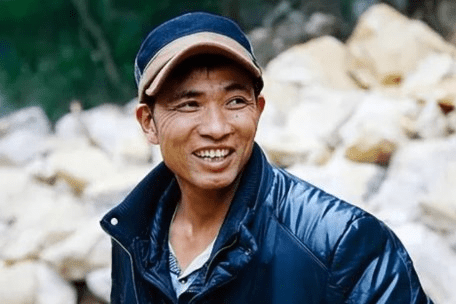
In 2014, in a remote village in Guangxi(广西)China, a 44-year-old man named Huang Yuanfeng was diagnosed with terminal liver cancer. Doctors told him the reality: without treatment, he might live only three months; with treatment, perhaps a few more years—but at the cost of his family’s entire savings of 170,000 yuan.

Most people would have chosen to fight for their own survival.

But Huang made a different decision.

Looking at the muddy, nearly impassable road in his village—a road that trapped children at home during rainy days and left crops to rot—he chose to spend all his savings not on treatment, but on building a road for everyone.

When the money ran short, he borrowed more from neighbors, making a solemn promise: “Even if I die, my son will repay you.”

Against all odds, the road was completed. It transformed the village, bringing in visitors, creating opportunities, and improving countless lives.

But what happened next was even more astonishing.

When Huang returned to the hospital for a check-up, his condition had not worsened—in fact, it had stabilized, even improved. What seemed like a certain end became an unexpected turning point.

His story carries a simple but powerful truth:

Kindness is never lost.
The good you do for others may one day return to protect you—especially in life’s most dangerous moments.

Link:https://peacelilysite.com/2026/03/16/two-stories-one-truth-how-kindness-can-save-you-when-it-matters-most/

From Fear to Love: Consciousness, Compassion, and Humanity’s Inner Awakening

In times when the world feels overwhelmed by conflict, division, and uncertainty, many people are searching for deeper answers about human consciousness and the true purpose of life. One thinker whose work has inspired millions to reflect on these questions is Gary Zukav, a writer and former physicist known for exploring the relationship between science, consciousness, and spiritual growth.

Zukav first gained recognition through his book The Dancing Wu Li Masters, which introduced complex ideas of modern physics to general readers. Later, his bestselling book The Seat of the Soul shifted the conversation toward a deeper exploration of human consciousness and spiritual evolution. In this work, Zukav proposes a powerful idea: humanity is undergoing a transformation from seeking external power to discovering authentic power—the power that arises from the soul.

His message can be summarized in three simple yet profound movements of the human spirit:

  • Humanity must move from fear to love
  • from control to compassion
  • from external power to inner wisdom

Although Zukav approached these ideas through the lens of psychology and consciousness, they resonate deeply with teachings that have existed for thousands of years within Buddhism.

In Buddhist teachings, the mind is the source of both suffering and liberation. According to Gautama Buddha, our thoughts, intentions, and actions shape our experience of the world. This principle is closely connected to the law of Karma, which teaches that every action—whether physical, verbal, or mental—creates corresponding results.

When people act from fear, anger, or greed, they plant seeds of suffering. When they act from compassion, generosity, and wisdom, they create causes for peace and happiness.

Seen in this light, Zukav’s idea of moving from external power to authentic power reflects a timeless Buddhist insight: true strength does not arise from domination or control, but from the transformation of the mind.

In the modern world, success is often measured by status, wealth, or influence. Yet Buddhism reminds us that these forms of external power are temporary and unstable.

The Buddha taught that genuine freedom comes from cultivating inner qualities such as:

  • compassion
  • mindfulness
  • wisdom
  • loving-kindness

When these qualities grow within us, our consciousness naturally changes. Instead of reacting with fear or anger, we begin to respond with understanding and care. This is the beginning of authentic power—the same inner power Zukav describes.

Zukav believes humanity is evolving toward a new level of awareness, where people become more conscious of their intentions and the effects of their actions. This idea echoes the Buddhist path of awakening, where individuals gradually develop greater awareness of their thoughts and emotions.

Each moment offers a choice: to act from fear or from love, from control or from compassion.

If enough people choose compassion, the collective consciousness of humanity can also change. In this sense, spiritual transformation is not only personal—it is also global.

A Gentle Reminder for Our Time

In a world often shaken by conflict and division, Zukav’s words serve as a gentle reminder that true change begins within the human heart.

Humanity must move
from fear to love,
from control to compassion,
from external power to inner wisdom.

These movements are not only philosophical ideals; they are practical steps toward creating a more peaceful world. When we cultivate compassion and awareness in our own lives, we are already contributing to the transformation of human consciousness.

As the Buddha taught, peace in the world begins with peace in the mind. And when one heart awakens to compassion, it quietly lights the path for many others.

Link:https://peacelilysite.com/2026/03/12/from-fear-to-love-consciousness-compassion-and-humanitys-inner-awakening/

Appreciation of the Western Painting of H.H. Dorje Chang Buddha III — “The Rhythm of Water Bubbles”

A supernatural abstract color work

Through his brushwork, H.H. Dorje Chang Buddha III renders the subtle life cycle of a water bubble—its emergence, transformation, and eventual dissolution—with remarkable vitality. Though the medium is static, the painting evokes a striking sense of movement and immediacy. One almost senses the gentle drifting of bubbles across the surface, and even imagines the delicate sound that might accompany the instant when a bubble touches the ground and quietly disappears.

Beyond its visual beauty, the work carries a deeper contemplative resonance. In the fleeting rhythm of the bubbles, one cannot help but see a metaphor for the human condition. The trajectory of a bubble—from its brief formation to its silent vanishing—mirrors the arc of human life: birth, growth, aging, and departure. Life itself unfolds within the span of a breath, fragile and transient, reminding us of the importance of awareness and presence in each passing moment.

From an artistic perspective, the painting also demonstrates a remarkable command of impressionistic expression. The composition operates not only as a unified whole but also as a constellation of smaller visual worlds. Any isolated fragment of the canvas could stand independently as an exquisite impressionist study, rich in color, light, and atmosphere. This structural richness gives the work a dreamlike, almost illusory quality—where forms appear to emerge and dissolve within layers of color and movement.

In this way, the painting invites the viewer to linger, not merely to observe, but to reflect. It transforms a simple natural phenomenon into a meditation on impermanence, perception, and the delicate beauty of existence.

Click here to Wikitia page on H.H. Dorje Chang Buddha III that list major accomplishments and teachings with links.

Link: https://peacelilysite.com/2026/03/04/appreciation-of-the-western-painting-of-h-h-dorje-chang-buddha-iii-the-rhythm-of-water-bubbles/

When the Miraculous Manifests: A Testament to Supreme Realization

The president of the International Zhengfa Buddhist Institute, Layman Zheng Zhenhuang, a Taiwanese who served for many years as the head of Huiju Publishing House, and who also worked as an on-site interpreter for Tenzin Gyatso (the Dalai Lama), is a deeply devoted Buddhist practitioner. He has accumulated profound merit through his sincere dedication to Buddhist affairs and is known as a filial son.

In order to help his father quickly attain rebirth in a Buddha-land, he, together with Dharma Master Guangxin and others, journeyed across rugged mountains and snowy grasslands to seek an audience with the Great Dharma King Yangwo Yeshe Norbu (H.H. Dorje Chang Buddha III), the supreme Vajrayana upholder.

Before the Great Dharma King (H.H. Dorje Chang Buddha III) knelt three Rinpoches, twelve Dharma masters, over twenty virtuous lay practitioners including Zheng Zhenhuang, as well as dakinis, Dharma protectors, and various visible and invisible beings. At that time, the Great Dharma King announced:

“Now that you have come, nothing is more important than liberating the deceased. The deliverance of Zhenhuang’s father will be presided over by Vajravārāhī A Wang Norbu Pamu. Though she is thousands of miles away, she will use the miraculous powers of Buddhadharma to draw your father’s conscious spirit into her mandala. Within three days, he will be sent to the Western Pure Land of Ultimate Bliss, attaining rebirth at the middle grade of the middle level. Later, when you watch the video and look at the sky, you will know.”

After speaking, the Great Dharma King took out a videotape of Pamu’s Dharma image and said:

“First, you must understand how great Pamu is. Watch this tape.”

Layman Zhenhuang personally rewound the tape and operated the machine himself. As everyone watched, they repeatedly exclaimed that the merit was immeasurable and inconceivable. The true form of Vajravārāhī manifested—how could it possibly resemble an ordinary worldly appearance? It was incomparably majestic and solemn.

An alliance of eighty-three universities in the United States and around the world had jointly conferred upon Pamu the world’s first and only Triple-Body Doctorate along with the highest Golden Crown and Royal Robe. Seated upon the Dharma throne, Pamu received the certificate, the doctoral royal robe, and a diamond-studded golden crown valued at over twenty million U.S. dollars. These were presented after the American conferral chairman, the British vice chairman, and great living Buddhas performed formal prostrations.

Wearing the diamond crown, Pamu gave a teaching:

“Although you have done much, I will not say thank you. For me, this is merely a skillful means in carrying out Dharma activities. In truth, all conditioned phenomena are illusory and unreal, just like your bodies. Though they appear to exist, they are falsely existent—unreal.”

At that very moment, the diamond crown atop Pamu’s head suddenly vanished—in less than a hundredth of a second, it disappeared without a trace. When she then said she would bestow blessings upon everyone, the diamond crown instantly reappeared on her head. The chairmen and the great Rinpoches witnessed this transformation of impermanence in a single instant. Hearing her profound exposition of ultimate truth, their discursive thoughts were stilled, wisdom opened suddenly, and all generated the Mahayana bodhicitta.

After the viewing, Layman Zhenhuang removed Pamu’s Dharma-image tape from the camera, wrapped it in a khata (ceremonial scarf), and hung it around his neck for blessing.

At that moment, the Great Dharma King (H.H. Dorje Chang Buddha III) instructed him to immediately write out his father’s birth data. Then Layman Zhenhuang took from his pocket a brand-new, unused videotape and recorded the birth information along with the scene of the Rinpoches, Dharma masters, monks, nuns, and lay disciples present. After filming, he removed that newly recorded tape and placed it securely in his jacket pocket.

The Great Dharma King (H.H. Dorje Chang Buddha III) then pointed to the Pamu tape hanging around Zhenhuang’s neck and said:

“Pamu possesses unsurpassed merit. She is the great and compassionate Holy Mother. Now, through the great miraculous powers of Buddhadharma, Pamu has gathered all the images you just recorded into the Dharma tape hanging around your neck.”

Though everyone held the Great Dharma King (H.H. Dorje Chang Buddha III) in the highest respect, several people harbored serious doubts. They had just watched Pamu’s tape from beginning to end and had seen none of the present assembly in it. Moreover, after playing it, Zheng had hung it around his neck without removing it even for a second. The newly recorded tape had been kept separately in his pocket—how could its images possibly enter the tape around his neck?

The Great Dharma King then said:

“Watch Pamu’s tape again.”

Zheng removed the tape from his neck, rewound it the same way, and played it a second time. Instantly, everyone exclaimed in unison, “Wow!” They were stunned and deeply moved. The entire scene that had just been recorded—and was still in Zheng’s pocket—now appeared clearly and identically on Pamu’s tape. They played it a third time; it remained perfectly clear and unchanged.

Most crucially, after the first viewing, Pamu’s tape had not come into contact with any machine. Everyone had seen Zheng hang it around his neck immediately, without it leaving him for even a second. How could completely unrelated footage have entered that tape? The true Buddhadharma is profoundly great and wondrous—whether radio waves, cables, computers, or anything in the universe, all realms can transform in accordance with the mind.

After watching again, the tape remained in the machine. The Great Dharma King (H.H. Dorje Chang Buddha III) then said:

“Now I request Pamu to gather your father and everyone’s images into her Dorje mandala for blessing.”

With just that sentence, they played the tape a fourth time. The clear scenes of the assembly had vanished without a trace, leaving only Pamu’s original footage. At that moment, Rinpoche Bodi Wentu shouted:

“Everyone, look! There is Buddha-light in the sky!”

All present saw multicolored Buddha-light flashing across the boundless heavens, radiating warm streams of blessing upon the assembly. They were filled only with awe and praise. Pamu had indeed gathered them for blessing—only their images had been removed; Pamu’s own image remained as before.

The Great Dharma King (H.H. Dorje Chang Buddha III) then said:

“I will convey a few words from Pamu to you. These are also my words: When miraculous powers manifest, once the event has passed, let it pass. Do not cling to it. It should be understood as illusion, encompassed by emptiness. Therefore, one should give rise to the mind without abiding anywhere. If you have the opportunity, study my ‘The Supreme and Unsurpassable Mahamudra of Liberation,’ and everything will become clear.”

After speaking, the Great Dharma King (H.H. Dorje Chang Buddha III) closed his eyes and remained unmoving.

You may reflect on this: in today’s world, who possesses such realization and spiritual attainment? You may ask Layman Zheng. He has encountered many great Rinpoches and Dharma masters, and especially has had deep karmic connections translating Dharma for the Dalai Lama. If any other Dharma King possessed such realization, he would surely have sought the Dalai Lama’s assistance. He would not have crossed mountains and grasslands to seek this Great Dharma King to liberate his father.

More importantly, this Great Dharma King (H.H. Dorje Chang Buddha III) is untouched by worldly fame and profit. His Dharma virtue rises to lofty peaks, transcending past and present. He is supremely proficient in both the Exoteric and Esoteric teachings and the Tripiṭaka, and is a great upholder of Buddhadharma in today’s world. Thus, his correction of the treatises attributed to Bodhidharma is an invaluable treasure, worthy of the utmost reverence and study. You should also read The Essence of Buddhadharma, recorded by Venerable Guangxin. Only after reading and realizing will you truly understand. To say more would be of little use—let it end here.

(This post is translated and excerpted from the preface to On Correcting the Treatises of Patriarch Bodhidharma, written by Lama Dorje Losang for your reference only. For the original Chinese version, please click here.)

Click here to Wikitia page on H.H. Dorje Chang Buddha III that list major accomplishments and teachings with links.

Link:https://peacelilysite.com/2026/02/26/when-the-miraculous-manifests-a-testament-to-supreme-realization/
Walking for Peace: A Call for Moral Leadership Today

In a world shadowed by war, polarization, and a visible crisis of character among national leaders, many people feel a quiet but persistent sense of moral drifting. We watch the headlines, we hear the rhetoric, and we wonder: Where is the steady compass that points us toward what is right?

At this crossroads, political strategies alone are not enough. What we urgently need is moral leadership.

History reminds us what that looks like. Martin Luther King Jr. transformed American society not by deepening divisions, but by calling a fractured nation back to its highest values. His authority did not come from force, wealth, or position. It came from moral clarity. He appealed to conscience. He awakened compassion. He united people under the banner of shared human dignity.

Today, facing new global conflicts and cultural tensions, we must ask again: Where will the next wave of moral authority arise?

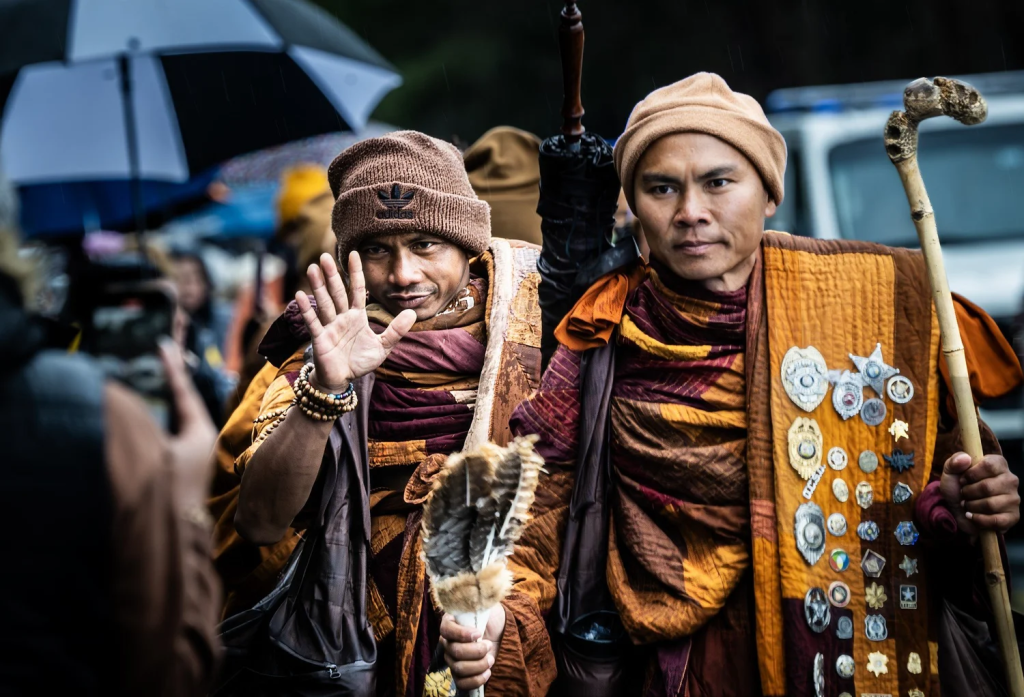
Buddhist monks walking in silence, carrying a powerful message of peace and mindfulness. (Handout photo)

Recently, about twenty monks completed a 108-day walking journey for peace. Their pilgrimage was not a political campaign. It was not a media spectacle. It was a living embodiment of mindfulness and compassion in action. Step by step, through towns and cities, they carried a quiet message: peace is not merely an agreement signed on paper—it is a way of walking through the world.

In a society saturated with noise, outrage, and endless commentary, their disciplined silence spoke volumes. Their presence offered a visual reminder that true leadership begins with inner cultivation. When we lead with anger, we multiply conflict. When we lead with compassion, we create space for healing.

This is where Buddhist wisdom offers a profound contribution. Rooted in great compassion, loving-kindness, and deep self-reflection, the Buddhist path teaches that personal transformation and public responsibility are inseparable. A leader who has not mastered their own mind cannot bring harmony to others.

Across North America, millions now identify with Buddhist teachings, making it one of the most influential spiritual communities in the region. This growing presence brings an essential perspective to our troubled era—one that emphasizes empathy for all who suffer and reverence for every form of life.

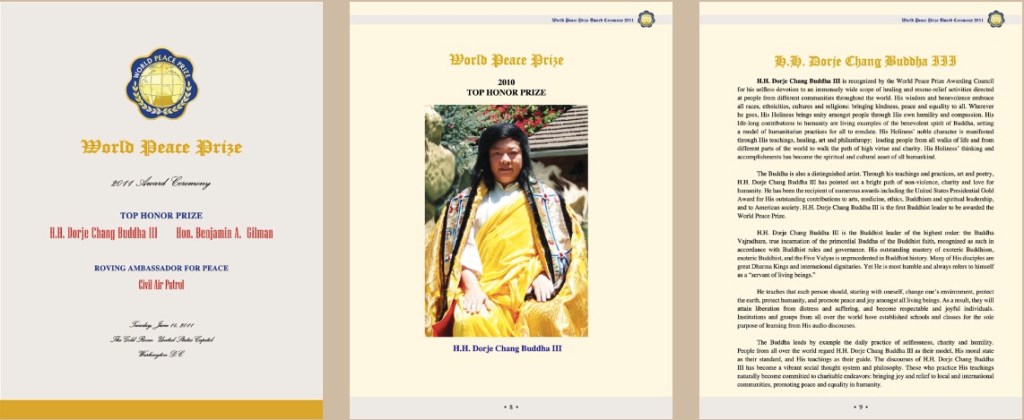
Within this tradition, many look to Dorje Chang Buddha III as an example of moral leadership. Having lived in the United States for more than two decades, he has been recognized internationally for humanitarian and charitable work. His honors include the World Peace Prize, the Presidential Gold Medal, the Dr. Martin Luther King Jr. Legacy Award, and even a resolution passed in the United States Senate in recognition of his contributions.

Yet perhaps more powerful than any award is his response to recognition. In an age driven by ego and self-promotion, he has expressed a vow of radical humility:

“I will bear all of the karmic offenses committed by living beings, and I will give everyone all of the good karma and merit that I plant.”

Whether one interprets this statement spiritually or symbolically, its moral essence is clear: a true leader does not seek to accumulate praise or advantage. A true leader seeks to shoulder responsibility and give benefit.

This is the kind of leadership our world desperately needs.

Moral leadership is not confined to one religion, culture, or tradition. It can be expressed through Judeo-Christian ethics, Buddhist compassion, or any path that places the common good above personal ambition. What matters is the heart behind the action.

If we are to navigate the challenges of our era, the answer will not come solely from policy, power, or popularity. It will come from conscience.

And perhaps the real invitation is not only to seek moral leaders—but to become them, each in our own sphere of influence.

Link:https://peacelilysite.com/2026/02/19/walking-for-peace-a-call-for-moral-leadership-today/

Finding Your North Star: A Guide to the Five Mindfulness Trainings

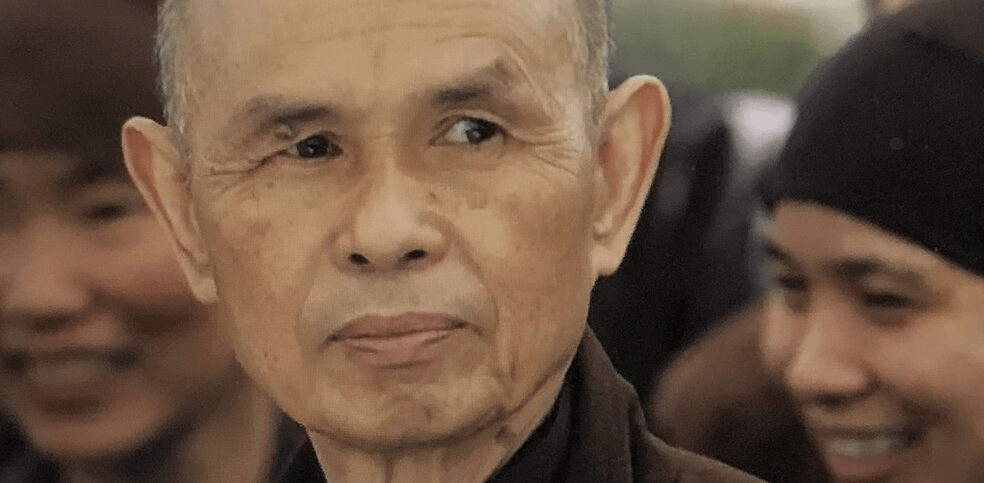
In a world that often feels fragmented and fast-paced, many of us are searching for a compass—a way to live that feels both grounded and deeply ethical. Thich Nhat Hanh, the beloved Zen Master and founder of the Plum Village tradition, offered exactly that through the Five Mindfulness Trainings.

These aren’t rigid “commandments” or a list of “don’ts.” Instead, they are a modern, proactive framework for cultivating peace, protecting life, and nurturing happiness within ourselves and the world.

At their core, the trainings are a reinterpretation of traditional Buddhist precepts, designed for our modern, interconnected lives.

  1. Reverence for Life This training is an invitation to cultivate compassion. It’s about more than just avoiding harm; it’s about actively protecting life and practicing nonviolence toward ourselves, our neighbors, and the natural world.
  2. True Happiness We often chase wealth or fame, thinking they are the keys to joy. This training reminds us that true happiness is found in generosity and the ability to be content in the present moment. It encourages us to live simply and avoid exploiting others.
  3. True Love In our relationships, integrity is everything. This training emphasizes responsibility and ensures that our most intimate connections are grounded in deep love, commitment, and respect for the harmony of families.
  4. Loving Speech and Deep Listening Communication is a powerful tool for healing. By practicing deep listening without judgment and using speech that inspires hope and reconciliation, we can move mountains of misunderstanding and alleviate the suffering of those around us.
  5. Nourishment and Healing What we “consume” isn’t just food. It’s the media we watch, the conversations we have, and the substances we use. This training focuses on mindful consumption to protect our mental and physical well-being from toxins and despair.

The beauty of the Five Mindfulness Trainings lies in how they address the complexities of the 21st century.

  • Interbeing: They are rooted in the understanding that we are not separate entities. What happens to the Earth happens to us. When we heal ourselves, we heal the world.
  • Universal Ethics: While born from Buddhist wisdom, these trainings are non-sectarian. They are accessible to anyone, regardless of their religious or spiritual background.
  • Transformation over Rules: This is an ongoing practice. The goal isn’t “perfection” but a continuous, mindful process of shifting our focus from self-interest to collective well-being.
  • Sangha (Community) Support: We don’t have to do this alone. These trainings are often practiced within a Sangha, a community of friends who support each other in staying mindful and compassionate.

The Five Mindfulness Trainings are a gift—a map that leads us back to our best selves. By embracing these guidelines, we contribute to a collective awakening, one mindful breath and one compassionate action at a time.

“The Five Mindfulness Trainings are the most concrete way to practice mindfulness. They show us how to live our lives in a way that brings peace and happiness to ourselves and to others.” — Thich Nhat Hanh

Link:https://peacelilysite.com/2026/02/16/finding-your-north-star-a-guide-to-the-five-mindfulness-trainings/

Serving Day and Night: A Close Disciple’s Account of H.H. Dorje Chang Buddha III

In a recent episode of “Expounding the Absolute True Through the Heart Sutra,” a longtime disciple, Layman Qi, shared his personal experiences of serving and accompanying H.H.Dorje Chang Buddha III for more than twenty years. What he described was not merely a teacher’s routine—it was a life of tireless, wholehearted service to all living beings.

Layman Qi has followed H.H.Dorje Chang Buddha III for over two decades, often driving for Him and staying close to Him in daily life. Through these years, he witnessed something that left a deep impression on his heart:

“In all these twenty-plus years,” he said, “I have never truly seen the Buddha rest. I do not even know when He rests.”

From early dawn, instructions are already being given. Throughout the day, the Buddha meets disciples, expounds the Dharma, grants empowerments, and resolves spiritual questions. Frequently, these activities continue until one, two, or even three o’clock in the morning.

Some may assume that after leaving the temple, He returns home to rest. According to Layman Qi, this is not so. Even when returning late—sometimes at three or four in the morning—His Holiness still carefully instructs disciples to ensure that even the dogs have been fed, water prepared, and that animals, including wildlife, are properly cared for.

Layman Qi describes H.H. Dorje Chang Buddha III as the most hardworking person he has ever encountered. Not only does the Buddha care for disciples, but He also performs Dharma services, dedications of merit, and liberative practices for countless sentient beings—including beings of the Six Realms whom ordinary eyes cannot see.

Meals are simple and often delayed. Breakfast is typically just a small bowl of porridge with a bit of pickled vegetables. Many days, even by seven or eight in the evening, lunch has still not been taken.

Disciples sometimes travel thousands of miles to seek an audience. Layman Qi understands their sincerity. Yet he gently reminds fellow practitioners: if one truly seeks the Buddha, the purpose should be to learn how to cultivate, how to transcend birth and death, and how to receive authentic Dharma teachings—not to occupy time with mundane disputes or worldly concerns.

Layman Qi reflects deeply on this point. In worldly life, one may seek employment for financial gain. But a Buddhist disciple seeking the Buddha should seek liberation, wisdom, and genuine cultivation.

Worldly difficulties—business setbacks, family discord—arise from karma. As the Buddha teaches, even a cool breeze in summer or the loss of a single hair operates within cause and effect. Understanding this principle, disciples should focus on transforming their karma through practice, rather than burdening the Buddha with worldly entanglements.

When countless disciples seek meetings daily, even a few minutes of casual worldly conversation multiplied many times over would prevent the Buddha from guiding those sincerely seeking liberation. For Layman Qi, this understanding has become an essential lesson in cultivation itself.

Perhaps the most moving detail is what happens after disciples finally rest for the night.

Layman Qi explains that stacks of requests—for blessings, dedications, and liberation rites—are presented to the Buddha. While others sleep, His Holiness continues performing practices and dedicating merit for sentient beings.

“To us,” Layman Qi reflects, “rest means sleep. But for the Buddha, there seems to be no such thing as rest. Twenty-four hours a day, His life is for living beings.”

What Layman Qi shares is only a glimpse. He openly admits that what he has seen is just a small portion of the Buddha’s boundless effort and compassion. Yet even this small portion, he says, is already beyond what ordinary people could endure.

In his words, the Buddha “never considers Himself.” Every action is directed toward benefiting living beings. This, he believes, is not only an expression of supreme compassion but also a profound lesson for all practitioners.

To serve without seeking return.
To give without calculating personal gain.
To work tirelessly for the liberation of others.

This is the example he has witnessed for over twenty years.

This post is translated and edited from Interview with a Buddhist Disciple (62): AM1300 Chinese Radio Station – Exclusive Interview with U.S. Layman Qi Pengzhi 《佛弟子訪談(六十二):AM1300中文廣播電臺-專訪美國 戚朋直居士》 by Linda Chang. For original records, please click here.

Click here to Wikitia page on H.H. Dorje Chang Buddha III that list major accomplishments and teachings with links.

Link:https://peacelilysite.com/2026/02/13/serving-day-and-night-a-close-disciples-account-of-h-h-dorje-chang-buddha-iii/

Call Me by My True Names

In times of uncertainty and turmoil, the voice of compassion becomes more precious than ever. Thich Nhat Hanh was a world-renowned Vietnamese Zen Buddhist monk, teacher, poet, author, and peace activist whose life embodied mindfulness and nonviolence. His profound influence reached far beyond the Buddhist community; he was nominated for the Nobel Peace Prize by Martin Luther King Jr., who recognized in him “an apostle of peace and nonviolence.”

Today, as the world feels divided and restless, his poem “Call Me by My True Names” invites us to look deeply into our shared humanity. It challenges us to see beyond separation—beyond “us” and “them”—and to recognize that within each of us lives both suffering and compassion. Reading his words now feels like a gentle but powerful reminder: true peace begins when we awaken to our interconnectedness.

Call Me by My True Names

Do not say that I’ll depart tomorrow
because even today I still arrive.

Look deeply: I arrive in every second
to be a bud on a spring branch,
to be a tiny bird, with wings still fragile,
learning to sing in my new nest,
to be a caterpillar in the heart of a flower,
to be a jewel hiding itself in a stone.

I still arrive, in order to laugh and to cry,
in order to fear and to hope.
The rhythm of my heart is the birth and
death of all that are alive.

I am the mayfly metamorphosing on the surface of the river,
and I am the bird which, when spring comes, arrives in time
to eat the mayfly.

I am the frog swimming happily in the clear pond,
and I am also the grass-snake who, approaching in silence,
feeds itself on the frog.

I am the child in Uganda, all skin and bones,
my legs as thin as bamboo sticks,
and I am the arms merchant, selling deadly weapons to Uganda.

I am the twelve-year-old girl, refugee on a small boat,
who throws herself into the ocean after being raped by a sea pirate,
and I am the pirate, my heart not yet capable of seeing and loving.

I am a member of the politburo, with plenty of power in my hands,
and I am the man who has to pay his “debt of blood” to, my people,
dying slowly in a forced labor camp.

My joy is like spring, so warm it makes flowers bloom in all walks of life.
My pain is like a river of tears, so full it fills the four oceans.

Please call me by my true names,
so I can hear all my cries and laughs at once,
so I can see that my joy and pain are one.

Please call me by my true names,
so I can wake up,
and so the door of my heart can be left open,
the door of compassion.

Each time I read “Call Me by My True Names” by Thich Nhat Hanh, I feel both unsettled and awakened.

The poem asks us to see what we often refuse to see—that we are not separate from the suffering of the world. We are not only the compassionate helper, but also, in some deep and interconnected way, the frightened child, the victim, and even the one who causes harm. This is not an easy truth to hold. Yet it is a profoundly liberating one.

The poem gently dissolves the illusion of “us” and “them.” It invites us to return to our true humanity—tender, vulnerable, and deeply connected.

And perhaps, in remembering this, we take one small but meaningful step toward peace.

Link:https://peacelilysite.com/2026/02/12/call-me-by-my-true-names/

Pilgrimage to Bhutan (Part 3): Audience with the Je Khenpo and the Ascent to Tiger’s Nest

By Gongjue Tuji

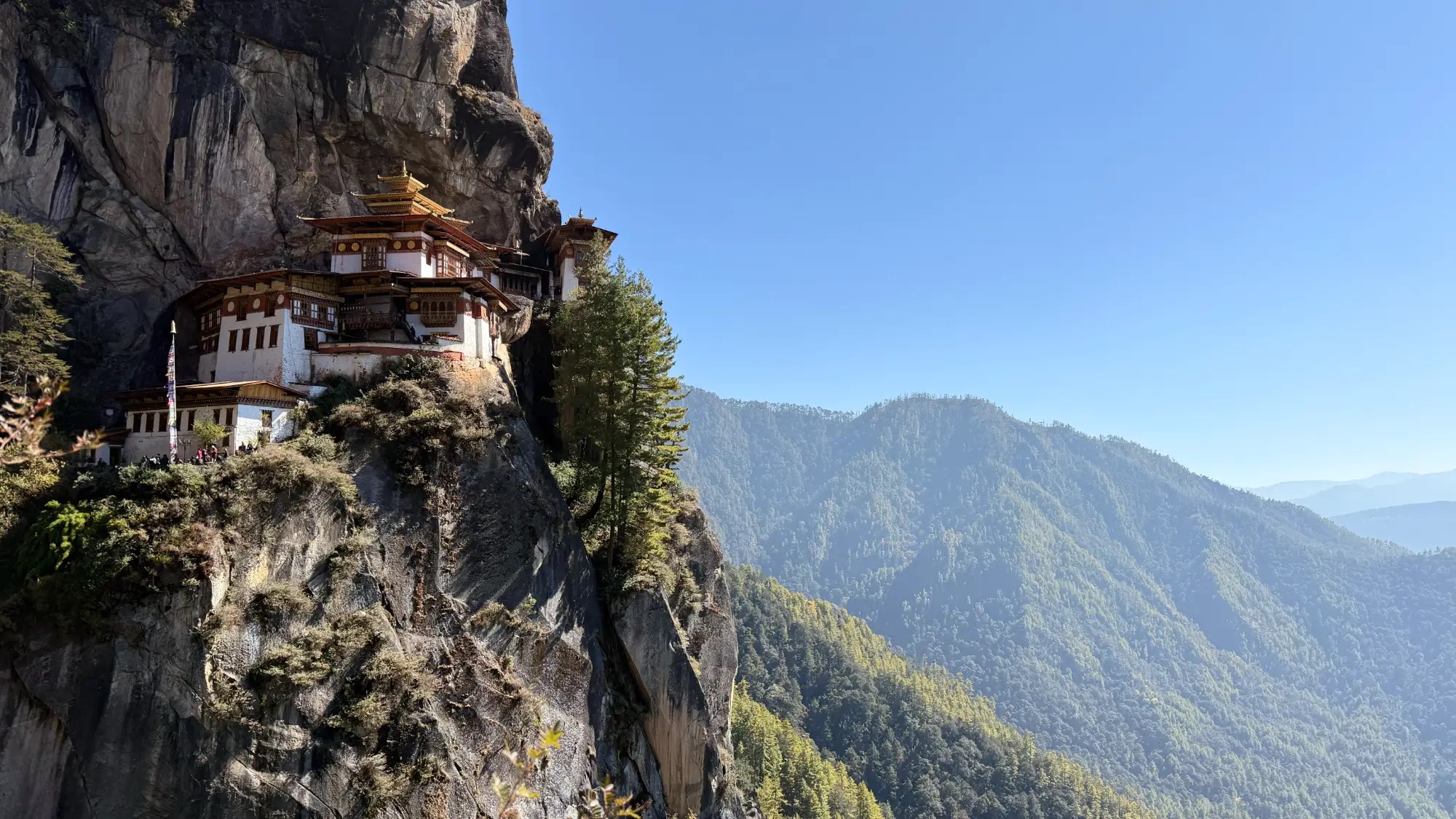
View of Taktsang Monastery on the cliff face, taken from the cafeteria viewpoint halfway up the trail.
The goal of the ascent in sight: Taktsang Monastery is perched high on the steep cliff face

On a pilgrimage to holy places, one rarely follows a rigid plan. Rather, one engages with a flow of events. Our last days in Bhutan reminded us how valuable it is to let go of expectations. We learned that special doors often open exactly when one is ready to leave the original path.

Change of Plans in Punakha: Trusting the Flow of Things

The sixth day showed us this very clearly. Actually, we had a fixed plan: We wanted to drive from Punakha back to Paro. There, we had donated 3,000 butter lamps which we wanted to light ceremonially in a temple.

But then we received news on short notice that an audience with His Holiness the Je Khenpo, the highest religious head of the country, would be possible. Such an opportunity is a great blessing. However, there was a restriction: Our entire travel group was simply too large for this spontaneous audience.

So we had to split up in Punakha. One part of the group drove directly on to Paro, while the other part drove to Thimphu, where His Holiness the Je Khenpo was staying at the time. I traveled with this group.

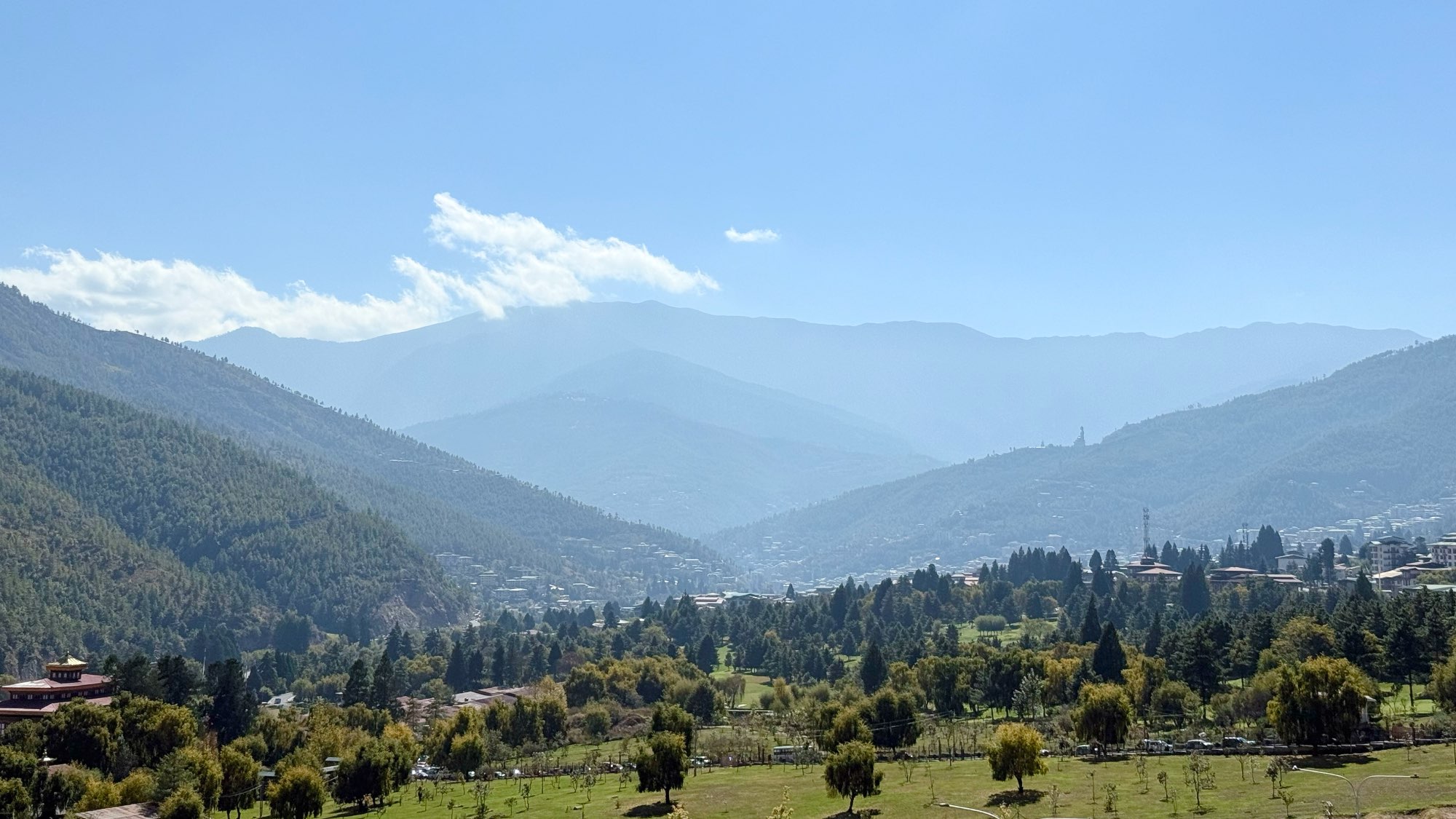
Scenic panoramic view over the green Thimphu Valley, with the distinctive Buddha Dordenma statue visible in the distance atop the mountain.
View of Thimphu with the Buddha Dordenma statue in the background

Thangton Dewachen Nunnery: Legacy of the Iron Bridge Monk

Arriving in Thimphu, we still had some time before the appointment. We visited the Thangton Dewachen Duthop Nunnery. It is the only one of its kind in the capital and goes back to the legendary Thangtong Gyalpo. He was a fascinating personality: A great Mahasiddha and at the same time an ingenious engineer who lived in the 15th century. He is famous as the “Iron Bridge Monk,” as he built dozens of suspension bridges made of iron chains throughout the Himalayas to allow pilgrims and travelers to cross raging rivers. Many of his constructions withstood the centuries. We were welcomed very warmly at this place: We were served tea in the courtyard of the monastery, and we could enjoy the peaceful atmosphere for a moment before we had to leave.

Gongjue Tuji in traditional robes standing in the sunny courtyard of the Thangton Dewachen nunnery next to a tall Dharma pillar, while a dog sleeps peacefully in front.
Visiting the Thangton Dewachen Duthop Nunnery

Kalachakra Initiation: Encounter with H.H. the Je Khenpo

After lunch, we made our way to the stadium. There, H.H. the Je Khenpo was leading the conclusion of the Kalachakra initiation. The crowds were immense. The stadium itself was packed to capacity, but that was far from enough. Countless people had also gathered on the grounds outside to partake in the event. It was a very impressive image. The ceremony was also being broadcast live on Bhutanese television. We initially had to wait before the gates until we were allowed into the stadium.

After some time, we were able to enter and were led to a separate waiting area inside the stadium. During this time, a chance but wonderful encounter occurred. We met the young Vairochana Rinpoche (Ngawang Jigme Jigten Wangchuk). He is a highly revered Tulku and the son of Her Royal Highness Princess Sonam Dechan Wangchuk. He is revered as the reincarnation of the great translator Vairochana from the 8th century, one of the most important disciples of Guru Padmasambhava.

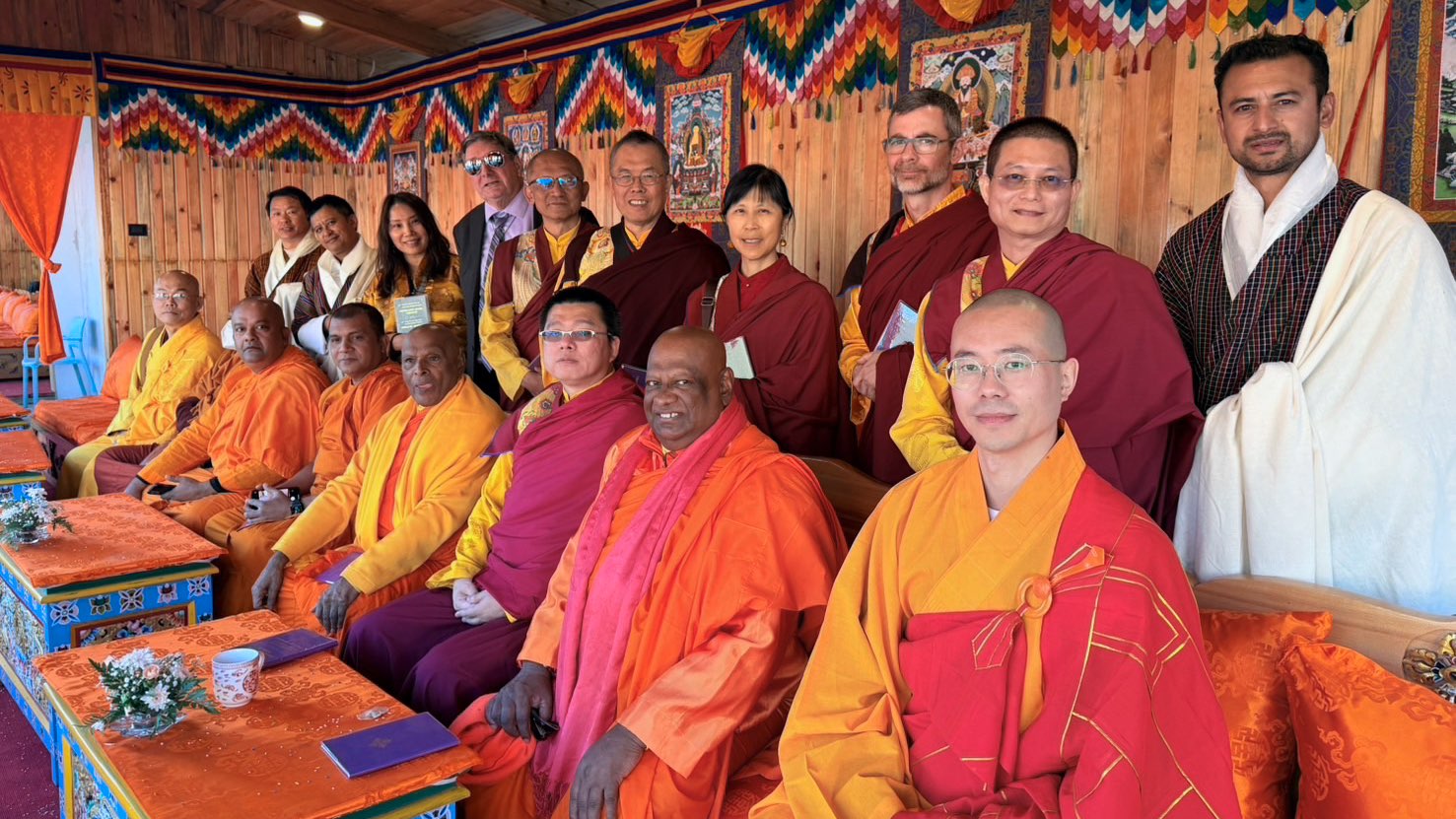
Following this, we were granted an audience with H.H. the Je Khenpo. Filled with gratitude, we presented him with a Khata (white scarf) as a token of our deep respect. In this special setting, we also had the opportunity to present His Holiness with information regarding the ‘Holy Heavenly Lake Buddhist Town’ project. Each of us then received a personal blessing, and upon our departure, he presented us with a text of the Amitabha Sadhana for our own practice.

Group photo of the Buddhist travel group after the special audience with H.H. the Je Khenpo at the Thimphu stadium following the Kalachakra initiation.
Our group after the audience with H.H. the Je Khenpo

After the meeting with the Je Khenpo, a further great honor was completely unexpectedly offered to us: Actually, we were supposed to meet the young Vairochana Rinpoche and the Queen Mother for an official audience afterwards. But when the Kalachakra initiation ended, thousands of people streamed out of the stadium at the same time. Traffic in Thimphu came to a complete standstill. There was no getting through, and we could not reach the agreed location in time. Such are the karmic conditions sometimes. But we did not quarrel with fate: After everything we had experienced that day and the blessing we were allowed to receive, we felt richly gifted.

The Tiger’s Nest: Ascent to Guru Rinpoche’s Cave

On the last day of our trip, November 15th, the arguably most famous landmark of Bhutan was on the agenda: Paro Taktsang, widely known as the Tiger’s Nest. It is not only architecturally deeply impressive, but one of the holiest sites in the entire Himalayas.

The famous Tiger's Nest Monastery (Paro Taktsang), clinging spectacularly to a sheer cliff face in the Paro Valley of Bhutan, set against a blue mountain backdrop.
Paro Taktsang Monastery (Tiger’s Nest)

We set off very early to reach the base camp, the parking lot at 2,300 meters. From there, it is about 800 vertical meters up to the monastery, which sits at 3,120 meters. For visitors who do not quite trust themselves with the steep climb, there is generally the option to be carried by a horse or mule for the first part of the route. Our group, however, decided to cover the entire path on foot under our own power.

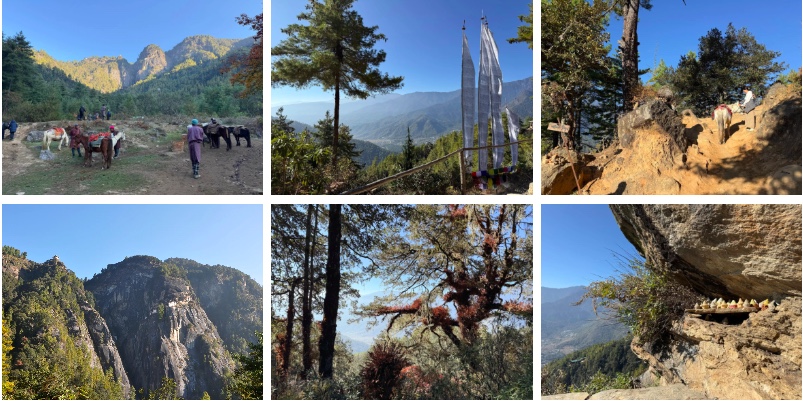
The ascent took just under three hours. The path is beautiful, but also demanding. It leads through a dense pine forest where rhododendrons grow and the trees are draped with moss. Again and again, prayer flags flutter in the wind. Halfway up, we took a short rest at a café. From there, you already have a first, breathtaking view of the monastery, which literally clings to the steep rock.

Impressions (in order): Resting horses at the starting point, fluttering prayer flags against the mountain backdrop, pack animals on the dusty trail, the first distant view of the cliffside monastery, the moss-covered mountain forest, and Tsa-Tsa offerings in a rock niche.

The history of this place is closely connected to Guru Rinpoche, the great Master Padmasambhava. He is revered by the Bhutanese as the “Second Buddha,” as he brought and firmly established Tantric Buddhism, the Vajrayana, in Bhutan in the 8th century. He manifested his supernatural powers and flew to this very spot on the back of a tigress to subdue a demon. Some say that the tigress was his tantric consort Yeshe Tsogyal in a transformed state. In the cave known as Taktsang Senge Samdup, around which the monastery was later built, he then meditated for exactly three years, three months, three weeks, and three days.

Once at the top, we had to hand in our cameras and bags at the entrance, as photography inside is strictly forbidden. We visited several small temples within the complex. In a special room that is guarded around the clock, I lit a butter lamp. This is the only place in the monastery where open fire is still permitted after a devastating fire destroyed large parts of the complex in the past. In Buddhism, lighting these lamps is a meritorious central ritual.

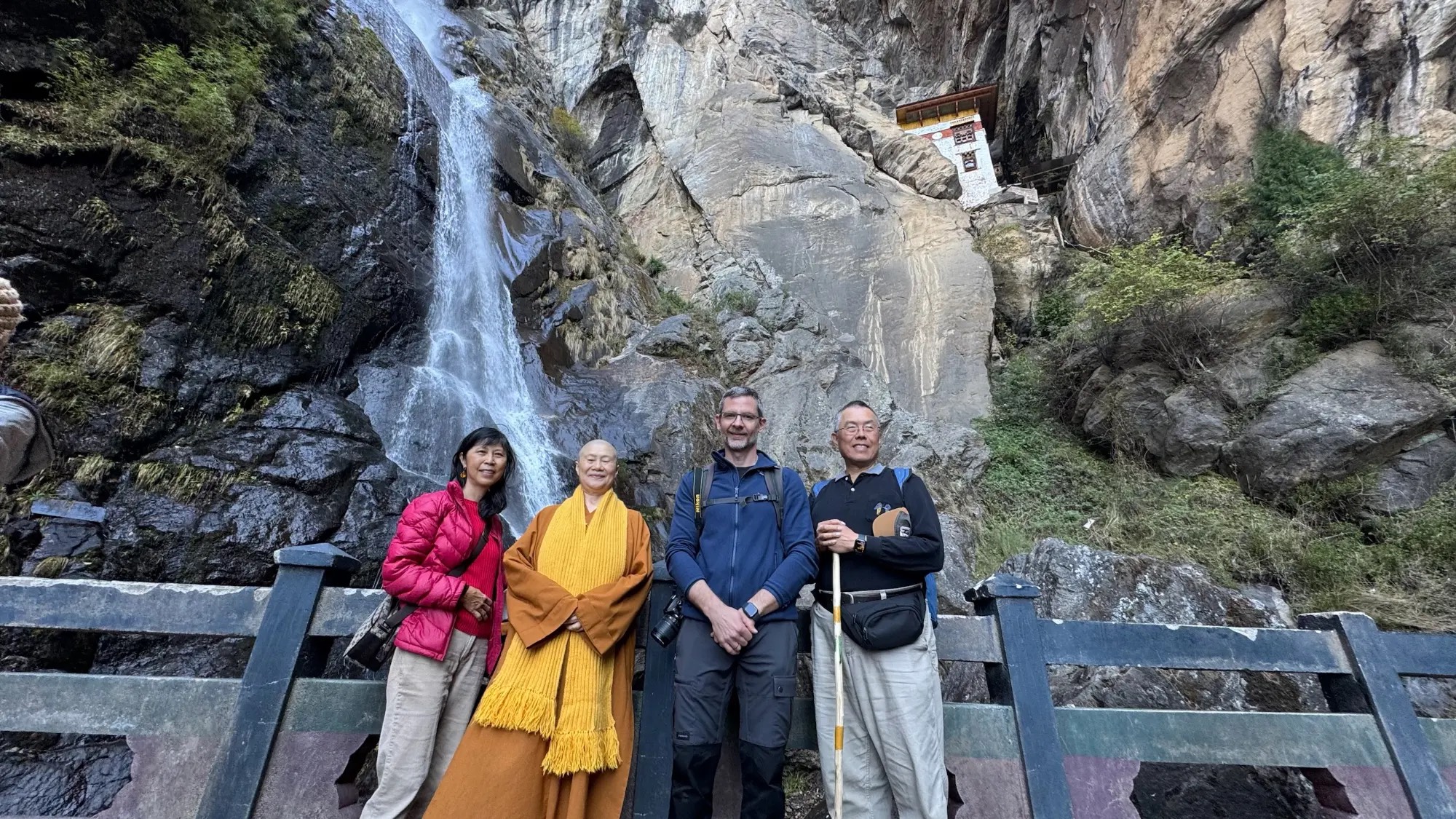
Gongjue Tuji and Venerable Master Shi Zheng Da standing with Dharma siblings in front of the sacred waterfall near the entrance to Paro Taktsang (Tiger's Nest).
With Venerable Master Shi Zheng Da in front of the Taktsang Waterfall

Farewell in Paro: A Promise to Return

Back at the hotel in Paro, a special guest awaited us in the evening: Dasho Passang Dorji, the former Speaker of the National Assembly of Bhutan. He had been instrumental in organizing the official appointments and came by personally to apologize politely that the meeting with the King had not taken place due to the commotion. He promised us: “Next time I will arrange, this time the King and the Queen have been too busy.”

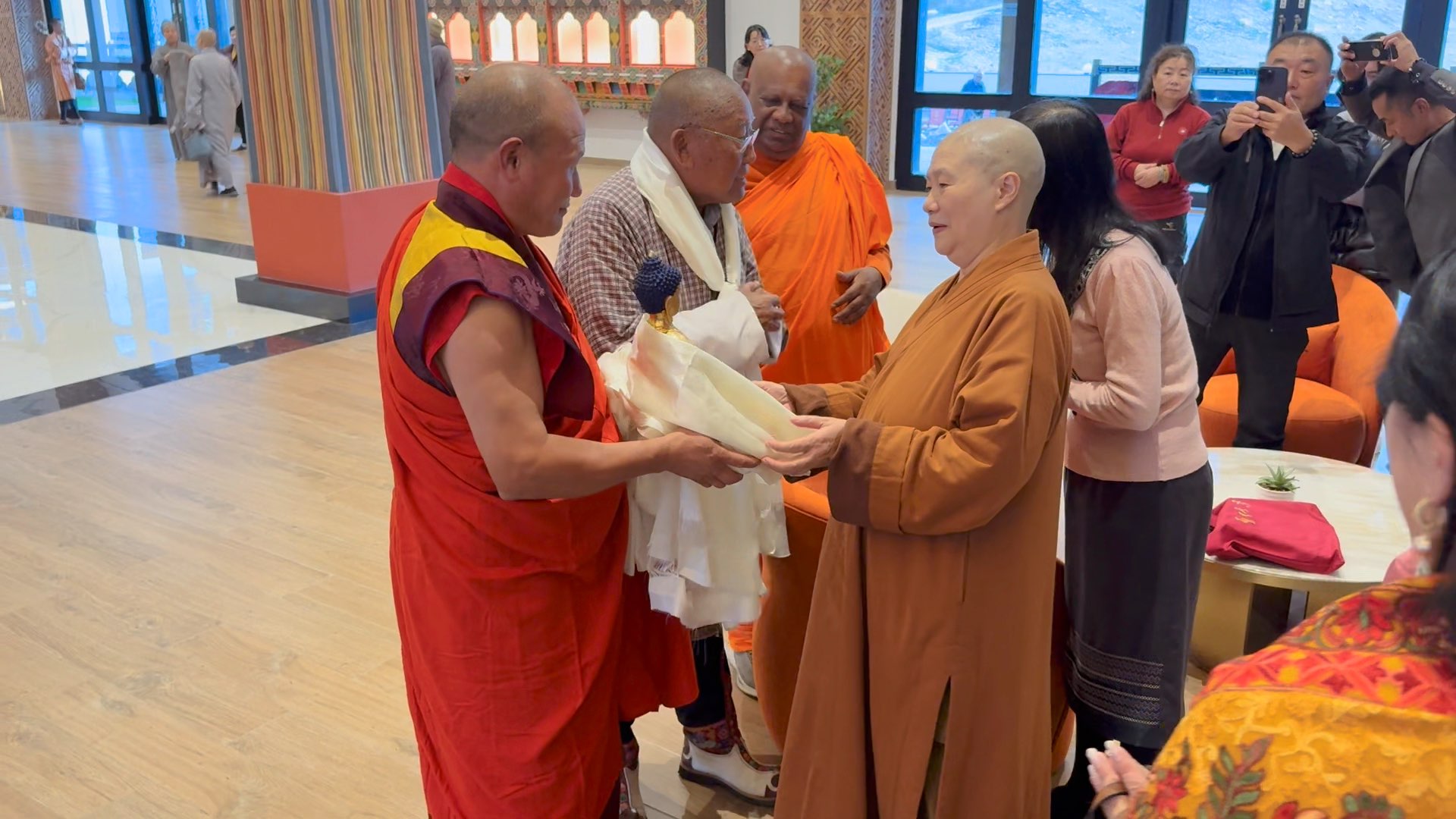
Ceremonial exchange of gifts between Venerable Master Shi Zheng Da and Dasho Passang Dorji in the hotel lobby at the conclusion of the trip.
Exchange of gifts with Dasho Passang Dorji

In a very friendly atmosphere, an exchange of gifts took place. The Venerable Master Shi Zheng Da presented him with a special art object, a luminous three-dimensional picture of a Yun sculpture designed by H.H. Dorje Chang Buddha III. In return, he gave the Master a large golden Shakyamuni Buddha statue. It was a worthy moment of connection.

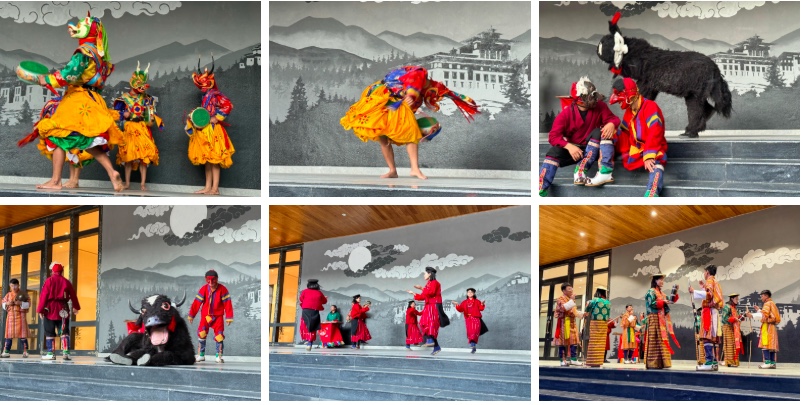
Scenes from the performance (in order): The famous Drametse Ngacham (Dance of the Drums), a solo dancer bowing deep, the performers of the yak scene, the humorous interaction of the yak with the audience, the women’s dance group in red garments, and finally a traditional performance with bows and arrows combining song and dance.

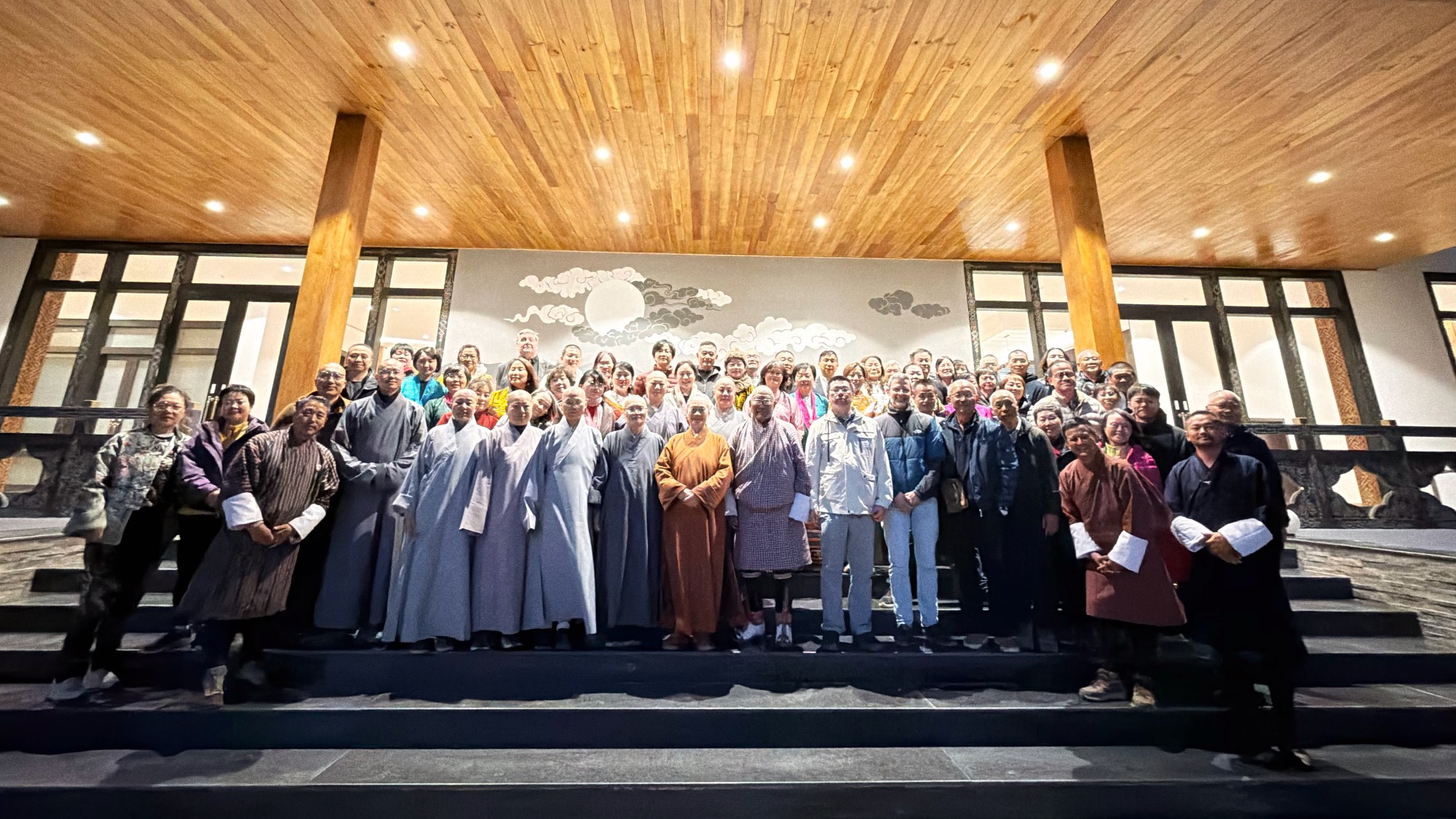
Afterwards, we watched a cultural performance together with Dasho Passang Dorji. There were traditional dances and songs whose gentle, flowing movements radiated great calm and peace. There were also humorous interludes, like the dance of a yak, where the performers visibly had fun. Even though I did not understand the language, the joy was contagious. After this show, we all gathered for a large group photo to capture this beautiful final evening.

Large farewell group photo of the entire travel group together with Dasho Passang Dorji and the Bhutanese guides on the illuminated steps of the hotel.
Our entire group with Dasho Passang Dorji and our guides

The next morning, November 16th, it was time to say goodbye. From the hotel, we could look directly at the airport. We had arrived to make a contribution with our donation and our plans. But as I boarded the plane now, I felt that we ourselves were taking away far more than we had given. I took with me not only memories of the mighty mountains and venerable monasteries, but the feeling of a deep connection with our travel group and the people in Bhutan. I return with much inspiration and a heart full of gratitude for the blessing I was allowed to experience in this country.

Link:https://peacelilysite.com/2026/02/05/pilgrimage-to-bhutan-part-3-audience-with-the-je-khenpo-and-the-ascent-to-tigers-nest/

Xing Garden on Mount Rili: Where Nature, Brush, and Spirit Converge

Chinese Painting by H.H. Dorje Chang Buddha III

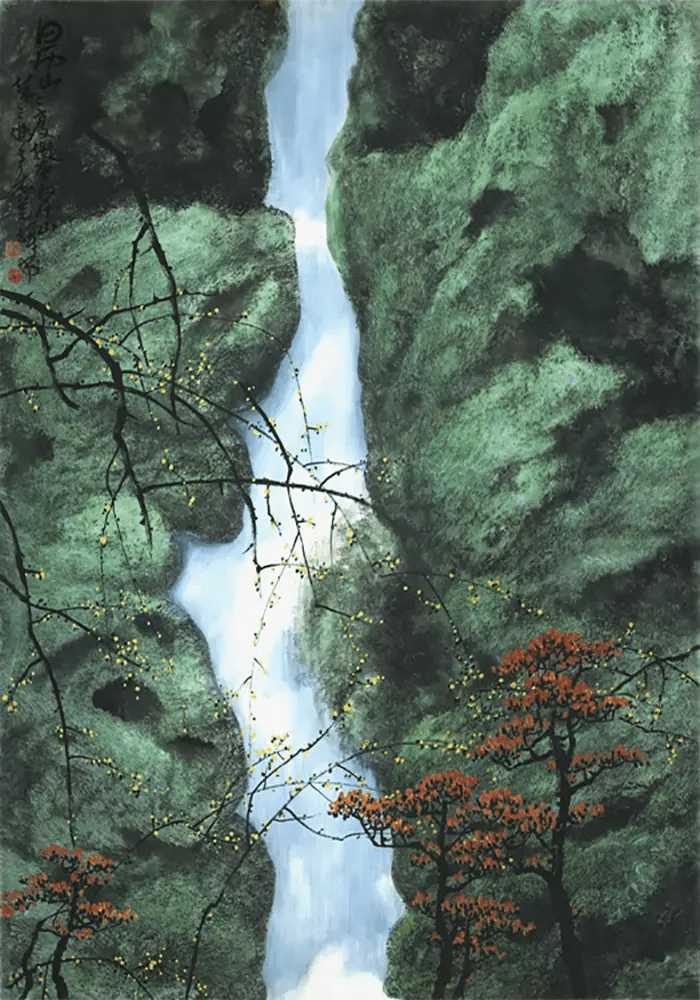
Created in 1993, Xing Garden at Mount Rili stands as a masterful expression of the artist’s profound understanding of nature and brushwork. The painting presents a dramatic world of steep cliffs and cascading water, inviting the viewer into a landscape that feels both monumental and intimate.

Dominated by vibrant greens, the work vividly captures moss and grasses spreading freely across rocky surfaces. These lush tones breathe life into the cliffs, softening their ruggedness while emphasizing the quiet vitality that thrives within seemingly harsh terrain. Nature here is not static; it pulses with energy and renewal.

The painting employs the refined “Miaoxie” (妙写) technique—a style that reveals its true depth through careful observation. At first glance, the composition appears fluid and effortless. Yet upon closer inspection, the brushstrokes intertwine like delicate wires, layered and interwoven with extraordinary precision. These subtle lines create constant movement and variation, generating emotional richness and visual intrigue through their complexity.

One of the most captivating aspects of this work lies in its masterful use of illusory watery ink, where solidity and transparency coexist. Ink seems to flow and dissolve at the same time, offering a boundless sense of depth and atmosphere. Whether viewed from afar or examined up close, the painting reveals a bottomless waterfall, rendered with meticulous detail yet infused with powerful momentum.

What is especially striking is the contrast between refinement and strength. From a distance, the scene appears serene and orderly; yet when the viewer studies the brushwork closely, the strokes reveal unexpected vigor and boldness. Within apparent emptiness, there is substance; within seeming chaos, there is profound order. This balance embodies the highest level of artistic cultivation.

Through free yet disciplined brushwork, the artist transforms a simple natural motif—a waterfall between two cliffs—into a scene of extraordinary aesthetic depth. The power of each stroke carries both physical strength and spiritual presence, allowing the painting to transcend mere representation and enter the realm of lived experience.

Xing Garden at Mount Rili is more than a landscape painting. It is a quiet dialogue between nature and the artist’s inner world, revealing how true mastery lies not in excess, but in the ability to uncover profound beauty within simplicity.

This beautiful artwork is part of the permanent exhibition at the International Art Museum of America, located in downtown San Francisco.

Link:https://peacelilysite.com/2026/02/03/xing-garden-on-mount-rili-where-nature-brush-and-spirit-converge/