Most religions have moral and ethical rules and commandments. Buddhism has Precepts, but it’s important to understand that the Buddhist Precepts are not a list of rules to follow.
In some religions, moral laws are believed to have come from God, and breaking those laws is a sin or transgression against God. But Buddhism doesn’t have a God, and the Precepts are not commandments. However, that doesn’t exactly mean they’re optional, either.
The Pali word most often translated as “morality” is sila, but sila has many connotations that go beyond the English word “morality.” It can refer to inner virtue such as kindness and truthfulness as well as the activity of those virtues in the world. It can also refer to the discipline of acting in a moral way. However, sila is best understood as a kind of harmony.
Being in Harmony
The Theravadin teacher Bikkhu Bodhi wrote,
“The Buddhist texts explain that sila has the characteristic of harmonizing our actions of body and speech. Sila harmonizes our actions by bringing them into accord with our own true interests, with the well-being of others, and with universal laws. Actions contrary to sila lead to a state of self-division marked by guilt, anxiety, and remorse. But the observance of the principles of sila heals this division, bringing our inner faculties together into a balanced and centered state of unity.” (“Going for Refuge and Taking the Precepts “)
It is said that the Precepts describe the way an enlightened being naturally lives. At the same time, the discipline of upholding the Precepts is part of the path to enlightenment. As we begin to work with the Precepts we find ourselves “breaking” or defiling them over and over. We can think of this as something like falling off a bicycle, and we can either beat ourselves up about falling—which is disharmonious—or we can get back on the bicycle and start pedaling again.
The Zen teacher Chozen Bays said, “We just keep on working, we are patient with ourselves, and on and on it goes. Little by little our life comes more into alignment with the wisdom that gives rise to the precepts. As our minds get clearer and clearer, it’s not even a matter of breaking or maintaining the precepts; automatically they are maintained.”
The Five Precepts
Buddhists don’t have just one set of Precepts. Depending on which list you consult, you might hear there are three, five, ten, or sixteen Precepts. Monastic orders have longer lists.
The most basic list of Precepts is called in Pali the pañcasila, or “five precepts.” In Theravada Buddhism, these Five Precepts are the basic precepts for lay Buddhists.
A more literal translation from the Pali for each of these would be “I undertake to observe the precept to abstain from [killing, stealing, misusing sex, lying, abusing intoxicants].” It’s important to understand that in maintaining the Precepts one is training oneself to behave as a buddha would behave. It’s not just a matter of following or not following rules.
The Ten Grand Precepts
Mahayana Buddhists generally follow a list of Ten Precepts that are found in a Mahayana Sutra called the Brahmajala or Brahma Net Sutra (not to be confused with a Pali sutra of the same name):
Some Mahayana Buddhists also vow to uphold the Three Pure Precepts, which are associated with walking the path of a bodhisattva. These are:
To do no evil
To do good
To save all beings
The Pali words usually translated as “good” and “evil” are kusala and akusala. These words can also be translated “skillful” and “unskillful,” which takes us back to the idea of training. Very basically, “skillful” action takes oneself and others closer to enlightenment, and “unskillful” action leads away from enlightenment.
To “save all beings” is the bodhisattva’s vow to bring all beings to enlightenment.
The Sixteen Bodhisattva Precepts
You will sometimes hear of the Bodhisatva Precepts or the Sixteen Bodhisattva Vows. Most of the time, this refers to the Ten Grand Precepts and Three Pure Precepts, plus the Three Refuges:
I take refuge in the Buddha. I take refuge in the Dharma. I take refuge in the Sangha.
The Eightfold Path
To fully understand how the Precepts are part of the Buddhist path, begin with the Four Noble Truths. The Fourth Truth is that liberation is possible through the Eightfold Path. The Precepts are connected to the “ethical conduct” part of the Path—Right Speech, Right Action and Right Livelihood.
The moment I heard that I would be going with Venerable Dharma Teacher Long Hui to Los Angeles, unspeakable joy arose in my heart. On the way to Los Angeles, a rainbow suddenly emerged from the drizzling sky, emitting beautiful lights of various colors. A white celestial crane seen in the distance flew near and landed at the side of the freeway gazing at us, as if paying us respect. All of these signs expressed auspicious blessings. I strongly sensed that what I had wished for so long was about to come true.
A notice arrived in the afternoon of December 28th. From Venerable Dharma Teacher Long Hui’s somewhat tense facial expression, I could tell this must be the time for me to pay my respects and visit the Buddha Master. Just as expected, when we stepped into the mandala, I saw H.H. Dorje Chang Buddha III Wan Ko Yeshe Norbu Holiest Tathagata sitting upright on the dharma platform. His Holiness appeared so dignified and had an expression of loving-kindness. As I sincerely prostrated myself to H.H. Dorje Chang Buddha III, all I heard was the cordial voice of His Holiness telling everyone to come sit toward the front. I sat beside Venerable Dharma Teacher Long Hui. Dharma Teacher Jue Hui and Dharma Teacher Ruo Hui also sat with us.
Venerable Dharma Teacher Long Hui reported to the Buddha Master regarding the Buddhist chanting work that had taken place at Hua Zang Si over the past two months. Next, the Buddha Master called my name: “Fa Hai, proceed with what you want to say.” Without knowing why, my mind went totally blank. I felt that my entire body was soaking in a kind of freshness. I remained kneeling with a very straight back, as if I had entered a state of meditation. At this time, I only heard the Buddha Master say, “It is all right. Just speak directly!” Yet, I still could not speak and was silent for another eight or nine minutes. I could sense that the Buddha Master was patiently waiting. Finally, a sound floated out of my mouth: “My karmic affinity with the Buddha Master should have begun ten years ago. Because I could not come to America, I was not able to visit His Holiness. I finally got a visa last year. Only this year did I have the opportunity to visit Hua Zang Si, where I respectfully listened to recorded dharma teachings of the Buddha Master. For more than one straight month, I have listened to the recorded dharma discourses without the slightest sense of tiredness.
This has been the most beneficial and rewarding time of my entire life. The beneficial effects I have experienced can never be expressed in words. I bring my body, speech, and mind to respectfully visit the Buddha Master at this time. Today, I would like to specially request a great dharma from H.H. Dorje Chang Buddha III. I would not hesitate to leap into boiling water or walk on fire in order to obtain this great dharma. I am willing to undergo any test in order to obtain such dharma. I am even willing to sacrifice my own life. It might sound like I am exaggerating, but I truly can do such things.”
Perhaps because I was too nervous or focused, I unexpectedly was not able to express exactly what I meant to say. However, I silently told myself that the Buddha Master definitely understands what I am trying to express and what dharma I am requesting. I still remember that I fasted for a full 21 days in the Philippines in order to obtain this great dharma. This is because I am very aware that in this world only H.H. Dorje Chang Buddha III can accomplish this task and announce to the world this great dharma in order to demonstrate the brightness of Buddha and enable the correct dharma to exist in this world forever.
At first, the Buddha Master did not answer my request directly but gave us a profound and important discourse. Only afterward did I realize that this discourse was actually the beginning of His Holiness’s response to my question. His Holiness specifically pointed out the various kinds of confusion and mistakes that have appeared within Buddhism in this current Dharma Ending Age. Some Buddhist sutras contain serious mistakes. What is even more serious is that there are some so-called eminent monks and great virtuous beings who, due to their erroneous understanding and views, seriously misguide others when giving discourses on the dharma. What is even sadder is that believers who do not understand the truth still fanatically follow them and prostrate to them in worship. H.H. Dorje Chang Buddha III does all He can to correct these heretical ideas and views. However, being limited by the karma of living beings, H.H. Dorje Chang Buddha III feels that it is very difficult to change the current situation despite His wish to do so. The Buddha Master gave some examples of these heretical ways within both esoteric Buddhism and exoteric Buddhism. These very worrisome examples left me not knowing whether to laugh or cry.
After finishing the discourse, the Buddha Master said to me directly, “Fa Hai, you did not say what great dharma you want to request. Let me say it for you. The dharma you want to request is to film a movie of the Buddha. There really is no one else besides me who can do this because I completely understand the teachings of the Buddha. I can write the script. This movie must be filmed. The only thing is that the karmic conditions this year are not quite mature enough because the script needs to be written and actors need to be found, especially actors who are qualified. As for funding, as long as there is a script, there will be people who will sponsor and invest. Besides, the movie of the Buddha will not be filmed as one undivided whole but will be divided into a series of 100 parts or episodes. Perhaps this is really the right channel. After all, the influence of a book is limited as it reaches fewer people than a movie, which has much more of an international impact. In addition, when we do this, many problems might be solved. We might even be able to build several temples this way!” At this moment, I understood that the discourse just given by H.H. Wan Ko Yeshe Norbu Holiest Tathagata on the current chaotic situation within Buddhism illustrated that it is impossible for anyone else to write in a script the authentic doctrines of the Buddha.
Listening to this point, I was really shocked in my heart. I used to pay respect and visit many eminent monks and great virtuous beings. I requested from them great dharma. None of them knew what this great dharma in my mind was that I wanted to request. H.H. Dorje Chang Buddha III is truly magnificent. I did not reveal in the slightest what great dharma I wanted to request. Nonetheless, what His Holiness stated was the exact great dharma in my mind that I wanted to request.
His Holiness then said, “Fa Hai, when you come back from mainland China, I will transmit to you dharma according to the formal rituals of Tibetan esoteric Buddhism. You still have some negative karma. At that time, I will perform an initiation for you and eliminate your karmic hindrances. You will see.” I was totally engulfed in the joy of the dharma. The Buddha Master further said, “On your way here, the rainbow and the celestial crane you saw augured that your future undertakings will be bright. However, behind the brightness lurks darkness, and there are twists and turns on the path. We will soon face some attacks and slander, although those who commit the slander will all end up losing. When A Treasury of True Buddha-Dharma is published, no force can obstruct or destroy us because what is in that book are facts.” The Buddha Master finished by saying, “The movie of the Buddha definitely has to be filmed. You see, Fa Hai, your wishes have all been fulfilled. How fortunate you are!”
Actually, there are no words that can express my happiness. There are also no words that can express my gratitude toward H.H. Dorje Chang Buddha III.
I only want to respectfully offer to the Dorje Chang Buddha III my most beautiful spirit, my most beautiful melody, my most beautiful singing voice, and my best wishes. May all those who hear this beautiful melody and singing voice be happy.
I would like to express my special thanks to an anonymous person who ten years ago sent me an express mail package in which a yellow silk scarf was wrapped around the book The Fruits of Pious Devotion and CD’s that had a picture of H.H. Dorje Chang Buddha III on their covers. It is because of this present that seeds planted ten years ago have borne fruit in the form of my taking refuge in the His Holiness as my Buddha Master and in the form of my witnessing the magnificence of the Buddha-dharma.
Everything I described above is true. I am a Buddhist nun. I accept the karmic responsibility for my words. If what I have stated is false, I will descend into the Vajra Hell. If what I have stated is true, I would like to dedicate the resulting merit to all living beings in the dharma realm so that they will soon realize enlightenment.
Respectfully written by disciple Fa Hai Shi December 30, 2006
The above account was written by Fa Hai Shi. We three humble Buddhist nuns provide the following testimonials.
Encountering an Unusual Occurrence
Basically, whenever people pay their respects and visit H.H. Dorje Chang Buddha III Wan Ko Yeshe Norbu Holiest Tathagata, they make good use of their short meeting time by posing prepared questions or by requesting the transmission of dharma. Some groups have really made the best use of their time by requesting answers to problems that have arisen.
From left to right: Ruo Hui Shih, Long Hui Shih, and Jue Hui Shih
However, there was one particular occasion in the afternoon of December 28, 2006 when a dharma teacher from the Philippines, Fa Hai, came to the mandala from thousands of miles away. This was the first time she was granted an audience with H.H. Dorje Chang Buddha III. When H.H. Dorje Chang Buddha III asked her what question she had, I saw that Buddhist nun take a deep breath. She then unexpectedly remained silent as she stared at the Buddha Master with open eyes, sometimes lowering her head. Perhaps all of this was due to nervousness or other factors. At this time, the Buddha Master also did not speak. Seconds and then minutes passed by in silence. Then, that dharma teacher sighed once more and straightened her back, still looking at the Great Dharma King without uttering a sound. Strangely, Dorje Chang Buddha III also remained silent. A moment later, she sighed for the third time but still did not reply to the Buddha Master. The duration of this silence lasted more than eight minutes. This kind of situation had never happened before.
Finally, the dharma teacher spoke. She said she had come with a wish to request a great dharma. If her wish to obtain this great dharma were fulfilled, she said she would dedicate her life to the Buddha-dharma and living beings, even if it meant sacrificing her life. After uttering such words, she again fell into silence without mentioning what dharma she wished to request.
At this time, Dorje Chang Buddha III said, “Do not say anymore. I will give you a discourse.” The Buddha Master pointed out what request was in the mind of this Buddhist nun. That discourse not only enabled us disciples who were there to once again witness the supernatural powers of H.H. Dorje Chang Buddha III, it also enabled us to understand precious dharma principles.
Because I took Dharma Teacher Fa Hai to pay her respects to H.H. Wan Ko Yeshe Norbu Holiest Tathagata, I was there and personally witnessed everything that happened. Everything I described above is true. If what I have stated above contains false words, may I never become accomplished in the dharma. If what I have stated above is true, I dedicate the resulting merit to all living beings so that they may soon hear the correct dharma and soon attain liberation and accomplishment.
Buddhist disciple Long Hui Shih
I was present at the time. I hereby confirm that what is stated above is true. If what is stated above is false, I am willing to descend into hell and experience negative karmic retribution. If everything stated above is true, I dedicate the resulting merit to all living beings so that they may soon hear the correct dharma and soon realize enlightenment.
Buddhist disciple, Jue Hui Shih
Everything stated above is true. If what is stated above contains false words, I will not become accomplished in the dharma and will become impoverished and miserable. If what is stated above is true, I wish to dedicate the resulting merit to all living beings so that they may always see Buddha and attain liberation.
Buddhist disciple, Ruo Hui Shih
(This is a complete translation of the Chinese text that follows originally written and signed by Fa Hai Shih, Long Hui Shih, Jue Hui Shih, and Ruo Hui Shih.)
The Medicine Buddha is a great teacher who purifies all obstacles and brings healing to the world. When the Medicine Buddha was practicing the Bodhisattva path in past lives, he made twelve great vows to relieve the suffering of sentient beings and bring them happiness including curing physical disabilities, relieving poverty, providing material needs, guiding those astray, and liberating prisoners. He is associated with a pure land in the East called Vaiḍūryanirbhāsa, or “Pure Lapis Lazuli”.
On the 29th day of the ninth lunar month, Buddhist disciples worldwide honor the birthday of Bhaisajyaguru Buddha, known as the Medicine Buddha or the Great Medicine King. He is also referred to as the Buddha of Twelve Great Vows, embodying deep compassion and healing. Presiding over the Pure Land of Lapis Lazuli Light in the East, the Medicine Buddha has inspired countless practitioners with his transformative teachings and boundless compassion.
Hua Zang Si, a Buddhist temple in the Mission District of San Francisco, California, held a Namo Medicine Buddha Holy Birthday Dharma Assembly on November 16, 2025. The next scheduled Dharma assembly will be the Namo Amitabha Buddha Dharma Assembly to be held on December 28, 9:30 am.
In Tibetan esoteric dharma, there are five types of precious pills. They are the Nectar Pill, the Long Life Pill, the Great Precious Pill, the Vajra Pill and the Supreme Precious Pill. Actually, these five types of pills are made from nectar bestowed by different Buddhas. There are also red pills and black pills made with Chinese herbs after the herbs are empowered through mantras, such as the red pills and white pills made by H.E. Tangtong Gyalpo. The Long Life Pill has the empowering effect of extending one’s lifespan. The Great Precious Pill can further one’s accomplishment in the dharma. The Vajra Pill can help dispel demons and increase longevity and good fortune. The Supreme Precious Pill can ensure accomplishment in the dharma. The five types of pills are crystallization of merit produced from the power of Buddha-dharma and the empowerment of Buddhas and Bodhisattvas. Basically, all great rinpoches have what they call precious pills. But most of them are of the ordinary type, not the holy precious type of pills. Holy precious pills and ordinary ones are two totally different concepts. I personally saw Nectar Pills made from nectar bestowed by Buddhas. I also personally saw true Vajra Pills and heard them chant mantras.
Certain famous rinpoches and dharma kings from the highest temples in Tibet have said that the Buddha-dharma that can enable a vajra pill to fly has not been seen in this world in three hundred years. This is a fact. There was a crazy yogi named Be Wa Ba who could manifest such power hundreds of years ago, but according to these respected rinpoches and dharma kings who have had contact with all of the well known dharma kings of recent times, this dharma had disappeared from this world.
I follow my Buddha Master, H.H. Dorje Chang Buddha III Wan Ko Yeshe Norbu Holiest Tathagata, and am constantly by His Holiness’s side. Therefore, I have experienced many magnificent and real manifestations of Buddha-dharma. Now I will tell everyone about my experience of the true Vajra Pill. When the holy vajra mantra and mudra are practiced, the Vajra Pill will jump and even transform into rainbow light and soar into the sky. I have also heard the Vajra Pill dance and chant mantras. I watched other people listen to the Vajra Pill sing songs.
I vow that the events reported here are true and happened as reported. If not, I am willing to bear the karmic retribution of the hell realms.
Amazing supernatural events preceded my first experience with the karmic affinity of the Vajra Pill. This happened in April, 2003. I traveled from San Francisco to Los Angeles to see H.H. Wan Ko Yeshe Norbu. During the trip I suddenly saw a colorful and large rainbow light appear in the sky. The rainbow completely surrounded the sun. There were also Sanskrit symbols in the sky. Just as the rainbow was fading from sight, I was able to take a picture of the bottom half of this light by focusing the camera below the sun. A dignified Buddha–Dorje Chang Buddha–appeared in the middle of the rainbow. This Buddha became my Buddha master, H.H. Wan Ko Yeshe Norbu, who was wearing a red robe and was sitting in the middle of the rainbow. The scene was awesome and extremely wonderful. The rainbow light appeared in the sky for several hours.
When I arrived, I was fortunate to immediately see my Buddha Master. A great lama obtained three true Vajra Pills and had respectfully given them to H.H. Wan Ko Yeshe Norbu Holiest Tathagata as an offering. The Buddha Master bestowed me with two of them. Unexpectedly the Vajra Pills in my hand started to jump. At that time the Vajra Pills jumped in my hand just as if they were alive. They not only jumped but one of them started to circle around and left my hand. It transformed into a dazzling bright red light and soared into the sky. At that time, I saw that the Buddha Master, who sat far away on the dais, had become a blue Buddha Vajradhara. The blue light was shining bright. The scene was very dignified. I was greatly astonished. This is when I first saw the true Vajra Pill and the true identity of my Buddha Master.
There was a very virtuous disciple who came from Australia. Because of a question I had asked H.H.Wan Ko Yeshe Norbu Holiest Tathagata about a dharma matter concerning mysterious power, the Holiest Tathagata said to me, “Bring your Vajra Pill to empower this disciple.” I took out the Vajra Pill. In order to prevent the Vajra Pill from escaping, this great layperson personally put the Vajra Pill in a small cup and sealed the cup with a piece of paper. The disciple put the cup to his ear and moved 15-20 feet away from the Holiest Tathagata. Several of us were sitting on the floor around H.H. Wan Ko Yeshe Norbu Holiest Tathagata. Then everyone started to chant mantras and practice dharma. Soon the Vajra Pill began to chant and sing Buddhist songs. This layperson was very moved. It is hard to believe that a tiny pill can actually sing Buddhist songs, but I have heard this myself. Actually, I did not hear Buddhist songs, but clearly heard the chanting of holy mantras. The sound came from this tiny BB sized pill that I personally held to my ear. It is truly unbelievable. In this world within the supreme Vajra Division of Esoteric Buddhism the Vajra Pill truly can be categorized into ordinary types and holy types. The Vajra Pill in my hand was living proof of the holy type.
Today I sincerely tell everyone my personal experience. My Buddha Master, H.H. Dorje Chang Buddha III Wan Ko Yeshe Norbu Holiest Tathagata is the supreme and highest Buddha. May all living beings have the good fortune to hear, learn, and practice the true Buddha-dharma and quickly attain enlightenment.
I, Buddhist disciple Zhaxi Zhuoma, sincerely vow and clearly write down these events to prove the existence of the true Buddha-dharma in the world today.
In the Tang Dynasty, there lived a monk named Jian Kong (Venerable “Mirror-of-Emptiness”), who in his previous life had been a diligent spiritual practitioner. Yet after reincarnating, he was born not as a monk, but as a poor scholar—one who, despite twenty long years of effort, could not pass the imperial examinations. He had no money, no connections, and often struggled even to find a simple meal. Hunger followed him like a shadow.
One day, after days of near-starvation, he set out toward a nearby temple, hoping to find something—anything—to eat. But halfway there, by the side of a river, his strength gave out completely. Weighed down by exhaustion and despair, he collapsed on the riverbank and began to cry. He was already around forty-five years old, and life felt unbearably harsh.
As he wept, a Brahmin monk suddenly appeared before him, radiant and calm.
“Venerable Dharma Master,” the monk said, “are you satisfied with the taste of wandering through worldly life?”
The scholar was startled. “Satisfied? It has been nothing but suffering! But I am a layman—why do you call me “Dharma Master”? That title doesn’t belong to me.”
The Brahmin monk smiled gently. “You are starving and confused now, so you’ve forgotten everything.”
He reached into his bag and took out a large, fist-sized date. “This is a special fruit from my homeland. Eat it. Then you’ll understand.”
The scholar ate the date. Sleepiness washed over him at once, and he lay down beside the river. When he awoke, something astonishing had occurred— his entire past life came flooding back.
He remembered that he, the Brahmin monk standing before him, and three others had all been fellow practitioners in their previous lives. Filled with emotion, he asked:
“What about Monk Zhen? How is he doing in this life?”
The Brahmin monk replied, “In his past life he had not yet cut off worldly attachments, nor had he achieved realization. In this life, he has become a monk again in Sichuan. He has now completely severed his desire for fame and fortune. He will attain accomplishment in this very life.”
The scholar asked about another of their five companions. “And Master Shen? What about him?” “His wishes remain unfulfilled,” the monk answered.
Then he asked about the third companion, Master Wu. The monk sighed gently: “You know him. In our past life, he once joked before a stone Buddha statue: ‘If I cannot attain supreme enlightenment, then at least let me become a mighty nobleman.’ Well, his vow has come true. Just yesterday, I heard he was appointed a general. He has completely forgotten he was once a monk.*”
Finally, the Brahmin monk turned to him and said:
“Among the five of us, I alone have attained liberation. And you—of all of us—you alone have fallen to such a state that you cannot even find enough food to fill your stomach.”
The scholar was bewildered. “In my past life,” he said, “for decades I ate only one meal a day and wore one tattered robe for over thirty years. I practiced diligently and lectured on the Dharma tirelessly. I was a well-known Dharma Master. How could my karma now be so miserable?”
The Brahmin monk answered with unmistakable compassion:
“Yes, you cultivated hard. But when you taught the Dharma, you often mixed in ideas from Daoist and other non-Buddhist teachings. This confused your listeners. You also held back special teachings out of stinginess, unwilling to share them openly. And although you kept the precepts, you broke them in many subtle ways. Given all this, your current life’s hardship is already a fortunate result.”
Hearing this, the scholar felt deep remorse and sadness. But instead of despair, a new resolve arose within him.
He vowed to renounce worldly life and become a monk once more.
Seeing his sincerity, the Brahmin monk took out a mystical mirror from his bag. In it, the scholar saw with clarity:
his own past lives,
the karmic results of all beings’ actions,
even the future rise and fall of the Dharma.
The mirror was said to be like the Seven-Jewel Trees of the Pure Land, which reveal the karmic truths of the universe with perfect brightness.
With this profound vision, his conviction became unshakable. He immediately entered monastic life, practiced with genuine diligence, and in time became a highly respected and accomplished master.
Recognitions and Congratulations to H.H. Dorje Chang Buddha III
When over a hundred great Dharma Kings, Regents, and Rinpoches from various Buddhist traditions throughout the world lawfully recognized, in accordance with Buddhist precepts, that Namo H.H. Dorje Chang Buddha III is the reincarnation of the ancient Buddha, Buddhist disciples around the globe rejoiced in celebration. The descent of Namo H.H. Dorje Chang Buddha III brings to the beings of this Dharma-ending age the correct and unerring True Dharma of the Tathagata that leads to liberation from the cycle of birth and death. How fortunate living beings are to personally hear the teachings of the Buddha — there is now hope for attaining enlightenment in this very lifetime!
Online Slander and Misunderstanding of H.H. Dorje Chang Buddha III’s Holy State
However, some people on the internet refuse to face the legitimate recognitions, the holy realization, and the perfect mastery of theFive Vidyās and teachings of H.H. Dorje Chang Buddha III with reason or correct understanding. Instead, they fabricate rumors, spread insults, slander, defamation, and false accusations — maliciously twisting facts, inventing lies, and making baseless claims. They use vulgar words, forge fake documents, false notices, and false statements, and even create distorted images and mocking content — doing everything they can to attack H.H. Dorje Chang Buddha III. Through their own words and actions, they merely expose their ignorance and lack of virtue.
Some say, “A Buddha or Bodhisattva is realized through practice, not by ‘recognition.’” “Shakyamuni Buddha didn’t need a certificate of recognition.” But their purpose is clear — to stop more people from learning the true Buddha Dharma and attaining liberation!
So, does a Buddha need recognition when descending into the world?
A Practice for the Benefit of Sentient Beings.
A Buddha is one of unsurpassed, perfect enlightenment and complete wisdom. The reason one is a Buddha lies in their realization and enlightenment — not because of any recognition by others. No matter how great a Dharma King, Regent, or Rinpoche may be, their level of realization is far inferior to that of a Buddha; thus, any recognition they offer to a Buddha would be, in essence, just a piece of paper of no value to the Buddha.
However, because sentient beings in this world often lack the wisdom to discern between true and false saints, between genuine Buddha Dharma and false teachings that imitate Buddhism, they may easily be misled by superficial appearances and deviant views. Therefore, for the benefit of sentient beings, by following the Buddhist tradition of formal recognition, those virtuous masters issued such recognitions that help people give rise to faith and thus be saved. This is an act of right knowledge and right view.
The Example of Master Padmasambhava and the Importance of Recognition
Master Padmasambhava
When Master Padmasambhava first went to Tibet to propagate the Dharma, he was not greeted with respectful welcoming crowds. Instead, the Tibetan people were terrified and shouted, “Quick! Drive out this sorcerer who performs strange magic without lineage transmission! Do not let him deceive us with his witchcraft!” They even lifted him up and threw him into a muddy pit. Later, Master Padmasambhava returned to India and asked two renowned masters to write letters of recognition. Only then did Buddhism begin to flourish in Tibet. In fact, those two masters later became Master Padmasambhava’s disciples.
Therefore, when Buddhas or Bodhisattvas reincarnate and manifest again in this world, undergoing recognition according to Buddhist rules is not for their own sake, but for the sake of helping sentient beings generate faith and thereby be liberated.
Indeed, the realization and attainment of a Buddha or Bodhisattva come from their own cultivation and enlightenment. The realization, virtue, and attainment of all Buddhas and Bodhisattvas are the manifestation of their supreme enlightenment. The pure and flawless conduct of Namo H.H. Dorje Chang Buddha III, His mastery of both exoteric and esoteric teachings, His perfect command of the Five Vidyās, and His countless acts of liberating sentient beings — all fully demonstrate the enlightenment and realization of a true Buddha!
Therefore, I sincerely advise those who slander: repent sincerely before the Buddhas and Bodhisattvas, or karmic retribution will not spare you! At the same time, I compassionately remind all who truly wish to learn and practice Buddhism: we live in the Dharma ending age, when confusion prevails, and the nature of the demonic offspring is to destroy the Dharma and obstruct sentient beings from learning the true path. Kind-hearted beings, please open your eyes of wisdom, discern the true from the false, and do not be deceived by demonic forces — lest you miss the supreme Dharma opportunity that can bring you liberation from birth and death in this very lifetime!
In 1947, shortly after Japan’s surrender and withdrawal from China, the great Zen Master Xuyun (Empty Cloud) gave a profound speech at a middle school. The nation was still recovering from the devastation of war, and hearts were heavy with both relief and sorrow. With deep compassion, Master Xuyun used the timeless wisdom of the Buddha to explain the law of cause and effect (karma) — reminding people that wars do not arise by chance, but are the result of humanity’s collective actions.
He taught that true peace cannot be achieved through force or politics alone. Only by transforming our hearts and purifying our minds through virtue, compassion, and the practice of Buddhist teachings can we bring real and lasting peace to the world.
War does not arise by chance — it is the collective karma of all beings that brings it forth.
Dear friends, during the years of occupation, we endured immense suffering under the enemy’s oppression — our lives were steeped in water and fire, hardship and pain. Now that our nation has regained its light, we should feel endless gratitude and reflection. We must understand that the outbreak of war is not accidental; it is the result of the shared karma created by all individuals.
The ancient masters said, “If you wish to know the causes of your past lives, look at what you are experiencing in this life. If you wish to know the results of your future lives, look at what you are doing now.” They also said, “Even after hundreds or thousands of eons, the karma one has created will not disappear. When the conditions ripen, the results will be experienced by oneself.”
When people lose their moral compass and commit all kinds of evil, they plant the seeds for calamities such as war, floods, fires, and famine. If we wish to change the will of Heaven and eliminate disasters, we must begin by transforming human hearts — by restoring virtue and morality. When everyone practices the Five Precepts and the Ten Good Deeds, cultivates upright minds and pure conduct, and lives with benevolence, trust, and righteousness, then the hearts of men and the will of Heaven will naturally align.
But if people persist in wrongdoing and refuse to repent, how can hostility and suffering ever be dissolved? The Buddha said, “The sea of suffering has no end, but when one turns around, there is the shore.” This means awakening from delusion and returning to goodness — the essential path to liberation.
We must truly believe in the law of cause and effect. It is not fiction but reality. If everyone understood that good deeds bring good results, and evil deeds bring suffering — that when one plants melons, one harvests melons; when one plants beans, one harvests beans — then no one would dare to act against conscience or break the law. Out of great compassion for all beings, Shakyamuni Buddha renounced his royal life and underwent arduous practice to save the world from ignorance and suffering.
If we understand the principle of cause and effect and wish to avoid future suffering, we must now create good causes. The hardships we experience today are the results of past evil actions. Therefore, we should now sow good seeds, and in time, we will naturally reap good fruits.
The scriptures speak of “Anuttara-samyak-sambodhi,” meaning “unsurpassed perfect enlightenment.” In its essence, it transcends the distinction of self and others — there is no “you” and “me.” But this state must be cultivated from one’s own heart. If our minds remain filled with greed, anger, and ignorance, unable to abandon all evil and practice all good, the barriers of self and ego become like iron mountains, preventing us from reaching the Pure Land or true harmony. This is the most crucial point — one we must all remember well.
The Sanskrit word “Buddha” means “the Awakened One.” Enlightenment has three aspects: awakening oneself, awakening others, and perfecting both understanding and conduct.
To awaken oneself is to realize that all experiences of good and evil, joy and suffering, arise from cause and effect. Once a person truly understands this, delusion fades, the four attachments dissolve, and one becomes enlightened.
To awaken others means recognizing that all living beings — whether born from the womb, from eggs, from moisture, or by transformation — all possess Buddha nature. They are called “sentient beings” only because they are deluded and unaware. We should therefore cherish and respect ourselves, and in keeping with the Buddha’s great vow of compassion and universal salvation, share these truths with others, guiding them out of the sea of suffering.
As stated in the Śūraṅgama Sūtra: “Regard all men as your fathers and all women as your mothers.” If we cultivate such deep reverence and love, especially for widows, orphans, and those who are lonely or destitute, and show them kindness and compassion through giving and aid, we can realize true equality and the ideal of great harmony.
To perfect both understanding and conduct means to live according to the Buddha’s teachings and precepts until one’s virtue and merit are complete. After the Buddha’s passing, he left behind the Three Baskets of Scriptures — Sutra, Vinaya, and Abhidharma — as our priceless raft to cross the sea of suffering. All the rules and precepts should be faithfully practiced. When one fulfills them completely, that is the perfection of wisdom and conduct.
Thus, the Buddha is the awakened one, while sentient beings are the deluded. The distinction between delusion and enlightenment marks the boundary between beings and Buddhas. To turn away from delusion and return to truth — that is awakening, and that is Buddhahood.
To further illustrate the law of karma, there is a story from one of Shakyamuni Buddha’s past lives.
Long ago, in the city of Rajagaha, there was a fishing village with a large pond. One year, a great drought struck, and the pond began to dry up. The villagers caught and ate almost all the fish, until only one giant fish remained, which was finally killed and eaten. Only one eight-year-old boy refused to eat the fish; he simply watched and laughed.
In his later life as the Buddha, King Prasenajit of Kosala, a devoted follower of the Buddha, married a princess of the Shakya clan, and they had a son named King Virudhaka. After ascending the throne, Virudhaka led his army to attack the Shakya capital of Kapilavastu and slaughtered all its inhabitants.
During that time, the Buddha suffered a severe headache for three days. His disciples begged him to use his powers to save the Shakya people, but he refused. Even when Maudgalyayana repeatedly pleaded, the Buddha said no. Maudgalyayana tried to rescue some survivors with his alms bowl, but when he put it down, all he found was a pool of blood.
When the disciples asked why, the Buddha revealed the cause: in a past life, during a great drought in Rajagaha, the villagers had killed and eaten the fish in that pond. The giant fish was reborn as King Virudhaka, and the villagers were reborn as the Shakyas who were killed. The young boy who merely watched and laughed was reborn as Shakyamuni Buddha himself. Because this karma had matured, the outcome was unchangeable.
The Buddha fully understood this karmic connection and taught it to his disciples as a warning. Chan Master Yuan Yun wrote in verse:
“For hundreds of years, the soup in your bowl Is filled with deep hatred, hard to dissolve. If you wish to know why wars arise, Listen to the cries from the butcher’s gate at midnight.”
Reflect on this story and recite the verse, and you will awaken to the true causes of war and violence — and learn to guard your conduct with mindfulness.
If we wish to transform the world and move toward true harmony, everything must begin with our hearts. Students should study diligently, yet never forget the greater mission of saving the world. And the first step to saving the world is saving the heart — correcting one’s own wrong thoughts and firmly believing in the law of cause and effect, avoiding all evil paths.
By cultivating sincerity, righteousness, self-discipline, and harmony within the family, one can extend peace to the nation and the world. If all the people of every country sincerely believe in karma and practice the Eight Virtues and Ten Precepts, then oppression, violence, and wars will cease to arise. True peace, equality, and the Pure Land of Great Harmony will appear, free from the Five Defilements and all suffering.
For the original Chinese speech, please click here. This English translation is by Linda Chang and is provided for reference only.
Hidden in the quiet county of Yixian in northern China, Fengguo Temple has stood for over a thousand years as a living testament to ancient Chinese wisdom and spiritual devotion. Its magnificent Mahavira Hall, the largest single-story wooden structure of its time, houses seven colossal clay Buddhas that have miraculously survived the centuries. This temple is not only an architectural marvel but also a sacred symbol of harmony, resilience, and faith that continues to inspire all who visit.
A Thousand Years of Faith and Architecture
Beyond the Shanhai Pass, in the northern part of Jinzhou City, Liaoning Province, stands the quiet county of Yixian, home to one of China’s most magnificent ancient temples — Fengguo Temple. This remarkable site, founded over a millennium ago, is not only a masterpiece of Liao Dynasty Buddhist architecture but also a living testament to the extraordinary ingenuity of ancient Chinese builders and the enduring power of faith.
In 2020, Fengguo Temple celebrated its thousandth anniversary. Through a thousand years of wind, snow, wars, and earthquakes, its grand Mahavira Hall still stands tall — a miracle in both architecture and spirituality.
The Majestic Great Hall
The heart of Fengguo Temple is its Mahavira Hall (Great Buddha Hall), one of the Eight Great Structures of the Liao Dynasty. Built in 1020 CE, it measures 49.5 meters wide, 26.6 meters deep, and 19.9 meters high, covering an area of 1,317 square meters. Standing on a 3.2-meter-high platform, the hall is the largest single-story wooden structure of ancient China — magnificent, solemn, and breathtaking.
Ingeniously designed, the hall uses a “reduced-column” method to maximize interior space while maintaining perfect stability. Ancient builders applied advanced techniques known as “side-foot” and “rising beam”, ensuring the building’s balance and graceful proportions. The massive bracket sets under the eaves are bold yet refined, exuding strength and elegance.
Thanks to its precise structural mechanics, the Great Hall has remained perfectly upright for a thousand years, without any sign of warping or tilting — an unparalleled achievement in the history of wooden architecture.
The Seven Buddhas: Eternal Clay Sculptures
Inside the Great Hall, seven colossal clay Buddha statues, each about nine meters tall, sit side by side upon a brick platform. From east to west, they are: Kashyapa Buddha, Krakucchanda Buddha, Sikhin Buddha, Vipashyin Buddha, Visvabhu Buddha, Kanakamuni Buddha, and Shakyamuni Buddha.
These are the “Seven Buddhas of the Past” mentioned in Buddhist scriptures, symbolizing the eternal cycle of enlightenment in our world. Each Buddha exudes solemn dignity, with serene expressions and graceful postures, reflecting the Liao Dynasty’s continuation of Tang-style Buddhist artistry. Two bodhisattvas stand beside each Buddha, adding vitality and compassion to this sacred tableau.
This magnificent ensemble is the oldest and largest group of colored clay Buddha statues in the world. Despite being made of fragile clay, they have miraculously survived for over a thousand years, their colors still soft and luminous. This endurance is nothing short of a miracle — a union of artistic mastery and the blessings of faith.
The Legend of the Buddha Catching a Shell
During the Liaoshen Campaign in the late 1940s, Yixian became a battlefield. Amid the chaos, a shell pierced through the roof of the Great Hall and fell directly into the right hand of the Shakyamuni Buddha statue. Miraculously, the shell did not explode.
Locals still tell this story as “The Buddha Caught the Shell with His Hand.” Whether fact or legend, it adds an aura of mystery and divine protection to the temple’s long history — as if the Buddhas themselves were silently safeguarding their sacred home.
The Flying Devas of Liao
The beams and rafters inside the Great Hall are adorned with over 4,000 square meters of original Liao Dynasty murals. Among them, the heavenly maidens — the Flying Devas — are the most enchanting. With radiant faces and flowing ribbons, they drift gracefully through clouds, offering flowers and fruits to the Seven Buddhas below.
Their movement contrasts beautifully with the Buddhas’ stillness, creating a breathtaking scene of divine harmony and devotion. The surrounding walls also preserve Yuan and Ming dynasty murals depicting ten Buddhas, eight Bodhisattvas, and the Eleven-Faced Avalokiteshvara, adding even more layers of spiritual and artistic richness to this timeless sanctuary.
A Thousand Years of Wonder
Standing before this majestic hall — a wooden structure that has endured a millennium — and gazing upon the clay Buddhas whose serene faces have survived a thousand winters, one cannot help but wonder:
How can a wooden palace withstand ten centuries of storms and wars? How can clay sculptures remain whole and radiant after a thousand years?
Is it the wisdom of the ancients? The strength of art? Or the blessing of the Dharma itself?
Perhaps the answer lies within every beam, every brushstroke, and every tranquil smile of the Buddhas.
May the Buddhas and Bodhisattvas bless all beings with peace, compassion, and happiness. Namo Amitabha.
Recently, a Western friend asked me why I believe that H.H. Dorje Chang Buddha III is the true Buddha. He told me that when he searched online, he found many negative comments, and even saw that some Rinpoches claimed they did not recognize the Buddha at all. Sadly, certain people with evil intentions have slandered H.H. Dorje Chang Buddha III, falsely accusing Him of conferring the title upon Himself, thereby misleading Buddhist practitioners and causing great harm.
I feel deeply saddened that so much true and authentic information about the Buddha has been buried under falsehoods and misunderstandings. To help clarify, I would like to share selected passages from the publicly available book H.H.Dorje Chang Buddha III (A Treasury of True Buddha-Dharma). In it, many Bodhisattvas, Dharma Kings, Rinpoches, Dharma Teachers, as well as renowned monasteries, issued official certificates and congratulatory letters confirming the identity of H.H. Dorje Chang Buddha III.
The above photo of sixty such dharma kings, rinpoches, and temples, many of whom are shown below. Photos of some of these dharma kings and rinpoches actually signing or stamping their letters are also included. Although this is only a small portion of those who have recognized H.H. Dorje Chang Buddha, the following list does represent the highest present-day dharma kings and regent dharma kings from various temples or famous rinpoches in current times. It is they who recognized or corroborated, or sent congratulations to H.H. Dorje Chang Buddha III.
For more information and more detailed biographies on many of these great holy beings as well as their letters of certification and congratulation see A Treasury of True Buddha-Dharma.That book also explains how many of these holy beings had their identities.
H.H. Dodrupchen Rinpoche (1927- ), a famous great dharma king of the Nyingma sect who is the sole holder of the complete Longchen Nying-thik, said the following in his letter congratulating the publication of A Treasury of True Buddha-Dharma: “I found the book wonderful and amazing and totally inspiring. . . [It is a] truly miraculous and extraordinary expression of truth expressed and unexpressed beyond words in Buddha Dharma.”
An incarnation of Guru Padmasambhava, H. H. Dodrupchen Rinpoche IV, Thupten Thrinle Palzang, is the holiest great dharma king within the Nyingma lineage. His Holiness is the greatest living Dzogchen or Great Perfection master and the main lineage holder of the Longchen Nyingthik lineage, the highest dharma in Tibet for perfecting the rainbow body. The first Dodrupchen, Jigme Thrinle Oser (1745-1821), was the greatest disciple of Jigme Lingpa (1730-1798). The Third Dodrupchen Jikmé Tenpé Nyima (1865-1926), was both a great scholar and a remarkable yogi.
The Dharma King’s main seat is at Chorten Gonpa Monastery, which His Holiness founded in the outskirts of Gangtok, Sikkim. His Holiness is also the spiritual director of the very small isolated Sera Gonpa (Nubri Monastery) in Kylmo Lung (Peaceful Valley), Nepal. It is unique in that the 50 monks and 50 nuns that study there have identical programs. H. H. Dodrupchen Rinpoche IV is represented in the USA by the Mahasiddha Nyingmapa Center, Kunzang Choling Temple, in Hawley, MA.
H.H. Dharma King Penor Rinpoche
H.H. Dharma King Penor (1932-2009), a supreme dharma king of the Nyingma sect, wrote the following in a letter to rinpoches: “H.H. Dorje Chang Buddha III Yangwo Wan Ko Yeshe Norbu. . . has been recognized by numerous greatly virtuous and eminent monastics. . . A Treasury of True Buddha-Dharma. . .will provide the karmic conditions for living beings to . . . attain the ultimate state of Buddhahood.”
An incarnation of Vajrapani Bodhisattva, the eleventh lineage holder of the Nyingma Palyul tradition, Kyabje Drubwang Pema Norbu Rinpoche, was born in December 1932 in the Kham region of eastern Tibet and left this world in March 2009. After H. H. Dilgo Khyentse departed in 1991, H. H. Penor Rinpoche became the Supreme Head of the Nyingma Sect. In 2001 he resigned from that position to devote more time to his extensive global network of monasteries and dharma centers, recommending that H. H. Mindrolling Trichen Rinpoche assume that position. His Holiness Karma Kuchen Rinpoche IV, is the current head of the Palyul subsect.
His Holiness’s Main seat was at Palyul Monastery in Tibet, one of the six main Nyingma monasteries. His Main seat outside of Tibet was at Namdroling (Thegchog Namdrol Shedrub Dargyeling) Monastery, Bylakuppe in Karnataka State, South India, close to the sacred Drekar Pungwa Stupa where Buddha first taught the Kalachakra Tantra. In 1978 the Ngagyur Nyingma Institute for Higher Buddhist Studies was added along with a nunnery and college for women. His Holiness had a number of branch temples in the US and a retreat center in McDonough, New York. During the 2008 Dharma Propagation Tour, Zhaxi Zhuoma Rinpoche and other tour members were able to have an audience with His Holiness and hear His Holiness Penor Rinpoche praise H.H. Dorje Chang Buddha III. The rinpoche said that it was good that such a holy being would incarnate in these dharma-ending days.
H.H. Jamyang Lungdok Gylatsen Rinpoche
H.H. Dharma King Omniscience Jamyang Lungdok Gyaltsen (Lama Achuk 1927-2011),who is the incarnation of Venerable Longsal Nyingpo, stated in his recognition certificate, “. . . H.H. Master Wan Ko Yee . . . is the incarnation of Vimalakirti. . . is Dorje Chang Buddha III. . . .”
H. H. Jamyang Lungdok Gyaltsen or Lama Achuk (Also referred to as Khenpo Achuck Brioche or Achiu Kamabu or Lama A-chos) is an incarnation of the great terton Rigdzin Longsal Nyingpo (1625-1682) of Kathok Monastery. He was the head of the Nyingma Sect in China and the foremost person of great holiness and virtue in all Tibet.
He was born in 1927 in Eastern Tibet and spent 43 years in retreat with his master, Tulku Arik Rinpoche. On July 23, 2011 he entered into paranirvana. His Holiness lived at Yarchen
Vajra body of Lama Achuk
Uddiyana Meditation Monastery, an encampment (gar) of thousands of monks, nuns, and lay practitioners, that he established in an isolated valley near Ganzi (Kandze) in Baiyu (White Jade) County, in Sichuan Province, China. This was the largest concentration of rinpoches and lamas in the entire world. The cremation ceremony of Lama Achuk commenced on August 29, 2011. The body of Lama Achuk shrunk from a height of almost six feet (1.8 meters) to about 1 inch tall, a sign of very high realization. From time of Lama Achuk’s paranirvana to the cremation, many auspicious signs appeared, five colored rainbows were often sighted in the sky and five colored pure lights often appeared in the area surrounding Lama Achuk’s body. More than 100,000 sangha members and lay devotees attended the puja and paid respect to the sacred body of Lama Achuk.
One of his disciples, Khenpo A-chos, achieved the rainbow body earlier in 1998. Father Tiso, a Catholic priest who went to Tibet to investigate the rainbow body phenomena at the suggestion of the Benedictine monk David Steindl-Rast, found evidence that H. H. Lama Achuk himself had already achieved the rainbow body as well.
H.H. Dharma King Jigme Dorje
On behalf of the Jonang sect, H.H. Dharma King
H.H. Dharma King Jigme Dorje stamps his seal onto his congratulatory letter to H.H. Dorje Chang Buddha III that he had already signed.
Jigme Dorje (1944- ), who is the Supreme Dharma King of the Jonang sect, respectfully congratulated H.H. Dorje Chang Buddha III Wan Ko Yeshe Norbu with the following words: “Such superlative accomplishments are truly unprecedented in the past few thousand years, outshining the accomplishments of all
Kalachakra Mandala created by Jonang monks at Jamdha Monastery, Golok Region, Amdo, Tibet
others, both ancient and modern. His Holiness is a shining paragon among Buddhas.”
The supreme dharma king of the Jonang sect, H. H. Jigme Dorje is an incarnation of the Shambhala King, Suchandra, who was the first to receive the Kalachakra tantra from Shakyamuni Buddha. His Holiness continues to hold the highest teachings of the Kalachakra dharma. H. H. Jigme Dorge was born in 1944 and is head of the Zangwa (Tsangwa) Dazang Monastery in Eastern Tibet.
H.H. Dharma King Mindrolling Trichen
The chief secretary for H.H. Dharma King Mindrolling Trichen (1031-2008) of the Nyingma sect, Ven. D. G. Khochhen Rinpoche, sent a congratulatory letter on behalf of Dharma King Mindrollling Trichin and the Mindrolling Sangha in which he wrote, “. . . H.H. Wan Ko Yeshe Norbu Dorje Chang brings good fortune and wisdom to all living beings.”
Trichen Jurme Kunzang Wangyal, Mindrolling (Mindling) Trichen Rinpoche XI (1931-2008), was the supreme head of the Nyingma sect. Although the original seat of Mindrolling, one of the six major Nyingma monasteries founded in 1876 by Rigzin Terdak Lingpa on the south side of the Tsangpo River, is near Lhasa, Tibet, a new Mindrolling Monastery has been established at Dehra Dun, in Uttranchal State, India. The Nagyur Nyingma College, Mindrolling’s Institute of Advanced Buddhist Studies. (Five Vidyas University) is also located there. His Holiness’s daughter, H.E. Khandro Rinpoche has a retreat center in the USA and continues the Jetsunma lineage of female masters there and at Samten Tse, her nunnery in India.
H.H. Dharma King Trulshik
The famous H.H. Dharma King Trulshik Rinpoche (1924-2011), who is a master of H.H. the Dalai Lama and the root master of several Tibetan Buddhist dharma kings and lineage holders, wrote the following words respectfully congratulating Buddha Vajradhara Yangwo Wan Ko Yeshe Norbu: . . . “A Treasury of True Buddha- Dharma. . .will become the cause whereby each sentient being who has descended into the abyss of the six realms of reincarnation leaves suffering and attains happiness.”
H. H. Nyingma Dharma King Zhadeu Trulshik (Trulshig) Chenpo Ngawang Chokyi Lodro Rinpoche (1924-2011), who resided in the Everest region of Nepal, was an incarnation of Maitreya Bodhisattva and a lineage holder from the first Dodrupchen, Jigme Thrinle Oser. His Holiness was considered the closest and most accomplished disciple of H. H. Dilgo Khyentse Rinpoche and like Khyentse Rinpoche a leading proponent of the Rime or non-sectarian movement in Tibet. He was entrusted with the responsibility of finding and recognizing the incarnation of Khyentse Rinpoche after he passed on in 1991 as well as Tulku Urgyen Rinpoche after he left this world in 1996. Dharma King Trulshik founded a remote monastery and retreat center in Nepal at Tubten Choling. He was the fifth Supreme Leader of the Nyingma Sect until his death in 2011.
H.H. Taklung Tsetrul Rinpoche
The highest dharma king of the Northern Treasure lineage of the Nyingma sect, H.H. Dharma King Taklung Tsetrul (1926-2015), wrote the following words of congratulations: “His Holiness Dorje Chang Buddha III Wan Ko Yeshe Norbu possesses the true dharma of the Buddhas . . .
H. H. Taklung Kyabgon Tsetrul Thupaten Gyaltsen Rinpoche is the Dharma King of the Drak Dorje (Vajra or Indestructible Rock) Monastery, one of the six main Nyingma Monasteries, founded in 1610 by Rigdzin Ngakgi (Aji) Wangpo (1580-1639). This monastery specialized in the changter or jangter tradition of Rigdzin Godem (1337-1408). Rigdzin Godem was the master of the “northern terma (treasures)” tradition of the Nyingma school. Rigdzin Godem literally means “the vidyadhara with the vulture feather.” He received this name because three vulture feathers grew from his head when he was twelve years old, and five more when he was twenty-four. A reincarnation of Dorje Dudjom of Nanam, one of the nine close Tibetan disciples of Guru Padmasambhava, he is also counted among the five king-like tertons and one of the three nirmanakayas of Guru Padmasambhava. In 2011 he became the Supreme Leader of the Nyingma Sect.
H.H. Dharma King Jigdal Dagchen Sakya
H.H. Dharma King Jigdal Dagchen Sakya (1929- ), the second highest leader of the Sakya order, offered the following congratulations: “Many masters praise H.H. Dorje Chang Buddha III Wan Ko Yeshe Norbu and his book about his Dharma activities. The book’s name is A Treasury of True Buddha-Dharma.”
H. H. Jigdal Dagchen Sakya Rinpoche is the head of the Phuntshok Phodrang branch of the Khon dynasty, the main lineage of the Sakya tradition. The leadership of the Sakya sect has rotated between the Phuntshok Phodrang branch and the Dolma Phodrang branch, currently headed by H. H. Sakya Trizin. H. H. Jigdal Dagchen Sakya founded and serves as the main teacher of Sakya Monastery of Tibetan Buddhism in Seattle, WA. He has given teachings and empowerments in other parts of the United States and Canada as well as various European and Asian countries.
H.H. Dharma King Sakya Trizin
H.H. Great Vehicle Dharma King Sakya Trizin (1945- ), who is the supreme leader of the Sakya order and the nirmanakaya of Manjushri Bodhisattva, wrote the following recognition concerning the descent into this world of H.H. Dorje Chang Buddha III: “. . . H.H. Yangwo Wan Ko Yeshe Norbu . . . is . . .Buddha Vajradhara Dorje Chang Buddha III.”
A true nirmanakaya of Manjushri Bodhisattva, The 41st Patriarch of the Khon lineage of the Sakya tradition was born September 7, 1945 in Tsedong near Shigatse, Tibet. While maintaining temples and dharma centers all over the world, His Holiness lives in Rajpur in Northern India with his wife and two sons.
The main seat of H. H. Sakya Trizin, the Sakya Centre at Tsechen Tenpai Gatsal Monastery, and the Sakya College are located north of New Delhi in Rajpur, Dehradun, India. Another major Sakya monastery exists at Sa Magon in Puruwalla, Himachal Pradesh, a state in northwest India, along with the Sakya Institute for Higher Buddhist Studies.
The seat of H. H. Sakya Trizin in the United States is located at Tsechen Kunchab Ling, the Temple of All-Encompassing Great Compassion, in Walden, New York. His older sister, H.E. Sakya Jetsun Chimey Luding (1938-), lives in North America.
H.E. Chogye Trichen Rinpoche
H.E. Dharma King Chogye Trichen, Ngawang Khyenrab Thupten Lekshe Gyatso (1920-2007), who was Dharma King of the Tsharpa branch of Sakya sect and the root master of H.H. the Dalai Lama, offered the following respectful congratulations: “H.H. Buddha Vajradhara (Dorje Chang) Yangwo Wan Ko Yeshe Norbu: A Treasury of True Buddha-Dharma. . . is the guidepost leading to true Buddha- dharma and the gateway of the dharma leading to benefiting and providing happiness to sentient beings.” H.E. Dharma King Chogye Trichen and Ven. Shabdrung Rinpoche are seen here reading the manuscript copy of A Treasury of True Buddha-Dharma, which has now been published as H.H. Dorje Chang Buddha III.
H. E. Chogye Trichen RInpoche, Ngawang Khyenrab Thupten Lekshe Gyatso, was the dharma king and head of the Tsharpa (Tsar) sub-sect of the Sakya Sect and thought to be an incarnation of Mahasiddha Virupa. He was enthroned as the 26th patriarch of Phenpo Nalendra Monastery in North Lhasa, Central Tibet, that was founded in 1425 by the great Sakya master Rongton Sheja Kunrig (1367-1459). The “Whispered-Lineage of Tshar” founded by Tsharchen Losel Gyatso (1502-1566) considered this to be the seat of their lineage. H. E. Chogye Trichen rebuilt the Nalendra Monastery in Nepal, which became the seat of the Tsharpa sub-sect. His Eminence established the Tashi Rabten Ling Monastery in Lumbini, the birthplace of Lord Buddha, as well as the Jamchen Lhakhang Monastery and retreat center in Boudha, Katmandu where he resided until his death in 2007. He also established centers in Hong Kong, Taiwan, Australia, and New Zealand. His Eminence taught in the West and started dharma centers in America as well.
H.E. Sharmapa
The Red Jewel Crown Dharma King H.E. Shamarpa Rinpoche (1952-2014) is the nirmanakaya of Kuan Yin Bodhisattva and is the chief of the four regents of the Kagyu sect. He offered his respectful congratulations with the following words: “H.H. Yangwo Wan Ko Yeshe Norbu . . . the third incarnation of Vajradhara . . . all his accomplishments . . . will benefit sentient beings. . .”
H. E. Mipham Chokyi Lodro of the Kagyu Sect, an incarnation of Avalokiteshvara, is the present Shamarpa and the second nirmanakaya of the Karmapa. The second Karmapa, Karma Pakshi (1204 – 1283), predicted that “future Karmapas shall manifest in two nirmanakaya forms.” The Karmapa would continue to incarnate at different times as two beings and one would recognize and teach the other. One would be known as the Black Jewel Crown Karmapa and the other as the Ruby-red Jewel Crown Shamarpa. The Shamarpa, in the absence of the Karmapa, is the lead regent with responsibility over both administrative and Buddha-dharma matters. His Eminence was born in 1952 in Derge, Tibet. The main seat of the Karma Kagyu lineage has been at Tsurphu Monastery in central Tibet where it was established in 1159 by the First Karmapa, Dusum Khyenpa (1110-1193). After leaving Tibet, the 16th Karmapa established the main seat of the Karmapa outside of Tibet at Rumtek Monastery.
His Holiness, the 14th Shamar Rinpoche or Shamarpa has established many dharma centers in the West.
H.E. Goshir Gyaltsab Rinpoche
H.E. Goshir Gyaltsab Rinpoche (1954- )is the incarnation of Patriarch Gampopa. He is the only regent for the Karmapa Great Jewel Dharma King who has the title of “National Master.” He respectfully praised the incomparable Master, H.H. Yangwo Wan Ko, as Vimalakirti and stated: “. . . .I sincerely wish that . . . the multitudinous living beings who have the karmic affinity to read A Treasury of True Buddha-Dharma. . . will attain the supreme fruits of perfect enlightenment, omniscience, and Buddhahood!”
The Vajra Regent and caretaker for the Karmapas, H. E. Goshir, is the current incarnation of the founder of the Kagyu Sect, Master Gampopa (1079-1153). He lives in Sikkim where he oversees Rumtek, the main monastery of the Karma Kagyu as well as his own monastery Ralang, also in Sikkim. He was born in Nyimo, near Lhasa, in 1954. In 1959, the 16th Gwalya Karmapa, Rangung Rigpe Dorje, carried the dharma king on his back as he left Tibet. The Orange Jewel Crown Dharma King along with The Ruby-red Jewel Crown Dharma King Shamarpa, Situpa Rinpoche, and Jamgon Kongtrul Rinpoche are considered the four princes or regents for the Black Crown Karmapa. There are currently two incarnations considered to be the 17th Black Crown Karmapa, Urgyen Trinley Dorje (1985– ), who is recognized by H. E. Goshir Gyaltsab Rinpoche and H. E. Tai Situ Rinpoche, and Trinley Thaye Dorje (1983– ), who is recognized by H. E. Shamarpa Rinpoche. The North American seat of the Karma Kagyu, Karma Triyana Dharmachakra, is located in Woodstock, NY.
Tangtong Gyalpo Bodhisattva
The name Tangtong Gyalpo Bodhisattva has gone down in Buddhist history. In the past, this Bodhisattva was the leader of the four main sects of esoteric Buddhism in India, Bhutan, Sikkim, Mongolia, and eastern Tibet. The people of Tibet call this Bodhisattva the father of medicine, the father of bridges, the father of Tibetan opera, and the father of ferryboats. During a dharma assembly held at Hua Zang Si in San Francisco of the United States in which Buddha-dharma realization was manifested, H.E. the sixteenth Tangtong Gyalpo Bodhisattva saw the realization and virtue of H.H. Dorje Chang Buddha III Wan Ko Yeshe Norbu. He was astounded and immediately prostrated before His Holiness, formally acknowledging His Holiness as his Master. In his congratulatory letter to His Holiness, he stated the following: “. . . H.H. Wan Ko Yeshe Norbu is . . . the Master of the Five Buddhas, and has for the first time in the history of Buddhism in the human realm truly manifested complete proficiency in exoteric and esoteric Buddhism and perfect mastery of the Five Vidyas. This is a goal of Buddhism that all other Buddhists have not been able to achieve. This goal has finally been achieved by H.H. Wan Ko Yeshe Norbu.”
H.E. the sixteenth Tangtong Gyalpo Bodhisattva (Thangtrul Rinpoche) took birth in Bhutan. His physical appearance resembles that of Guru Padmasambhava. Even when he sleeps, his eyes remain open. He saw H.H. Wan Ko Yeshe Norbu during a Dharma Assembly that took place in 2005 at Hua Zang Si in San Francisco, U.S.A. In a supernatural state of samadhi, he instantly saw that H.H. Dorje Chang Buddha, the highest ancient Buddha in the dharma realm, had already come to this world again. He at once formally acknowledged H.H. Dorje Chang Buddha III Wan Ko Yeshe Norbu as his master. H.H. Dorje Chang Buddha III asked him, “Did you follow and learn dharma under Guru Padmasambhava? Why have you come here?” H.E. Tangtong Gyalpo answered that he had received teachings directly from Guru Padmasambhava and from H.H. Sakya Trizin. He also said that he had come to request the highest dharma in order to save living beings. H.H. Dorje Chang Buddha III immediately snapped His fingers, and a dharma bowl manifested awesome power. H.H. Dorje Chang Buddha III then accepted H.E. Tangtong Gyalpo as one of his disciples who is on the level of a great venerable one and performed an initiation for him. H.E. Tangtong Gyalpo took that dharma bowl back to his home country.
He later learned that the book A Treasury of True Buddha-Dharma about the H.H. Dorje Chang Buddha III Wan Ko Yeshe Norbu Holiest Tathagata was about to be published. He thereupon organized many rinpoches to practice the Kuan Yin Dharma one billion times as an offering to His Holiness Dorje Chang Buddha III.
H.E. Xiazhu Quiyang Rinpoche
H.E. Xiazhu Qiuyang Rinpoche, who is the incarnation of Venerable Naropa, respectfully congratulated the highest and holiest Wish Fulfilling Jewel Dharma King Wan Ko as follows: “. . .the book A Treasury of True Buddha-Dharma. . . is the highest authentic dharma that is of benefit to living beings.”
H.E. Dharma King Xiazhu Qiuyang has just stamped his fingerprint onto the congratulatory letter he wrote to H.H. Dorje Chang Buddha III.
H. E. Xiazhu Qiuyang Rinpoche of the Geluk Sect is a current incarnation of the great Mahasiddha Naropa (1016-1100), the venerable leader of 100,000 dakinis. Naropa, a former abbot at the famous Nalanda University in north-east India, was Master Marpa’s guru and the disciple of Tilopa. Master Tilopa received the dharma directly from Dorje Chang Buddha as did Naropa’s sister, Lady Niguma. H. E. Xiazhu Qiuyang was born in 1945, and has become greatly accomplished in Dakini Dharma, having received guidance and empowerment from Vajrayogini herself.
H.E. Renzeng Nima Rinpoche
H.E. Dharma King Renzeng Nima is holding the congratulatory letter he wrote to H.H. Dorje Chang Buddha III.
H.E. Mighty Lion Dharma King Renzeng Nima previously vowed to stay in a mountain valley engaged in solitary meditation for the rest of his life. He possesses supernatural powers, inspires awe throughout Tibet, and is the reincarnation of King Gesar. He wrote the following words of recognition: “. . . H.H. Master Wan Ko Yee . . . is the true incarnation of Dorje Chang Buddha.”
H.E. Dharma King Renzeng Nima of the Nyingma Sect is a great terton and the current nirmanakaya of King Tuiba Gawa Gesar, the hero of Tibet’s great epic saga.
H.E. Ngagwang Pedma Namgyal Palzangpo
His Eminence Ngagwang Pedma Namgyal Palzangpo stamps his seal onto his congratulatory letter to H.H. Dorje Chang Buddha III that he had already signed.
H.E. Dharma King Ngagwang Pedma Namgyal Palzangpo, who is a dharma king of the Jonang sect, respectfully congratulated H.H. Dorje Chang Buddha III Wan Ko Yeshe Norbu with the following words: “The body and lifespan of the Buddha Vajradhara of the dharma realm never comes to an end. His Holiness manifests Mahayana states and has the most wondrous powers of great compassion.”
The Jonang Dharma King, H. E. Ngagwang Pedma Namgyal Palzangpo (Penam Rinpoche), was born in 1925 near Amnhymachen, the holy Mountain of the protector Machen Pomra, in Amdo, Tibet. He has been recognized as an incarnation of Duqin Langwa, an incarnation of a close disciple of Guru Padmasambhava, Gelong Namuke Niangbo. His Eminence taught the Kalachakra Dharma in the United States and established Dorje Ling Dharma Centers in New York City and Atlanta, Georgia.
H.E. Mindrolling Khenchen Rinpoche
H.E. Mindrolling Khenchen Rinpoche of the Mindrolling Monastery wrote the following congratulations: “His Holiness Buddha Vajradhara III Yangwo Wan Ko Yeshe Norbu[’s] . . . A Treasury of True Buddha-Dharma. . . will restore dharma that had faded and will cause the growth of dharma that has not yet faded.”
The ninth Mindrolling Khenchen Rinpoche, Venerable Jigmey Namgyal, was born in 1970. His lineage began with the great translation master Lochen Dharmashri (1654-1717), the younger brother of Rigzin Terdak Lingpa, the founder of the original Mindrolling Monastery, located south of Lhasa in the Drachi Valley of central Tibet.
Since 1992, His Holiness has been the president of Nagyur Nyingma College, Mindrolling’s Institute of Advanced Buddhist Studies. (Five Vidyas University) at Dehra Dun, in Uttranchal State, India. The college was founded in conjunction with the new Mindrolling Monastery also located at that location.
H.E. Khandro Rinpoche
H.E. Jetsun Khandro Rinpoche of the Mindrolling lineage within the Nyingma sect is the incarnation of Yeshe Tsogyal. She sent a congratulatory letter expressing her deep gratitude toward H.H. Wan Ko Yeshe Norbu Dorje Chang Buddha for the book A Treasury of True Buddha-Dharma.
As an incarnation of Yeshe Tsogyal, the advanced disciple of Guru Padmasambhava, Her Eminence is part of the Jetsunma lineage of female masters at Mindrolling Monastery, which was founded in 1676 by Rigzin Terdak Lingpa. Her father, H. H. Trichen Jurme Kunzang Wangyal, the XI Mindrolling Trichen Rinpoche, was the head of the Nyingma sect.
Khandro Rinpoche has a North American retreat center in the Northern Shenandoah Valley adjoining the Blue Ridge Mountains in Virginia as well as Samten Tse, a nunnery in India.
H.E. Dzogchen Ganor Rinpoche
The famous H.E. Dzogchen Ganor Rinpoche offered the following congratulations: “. . . A Treasury of True Buddha-Dharma is the wish-fulfilling true dharma that the Buddha expounded.”
H. E. Ganor Rinpoche (1942- ) is the 14th reincarnation of Terton Ratag Pelsang (Karma Lekshe Drayang). He was born near the town of Palpung in the Derge District in eastern Tibet. Because of his level of realization and practices, he was able to perform many supernatural feats like leaving his footprint in rocks and tying swords into knots as if they were rope. He was also able to communicate with non-humans like nagas and devas. He was a great terton who revealed many hidden treasures.
H.E. Urgyen Xirao
H.E. Urgyen Xirao Woxiu, who is a great terton revered by all four types of monastic and lay Buddhists in the land of the Han- Chinese and the land of the Tibetans, wrote in his recognition certificate the following: “. . . Buddha Vajradhara assisted Sakyamuni Buddha in teaching the five hundred monks and other holy ones. . . . H.H. Master Wan Ko Yee, Yangwo Wan Ko Yeshe Norbu, is the incarnation of Buddha Vajradhara.”
Ven. Ugyen Xirao Woxiu of the Nyingma Sect is an incarnation of Ugyen Pema Lingpa (1450-1521), the fourth and most controversial of the Five Terton Kings. Guru Padmasambhava prophesied that Pema Lingpa would recover 108 sacred texts as termas, but due to inauspicious circumstances he only recovered 32. He was known for his spectacular and daring methods in recovering these texts. Once he dived into a lake in Bhutan holding a lighted butter lamp. He told onlookers that the lamp would go out if he were a false spirit. After he disappeared in the dark pool and all thought that he had drowned, he returned to the surface with his butter lamp still brightly burning and with a new terma. He is considered the greatest spiritual master of Bhutan and the immediate incarnation of Master Longchenpa (1308-1364).
H.E. Dorje Rinzin Rinpoche
H.E. Dorje Rinzin Rinpoche, master of the seventh Dzogchen Dharma King in China, stamps his fingerprint onto the congratulatory letter he wrote to H.H. Dorje Chang Buddha III.
H.E. Dorje Rinzin Rinpoche is the incarnation of Rigzin Terdak Lingpa Unchanging Vajra, who was the founder the Mindrolling monastery. H.E. Dorje Rinzin Rinpoche, a holy being of great enlightenment, is now the master of many great rinpoches. He said the following in his congratulatory letter: “. . . the accomplishments contained in A Treasury of True Buddha-Dharma. . . are those of Dorje Chang Buddha Wan Ko Yeshe Norbu, the Master of the Five Buddhas.”An incarnation of Rigzin Terdak Lingpa Unchanging Vajra Being (1646-1714) who was the great terton and founder of the Mindrolling monastery and lineage, H. E. Dharma King Dorje Rinzin Rinpoche of the Nyingma Sect was a model for eminent monastics to follow and emulate.
H.E. Dharma King Rabjam
H.E. Shechen Rabjam Rinpoche, the dharma king of the Shechen monasteries of the Nyingma sect, offered the following words of congratulations: “. . . H.H. Dorje Chang Buddha III Yangwo Wan Ko Yeshe Norbu, the Wish-Fulfilling Jewel Holy One, has taken action that spreads and makes grander the true Buddha- dharma. How wonderful!”H. E. Shechen Rabjam Rinpoche VII (1966- ) is the grandson of H. H. Dilgo Khyentse Rinpoche. The second Rabjam Rinpoche founded Shechen Monastery, one of the six main Nyingma Monasteries in Tibet, in 1695 in Kham. H. E. Shechen Rinpoche VII is the abbot and dharma king of Shechen Tennyi Dargyeling Monastery in Nepal, one of the largest and most beautiful monasteries outside of Tibet. It is located near the Great Stupa of Boudhanath, a suburb of Kathmandu and is noted for its ceremonies and sacred dances.
H.E. Renqing Rongbo Barongbo Rinpoche
H.E. Renqing Rongbo Barongbo Rinpoche, an eastern Tibetan Dharma King of the Nyingma sect, respectfully praised H.H. Wan Ko Yeshe Norbu with the following words: “The Master is the magnificent sambhogakaya Buddha who has descended into the human world again. . . . His Holiness’s accomplishments are unprecedented in this world and reflect the pinnacle of wisdom. May H.H. Dorje Chang Buddha boundlessly save living beings. . .”
H.E. Dharma King Renqing Rongbo Barongbo Rinpoche (1969- ) of the Nyingma Sect is a current incarnation of Venerable Ananda.
H.E. Green Jewel Crown Karmapa Dharma King Jiezhong
The Green Jewel Crown Karmapa, H.E. Great Jewel Dharma King Jiezhong, prostrated to H.H. Yangwo Wan Ko Yeshe Norbu, the Buddha Vajradhara, and wrote the following words: “A Treasury of True Buddha-Dharma about the Buddha Vajradhara is a concrete expression of the highest Buddha-dharma wisdom and abilities.”
The sixth Karmapa Green Jewel Crown Dharma King was born in 1967 in Tibet amidst wonderful auspicious signs. The 16th Karmapa, H. H. Great Jewel Dharma King Rangjiong Rigpe Dorje in India, recognized him as a previous incarnation of the Green Jewel Crown Dharma King Jiezhong Rinpoche.
H.E. Jigme Losel Wangpo
H.E. Jigme Losel Wangpo, the seventh Dzogchen Dharma King who resides in India, wrote the following words of congratulations: “. . . A Treasury of True Buddha-Dharma brings benefit to all sentient beings. . . .”
There are two incarnations recognized as the seventh Dzogchen Rinpoche of the Nyingma Sect: H. E. Jigme Losel Wangpo, born in 1964 in Gangtok, Sikkim, and H. E. Tenzin Longdock Nyima, born in Qinghai Province in the Bare Region of lower Amdo in 1974.
The original Dzogchen Monastery in Tibet, one of the six main Nyingma monasteries, was established in 1684 by Pema Rigdzin. More than 60,000 people have attained the rainbow body and become Buddhas in that lifetime while practicing at that monastery. H. E. Dharma King Tenzin Longdock Nyima Dzogchen Rinpoche VII is the current throne holder of Dzogchen Monastery in Tibet.
The official seat of H. E. Dharma King Jigme Losel Wangpo Dzogchen Rinpoche VII is at the new Dzogchen Monastery in Dhondenling, South India.
H.E. Tenzing Longdock Nyima
H.E. Tenzin Longdock (Lungdok) Nyima, the seventh Dzogchen Dharma King who resides in China, respectfully congratulated the ancient Buddha who saves all sentient beings in the three spheres, H.H. Yangwo Wan Ko Yeshe Norbu, as follows: “. . . A Treasury of True Buddha-Dharma. . . is like the. . . Wish-Fulfilling Jewel in that it outshines all ancient or modern, Chinese or non-Chinese books. . . . The book also opens up and develops the spiritual wisdom of people.”
Ven. Junmai Baima Dorje Rinpoche
Ven. Junmai Baima Dorje Rinpoche of the Shechen Temple is a nirmanakaya of Vajravarahi. He wrote a letter expressing his respect for the Three Bodies and Four Wisdoms of H.H. Yangwo Wan Ko Yeshe Norbu, the Dharma King of the Three Spheres. In that letter, he stated, “H.H. Great Dharma King is the first holy being who used true realization to display fully in the dharma realm the teachings of the Buddha! H.H. Great Dharma King is the true Buddha Vajradhara, the teacher of both humans and celestial beings!”
Ven. Junmai Baima Dorje Rinpoche VI of the Shechen Monastery in Tibet is a nirmanakaya of Vajravarahi. The first Junmai Baima Dorje was a famous terton and the second achieved the rainbow body. As a small child, the rinpoche could transform a thick knife into a knot. That knife is currently at Hua Zang Si in San Francisco as one of the many holy objects that they hold for public display and veneration.
Ven. Angwang Khyentse Rinpoche
Venerable Angwang Khyentse Rinpoche was the closest disciple of H.H. Dzongsar Khyentse Chokyi Lodro. He is the head of the Gensa Temple of the Sakya sect and has been in retreat for a long period of time. He possesses supernatural powers and is praised throughout the snowy plateaus of Tibet for his cultivation. In his congratulatory letter, he stated, “Greatest leader of Buddhism, H.H. Wan Ko Yeshe Norbu: . . . .Only the wisdom of the ancient Buddha, Dorje Chang Buddha, could produce such a textbook [as A Treasury of True Buddha-Dharma] . . . !”
Ven. Angwang Khyentse (Qinzhe) Rinpoche is the Head of the Sakya Gensa Temple in Tibet. He has been in retreat for many years. He is a successor to the dharma lineage of the second Jamyang Khyentse, Dzongsar Chokyi Lodro, the former abbot of the Dzongsar Monastery in Tibet and later the guru of the royal family of Sikkim. Dzongsar Khyentse was one of the incarnations of Jamyang Khyentse Wangpo (1820-1892), the great nonsectarian(rime) master and terton of the nineteenth century.
Ven. Yundeng Jiangcuo Rinpoche
The eighty-year-old Ven. Yundeng Jiangcuo Rinpoche, who is the incarnation of Patriarch Milarepa, respectfully offered the following congratulations on the publication of A Treasury of True Buddha-Dharma about Buddha Vajradhara: “This book manifests great Buddha-dharma based wisdom and contains accomplishments that no other person in history has achieved. Only H.H. Wan Ko Yeshe Norbu has attained such accomplishments.”
Ven. Abbot Kalsang Gyaltsen
Ven. Kalsang Gyaltsen, who represents H.H. the Dalai Lama and is fully authorized to exercise control over the Geluk sect in Nepal, stated in his congratulatory letter the following: “I am sure the works of Venerable Vajradhara Master Wan Ko will inspire all the sentient beings to a better understanding of both the theoretical and practical aspects of the Buddhist philosophy.”
Ven. Zangxia Rinpoche
The famous Zangxia Rinpoche prostrated to the ancient Buddha and greatest leader of Buddhism, H.H. Dorje Chang Buddha III, and stated, “. . . led us to find Dorje Chang Buddha, our supreme ancient Buddha, and thereby enabled all living beings to have the ultimate refuge in this Dharma-Ending Age!”
Ven. Bamba Tuben Geleg Gyatso Rinpoche
The famous Respected Bamda Tubten Geleg Gyatso Rinpoche stated: “. . . [I] beseech the magnificent and holy Dorje Chang Buddha III to bless all sentient beings in the six realms of reincarnation so that they may realize enlightenment soon, hear of and read A Treasury of True Buddha-Dharma, . . . and attain the perfect, supreme, and complete enlightenment of a Buddha.”
Ven. Baima Rongzhu Rinpoche
Ven. Baima Rongzhu Rinpoche is widely respected in India and is revered by the people who live along the banks of the Jinsha River. Having prostrated to H.H. Wan Ko Yeshe Norbu, he wrote, “Having read A Treasury of True Buddha-Dharma, I learned that the ancient Buddha, Dorje Chang Buddha, has descended to the human world again. This is truly our greatest blessing!”
Respected Eba Rinpoche
Respected Eba Rinpoche Danba Wangxu, the fifth dharma king of his temple, used the following words to express on behalf of other rinpoches deep gratitude to the most venerable H.H. Wan Ko Yeshe Norbu: “The supreme Dorje Chang Buddha has brought to us A Treasury of True Buddha-Dharma!”
Respected Khenpo Chucheng Qupei
Respected Khenpo Chucheng Qupei, whose status as khenpo was conferred upon him by H.H. Dharma King Sakya Trizin, respectfully praised H.H. Dorje Chang Buddha III Wan Ko Yeshe Norbu, as follows: “His Holiness is the supreme holder of the 84,000 Buddha-dharmas, the one who is in charge of all dharma methods of Buddhism. His Holiness was the first sambhogakaya Buddha in the dharmadhatu.”
Respected Wangzhi Tudeng Jigmei Rinpoche
Respected Wangzhi Tudeng Jigmei Rinpoche, the famous abbot of the Tsangtsang Temple, expressed his gratitude to the most venerable ancient Buddha, H.H. Dorje Chang Buddha III Wan Ko Yeshe Norbu, as follows: “The most honorable ancient Buddha has perfectly and flawlessly brought to this world the Buddha-dharma of Tibet’s four main sects as well as the exoteric Buddha-dharma.”
Respected Bishop Seicho Asahi
Respected Bishop Seicho Asahi is the supreme leader of the headquarters of the Koyasan Shingon-shu North American Mission. He praised H.H. Dharma King Wan Ko Yeshe Norbu, the Buddha Vajradhara, with the following words: “. . . Your Holiness’s great accomplishments on Buddhism . . . have never been seen before in the world. Your Holiness is truly the primordial Buddha who incarnated to this world to save living beings and to transmit the authentic Buddha-dharma of Tathagata.”
Bishop Seicho Asahi is the supreme leader of the of the Koyasan Shingon-shu North American Mission which has its headquarters in Los Angeles, CA. He was born in Hiroshima, Japan and came to California as a Buddhist minister in 1981. He has been active in community work, the Buddhist Peace Fellowship, interfaith activity, and developing a prison sangha at maximum security Folsom Prison near Sacramento, where he served as Buddhist chaplain prior to becoming Bishop.
The main headquarters of this sect of Esoteric Buddhism, Kongobu-ji (Vajra Peak Temple), is located at Koyasan (Mount Koya) in Wakayama perfecture, Japan. It has been designated as a World Heritage site by UNESCO. The temple was constructed in 1593 and rebuilt in 1863.
Gele Sanbu Rinpoche
Gele Sanbu Rinpoche prostrated to the supreme H.H. Yangwo Wan Ko Yeshe Norbu and stated, “H.H. Great Dharma King thoroughly understands the true causes and effects concerning all things in the universe. His Holiness is the first great holy being in the history of Buddhism to truly manifest in the human realm complete proficiency in exoteric and esoteric Buddhism and perfect mastery of the Five Vidyas!”
Luozhu Jiangcuo Rinpoche
Luozhu Jiangcuo Rinpoche prostrated to H.H. Wan Ko Yeshe Norbu and wrote, “I was fortunate to have respectfully read A Treasury of True Buddha-Dharma about the greatest leader of Buddhism, H.H. Yangwo Wan Ko Yeshe Norbu. . . . we see that a true Buddha has again descended into this world!”
Lama Renzhen Rinpoche
Lama Renzhen Rinpoche of the Five Vidyas Buddhist Institute prostrated to H.H. Wan Ko Yeshe Norbu and praised the accomplishments of the Vajra Dharma King of Great Holiness with the following words: “We have respectfully read A Treasury of True Buddha-Dharma about H.H. Buddha Vajradhara Great Dharma King and were truly astounded! . . . H.H. Great Dharma King represents the Buddha-dharma!”
At one time Buddha was living in Jetavanārāma. At that time the king of Kosala had a Brahmin who could tell whether a sword was lucky by smelling it. When smiths would bring their swords, if they had given bribes, he said, “It is good.” To those who did not give bribes, he said to them, “It is bad.” All in the course of time knew the deceptive nature of this man. Knowing his nature, one smith made a sword and making it very sharp, put it in a sheath filled with hot chili powder. He brought it to the king. The king summoned the Brahmin and requested him to tell them the goodness or badness of the sword.
The Brahmin, in accord with the order of the king, took the sword out from the sheath and placing it near his nose tried to smell it. Immediately, before he could say anything, the chili powder smelled by him caused him to sneeze. He could not remove the sword from his nose quickly enough, so when he sneezed, the sword cut off the tip of his nose. This story spread everywhere and eventually it reached even the monks in the preaching hall.
One day in the preaching hall of Jetavanārāma the assembled monks were speaking about this. When the Buddha visited there, the monks paid respect to the Buddha.
The Buddha asked, “Oh monks, what were you discussing before I came here?” Then the monks related the story of the Brahmin who smelled swords for the king of Kosala. Buddha said, “Not only today this man faced this mishap, but also in the past he faced the same fate.” The monks requested the Buddha to disclose the past story. The Buddha spoke then the past story:
At one time, a king called Brahmadatta ruled in Benares. He had a fortune-telling Brahmin who by smelling swords could tell their goodness or badness. He took bribes from the sword smiths. He condemned the work of those smiths who had not given bribes because they had not given him bribes.
Once a certain trickster smith made a good sword and made it well sharpened. He applied hot chili powder to it and took it to the king. The king summoned the Brahmin to examine the sword. As it was covered with hot chili powder, when he smelled it, he sneezed before he was able to remove the sword from his nose. The tip of his nose was cut off, and he was ashamed because of this. The king became very sad because of this and requested his craftsmen to make a fake tip for the Brahmin’s nose with wax. And the Brahmin again asked to work for the king.
At this time the king had a nephew at his palace, and also his daughter. The two of them since they were very young, had grown up together. When they got older, they fell in love with each other. The king did not know this secret love. The king and his ministers one day discussed the marriage of the princess. The king said, “I will give my daughter to a prince of another kingdom. If I do so, I will gain two new supporters, the prince and his father, to defend my kingdom.” Since then, the princess was not allowed to see the nephew with whom she had grown up so as to try to prevent them from falling in love. This strengthened their love for one another. And the nephew wanted to marry the princess as they both were now grown up.
The nephew therefore made a stratagem to marry the princess. He met the servant woman of the princess and gave her a bribe of a thousand gold coins. He requested her to keep the princess away for one day from the palace so that he could get to her. The woman said, “Do not worry. I will do it. I will take responsibility for that.”
Thinking of a stratagem, she went to the king and said, “Your lordship, your daughter is under the influence of an evil spirit. She is becoming unlucky and emaciated. Therefore, we will have to remove the evil spirit from her body.” The king asked, “What can we do for that?” The woman said, “In such-and-such a place there is a certain cemetery. There you need to make a stage. Keep a corpse on top of it, and cover it placing a bed over the dead body. We will place the princess on the bed and bathe her. Then the evil spirit will leave her.”
Hearing this, the king ordered her to do all these things and gave her all she had requested. She then undertook the task. She also tied some dried chili powder in a cloth, and she hid it near the bed so the nephew would be able to take it. She requested the nephew to go there and lie under the bed as the dead body. She explained to the nephew how to carry this off. The woman said to the caretakers, “When I come to the cemetery and wash the princess, the dead body will sneeze two or three times, come out from under the bed, and seize and devour the first one whom he sees. Therefore, be warned. Run away.” This was also mentioned to the nephew and princess, and the nephew was told, “When the caretakers run away, take the princess out of the cemetery, and after taking a bath with her, go wherever you like.”
On the day they set to have the service, the nephew went early and lay down under the bed she had prepared. The woman mentioned again to all the caretakers in the cemetery, “When the dead body sneezes, you will have to be ready for the death of the first one he seizes.” When, as she said, the nephew started to sneeze, all the caretakers laying their weapons down beside them, ran away from the cemetery screaming loudly. The retinue and other dignitaries who had come to witness this also all ran away.
When the nephew came out from under the bed, he took the princess, took a good bath, and went to his house with her. Hearing this news, the king became happy and he gave his daughter to the nephew.
Finalizing this story the Buddha said, “At that time the fortune-telling Brahmin who was skilled in sniffing swords was this fortune-telling Brahmin of today. The nephew prince of the king of Benares was I who am the Buddha.”
The moral: “What causes a loss for one person, may cause a gain for someone else.”




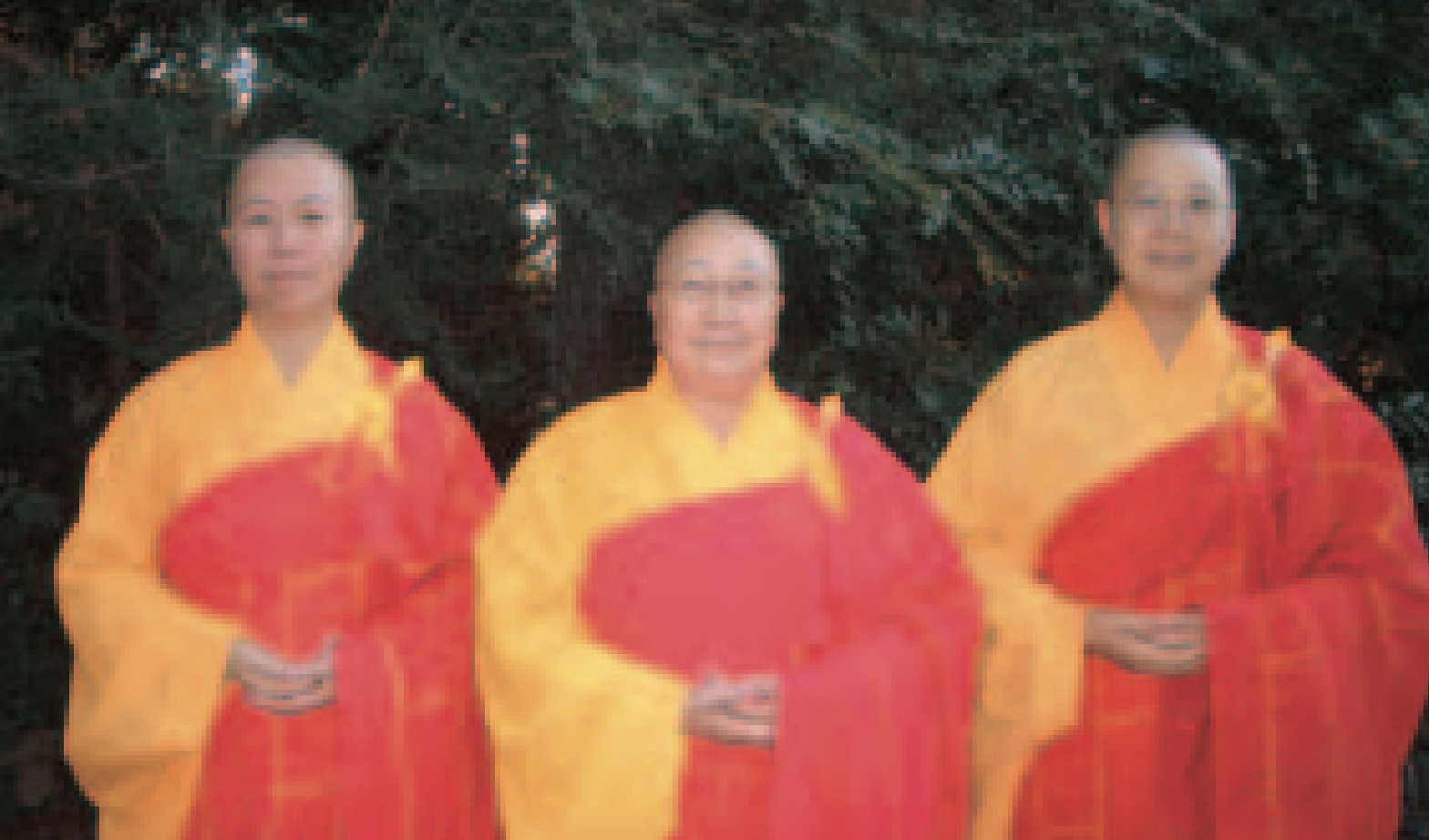



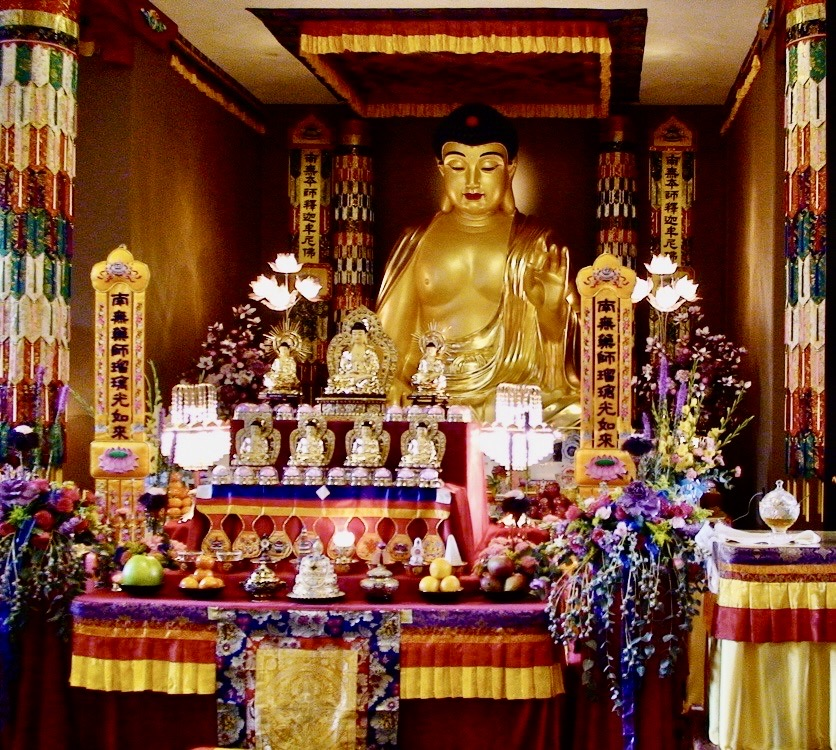


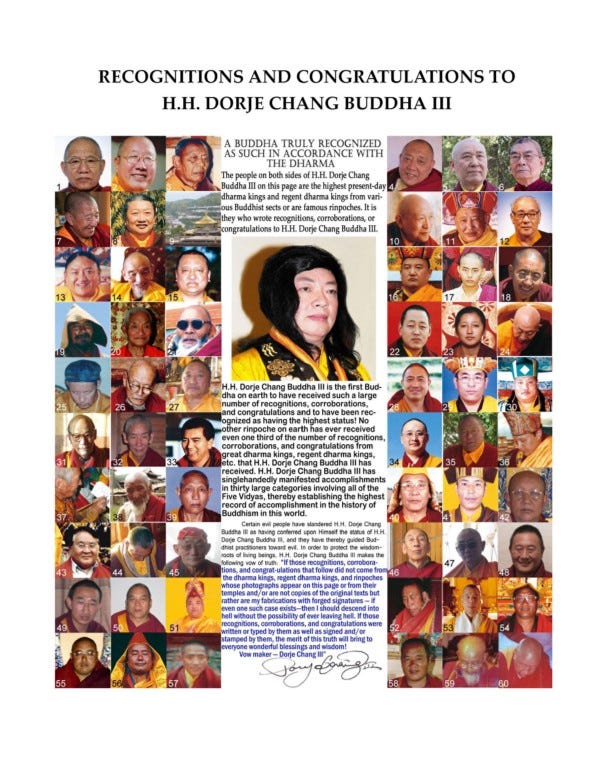
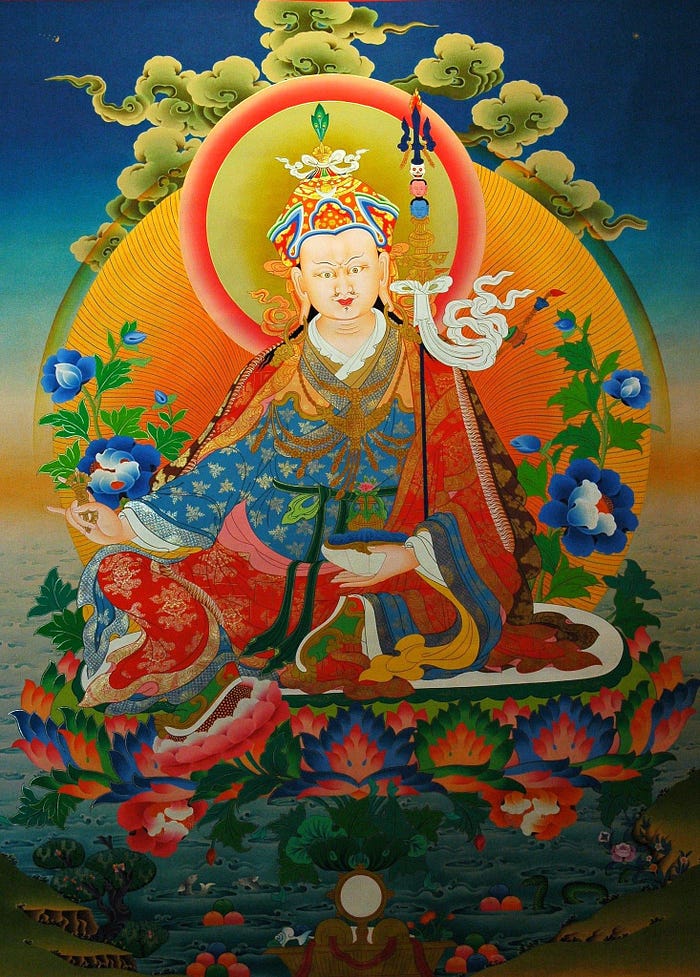



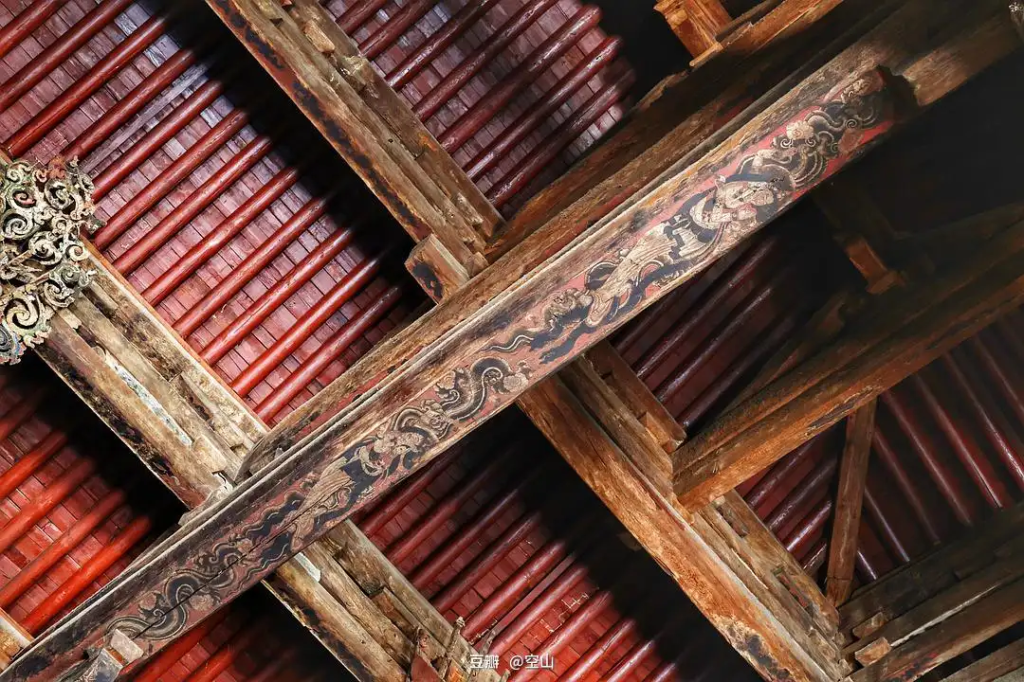
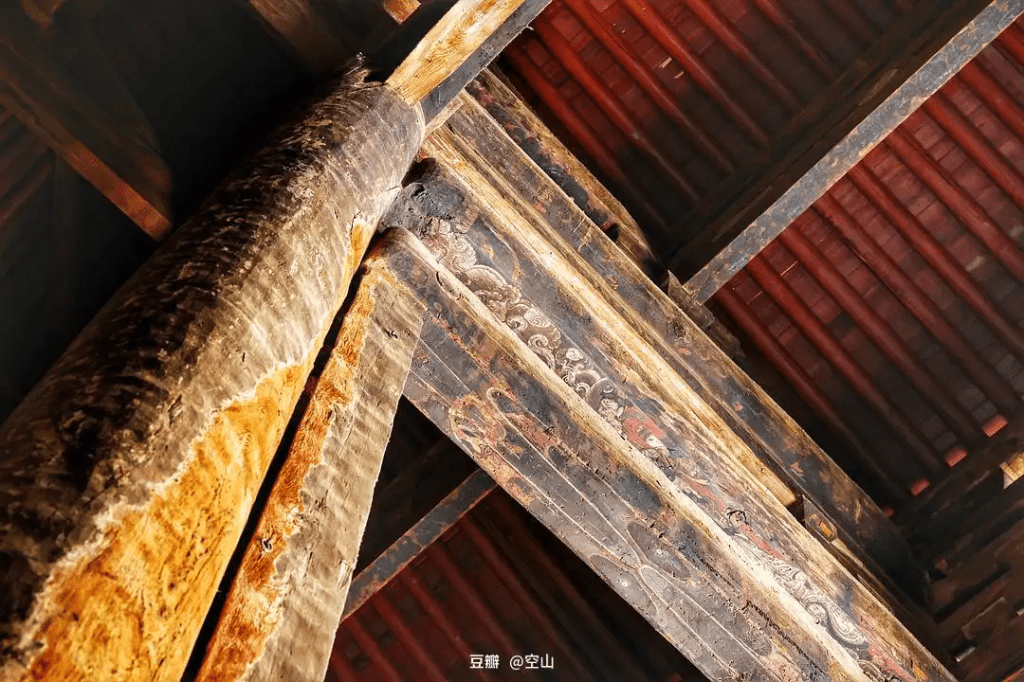

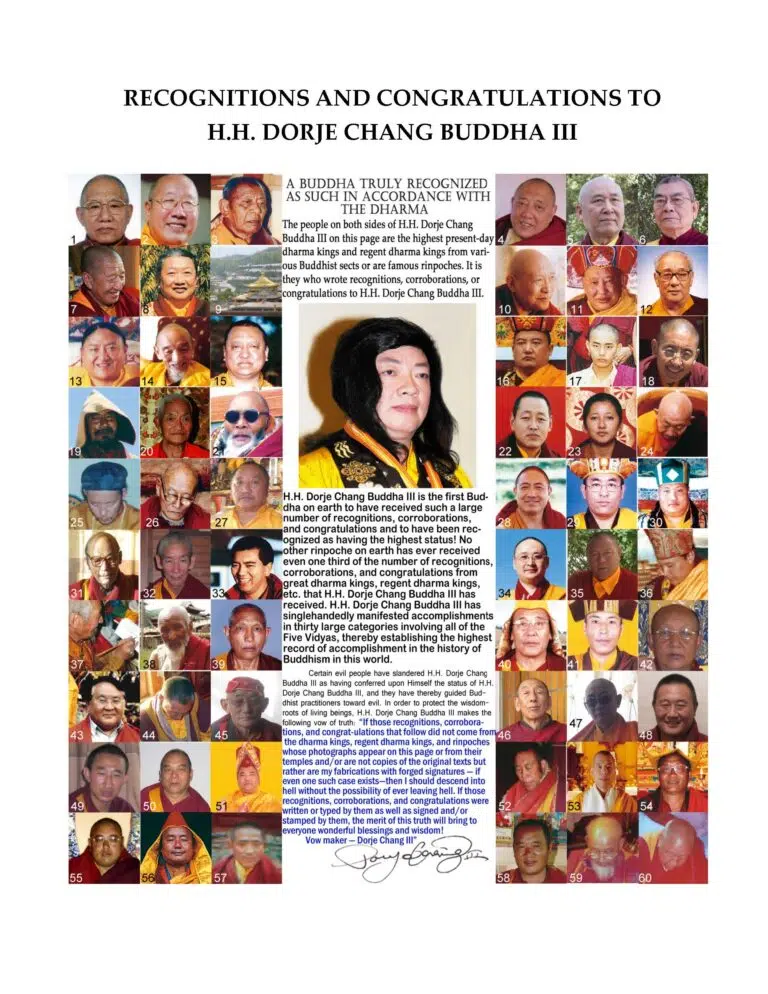
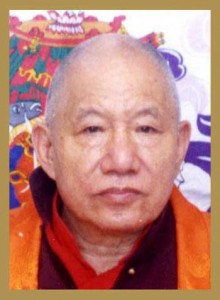
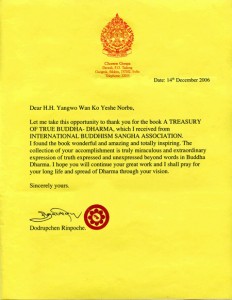


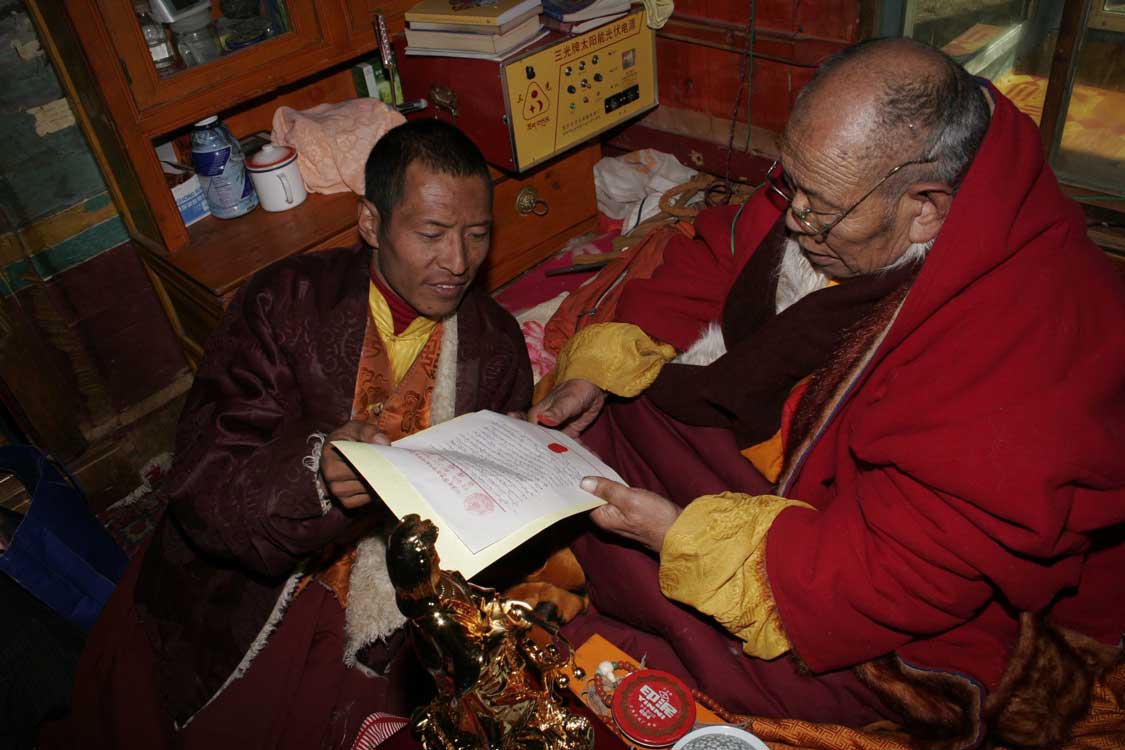


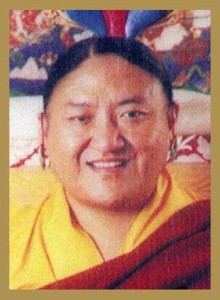
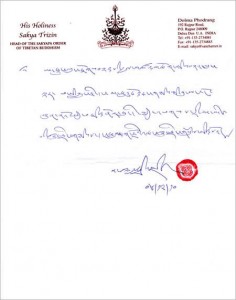

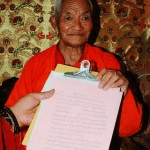

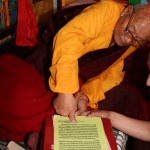

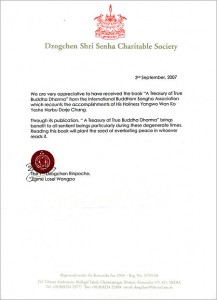

 Respected Khenpo Chucheng Qupei, whose status as khenpo was conferred upon him by H.H. Dharma King Sakya Trizin, respectfully praised H.H. Dorje Chang Buddha III Wan Ko Yeshe Norbu, as follows: “His Holiness is the supreme holder of the 84,000 Buddha-dharmas, the one who is in charge of all dharma methods of Buddhism. His Holiness was the first sambhogakaya Buddha in the dharmadhatu.”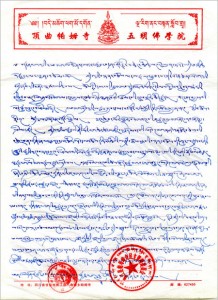


 Peace LiLy