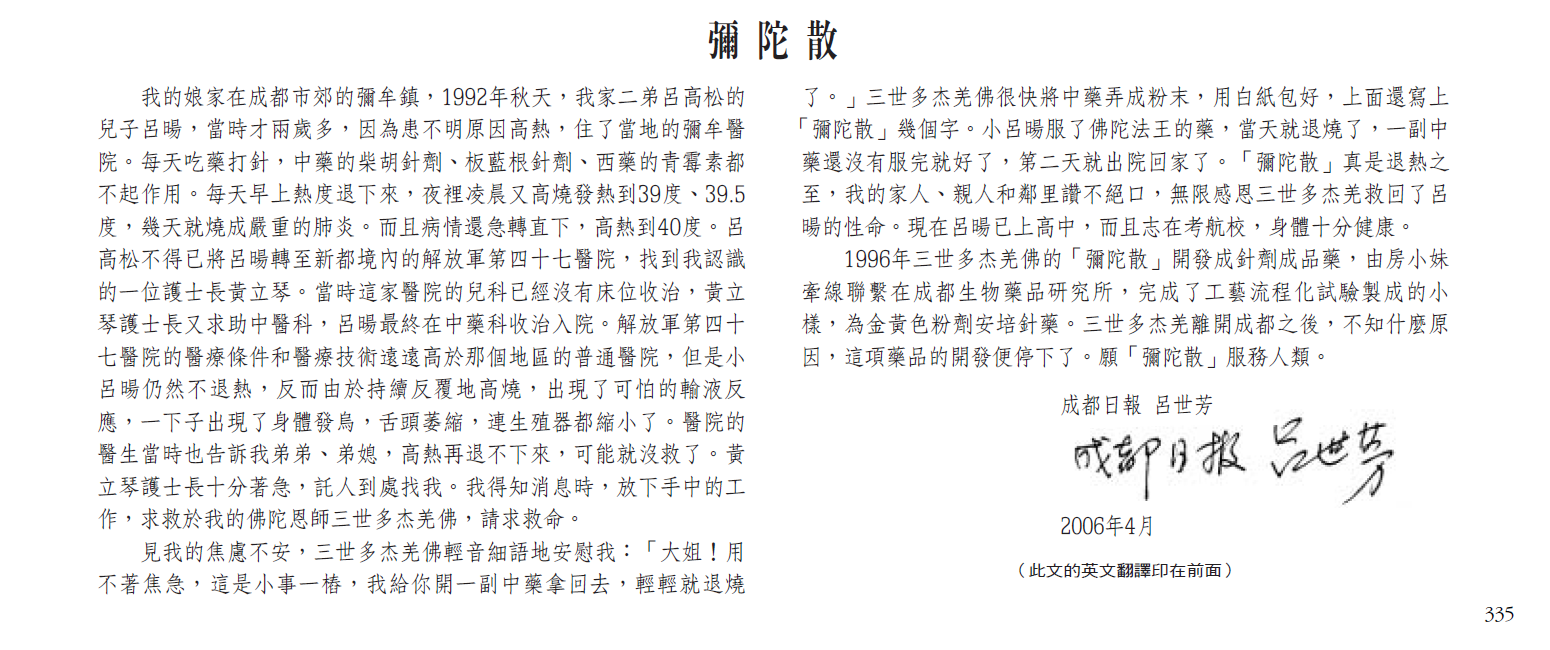
My family is originally from Mimou in the suburbs of Chengdu. In the autumn of 1992, my second younger brother Gao-Song Lu’s two-year-old son, Yang Lu, was hospitalized in the local Mimou Hospital with a mysterious high fever. Every day he received shots and took all sorts of medicine. This included Chinese herbal medicine, such as bupleurum falcatum and isalis root, and Western medicine, such as penicillin. None of them did any good. Every morning his fever would go down, but late at night it would rise up to 39°C (102.2°F) or 39.5°C (103.1°F). Within a few days, Yang Lu had developed a serious case of pneumonia. His condition worsened quickly, and his fever rose to 40°C (104°F). His father Gao-Song Lu had no choice but to move him to the 47th Military Hospital in Xindu.
There was a shortage of beds at the pediatric department, but with the help of the hospital’s head nurse, Li-Qin Huang, a friend of mine, Yang Lu found a place to stay at the department of Chinese herbal medicine. Yang Lu received much more advanced treatment at the military hospital than he did at that local ordinary hospital, but his temperature did not come down. To make matters worse, because of his continuous high fever, a horrible reaction to one of the intravenous shots all of a sudden caused his skin to blacken and and his tongue and reproductive organs to shrink. The doctor told my brother and his wife that Yang Lu might not live if the fever did not abate soon. Li-Qin Huang, the head nurse, was very worried and had someone look all over for me. When I finally heard what was happening, I dropped my work immediately and went to the residence of my respected Buddha master, His Holiness Dorje Chang Buddha III, to seek help.
I was very anxious, but H.H.Dorje Chang Buddha III consoled me. “Do not worry. This is a small matter. I will give you Chinese herbal medicine that will bring down the fever in no time.” H.H. Dorje Chang Buddha III promptly ground the medicine to powder, wrapped it in white paper, and wrote on it “Mi Tuo Powder.” Yang Lu took the medicine, and his fever came down that very day. He was cured without even taking all of the Chinese medicine. The next day he was able to check out of the hospital and return home. My family and neighbors marveled at the effectiveness of “Mi Tuo Powder” and were all deeply grateful to H.H. Dorje Chang Buddha III for saving Yang Lu’s life. Yang Lu is now in high school and plans to apply to the air force academy. He is very healthy.
In 1996, an injected form of H.H. Dorje Chang Buddha III’s “Mi Tuo Powder” was developed. Xiao-Mei Fang made arrangements with the Chengdu Institute of Biological Medicine to complete production procedures and produce a sample of golden ampere injected medicine. After H.H. Dorje Chang Buddha III left Chengdu, the development was terminated for some reason. I hope that someday “Mi Tuo Powder” will be made available to help all people.
Chengdu Daily News Shih-Fang Lu,
April, 2006
(This is a complete translation of the Chinese text that follows originally written and signed by Shi-Fang Lu.)
Editor’s Note: This article is dedicated to Mother’s Day. The author is a 47-year-old mother whose eldest son is already 20 years old. Two years ago, after unexpectedly becoming pregnant with a second child, she firmly chose to give birth despite her husband’s threats of divorce, opposition from family members, and the risks associated with advanced maternal age. How did she maintain such a moving and unwavering maternal love? What gave her the strength to stand against worldly pressures?
I. I Planned to Become a Nun, but Unexpectedly Became Pregnant
“If you insist on keeping this baby, then let’s get divorced! The older child stays with me, and you can raise the second child by yourself!”
My husband nearly shouted those words at me.
“Please,” I replied through tears, “the baby is perfectly healthy. Please give this child a chance to be born and live.”
That evening, after dinner, we once again argued fiercely about whether I should keep or abort this unexpected pregnancy. My husband presented every possible reason why we should not have a second child. Whether through persuasion or pressure, his goal was the same: he was determined that I terminate the pregnancy.
At that point, the “uninvited guest” in my womb was exactly three months old.
I call the baby an “uninvited guest” because I had already made up my mind to become a nun.
One day in 2017, I attended a Dharma listening session at a Buddhist center and respectfully listened to the Dharma discourses of H.H. Dorje Chang Buddha III. That gathering opened a completely new chapter in my life.
I subsequently took refuge in the Three Jewels. Through continuously listening to the Buddha’s Dharma discourses and studying Buddhist teachings, I gradually understood the true direction of my life and became determined to cultivate diligently. Eventually, I developed the aspiration to renounce worldly life and even completed an application to enter monastic life.
A few days after submitting the application, on December 8, 2018, I suddenly felt weak and nauseated. When I went to the hospital for an examination, the doctor informed me that I was pregnant.
It was completely unexpected.
Shock, confusion, struggle, disappointment—my emotions surged all at once. I had no idea what to do.
Had I not been studying Buddhism, I might have simply chosen abortion as many women do when they do not want a child. But as a Buddhist disciple, I had come to understand the law of cause and effect and the preciousness of obtaining a human birth.
How could I harm my own child and deprive a soul of the opportunity to be reborn as a human being?
Most importantly, I had already resolved to become a nun. Yet now this “uninvited guest” had arrived. Surely I could not enter monastic life while carrying a child.
Would I spend the rest of my life occupied with the responsibilities of family life?
Soon I came to accept the situation. This was karmic affinity—something beyond my control. I decided to follow the natural course of events.
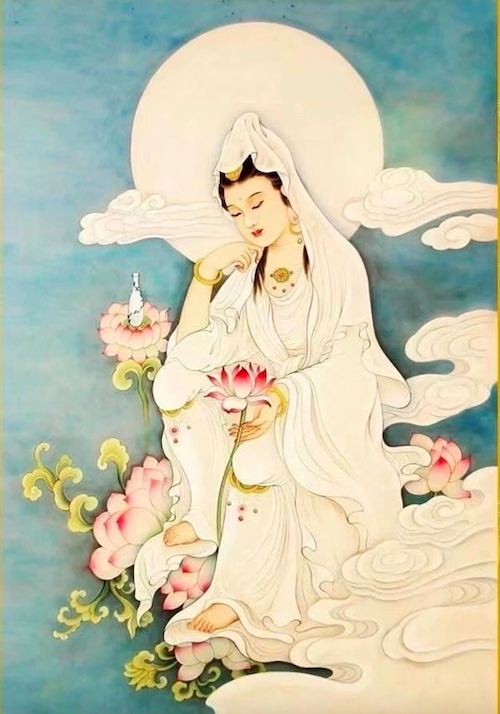
While silently reciting the holy name of Namo Avalokitesvara Bodhisattva, I underwent an ultrasound examination. The baby was healthy and developing normally.
The doctor said, “At your age, becoming pregnant is not easy. I’ll prescribe medication to help stabilize the pregnancy. If you don’t intend to keep the baby, you should schedule the procedure soon. You’re already nearly two months pregnant.”
His words only strengthened my determination to give birth.
II. “I Will Protect This Child with My Life”
Both my husband and I had health issues. It had not been easy raising our first son, who was already in high school. My husband had long opposed the idea of having another child, so I initially concealed the pregnancy from him.
However, he soon found out.
Our household erupted into turmoil.
Whether during meals, before bed, or through messages on WeChat, he constantly urged me to undergo an abortion. We argued repeatedly. He even accused me of being selfish.
I felt helpless and dreaded going home. I tried to avoid seeing him whenever possible.
The only place where I found peace was at the Buddhist center, listening to the Dharma discourses of H.H. Dorje Chang Buddha III and reciting the holy name of Namo Avalokitesvara Bodhisattva. Whenever I bowed before the Buddha or looked upon the image of Avalokitesvara Bodhisattva, I would burst into tears uncontrollably.
My husband then organized a family gathering and invited my siblings to persuade me to abandon the pregnancy.
Everyone expressed their opinions. Alone, I found myself debating against the entire family.
Then my husband delivered what he believed was the ultimate threat:
“If you insist on giving birth, then you’re on your own. We’ll get divorced. I’ll only take responsibility for our older child.”
Without hesitation, I replied:
“I will take full responsibility for whatever happens. Even if I become a beggar, I will raise this child. If anyone tries to take this child away, I will protect him or her with my life.”
I cried and ran outside.
In late December 2018, my husband placed a divorce agreement and our marriage certificate in front of me and demanded that I sign.
I faced the most difficult decision of my life:
Should I choose my child or my marriage?
Should I raise an infant alone, or maintain our family of three and continue our comfortable life together?
I did not sign the agreement.
Instead, I wrote a will.
As an older expectant mother, I knew there were risks associated with childbirth. I carefully arranged my affairs and entrusted a Dharma sister with the responsibility of raising the child if something happened to me. I hoped she would one day bring the child to pay respects to the Buddha. If that became impossible, I requested that a temple care for the child.
By continuously listening to the Buddha’s Dharma teachings, I gained a deeper understanding of karma and causality. I firmly believed that if I sincerely practiced according to Buddhist principles, the future would not be as bleak as I feared.
Kneeling before the Buddha altar, I made a solemn vow:
No matter how difficult the future became, I would not abort this child. Even if my own life were at risk, I would give birth. I prayed for the blessings of the Buddhas and Bodhisattvas to protect both myself and my child.
III. Upholding Buddhist Principles Brings the Best Outcome
Life is often full of unexpected turns.
On New Year’s Day 2019, my son returned home from school and accidentally discovered the unsigned divorce agreement on my bedside table.
Without hesitation, he tore it up.
Before returning to school, he secretly wrote a letter to his father and slipped it into his coat pocket.
When I later read the letter, I broke down in tears.
My son recalled how hard our family had worked to raise him, how loving his parents once were, and how much his mother had sacrificed. He even included a cherished family photograph.
After reading the letter, my husband’s attitude gradually softened.
When an ultrasound later confirmed that the baby was a healthy girl, the entire family rejoiced. My husband’s family had always hoped for a daughter.
From that moment onward, everyone’s attitude changed dramatically. Instead of opposition, they began showing genuine care and support.
Throughout the pregnancy, I continued attending Dharma study sessions, participating in Buddhist activities, and praying to Namo Avalokitesvara Bodhisattva. I also engaged in acts of merit such as life release, offering lamps, making offerings to the Buddha and Sangha, and reciting the Universal Gate Chapter of the Lotus Sutra.
Although I was considered an older expectant mother, my pregnancy progressed remarkably well.
On July 4, 2020, while lying on the operating table, I focused wholeheartedly on reciting the holy name of Namo Avalokitesvara Bodhisattva.
The cesarean section proceeded smoothly and without complications.
A healthy baby girl weighing 6.8 pounds was born.
Family and friends waiting outside the operating room were overjoyed.
My first cesarean section had been extremely difficult, with serious complications for both mother and child. Yet this time, I was able to get out of bed and walk the very next day.
When I returned to work after maternity leave, my colleagues remarked that I looked unchanged despite having given birth and joked that I had gained the perfect blessing—a son and a daughter.
I proudly replied:
“Of course it’s different when one has the blessings of the Buddhas and Bodhisattvas.”
And that is exactly how it felt.
Today, my daughter is nearly two years old.
Time and again, circumstances have unfolded in the best possible way. Relatives unexpectedly appeared when childcare help was needed. Teachers made special accommodations for her. She became beloved by classmates and teachers alike.
Everything seemed to fall naturally into place.
Only a few days after her birth, my husband was recommended for a local leadership development position. Friends congratulated him on receiving two blessings at once.
The storms that once threatened our family have long since passed.
Our family of four now enjoys a harmonious and happy life together.
Through this experience, I came to understand the true meaning of perseverance.
A mother’s willingness to protect her child, no matter the hardship or sacrifice, is perseverance.
A Buddhist disciple’s commitment to cherish all life and uphold the principle of “Refrain from all evil and practice all good” despite difficulties and humiliation is also perseverance.
People often ask me what gave me the strength to remain steadfast.
I can only say that beyond the power of maternal love, there was also the power of Buddha Dharma.
As Mother’s Day approaches, I hope that all parents may find the courage to uphold what is right and allow those karmically connected children who come into this world the precious opportunity of human life.
As long as we uphold wholesome causes and conditions, no obstacle is impossible to overcome.
Written by: Ye Mingzhu Edited by: Lamp Before the Buddha (Fo Qian Deng)
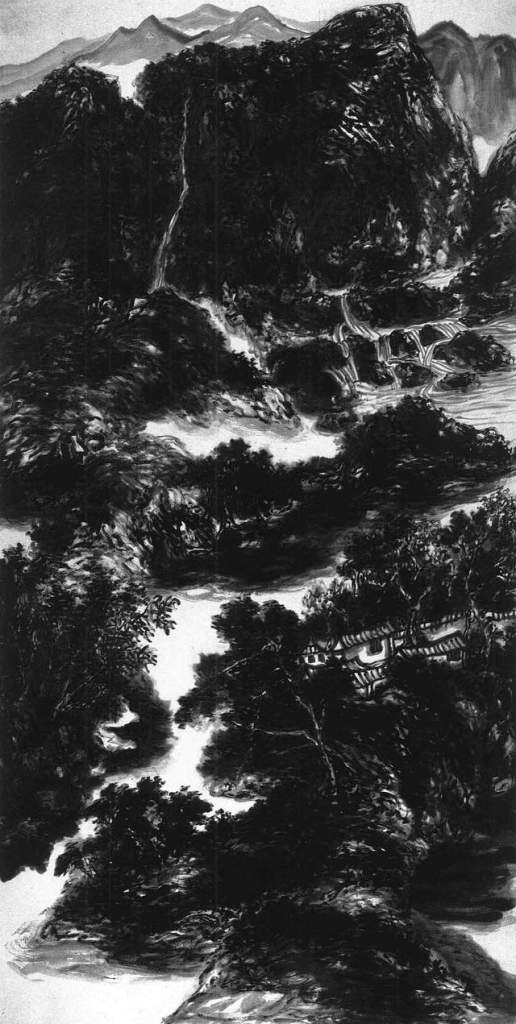
In the vast river of Chinese art history, literati landscape paintings (Wenrenhua 文人画) have traditionally served as a sanctuary for the soul—using brush and ink to transcend the mundane world and attain the highest realm of spiritual freedom. In the pantheon of contemporary Eastern art, “Ancient Cypresses Intoning by the Spring”—a Chinese landscape masterpiece by H.H. Dorje Chang Buddha III (Yi Yun Gao义云高)—stands as an immortal monument of the Literati Style (Wenfeng文风派). It not only showcases a profound scholarly aura and masterful brush-and-ink technique, but also ushers viewers into an eternal, boundless cosmic life-space.
The entire composition relies solely on shades of wash and ink to dot and stain the wondrous peaks, ancient cypresses, and secluded cottages. Through the masterful use of white space (liubai留白), the grand spectacle of thundering waterfalls and surging mountain springs is vividly brought to life. The sounds of roaring wind, rushing springs, and whispering pines are all transformed upon the paper into dynamic visual lines and lively ink tones, filling the entire conceptual space with invisible celestial melodies. This touch of pure ink is precisely the ultimate spiritual realm—honest, elegant, natural, yet profoundly deep—that Chinese literati across generations have spent their entire lives pursuing.
The artistic conception of Ancient Cypresses Intoning by the Spring is remarkably deep, ethereal, and serene. The imagery carries a desolate yet vast quality, evoking an ideal world of mythical mountains and jade islands completely untouched by worldly noise or secular dust.
Most profound of all is how the sense of time dissolves before this artwork:
No Human Traces: The painting features no worldly figures; it presents only the primordial essence of nature.
No Trace of the Artist: The brushwork is incredibly mature yet leaves no deliberate mark, as if the painting was not rendered by human hands but manifested spontaneously by heaven and earth.
No Trace of the Viewer: As you gaze into the painting, the ego dissolves, and the self merges entirely into the landscape.
Here, the duality of subject and object vanishes. All phenomena exist in pure, seamless unity, entirely natural and spontaneous. With a single brush, the artist delineates the physical form of the earth, yet weaves it seamlessly with the void of the universe—structuring a vibrant, ever-generating cosmic space.
📜 A Paradigm Beyond Reality: “Imagery Beyond the Universe, Life Beyond the Seasons”
The great Qing Dynasty master painter Yun Nantian once evaluated the highest realm of art with these words:
“Gazing deeply into this realm, every blade of grass, every tree, every hill, and every ravine feels uniquely carved from a pure spirit, belonging to no mortal world. Its imagery exists beyond the universe, and its life unfolds outside the four seasons.”
This means that a truly sublime artistic realm is born entirely from the pristine spirit of the artist—a sacred landscape unfindable in the mundane world. Its essence transcends physical boundaries, and its cycle of growth and decay outlasts the changing of spring, summer, autumn, and winter.
Ancient Cypresses Intoning by the Spring by H.H. Dorje Chang Buddha III is the perfect paradigm of this transcendent landscape art. Refusing to be bound by mere literal resemblance, it draws directly from the primordial source of the universe, using flawless contemporary brushwork to reawaken the core spiritual essence of traditional Chinese literati painting.
Ancient Cypresses Intoning by the Spring is far more than a master-level art treasure; it is a spiritual home where the soul can find perfect rest. In our bustling, modern society, when we gaze upon this masterpiece—listening to the low hum of the ancient cypresses and watching the crystal springs rush forth—the anxieties of life dissolve instantly. This is the power of true art, and this is the soul-stirring beauty that H.H. Dorje Chang Buddha III has bestowed upon the world.
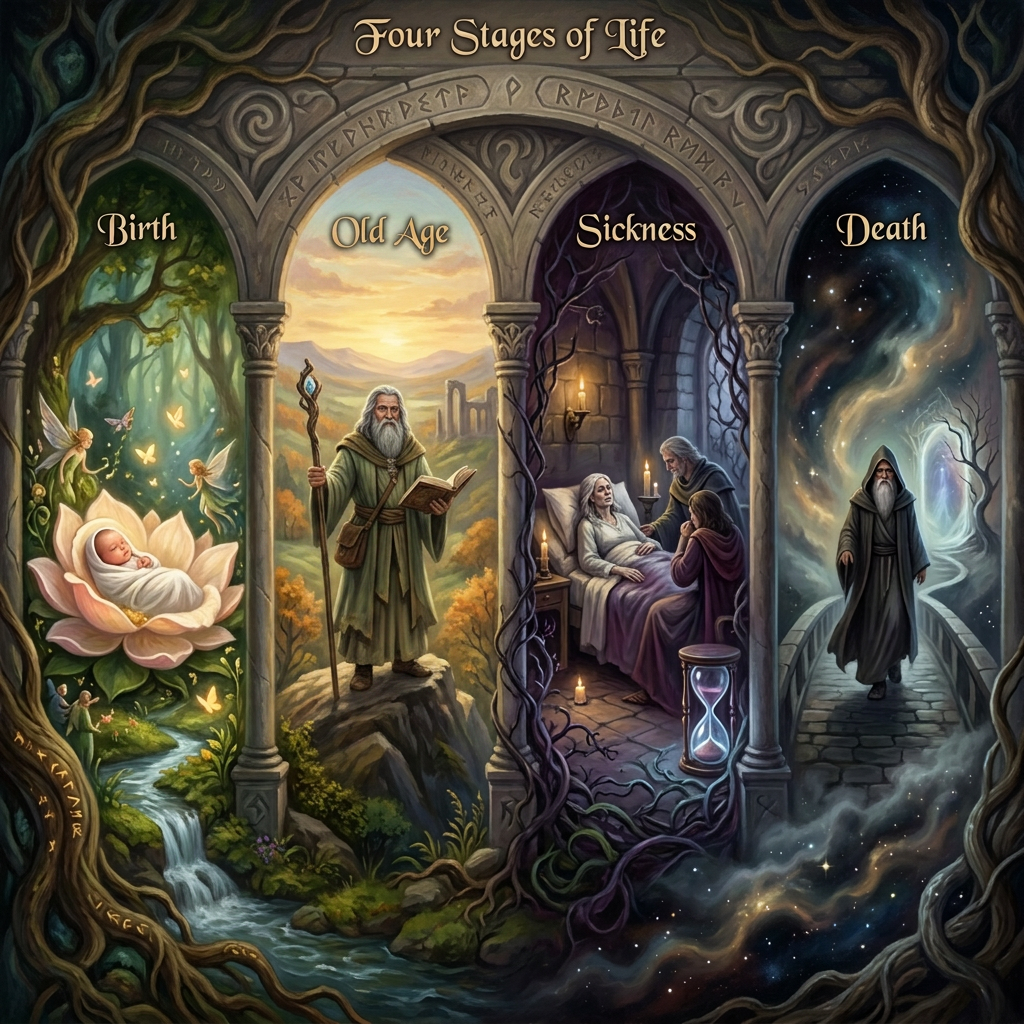
In this life, none of us can escape the torments of birth, aging, illness, and death. As the old saying goes, “Even the strongest man fears the toll of disease.” When our physical bodies face the pain of a terminal illness and our minds plunge into the fear of death, we often feel incredibly small and hopeless. However, the true, orthodox Tathagata Dharma possesses the magnificent power to enable sentient beings to completely sever the cycle of dark karma, achieve liberation in this very lifetime, and attain freedom over life and death.
This article is compiled from an actual radio interview with Ruzun Ruohui, the Abbot of Hua Zang Si in San Francisco. By sharing a profoundly moving example of a Buddhist disciple’s spiritual realization, Ruzun Ruohui reveals to the public how, under the guidance of our Buddha Master, one can transition from the agonizing pain of a terminal illness to passing away peacefully with palms pressed together—manifesting holy signs of liberation. This account serves as a bright highway to liberation for all sentient beings currently struggling in delusion and illness.
In the eyes of the mundane world, a severe illness—especially late-stage cancer—frequently brings excruciating physical and mental torment. However, Ruzun Ruohui explicitly points out that the fundamental purpose of our Buddhist practice is precisely to free ourselves from the suffering of birth, aging, illness, and death.
Yet, can one truly realize freedom over life and death and achieve holy fruits in this lifetime? Aside from using one’s own practice as a foundation, the most critical factor is that one must learn and practice “True Buddha Dharma.” Among the disciples of H.H. Dorje Chang Buddha III, instances of liberation and accomplishment are too numerous to count. This is exactly because they each received the transmission of sublime, corresponding Tathagata Dharma from their Buddha Master. Even when someone is afflicted with a fatal illness and on the brink of death, they can reverse their negative karmic retributions and achieve liberation in a very short period of time.
Among these, the real-life holy feat of the great accomplished practitioner, Layperson Zhao Yusheng in 2017, serves as a shocking, firsthand testimony to the world.
Layperson Zhao Yusheng’s path to liberation was not without obstacles; he had previously experienced an unfortunate detour into delusion.
He had followed an evil teacher and joined a cult. In his confusion, he carried out its wicked rules, helping the evil teacher promote falsehoods, deceive people, and conceal fabrications. These misdeeds, which harmed the public and society to protect the evil teacher’s private interests, left him heavily laden with dark karma. Because the law of cause and effect never fails, the retribution of his dark karma manifested: he was diagnosed with late-stage cancer. Tormented by the agonizing pain of his illness, he became lucidly aware that he had been utterly ruined by that evil teacher.
On June 27, 2017, suffering from terminal cancer, Layperson Zhao Yusheng mustered his last ounce of strength and flew to Los Angeles. There, he finally met the supreme H.H. Dorje Chang Buddha III. Before the Buddha Master, he offered his most devout and deeply painful repentance.
Facing this lost soul who was covered in dark karma and racked with pain, the great Buddha Master manifested boundless compassion. The Buddha Master told him:
“Whether you repent or not is not what is important. What matters is that you practice well from now on, truly change from evil to good, and benefit society and all sentient beings.”
This teaching reflected ultimate benevolence and compassion, looking past a sentient being’s historical mistakes and focusing entirely on their current self-renewal. Layperson Zhao Yusheng immediately made a great vow, swearing that he would never associate with the cult again, even if it meant “dying right then and there.” His sole wish for this life was to ascend to the Buddha Lands. This unreserved, absolute sincerity moved heaven and earth.
The Yidam Personally Descends: A Holy, Inner-Tantric Initiation Beyond Imagination
Seeing Layperson Zhao Yusheng’s sincerity and that his causal conditions had matured, H.H. Dorje Chang Buddha III compassionately took him refuge and immediately transmitted a supreme Great Dharma to him, invoking the Yidam, Amitabha Buddha!
At the site of the initiation and Dharma transmission, a sacred miracle manifested: Layperson Zhao Yusheng saw with his own eyes Amitabha Buddha descending into the sky, displaying the incomparably magnificent Thirty-Two Major Marks. The Buddha’s entire body emitted boundless golden light as He slowly descended onto the mandala. Overwhelmed with emotion, Zhao prostrated to the Buddha Master, and Amitabha Buddha personally touched his head to bestow the Dharma. The Buddha also pointed toward the West, allowing him to see with his own eyes the radiant, golden gates of the Western Land of Ultimate Bliss. The light streaming from within those gates was ten million times brighter than the sun!
Amitabha Buddha personally told him that at the end of his life, Avalokiteshvara Bodhisattva (Guan Yin) would be sent to receive and guide him to be reborn into the Middle Grade of the Middle Class of the Western Pure Land.
At that moment, H.H. Dorje Chang Buddha III said to him, “You have succeeded; your Yidam, Amitabha Buddha, has accepted you.” For over thirty years, Layperson Zhao Yusheng had chanted the Buddha’s name but never felt certain whether he could achieve rebirth. Now, he finally received a personal guarantee from the mouth of the Buddha.
Upon returning to San Francisco, he treated this transmission like an invaluable treasure, diligently practicing his daily cultivation. Originally, his fingernails had completely dried up and split due to late-stage cancer; however, after practicing the Dharma, they miraculously regrew into smooth, pink, healthy nails, and the cracking completely disappeared. This demonstrated that the blessings of the Buddha Dharma had permeated the very cells of his physical body.
A Sacred Moment of Simultaneous Resonance: Freedom Over Life and Death, Manifesting Auspicious Signs
On August 24, 2017, at approximately 2:15 PM, a moment arrived that all Buddhist disciples will remember for the rest of their lives.
At that exact time, in a mandala over 800 kilometers away, Rinpoches and Dharma Masters were requesting H.H. Dorje Chang Buddha III to expound the Dharma. In the middle of the discourse, the Buddha Master suddenly stopped without any prior sign and announced:
“Stop, I will not speak further. The grand causal condition has arrived; it has appeared. Avalokiteshvara Bodhisattva has escorted Zhao Yusheng away, and the people beside him have witnessed it too.”
Less than two minutes after the Buddha Master spoke these words, a Dharma Master’s phone at the scene rang. On the other end of the line was Mao Meimei, the Buddhist disciple responsible for caring for Layperson Zhao Yusheng. Trembling with immense excitement, she reported to the Buddha: Layperson Zhao Yusheng had achieved freedom over life and death, and Avalokiteshvara Bodhisattva had personally descended to escort him away!
It turned out that just two minutes prior, Layperson Zhao Yusheng had peacefully instructed his caregivers and his daughter from his sickbed, saying that he was about to leave. Using his remaining strength, he declared in a resonant voice:
“I will now use my freedom over life and death to perform a Dharma demonstration, proving that the Buddha Dharma of H.H. Dorje Chang Buddha III is the most supreme and holy! That evil teacher is a demon, a monster! A false teacher, a massive fraud, and a sinner! The true, orthodox Tathagata Dharma resides right here with our great Buddha Master, H.H. Dorje Chang Buddha III. Alright, alright, I will say no more—Avalokiteshvara Bodhisattva has come to receive me.”
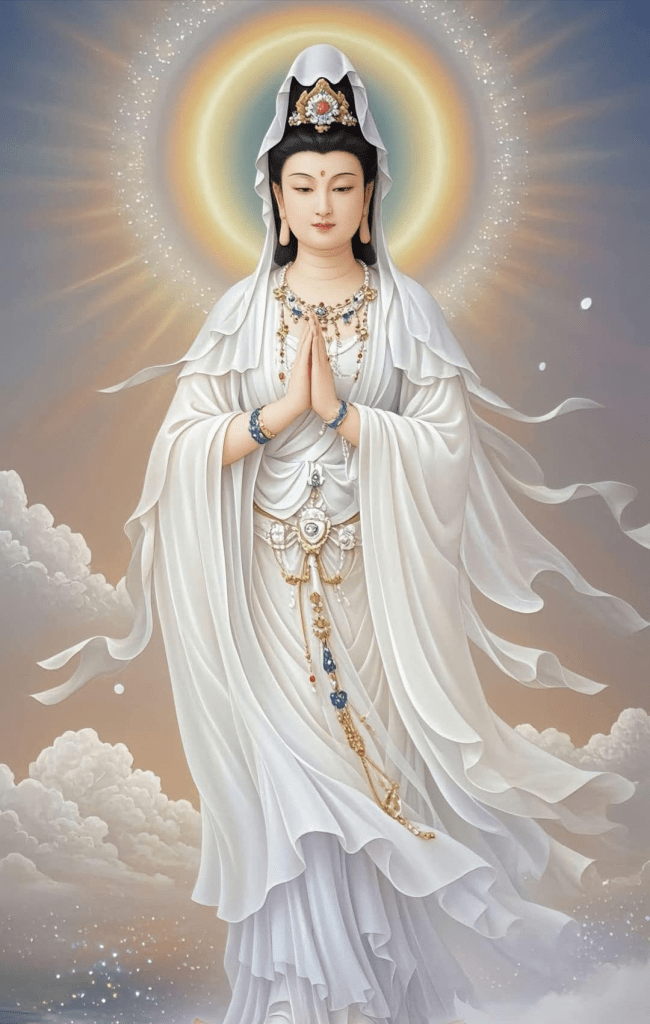
As soon as he finished speaking, a breathtaking holy feat occurred: Layperson Zhao Yusheng’s entire body emitted an extraordinary radiance. The people present clearly saw an immensely tall Avalokiteshvara Bodhisattva standing directly above his head, radiating intense white light, surrounded by beautiful five-colored auspicious halos—a scene of ultimate magnificence!
Following this, Layperson Zhao Yusheng’s consciousness burst forth from the crown of his head, transforming into a radiant holy being dressed in white garments. Stepping onto auspicious clouds, his consciousness rushed toward Avalokiteshvara Bodhisattva, ascending into the sky and departing. This astonishing sight was even witnessed by a 92-year-old Malaysian neighbor living across the street! Everyone rushed out into the courtyard and saw the entire sky filled with a dazzling, brilliant light. Avalokiteshvara Bodhisattva led the way, guiding the holy being Zhao Yusheng as he ascended to the Western Land of Ultimate Bliss, gradually fading into the depths of the sky.
Layperson Zhao Yusheng transformed from a terminally ill patient—deceived by an evil teacher and burdened with dark karma—into a liberated practitioner who received the true Dharma from H.H. Dorje Chang Buddha III. Within a mere two months, he realized a miracle of liberation: breaking free from the shackles of illness, gaining freedom over life and death, being personally received by Guan Yin, and leaving a sign witnessed by the entire neighborhood. This is not a myth; it is a holy manifestation of Buddha Dharma presented right before our eyes.
He departed with absolute freedom and ease. Before his passing, he courageously demonstrated the Dharma through the reality of freedom over life and death, exposing the false teacher and denouncing the demon, thereby using his compassionate heart to awaken deluded sentient beings.
Upon receiving the news, the Dharma Masters, monastic community, and laypersons at Hua Zang Si were filled with joy and comfort. This holy feat manifests clearly to the world: the true, orthodox Tathagata Dharma resides right here with H.H. Dorje Chang Buddha III! May all sentient beings who are still lost and struggling in the mundane world, on the brink of illness and death, encounter this causal condition. May they quickly stay away from false teachers and frauds, draw close to H.H. Dorje Chang Buddha III to study the true orthodox Tathagata Dharma, and step onto the path of genuine liberation and happiness!
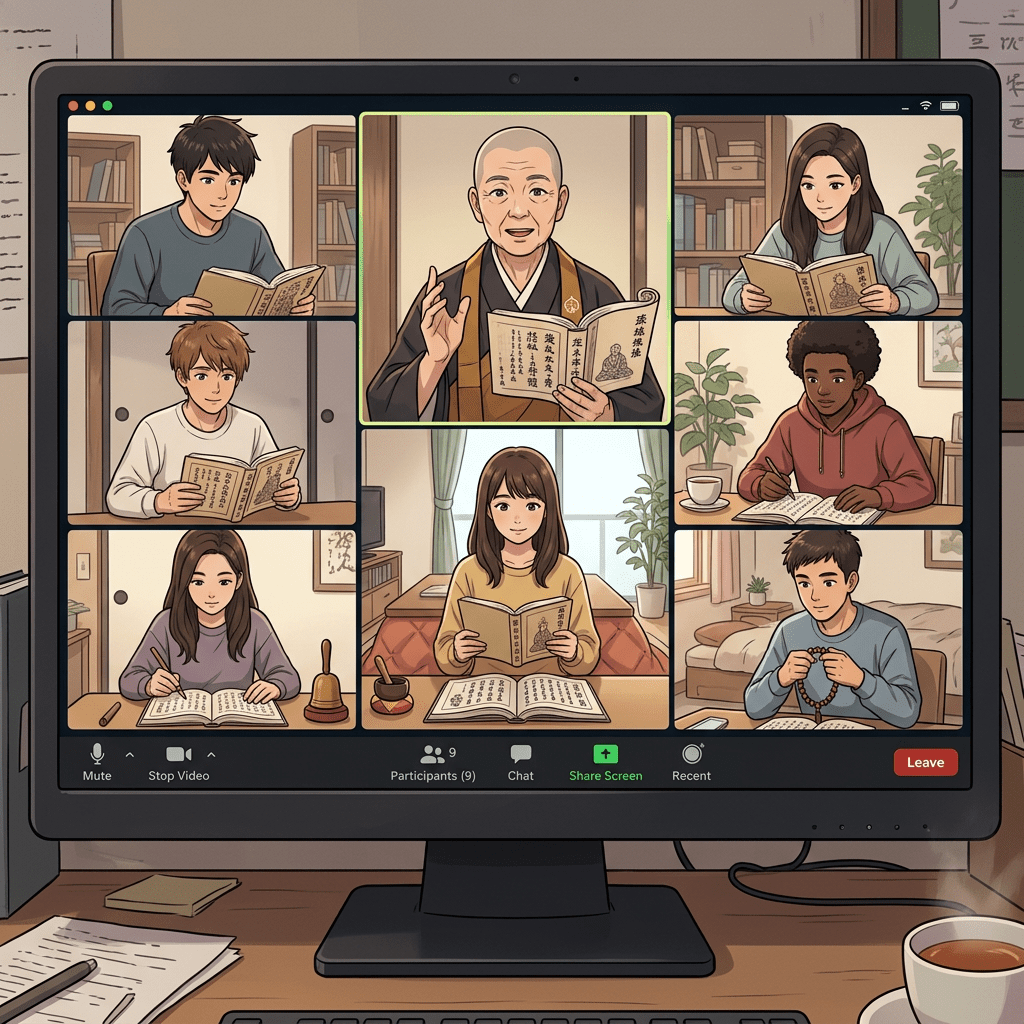
Recently, I joined an online Buddhist study group where we have been deeply immersing ourselves in learning the Sutra by H.H. Dorje Chang Buddha III. This experience has changed my life dramatically. As I began dedicating more intentional time to reading and listening to the Sutra, I noticed a powerful shift in my daily habits. I finally found the strength to break away from the mindless habit of scrolling through screens, freeing up the space and energy to exercise regularly. By simply replacing digital distraction with spiritual study and physical movement, I already feel significantly happier and healthier.
As I continue this journey, I often find myself reflecting on how these profound teachings apply to the ordinary, messy moments of everyday life. It is easy to study a principle conceptually, but the true cultivation begins when we bring it off the page and into our interactions with the world.
One teaching from the Sutra that has particularly influenced me—and completely shifted my perspective—is the vital importance of examining myself before focusing on the shortcomings of others.
In daily life, our default reaction to friction is often outward-facing. When someone cuts us off in traffic, misunderstands our intentions, or speaks with an edge in their voice, the ego immediately jumps to defend itself. It points a finger at the other person’s impatience, rudeness, or flaws.
However, the teachings of H.H. Dorje Chang Buddha III remind us that external circumstances are merely mirrors reflecting our own internal state. True cultivation requires us to break this habit of looking outward and instead turn our gaze fiercely and honestly inward.
Now, whenever I encounter misunderstandings, disagreements, or situations that test my patience, I pause. Before I speak, react, or allow resentment to build, I try to ask myself these four grounding questions:
Have I truly looked inward first? Am I seeing this situation clearly, or am I viewing it through the distorted lens of my own biases and expectations?
Is there something I need to improve in myself? Instead of demanding that the other person change, what flaw, impatience, or lack of skill in my own conduct needs addressing?
Am I responding with compassion and wisdom? Is my energy coming from a place of genuine care for the other person’s well-being, or is it coming from a desire to be “right”?
What attachment or habit might I be overlooking? What underlying ego-attachment—whether to my reputation, my comfort, or my pride—is causing me to feel triggered right now?
Although it is not always easy—and requires constant mindfulness—this practice has been quietly transformative. It acts as a circuit breaker for negative emotions. By shifting the focus from “what they did wrong” to “how I can grow,” I have found myself becoming genuinely more patient, more deeply understanding of others’ hidden struggles, and far less reactive to life’s daily irritations.
Cultivation is not about achieving perfection overnight; it is about making the consistent choice to choose wisdom over ego, one interaction at a time.
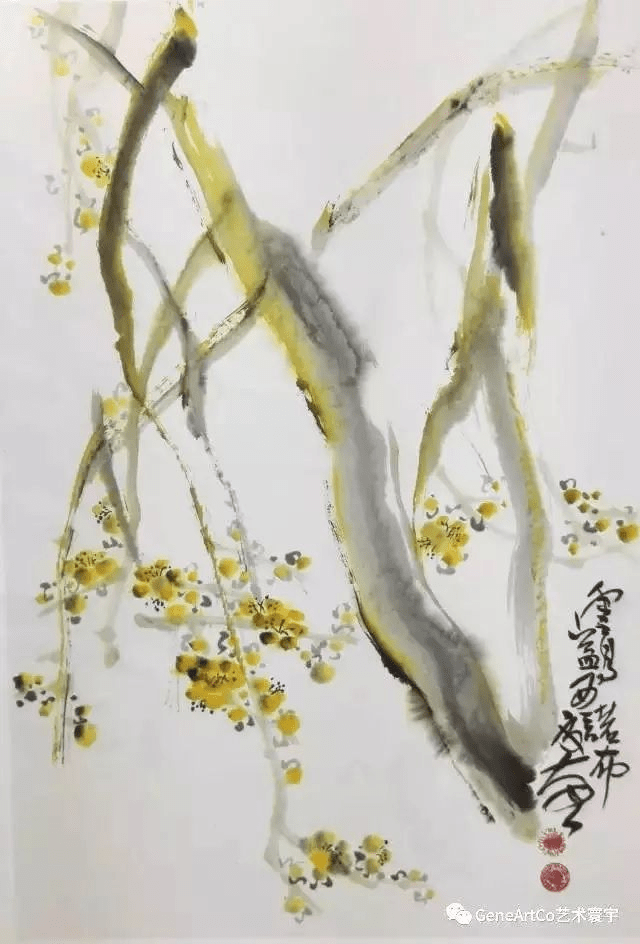
The moment your eyes rest upon “Flowers in the Garden”—a Chinese painting masterpiece by His Holiness Dorje Chang Buddha III—a sense of transcendent peace and quiet joy quietly washes over you.
The painting opens with a frame full of vital rhythm and poetic grace:
In a quiet garden, flower buds tremble on the verge of blooming, while a few solitary plum blossoms quietly unfold along the branches.
Look closely, and you can almost pierce through the canvas to inhale the faint, delicate fragrance drifting out from the silence. There is no noisy clamor of a garden in full, chaotic bloom. Instead, there are only a few scattered blossoms softly opening on the branch—yet in a single snapshot of time, they touch the tenderest part of the human heart, stirring a unique and profound sense of delight.
The Mastery of Elegance: Simple Strokes, Infinite Meaning
What truly mystifies viewers about “Flowers in the Garden” is its incredibly minimalist yet profoundly rich visual language. This artwork elevates the traditional ink-and-brush techniques of Chinese painting to their absolute zenith:
Lines that Vibrate with the Soul: The sparse, calculated lines in the painting are relaxed yet full of hidden strength, moist yet aged with character. They are not merely the structural forms of branches; they feel like the physical vibration of the creator’s soul, whispering endless stories across time. These rhythmic, undulating lines serve both as a deeply expressive emotional language and the powerful skeletal framework that supports the entire composition.
The Ethereal Space of Ink and Void: As our gaze passes through these sweeping lines to contemplate the negative space they divide, an otherworldly sense of emptiness embraces us. It is a beauty akin to “looking at flowers through a fog, or gazing at the moon reflected in water”—illusory, misty, and wonderfully detached from the mundane world.
Within this luminous, spiritually charged space, the creator embeds a crisp, rhythmically swift calligraphic inscription. The calligraphy and the painting reflect and elevate one another, suddenly bringing forth an indescribable artistic beauty.
This artistic ambiance—which flawlessly uses the solid to guide the void, remaining completely natural and untainted by the world—possesses an almost miraculous power of attraction. Effortlessly, it cleanses the viewer’s inner restlessness, transporting us into a completely transcendent, breathtakingly beautiful spiritual realm.
Words have an end, but artistic conception is infinite. “Flowers in the Garden” is far more than a traditional Chinese painting for passive appreciation; it is a tangible manifestation of H.H. Dorje Chang Buddha III’s world-astonishing artistic genius brought to the human realm.
[Introduction] This blog post is compiled and adapted from an interview with Buddhist Practitioner, Ruo Hui Ru Zun, the Abbot of Hua Zang Si in San Francisco, USA. To read the full transcript of the interview, please visit the official Hua Zang Si website:Full Interview Record.
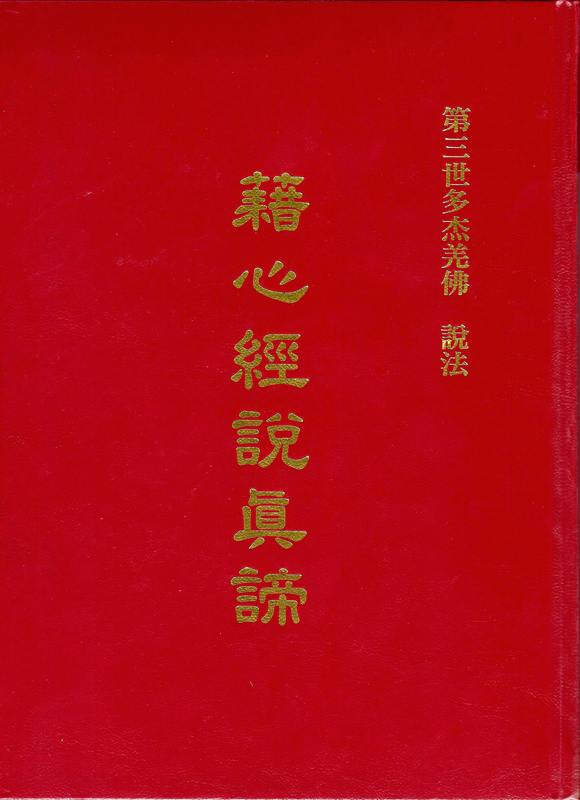
In this chaotic and bustling world, everyone is searching for a spiritual home and the ultimate truth of life and the universe. There exists such a supreme Buddhist treasure — Expounding the Absolute Truth Through the Heart Sutra. In this sacred text, Namo H.H. Dorje Chang Buddha III uses the verses of the Heart Sutra to directly reveal the ultimate truth regarding Buddhas, living beings, the sentient and insentient, and the cosmic principles of formation, existence, decay, and emptiness. This precious book is not only a monument of profound wisdom, but its birth and publication were accompanied by multiple miraculous events that defy modern science—leaving anyone who hears them deeply moved and awestruck.
⊙ Praise Across Time and Space: The Miraculous Audio Insertion by Avalokitesvara Bodhisattva
Looking back to the first day of the lunar new year in 1992, Namo H.H. Dorje Chang Buddha III formally commenced a 15-day discourse on the Dharma, responding to the matured karmic conditions of living beings. These fifteen days of Tathagata Dharma voice saved countless beings and left behind a startling legend that resonates to this day.
On a particular day during the continuous discourse, a holy manifestation occurred right before the assembly:
A Sudden Flash of Divine Light: Halfway through the discourse, the disciples present suddenly perceived a brilliant flash of light. The entire room instantly lit up, accompanied by an indescribable sense of wonder and auspiciousness.
Dual Recordings, a Unique Miracle: To ensure a rigorous record of the Dharma, two identical cassette recorders were placed at the scene to record simultaneously. Miraculously, when a disciple checked the tapes the following day, one of the tapes unexpectedly contained a flawlessly beautiful and divine female voice, while the other tape captured only the Buddha Master’s regular voice!
A Seamless, Supernatural Interwoven Insertion: This exquisite voice was not background noise; rather, it was precisely “inserted” right into the natural pauses between the Buddha Master’s sentences. In an era of cassette tapes without digital post-production or editing, it was humanly impossible to seamlessly weave an external voice into a live recording without creating blank gaps or requiring complex studio manipulation.
Afterward, the Buddha Master personally performed a Dharma evaluation to investigate, revealing a breathtaking truth—that beautifully moving voice belonged to none other than Avalokitesvara Bodhisattva (Guan Yin Bodhisattva). The Bodhisattva had personally manifested at the assembly to insert Her praise at the most pivotal moment of the Dharma discourse, pronouncing a supreme Name of a Dharma.
This extraordinary recording, carrying the divine praise of Avalokitesvara Bodhisattva, did not merely record supreme truth; it also bore a prophecy that transcended decades.
Back then, Namo H.H. Dorje Chang Buddha III openly declared to His disciples on the recording: In 20 years, this sacred book Expounding the Absolute Truth Through the Heart Sutra will be officially published. Upon its publication, it will move the Buddhas to shower down real holy nectar (amrita) from the Buddha Lands to empower and bless this precious book.
The wheels of history rolled forward. Twenty years later, this seemingly unbelievable prophecy achieved a 100% jaw-dropping, world-shaking realization in 2014.
⊙ Holy Nectar Descends Upon the Mandala: Ironclad Proof of Supreme Buddha Power
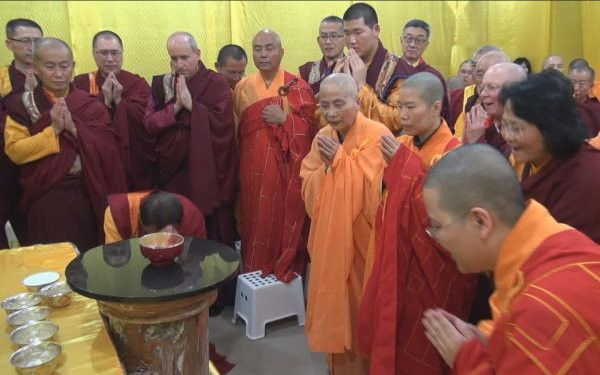
On March 7, 2014, the Holy Miracles Temple in the United States was filled with the resonance of sacred chants as the initial empowerment Dharma Assembly for Expounding the Absolute Truth Through the Heart Sutra commenced.
The sacred book and holy objects were reverently placed upon the Dharma dais. The assembly was co-presided over by the venerable Dharma King Lodro Thaye Rinchen Gyatso (Luodongzan), the octogenarian Kaichu Rinpoche, and the 20-year-old Gongga Rinpoche, while the seven types of Buddhist disciples sincerely chanted the Heart Sutra and holy mantras. As the assembly progressed, a deeply moving holy scene unfolded before heaven and earth:
Howling Winds, Yet the Holy Banners Remain Still: Just over ten minutes into the assembly, violent winds suddenly rushed through the air outside, roaring loudly as the Holy Dharma Protectors descended! Yet, incomprehensibly, the yellow satin banners hanging along the walls remained completely still, undisturbed by the howling winds. Amidst their amazement, the disciples present witnessed various magnificent holy scenes unique to their own vision.
Holy Nectar Descends Out of Vacuity Into an Empty Bowl: As the chanting paused and Gongga Rinpoche prepared to pour six cups of Dharma water into a violet-gold copper bowl that was completely empty, he looked through the transparent lid and was shocked to discover that the bowl was already filled with real holy nectar that had manifested out of nowhere! Overwhelmed with joy and reverence, the Rinpoche prostrated instantly.
A Five-Colored Spiritual Splendor Beyond This World: Subsequently, the monastics and Rinpoches rushed forward to view the manifestation. They beheld the holy nectar appearing in five colors, purple-red, or pure white. Its form, texture, and substance were completely unlike any matter found on Earth—exquisite and sublime beyond words.
As the violet-gold copper bowl was struck, its crisp, sacred resonance echoed through the Dharma Realm. Although Namo H.H. Dorje Chang Buddha III was not personally present to perform the rituals that day, it was precisely because the location of Expounding the Absolute Truth Through the Heart Sutra possesses boundless merit and supreme Buddha power that it naturally invoked this magnificent holy miracle of descending nectar, bridging the mortal and the divine.
Words can record history, but only holy miracles can validate ultimate truth.
From the miraculous insertion of Guan Yin Bodhisattva’s voice during its inception, to the descent of holy nectar upon its publication, these ironclad, auspicious miracles thoroughly prove that Expounding the Absolute Truth Through the Heart Sutra is a supreme, perfect treasury of Buddhist text. It is a guide capable of leading living beings across the six realms to achieve perfect blessings, wisdom, and ultimate liberation from life and death. May all fortunate readers encounter this book, share in its Dharma benefits, and attain perfect realization!
Have you ever wondered what it would be like to stand in the presence of true, living divine power? To witness a ritual where the boundaries between the mundane world and the heavenly realms completely dissolve?
While fire offerings (Homa) are celebrated throughout Tibetan and Indian Buddhist traditions for their power to eliminate disasters, eradicate obstacles, and increase blessings, there is a legendary form of this ritual that belongs almost entirely to history. It is called the Sublime Fire Offering (Holy Sunyan Homa).
For over eighty years, this ultimate rite had not been successfully manifested anywhere on Earth. But on September 19, 2018, at the Holy Miracles Temple, history was remade. Led by a Highest Holy Guru , an assembly gathered to witness an event that can only be described as a modern-day spiritual miracle.
To understand the magnitude of what transpired, one must understand the difference between a conventional fire offering and a true Sublime Fire Offering. Ruohui Ruzun, a holy virtue who was present, describes the difference as “the distance between a single step and ten thousand miles.”
Conventional Fire Offerings: Wood is stacked high, and prayers are chanted. However, when it comes time to light the fire, it is always done by human hands using ordinary lighters or matches.
The Sublime Fire Offering: Human hands cannot touch the flame. It requires the invocation of nine Tathagatas (Buddhas), the Vajra Matrika (Vajra Mother), the Prajna Mother, and holy dharma protectors to physically descend from the void. The fire must be ignited directly by the Holy Vajra Mother from the sky.
Many great masters and Dharma Kings over the last century have attempted this rite, only for it to function as an ordinary fire offering because they lacked the profound realization and spiritual power to invoke the Holy Manifestations.
The Defying of Reality: The Day the Vajra Mother Ignited the Flame
On that historic September day, devotees stood closely inside the Grand Main Hall, watching every movement with absolute focus.
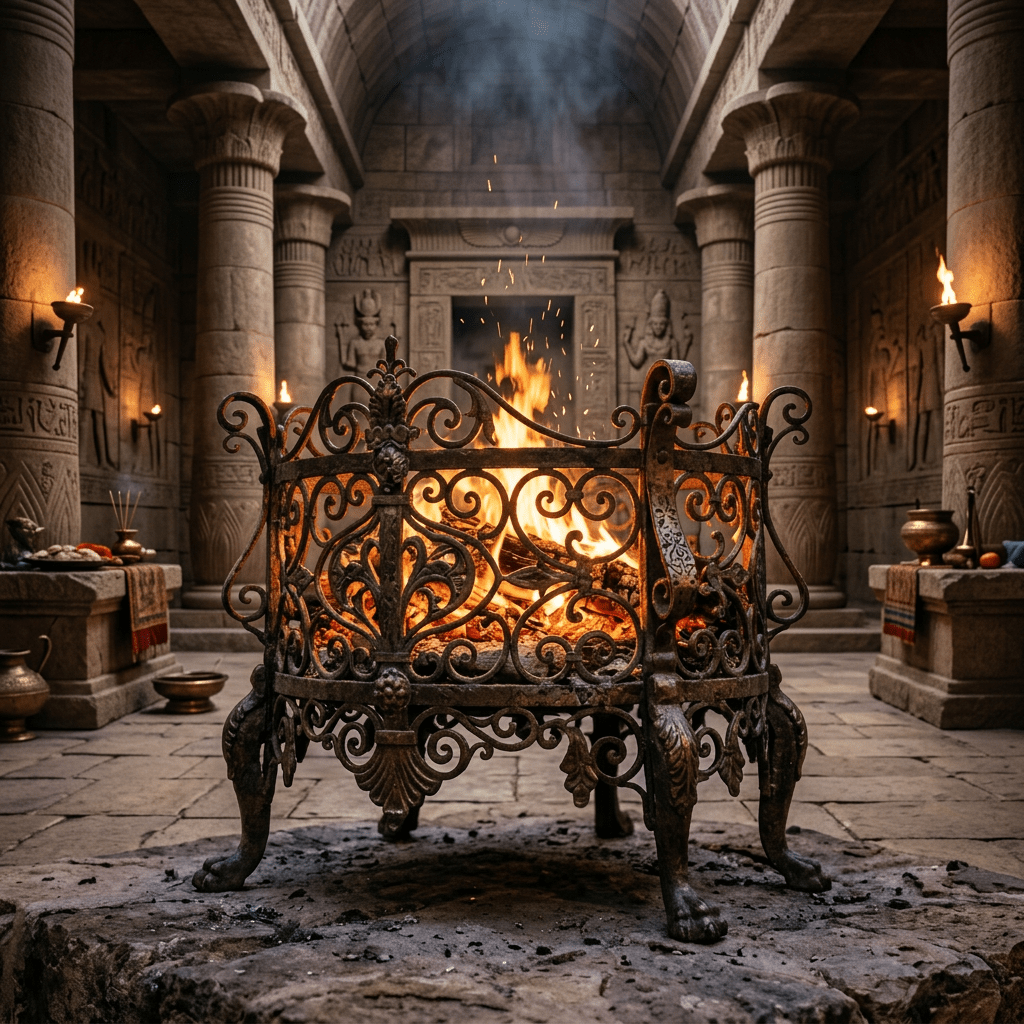
The offering altar was a newly crafted, pure copper brazier placed upon a simple flat table. It contained no electrical components, hidden mechanisms, or flammables. A team of over ten volunteers had meticulously scrubbed it top to bottom in front of everyone.
The Highest Holy Guru sat on the Dharma throne about 50 meters away. A holy virtue holding the rank of One Gold Button, Bodi Wentu Ruzun, served as the “Guarding Officer of the Fire.” He dipped a ceremonial fire-token into ghee, took a step with every mantra, and stopped about six meters away from the altar.
Suddenly, instead of stepping closer to light it manually, he looked up into the vast sky and called out:
“This Sublime Fire Offering is presided over by the Namo Highest Holy Guru. I request the Holy Vajra Mother to ignite the fire! If the Vajra Mother does not ignite it, then disciple Bodi Wentu will!”
He bowed deeply. From the distance, the Highest Holy Guru called out in a resonant voice: “We request the Holy Vajra Mother to ignite the Homa fire to eliminate obstacles and increase blessings for all living beings!”
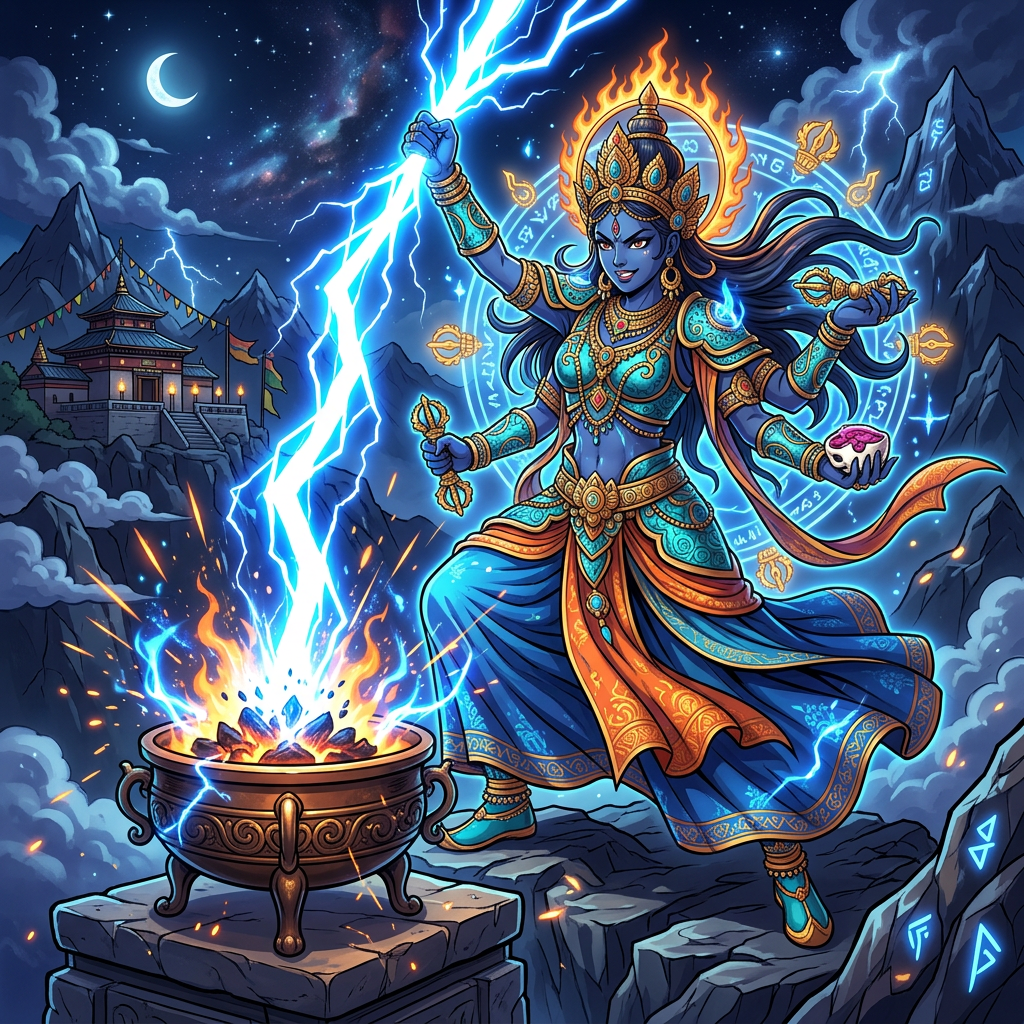
The moment the words left His lips, a brilliant flash of blue light cut through the air. The Holy Vajra Mother appeared in the void, pointed her finger, and shot a beam of lightning into the cold brazier.
Instantly, without any human intervention or spark, a roaring, magnificent fire erupted from the copper furnace. The sudden, immense power of the flame sent Rincpoche Bodi Wentu leaping back in awe before falling to the ground in prostration. The entire crowd fell to their knees, weeping and bowing in absolute ecstasy, as the sacred Homa ritual officially began.
As the offering continued, another extraordinary event unfolded. A Buddhist practitioner turned a heavy Vajra Demon-Banquishing Bowl upside down onto a small table. According to Dharma text, this bowl naturally draws in and traps the negative karma, demonic obstacles, and enmity of everyone present at the assembly.
As the negative energies tried to break free, the heavy bowl began to violently vibrate under their immense pressure. At that critical, hair-raising moment, a loud “BOOM!” echoed through the hall.
A bolt of lightning from the Vajra Mother struck the bowl, instantly pulverizing the dark karma and demonic entities into dust. Their consciousnesses were subsequently delivered by the Buddhas and Bodhisattvas to the Buddha Lands for strict cultivation and guidance.
Following this, the Highest Holy Guru—who had remained at a distance and never approached any of the ceremonial tables—performed the great Dharma of “Secretly Dispatching the Bodhisattva’s Petition.” With a thunderous sound, a flash of lightning swirled around the rim of the upside-down bowl and vanished. When the assembly flipped the bowl over, the petition paper inside had completely vanished into thin air under the watchful eyes of the crowd, confirming the absolute perfection of the ritual.
The transcendence of the Buddha Dharma manifested not only in grand lightning and fire, but also in the most subtle, undeniable details.
As the sacred wood burned, thick, dense clouds of Homa smoke billowed upward, filling the upper atmosphere of the grand hall. Under normal circumstances, lighting even half a cigarette in that hall would instantly trigger the ultra-sensitive smoke detectors, sounding alarms and unleashing the water sprinkler system.
Yet, throughout the entire sacred assembly, the smoke detectors remained completely silent. The spiritual energy of the Buddhas and Bodhisattvas perfectly governed the environment, leaving the technology untouched while filling the hearts of the devotees with boundless peace.
Witnessing this Sublime Fire Offering left everyone with a profound realization. As one of the great holy virtues remarked: “Compared to a Sublime Fire Offering, a conventional fire offering is like a single hair from nine oxen—mere child’s play.” The merit generated by a flame ignited directly from the void by the Vajra Mother is thousands of times greater than any fire lit by human hands.
For over eighty years, the world had only heard the theories of such spiritual milestones. This assembly proved that the supreme, true Buddha Dharma is alive, real, and accessible today.
The sacred brazier, offering table, and holy instruments used during this historic assembly are now permanently enshrined at the Holy Miracles Temple, welcoming pilgrims from all over the world to gaze upon them, pay respects, and connect with the profound blessings of that miraculous day.
(This article is adapted from an interview with Venerable Abbess Ruo Hui. For the core teachings of Buddhism, please always refer to the original recorded discourses and published books of H.H. Dorje Chang Buddha III.)
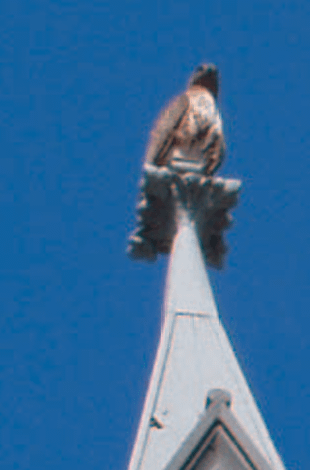
When H.H. Dorje Chang Buddha III Wan Ko Yeshe Norbu was correcting the discourse of a great dharma king, an enormous golden-winged legendary bird with the size of a small car flew into view and perched itself on the temple where H.H. Dorje Chang Buddha III was in order to prostrated to H.H. Dorje Chang Buddha III.三世多杰羌佛雲高益西諾布在修訂一位大法王的開示時,一隻展翅時大如小轎車的大鵬金翅鳥飛來三世多杰羌佛所在的寺廟禮拜。
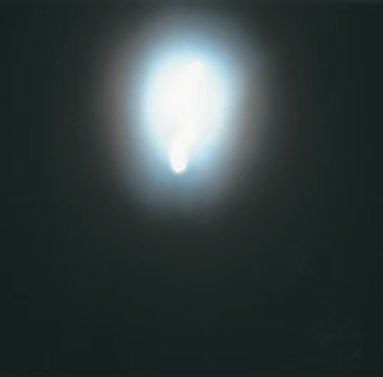
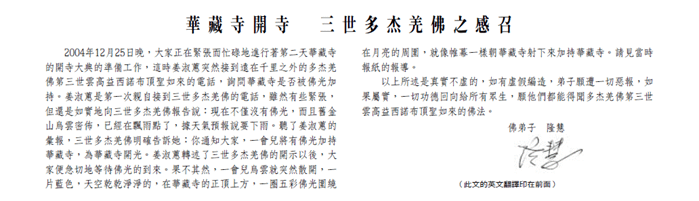
In the evening of December 25th, 2004, we were all working so hard to prepare for the next day’s grand opening of Hua Zang Si. Shu-Hui Chiang received a phone call from H.H. Dorje Chang Buddha III Wan Ko Yeshe Norbu Holiest Tathagata, who at that time was a thousand miles away from San Francisco, asking whether Hua Zang Si was blessed by a Buddha light. This was first time Shu-Hui Chiang received a direct call from H.H. Dorje Chang Buddha III. She was somewhat nervous but still reported to H.H. Dorje Chang Buddha III honestly, “There isn’t any Buddha light. It is cloudy and drizzling in San Francisco.” According to the weather forecast, it will start raining soon. After Shu-Hui Chiang’s report, H.H. Dorje Chang Buddha III told her clearly, “Notify everyone in Hua Zang Si. There will soon be a Buddha light to bless Hua Zang Si for the grand opening.” So she did. We all waited outside for the Buddha light. Not long, the clouds suddenly spread out.
The sky became clear. Right on top of Hua Zang Si, there was a big circle of multi-color Buddha light shining around the moon. It seemed like a curtain and shined down upon Hua Zang Si to bless it. There was a news report giving the details of the Buddha light that night.
All that is described above is nothing but the truth. If there is anything fake about this, I am willing to bear all punishment. If it is true, I dedicate all the merits to all living beings, who I wish would have the opportunity to listen to the dharma discourses of H.H. Dorje Chang Buddha III Wan Ko Yeshe Norbu Holiest Tathagata.
Buddha light bathed the temple, Hua Zang Si the night before the Dharma Assembly to mark its opening. Everyone at the scene saw the auspicious sign of a mani vajra beam appear within the Buddha light in the sky.(Photograph taken by Guang-Ming Li)開寺法會前一夜佛光沐洗華藏寺 ,大眾現場見到天空佛光中出現瑪尼金剛棒的瑞相。(李光鳴現場攝)
Buddhist disciple,
Long Hui Shih
(This is a complete translation of the Chinese text that follows originally written and signed by Long Hui Shih.)
How long has it been since you truly quieted your mind to listen to a bird’s song or feel the subtle arrival of spring?
When we slow down and face a masterpiece of freehand flower-and-bird ink painting—Su Shi Nao Chun (The Scholar’s Spring) by H.H. Dorje Chang Buddha III—we find a soothing remedy for the weary soul. With just a few expressive brushstrokes, this painting captures the boundless vitality of early spring. It is not merely a visual feast of fine art; it is a profound spiritual cleansing.
Traditional Chinese ink painting is deeply rooted in the philosophy of “using objects to express one’s will, and borrowing landscapes to convey emotion.” Through the vivid depiction of nature, the artist projects their inner spiritual world and genuine feelings, achieving a sublime state where scene and emotion blend, and the self merges with nature.
The Awakening of Spring: Dialogue in the Willow Branches
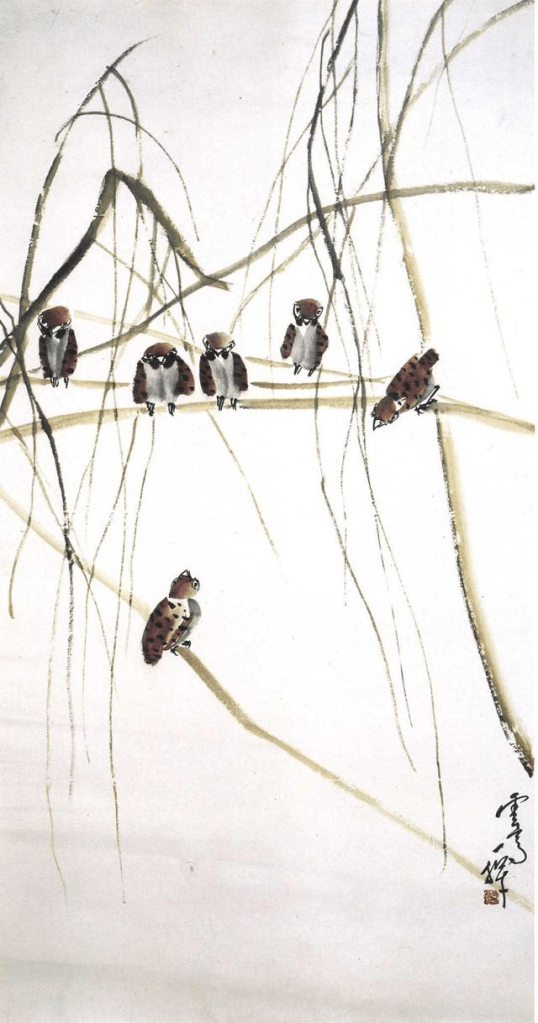
Stepping into the world of the painting, what immediately catches your eye and captures your breath is the lively group of birds awakening from their slumber. Facing the spring that has quietly arrived, they chirp and frolic on the branches with joyful abandon.
If you look closely, a bird at the bottom and another at the top right gaze at each other. Their eyes and postures suggest an intimate conversation, as if they are dueting a cheerful folk song, tirelessly spreading the beautiful news of spring’s return.
The artist’s depiction of these birds features exceptionally distinct and precise body language. The fresh, vivid artistic imagery springs to life, showcasing a masterful command of ink and a brilliant compositional mind.
Mastery of Ink: Finding Hope at the Edge of a Cliff
Traditional Chinese painting dictates that “the brush establishes the form and texture, while the ink distinguishes the substantial from the ethereal.” The artistic conception of a piece is born entirely from the movement of brush and ink. The brilliance of Su Shi Nao Chun lies first and foremost in its brushwork.
The lines in this piece are remarkably crisp, rising and falling with an organic, rhythmic tension. Through the controlled weight of pressing and lifting the brush, combined with sudden pauses and sharp turns, the ink gains a raw, powerful, and profound texture.
With simple, concise, and perfectly echoed strokes, the artist wonderfully captures the living dynamism of the willow branches. The entire canvas instantly becomes alive—this aliveness reveals a pure innocence, and it is only through such innocence that true spirituality shines. Once that spirituality emerges, the painting overflows with wit and charm, effortlessly ushering the viewer into a realm of subtle wonder.
This state of effortless, natural creation stems from the artist’s extraordinarily deep spiritual and artistic cultivation. As a master of art, H.H. Dorje Chang Buddha III has dedicated Himself to various forms of painting—including landscapes, figures, flowers, and birds—since youth. His art observes the universe and all living things through the light of Prajna (transcendental wisdom). Moving from the magnificent to the microscopic, the concepts under his brush evolve from the complex to the simple, leaving the ink pure and the brushwork liberated.
His brush often ventures into positions of extreme peril, where the composition seems pushed to a cliff’s edge. Yet, with a sudden, subtle turn of the brush, a whole new horizon opens up—just like the classic Chinese idiom: “Where hills bend and streams wind, the pathway seems blocked; yet past the dark willows and festive flowers, a new village appears.” A fresh, delightful, and breathtaking realm suddenly unfolds.
Flower-and-bird ink painting is not only a vital component of traditional Chinese art holding a significant place in the global artistic landscape, but it is also a symbol of the spiritual character and cultural soul of the Chinese nation.
The philosopher Jonathan Edwards once wrote:
“Spiritual holiness… brings an inexpressible purity, brightness, peacefulness and ravishment to the soul. In other words, that it made the soul like a field or garden of God.”
True works of art possess this exact power—to cultivate the soul and inspire people to look inward at their own spiritual world.