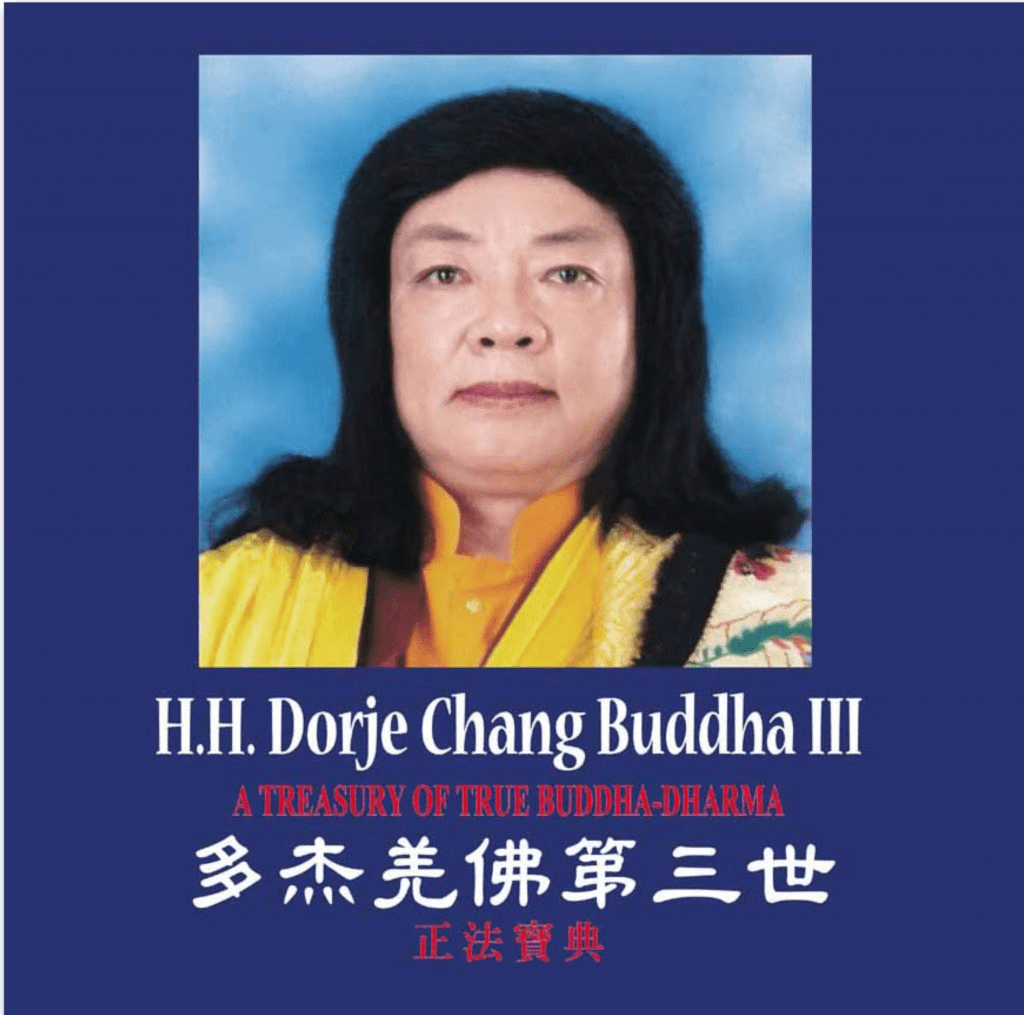
In a recent episode of “Expounding the Absolute True Through the Heart Sutra,” a longtime disciple, Layman Qi, shared his personal experiences of serving and accompanying H.H.Dorje Chang Buddha III for more than twenty years. What he described was not merely a teacher’s routine—it was a life of tireless, wholehearted service to all living beings.
Layman Qi has followed H.H.Dorje Chang Buddha III for over two decades, often driving for Him and staying close to Him in daily life. Through these years, he witnessed something that left a deep impression on his heart:
“In all these twenty-plus years,” he said, “I have never truly seen the Buddha rest. I do not even know when He rests.”
From early dawn, instructions are already being given. Throughout the day, the Buddha meets disciples, expounds the Dharma, grants empowerments, and resolves spiritual questions. Frequently, these activities continue until one, two, or even three o’clock in the morning.
Some may assume that after leaving the temple, He returns home to rest. According to Layman Qi, this is not so. Even when returning late—sometimes at three or four in the morning—His Holiness still carefully instructs disciples to ensure that even the dogs have been fed, water prepared, and that animals, including wildlife, are properly cared for.
Layman Qi describes H.H. Dorje Chang Buddha III as the most hardworking person he has ever encountered. Not only does the Buddha care for disciples, but He also performs Dharma services, dedications of merit, and liberative practices for countless sentient beings—including beings of the Six Realms whom ordinary eyes cannot see.
Meals are simple and often delayed. Breakfast is typically just a small bowl of porridge with a bit of pickled vegetables. Many days, even by seven or eight in the evening, lunch has still not been taken.
Disciples sometimes travel thousands of miles to seek an audience. Layman Qi understands their sincerity. Yet he gently reminds fellow practitioners: if one truly seeks the Buddha, the purpose should be to learn how to cultivate, how to transcend birth and death, and how to receive authentic Dharma teachings—not to occupy time with mundane disputes or worldly concerns.
Layman Qi reflects deeply on this point. In worldly life, one may seek employment for financial gain. But a Buddhist disciple seeking the Buddha should seek liberation, wisdom, and genuine cultivation.
Worldly difficulties—business setbacks, family discord—arise from karma. As the Buddha teaches, even a cool breeze in summer or the loss of a single hair operates within cause and effect. Understanding this principle, disciples should focus on transforming their karma through practice, rather than burdening the Buddha with worldly entanglements.
When countless disciples seek meetings daily, even a few minutes of casual worldly conversation multiplied many times over would prevent the Buddha from guiding those sincerely seeking liberation. For Layman Qi, this understanding has become an essential lesson in cultivation itself.
Perhaps the most moving detail is what happens after disciples finally rest for the night.
Layman Qi explains that stacks of requests—for blessings, dedications, and liberation rites—are presented to the Buddha. While others sleep, His Holiness continues performing practices and dedicating merit for sentient beings.
“To us,” Layman Qi reflects, “rest means sleep. But for the Buddha, there seems to be no such thing as rest. Twenty-four hours a day, His life is for living beings.”
What Layman Qi shares is only a glimpse. He openly admits that what he has seen is just a small portion of the Buddha’s boundless effort and compassion. Yet even this small portion, he says, is already beyond what ordinary people could endure.
In his words, the Buddha “never considers Himself.” Every action is directed toward benefiting living beings. This, he believes, is not only an expression of supreme compassion but also a profound lesson for all practitioners.
To serve without seeking return. To give without calculating personal gain. To work tirelessly for the liberation of others.
This is the example he has witnessed for over twenty years.
This post is translated and edited from Interview with a Buddhist Disciple (62): AM1300 Chinese Radio Station – Exclusive Interview with U.S. Layman Qi Pengzhi 《佛弟子訪談(六十二):AM1300中文廣播電臺-專訪美國 戚朋直居士》by Linda Chang. For original records, please click here.
Click here to Wikitia page on H.H. Dorje Chang Buddha III that list major accomplishments and teachings with links.
In times of uncertainty and turmoil, the voice of compassion becomes more precious than ever. Thich Nhat Hanh was a world-renowned Vietnamese Zen Buddhist monk, teacher, poet, author, and peace activist whose life embodied mindfulness and nonviolence. His profound influence reached far beyond the Buddhist community; he was nominated for the Nobel Peace Prize by Martin Luther King Jr., who recognized in him “an apostle of peace and nonviolence.”
Today, as the world feels divided and restless, his poem “Call Me by My True Names” invites us to look deeply into our shared humanity. It challenges us to see beyond separation—beyond “us” and “them”—and to recognize that within each of us lives both suffering and compassion. Reading his words now feels like a gentle but powerful reminder: true peace begins when we awaken to our interconnectedness.
Call Me by My True Names
Do not say that I’ll depart tomorrow because even today I still arrive.
Look deeply: I arrive in every second to be a bud on a spring branch, to be a tiny bird, with wings still fragile, learning to sing in my new nest, to be a caterpillar in the heart of a flower, to be a jewel hiding itself in a stone.
I still arrive, in order to laugh and to cry, in order to fear and to hope. The rhythm of my heart is the birth and death of all that are alive.
I am the mayfly metamorphosing on the surface of the river, and I am the bird which, when spring comes, arrives in time to eat the mayfly.
I am the frog swimming happily in the clear pond, and I am also the grass-snake who, approaching in silence, feeds itself on the frog.
I am the child in Uganda, all skin and bones, my legs as thin as bamboo sticks, and I am the arms merchant, selling deadly weapons to Uganda.
I am the twelve-year-old girl, refugee on a small boat, who throws herself into the ocean after being raped by a sea pirate, and I am the pirate, my heart not yet capable of seeing and loving.
I am a member of the politburo, with plenty of power in my hands, and I am the man who has to pay his “debt of blood” to, my people, dying slowly in a forced labor camp.
My joy is like spring, so warm it makes flowers bloom in all walks of life. My pain is like a river of tears, so full it fills the four oceans.
Please call me by my true names, so I can hear all my cries and laughs at once, so I can see that my joy and pain are one.
Please call me by my true names, so I can wake up, and so the door of my heart can be left open, the door of compassion.
Each time I read “Call Me by My True Names” by Thich Nhat Hanh, I feel both unsettled and awakened.
The poem asks us to see what we often refuse to see—that we are not separate from the suffering of the world. We are not only the compassionate helper, but also, in some deep and interconnected way, the frightened child, the victim, and even the one who causes harm. This is not an easy truth to hold. Yet it is a profoundly liberating one.
The poem gently dissolves the illusion of “us” and “them.” It invites us to return to our true humanity—tender, vulnerable, and deeply connected.
And perhaps, in remembering this, we take one small but meaningful step toward peace.
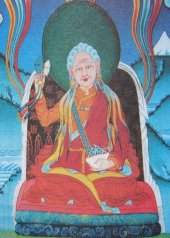
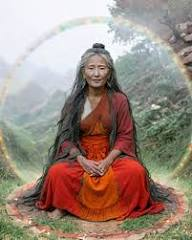
In the rich tapestry of Tibetan Buddhism, there are extraordinary practitioners whose lives themselves become teachings. Among them, Ayu Khandro (阿玉康卓) — also known by her Dharma name Dorje Peldron — stands as one of the most inspiring yoginis of the Nyingma tradition. Her life is not merely a story; it is a living example of devotion, perseverance, and profound realization.
Born in 1839 in the remote region of Kham, eastern Tibet, Ayu Khandro began her spiritual journey at a young age. She received teachings from many of the greatest masters of her time, including Jamyang Khyentse Wangpo, Jamgon Kongtrul, Chokgyur Lingpa, Nyala Pema Dundul, Adzom Drukpa, and Togden Rangrig — figures who were central to the non-sectarian Rimé movement in Tibetan Buddhism.
Unlike many who seek comfort or recognition, Ayu Khandro chose a life of renunciation and yogic discipline. She wandered widely across Tibet, lived in caves and hermitages, and devoted herself to decades of intense meditation. She spent more than fifty years in retreat, including prolonged periods of dark retreat, known in Tibetan as Yangti Nagpo — an advanced Dzogchen practice where the meditator withdraws from external light to focus inwardly on the nature of mind.
Dzogchen — The Great Perfection
Ayu Khandro’s life was profoundly rooted in Dzogchen (Great Perfection) — a teaching that points directly to the intrinsic, luminous nature of consciousness. Rather than seeking external accomplishments, she focused entirely on direct inner realization.
She was recognized as a terton — a revealer of hidden teachings — and was particularly known for transmitting sacred practices and giving initiations to practitioners, including the renowned master Chogyal Namkhai Norbu Rinpoche, who later wrote her biography based on her own oral account.
Ayu Khandro lived to the remarkable age of 115. In 1953, near the end of her life, she received visitors, gave away her precious possessions, and continued to teach and encourage those around her. After she passed away, it is reported in Tibetan Buddhist biography that her body remained in meditation posture for about two weeks before any signs of physical change occurred. By the end of this period, her body had shrunk to a fraction of its original size — an occurrence some traditions associate with deep spiritual attainment in Dzogchen practice, where the physical elements dissolve into subtler states.
This remarkable account, while extraordinary, is part of how her life has been transmitted in spiritual biographies — not as a spectacle, but as a sign of the depth and authenticity of her practice.
What makes Ayu Khandro’s life especially compelling is not just her longevity or her meditative achievements, but her steadfast devotion to the Dharma. She never sought fame or comfort. Instead, she walked the rugged paths of realization, teaching through action rather than words, presence rather than proclamation. Her retreats, pilgrimages, and meditation practices were not about escape, but about coming fully home to the true nature of mind.
Although few of us will ever undertake decades of meditation in darkness or faraway hermitages, Ayu Khandro’s life still speaks directly to modern seekers. In an era filled with distraction and ambition, her example invites us to ask:
What is true commitment?
How deeply can we trust the path we walk?
Can we place inner understanding above outer achievement?
Her life encourages us to remember that spiritual depth is not measured by loud accomplishments, but by quiet fidelity to practice.
Ayu Khandro remains a powerful reminder that liberation is not found on the surface of life, but in its quiet depths. Her unwavering dedication, her silent courage, and her embrace of the path offer inspiration — not as myth, but as a living reminder of what is humanly possible when devotion meets discipline.
Since the time of Shakyamuni Buddha, it has been a long-established tradition in Buddhism for disciples to make offerings to their masters or teachers from whom they receive the Dharma. This practice is clearly stipulated in Buddhist teachings and has been followed for over two thousand years across cultures and countries. Making offerings is regarded as both an expression of gratitude and a means of cultivating merit.
Yet, in striking contrast to this universal custom, H.H. Dorje Chang Buddha III made an extraordinary vow very early in His life: to never accept any offering from anyone.
Rather than receiving support, He has chosen to give unconditionally. Rather than being served, He serves others. H.H. Dorje Chang Buddha III has repeatedly said with humility, “I am a servant of living beings.”
This is not a symbolic statement—it is a lifelong practice.
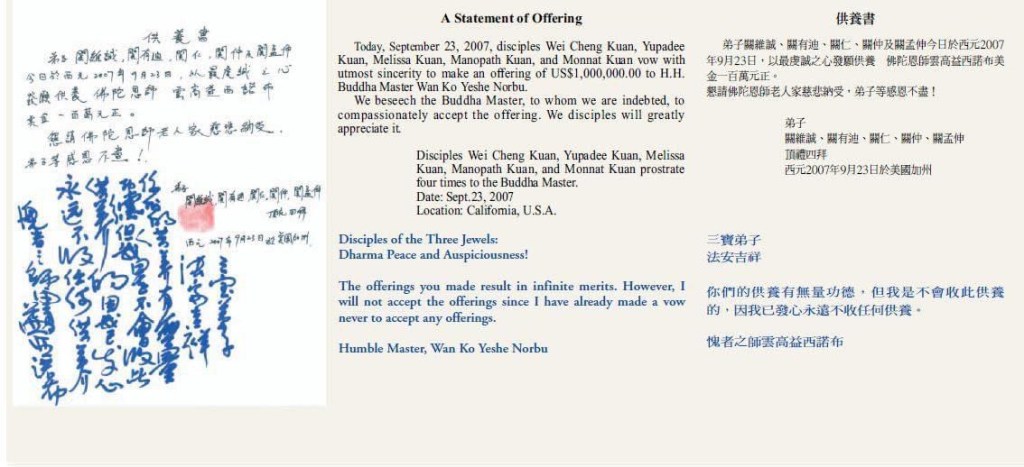
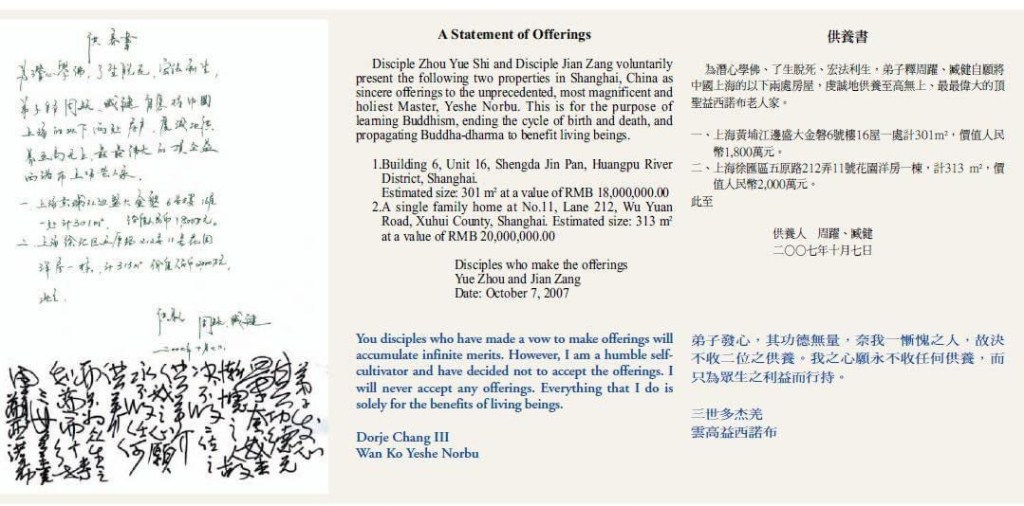
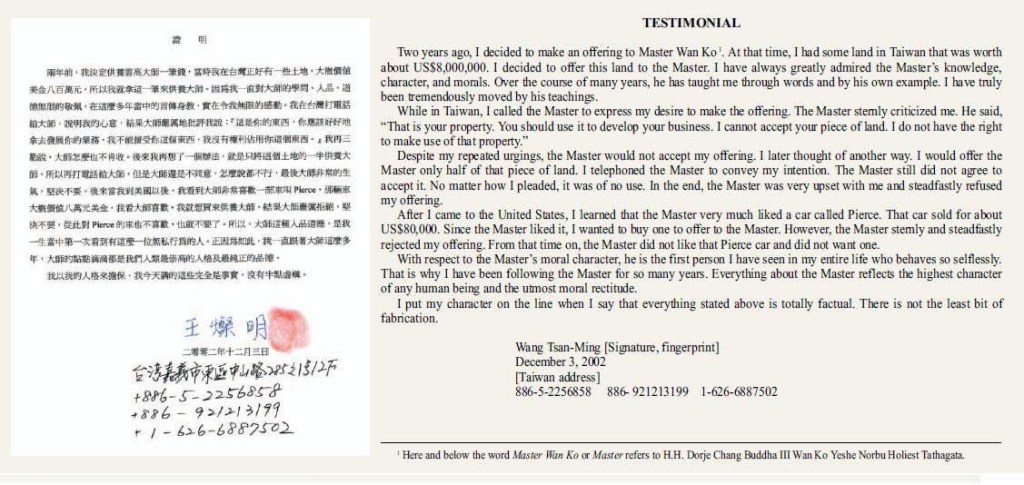
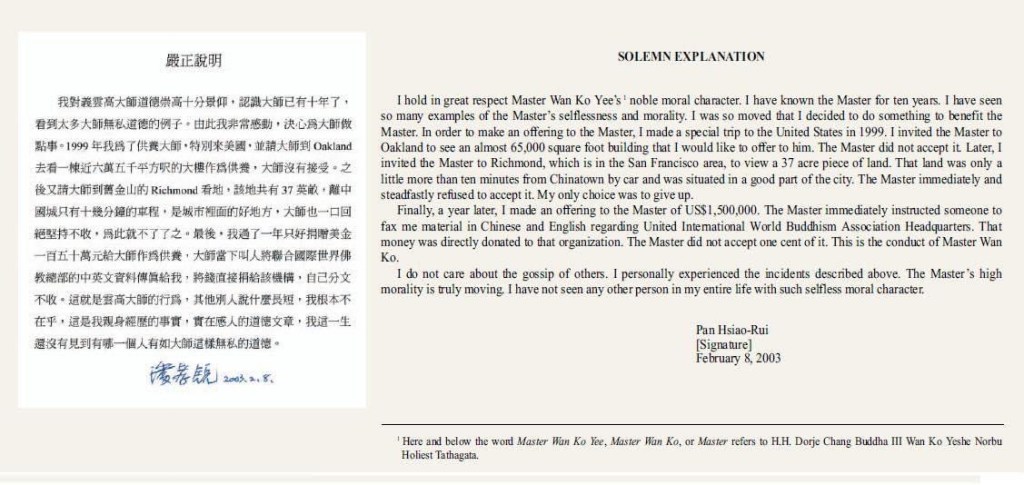
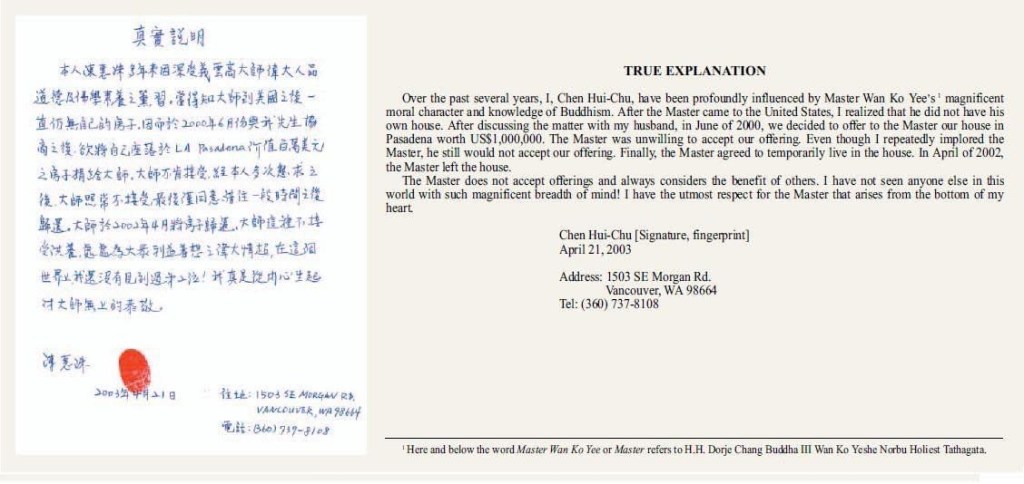
Throughout His life in China, and from the time He first settled in the United States to the present day, countless Buddhist disciples have sincerely attempted to make offerings to Him. These were not small gestures. Some offerings reached millions, even tens of millions of U.S. dollars, given voluntarily and without condition. Yet without exception, H.H. Dorje Chang Buddha III has steadfastly refused every offering, remaining absolutely faithful to His vow.
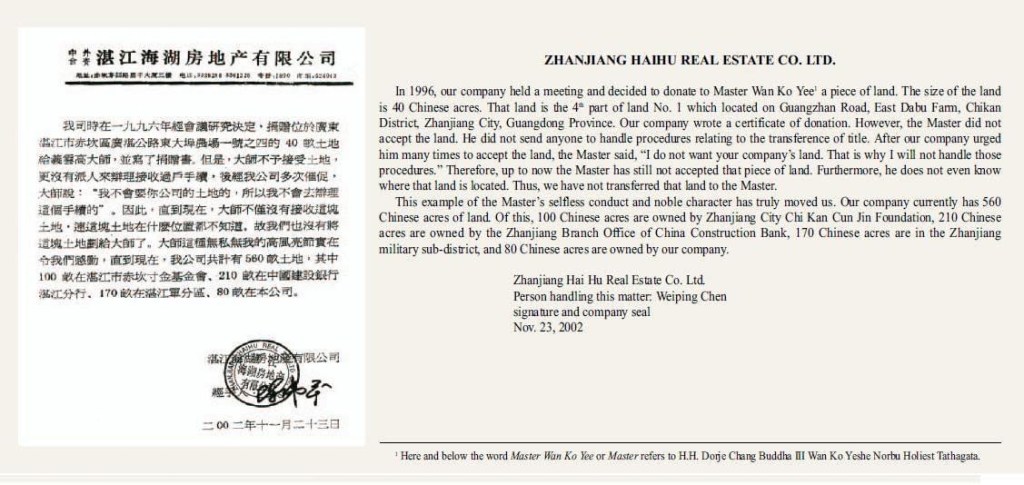
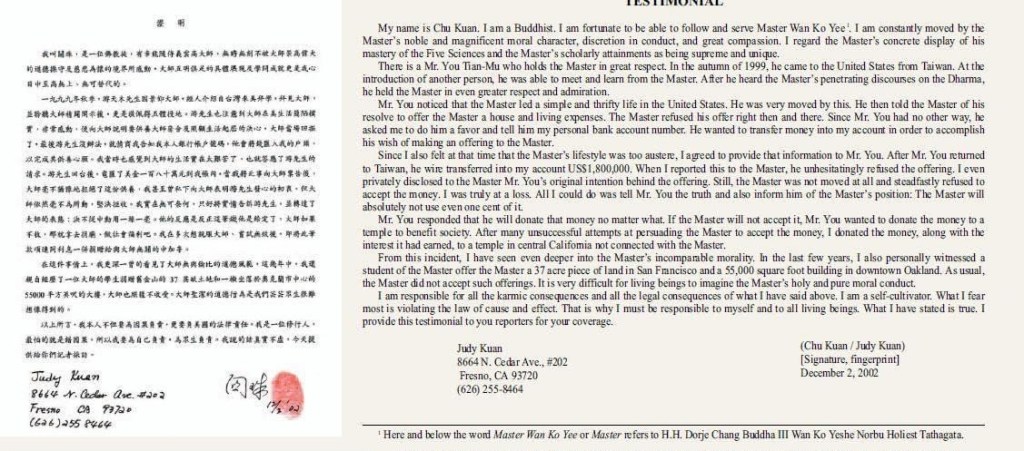
Many disciples, deeply moved by this experience, have written open and notarized testimonials describing how their offerings were respectfully but firmly declined. These accounts stand as living evidence of a level of integrity that is rare in any age.
In early 2018, at the Holy Miracles Temple, Ms. Judy Kuan—whose Dharma name is Dunzhu—solemnly made a public vow before Shakyamuni Buddha and Skanda Bodhisattva. Standing in the Grand Hall, she revealed a truth she had kept private for many years: her personal experience witnessing H.H. Dorje Chang Buddha III’s absolute refusal to accept offerings, regardless of their magnitude.
This invites us to pause and reflect. Imagine being faced with vast wealth—gold, land, and enormous sums of money—freely offered, unconditionally given, without demand or obligation. Could any ordinary person truly reject it all? Not a portion. Not even a single cent. And do so consistently, over decades, without wavering?
Could we remain completely untainted?
For many decades, H.H. Dorje Chang Buddha III has lived exactly in this way—helping others entirely on a voluntary basis, never seeking reward, recognition, or material gain. From early morning until late into the night—often two or three o’clock in the morning—He continues to work tirelessly to resolve the suffering of living beings, to address Dharma matters, and to guide others on the path of righteousness and compassion.
This is not occasional generosity. It is unceasing selflessness.
In a world where spiritual authority is too often entangled with wealth and power, the conduct of H.H. Dorje Chang Buddha III stands as a rare and powerful example. His life demonstrates that true cultivation is not spoken—it is lived. True compassion does not ask for return. And true realization naturally manifests as service to others.
Further supporting this truth, several Buddhist disciples have publicly released notarized letters, now translated into English, testifying that their offerings were refused. These documents exist not to persuade, but to allow people to see for themselves.
In the end, the question is not whether we admire such selflessness—but whether we allow it to awaken something within our own hearts.
For those who reflect deeply, the life of H.H. Dorje Chang Buddha III offers a quiet yet profound reminder: the highest virtue is to give without taking, to serve without asking, and to live entirely for the benefit of others.
Click here to Wikitia page on H.H. Dorje Chang Buddha III that list major accomplishments and teachings with links.
Click here for recognitions from Dharma Kings and Rinpoches
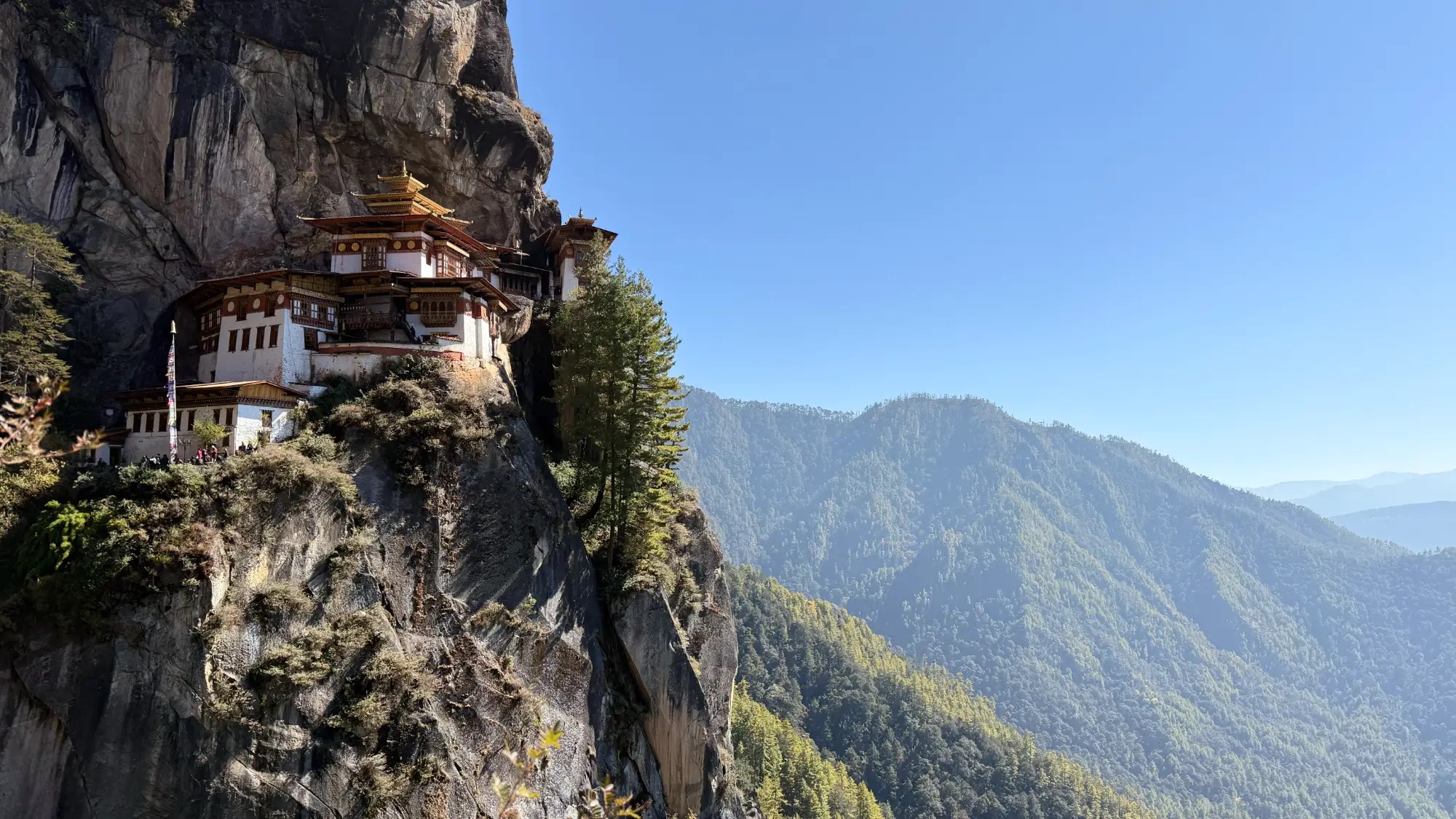
The goal of the ascent in sight: Taktsang Monastery is perched high on the steep cliff face
On a pilgrimage to holy places, one rarely follows a rigid plan. Rather, one engages with a flow of events. Our last days in Bhutan reminded us how valuable it is to let go of expectations. We learned that special doors often open exactly when one is ready to leave the original path.
Change of Plans in Punakha: Trusting the Flow of Things
The sixth day showed us this very clearly. Actually, we had a fixed plan: We wanted to drive from Punakha back to Paro. There, we had donated 3,000 butter lamps which we wanted to light ceremonially in a temple.
But then we received news on short notice that an audience with His Holiness the Je Khenpo, the highest religious head of the country, would be possible. Such an opportunity is a great blessing. However, there was a restriction: Our entire travel group was simply too large for this spontaneous audience.
So we had to split up in Punakha. One part of the group drove directly on to Paro, while the other part drove to Thimphu, where His Holiness the Je Khenpo was staying at the time. I traveled with this group.
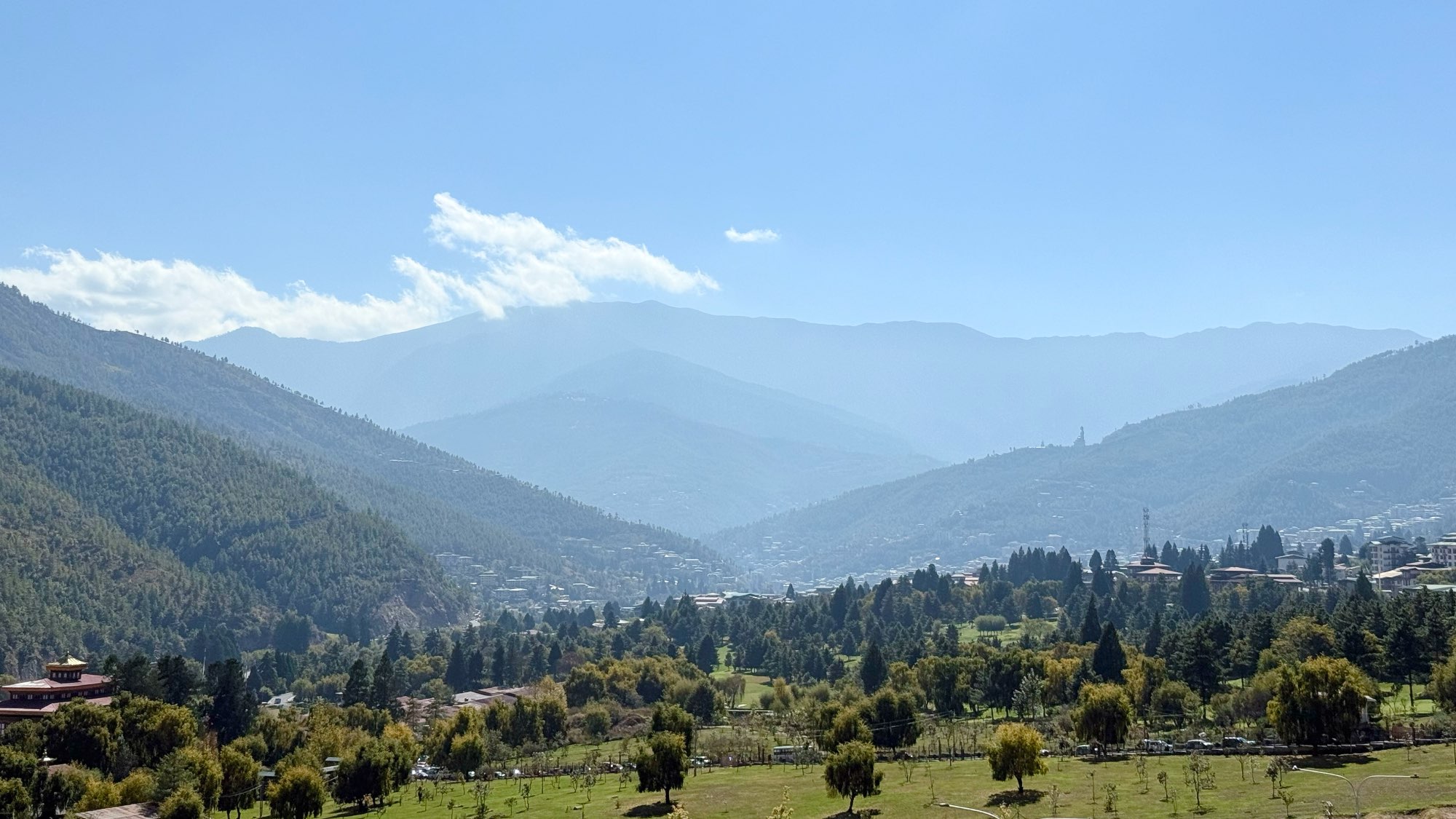
View of Thimphu with the Buddha Dordenma statue in the background
Thangton Dewachen Nunnery: Legacy of the Iron Bridge Monk
Arriving in Thimphu, we still had some time before the appointment. We visited the Thangton Dewachen Duthop Nunnery. It is the only one of its kind in the capital and goes back to the legendary Thangtong Gyalpo. He was a fascinating personality: A great Mahasiddha and at the same time an ingenious engineer who lived in the 15th century. He is famous as the “Iron Bridge Monk,” as he built dozens of suspension bridges made of iron chains throughout the Himalayas to allow pilgrims and travelers to cross raging rivers. Many of his constructions withstood the centuries. We were welcomed very warmly at this place: We were served tea in the courtyard of the monastery, and we could enjoy the peaceful atmosphere for a moment before we had to leave.
Visiting the Thangton Dewachen Duthop Nunnery
Kalachakra Initiation: Encounter with H.H. the Je Khenpo
After lunch, we made our way to the stadium. There, H.H. the Je Khenpo was leading the conclusion of the Kalachakra initiation. The crowds were immense. The stadium itself was packed to capacity, but that was far from enough. Countless people had also gathered on the grounds outside to partake in the event. It was a very impressive image. The ceremony was also being broadcast live on Bhutanese television. We initially had to wait before the gates until we were allowed into the stadium.
After some time, we were able to enter and were led to a separate waiting area inside the stadium. During this time, a chance but wonderful encounter occurred. We met the young Vairochana Rinpoche (Ngawang Jigme Jigten Wangchuk). He is a highly revered Tulku and the son of Her Royal Highness Princess Sonam Dechan Wangchuk. He is revered as the reincarnation of the great translator Vairochana from the 8th century, one of the most important disciples of Guru Padmasambhava.
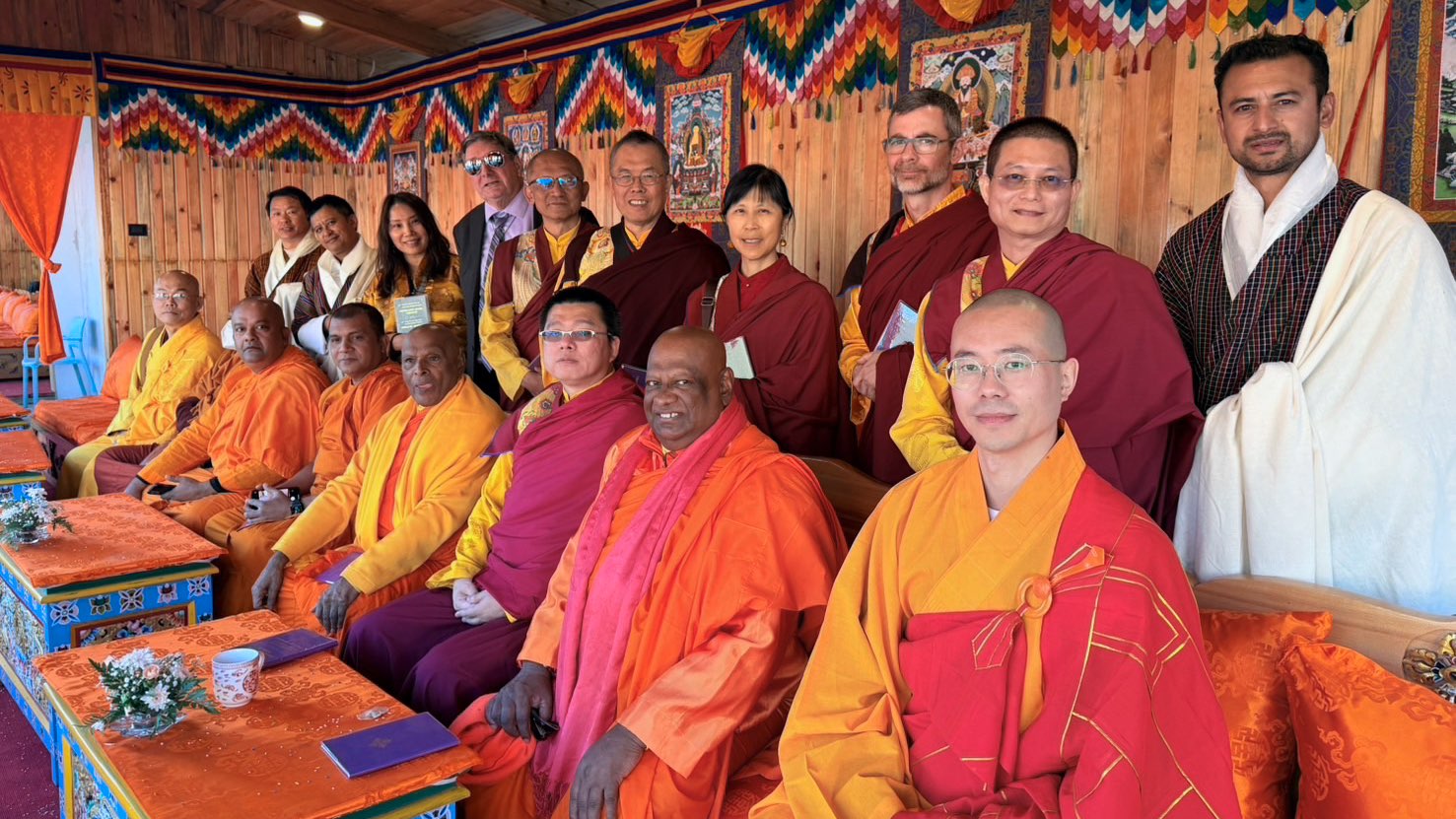
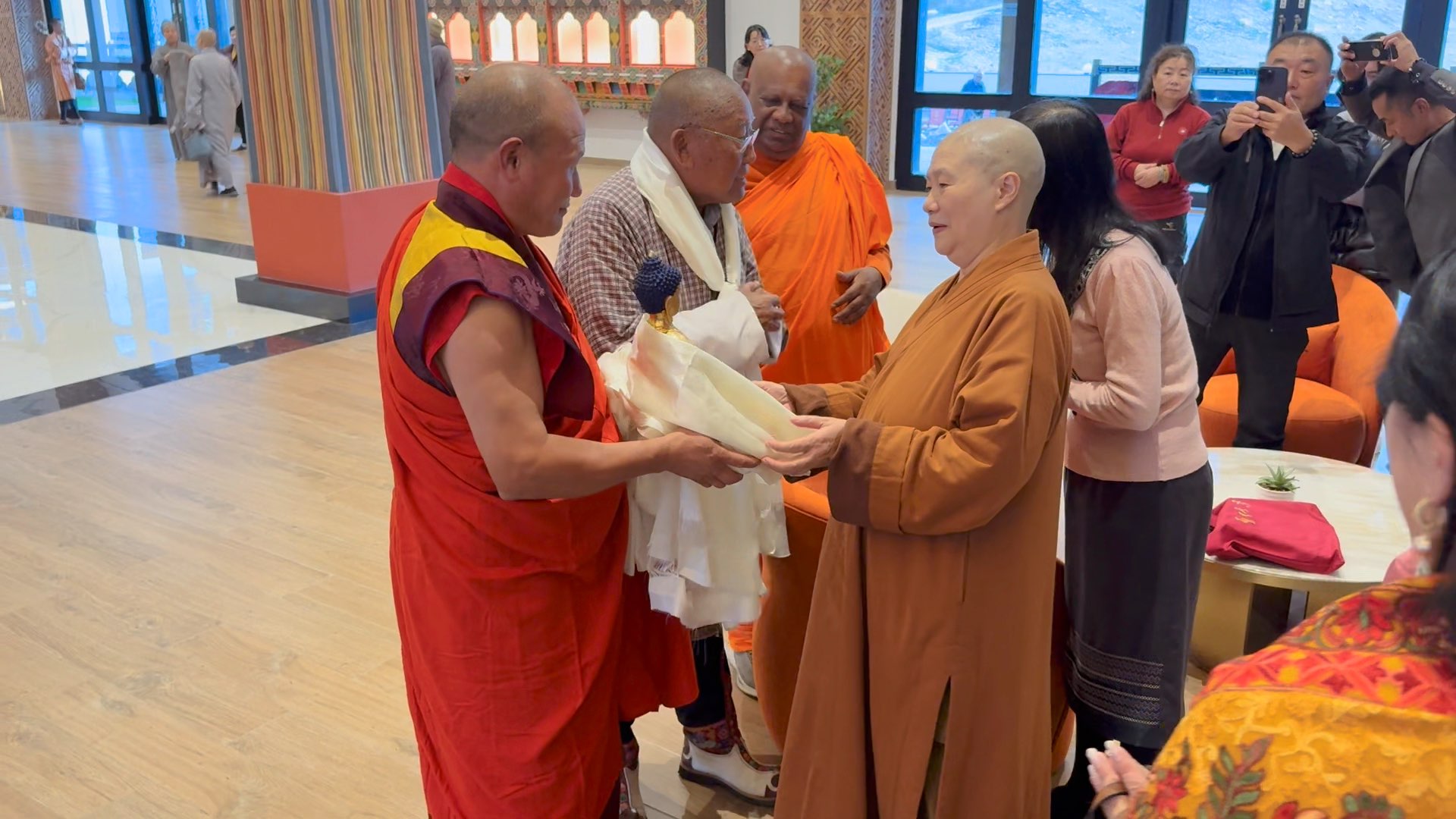
Following this, we were granted an audience with H.H. the Je Khenpo. Filled with gratitude, we presented him with a Khata (white scarf) as a token of our deep respect. In this special setting, we also had the opportunity to present His Holiness with information regarding the ‘Holy Heavenly Lake Buddhist Town’ project. Each of us then received a personal blessing, and upon our departure, he presented us with a text of the Amitabha Sadhana for our own practice.
Our group after the audience with H.H. the Je Khenpo
After the meeting with the Je Khenpo, a further great honor was completely unexpectedly offered to us: Actually, we were supposed to meet the young Vairochana Rinpoche and the Queen Mother for an official audience afterwards. But when the Kalachakra initiation ended, thousands of people streamed out of the stadium at the same time. Traffic in Thimphu came to a complete standstill. There was no getting through, and we could not reach the agreed location in time. Such are the karmic conditions sometimes. But we did not quarrel with fate: After everything we had experienced that day and the blessing we were allowed to receive, we felt richly gifted.
The Tiger’s Nest: Ascent to Guru Rinpoche’s Cave
On the last day of our trip, November 15th, the arguably most famous landmark of Bhutan was on the agenda: Paro Taktsang, widely known as the Tiger’s Nest. It is not only architecturally deeply impressive, but one of the holiest sites in the entire Himalayas.
Paro Taktsang Monastery (Tiger’s Nest)
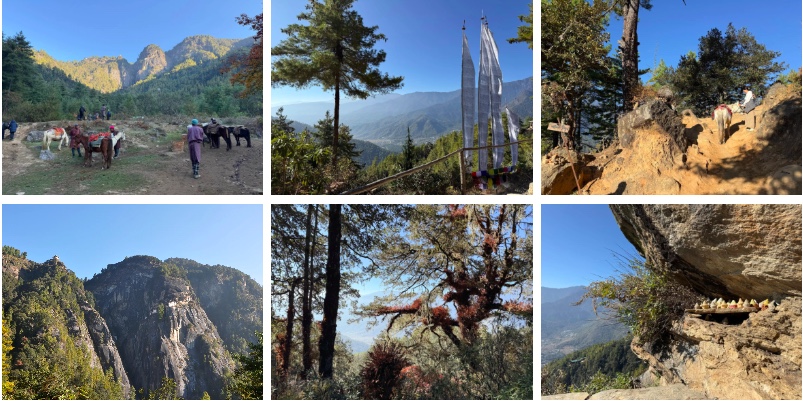
We set off very early to reach the base camp, the parking lot at 2,300 meters. From there, it is about 800 vertical meters up to the monastery, which sits at 3,120 meters. For visitors who do not quite trust themselves with the steep climb, there is generally the option to be carried by a horse or mule for the first part of the route. Our group, however, decided to cover the entire path on foot under our own power.
The ascent took just under three hours. The path is beautiful, but also demanding. It leads through a dense pine forest where rhododendrons grow and the trees are draped with moss. Again and again, prayer flags flutter in the wind. Halfway up, we took a short rest at a café. From there, you already have a first, breathtaking view of the monastery, which literally clings to the steep rock.
Impressions (in order): Resting horses at the starting point, fluttering prayer flags against the mountain backdrop, pack animals on the dusty trail, the first distant view of the cliffside monastery, the moss-covered mountain forest, and Tsa-Tsa offerings in a rock niche.
The history of this place is closely connected to Guru Rinpoche, the great Master Padmasambhava. He is revered by the Bhutanese as the “Second Buddha,” as he brought and firmly established Tantric Buddhism, the Vajrayana, in Bhutan in the 8th century. He manifested his supernatural powers and flew to this very spot on the back of a tigress to subdue a demon. Some say that the tigress was his tantric consort Yeshe Tsogyal in a transformed state. In the cave known as Taktsang Senge Samdup, around which the monastery was later built, he then meditated for exactly three years, three months, three weeks, and three days.
Once at the top, we had to hand in our cameras and bags at the entrance, as photography inside is strictly forbidden. We visited several small temples within the complex. In a special room that is guarded around the clock, I lit a butter lamp. This is the only place in the monastery where open fire is still permitted after a devastating fire destroyed large parts of the complex in the past. In Buddhism, lighting these lamps is a meritorious central ritual.
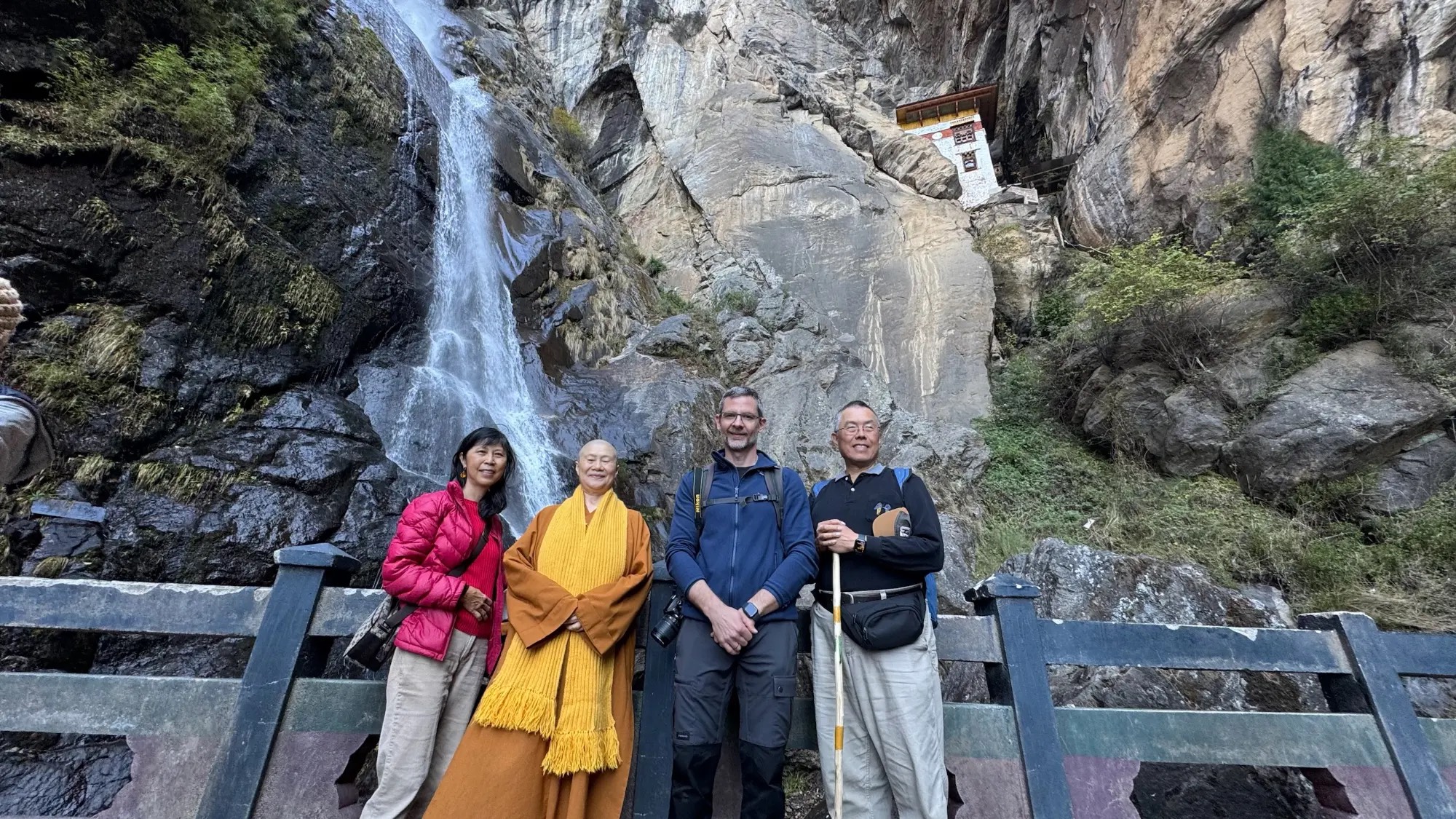
With Venerable Master Shi Zheng Da in front of the Taktsang Waterfall
Farewell in Paro: A Promise to Return
Back at the hotel in Paro, a special guest awaited us in the evening: Dasho Passang Dorji, the former Speaker of the National Assembly of Bhutan. He had been instrumental in organizing the official appointments and came by personally to apologize politely that the meeting with the King had not taken place due to the commotion. He promised us: “Next time I will arrange, this time the King and the Queen have been too busy.”
Exchange of gifts with Dasho Passang Dorji
In a very friendly atmosphere, an exchange of gifts took place. The Venerable Master Shi Zheng Da presented him with a special art object, a luminous three-dimensional picture of a Yun sculpture designed by H.H. Dorje Chang Buddha III. In return, he gave the Master a large golden Shakyamuni Buddha statue. It was a worthy moment of connection.
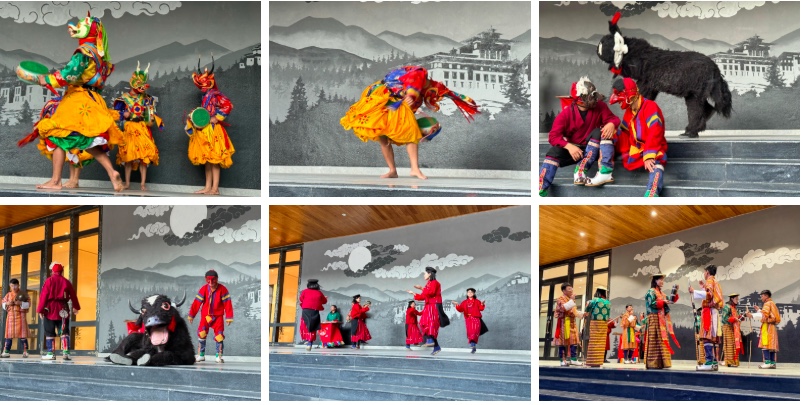
Scenes from the performance (in order): The famous Drametse Ngacham (Dance of the Drums), a solo dancer bowing deep, the performers of the yak scene, the humorous interaction of the yak with the audience, the women’s dance group in red garments, and finally a traditional performance with bows and arrows combining song and dance.
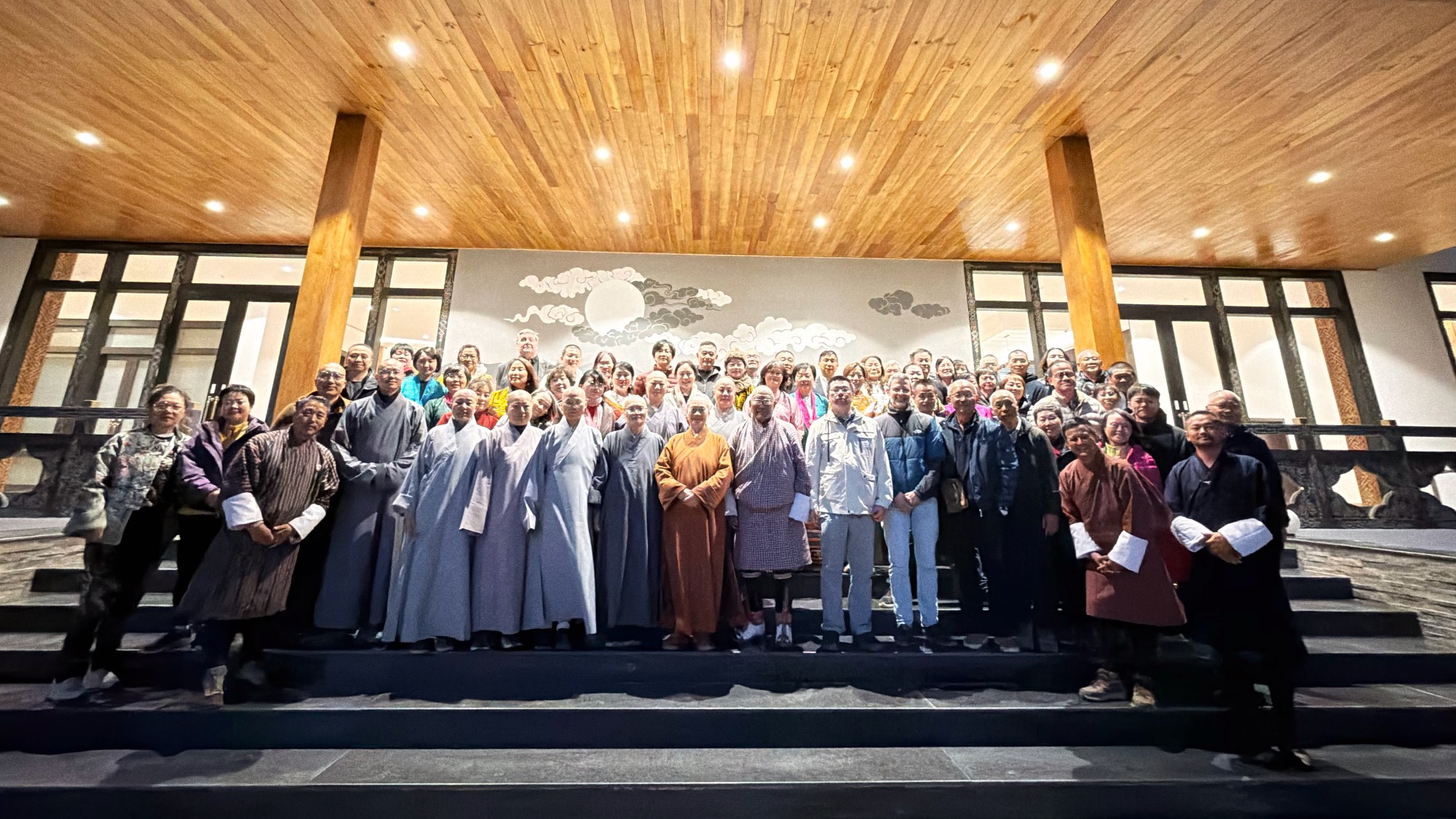
Afterwards, we watched a cultural performance together with Dasho Passang Dorji. There were traditional dances and songs whose gentle, flowing movements radiated great calm and peace. There were also humorous interludes, like the dance of a yak, where the performers visibly had fun. Even though I did not understand the language, the joy was contagious. After this show, we all gathered for a large group photo to capture this beautiful final evening.
Our entire group with Dasho Passang Dorji and our guides
The next morning, November 16th, it was time to say goodbye. From the hotel, we could look directly at the airport. We had arrived to make a contribution with our donation and our plans. But as I boarded the plane now, I felt that we ourselves were taking away far more than we had given. I took with me not only memories of the mighty mountains and venerable monasteries, but the feeling of a deep connection with our travel group and the people in Bhutan. I return with much inspiration and a heart full of gratitude for the blessing I was allowed to experience in this country.
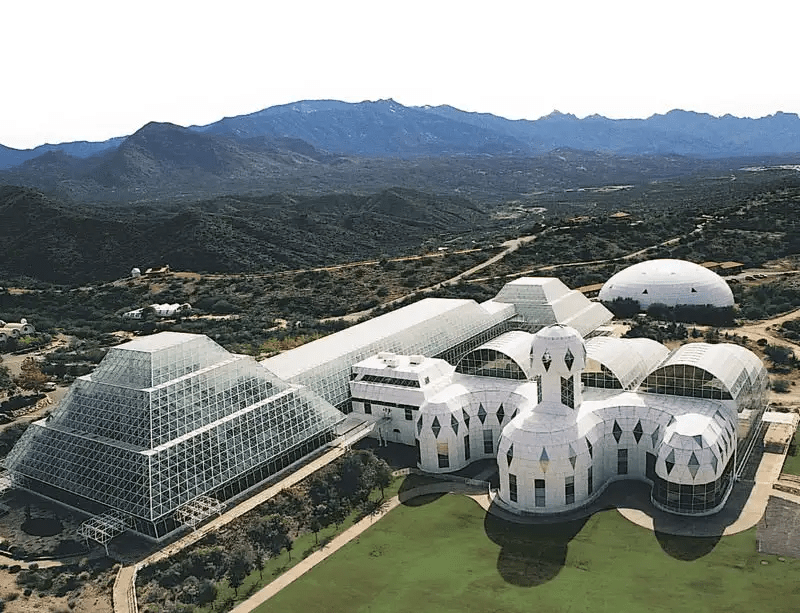
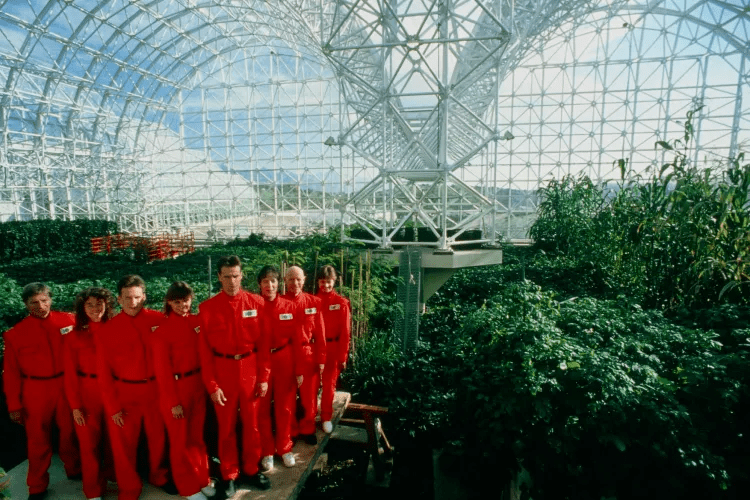
In 1991, deep in the Arizona desert, an unprecedented experiment quietly began—one that captured the imagination of the world and, in time, revealed a powerful lesson about humanity’s relationship with nature.
Eight people—four men and four women—were sealed inside a massive glass-and-steel structure known as Biosphere 2. Inside this enclosed world were recreated ecosystems meant to mirror Earth itself: a tropical rainforest, an ocean with coral reef, a desert, savanna, wetlands, farmland, and living quarters. For two full years, the inhabitants were to live completely self-sufficiently, growing their own food, recycling their air and water, and surviving without outside assistance.
The ambition was breathtaking. Biosphere 2 was envisioned as a blueprint for the future—an experiment to test whether humans could survive in closed ecosystems, potentially paving the way for space travel and the colonization of other planets. Behind this vision stood oil tycoon Edward Bass, who invested nearly $200 million into the project. It was, at once, a serious scientific endeavor and a meticulously choreographed public spectacle, drawing intense global attention from scientists, media, and the public alike.
Yet as the months passed, the experiment revealed something far more profound than plans for Mars.
Despite advanced engineering, cutting-edge technology, and idealistic human determination, the biosphere began to falter. Oxygen levels dropped unexpectedly. Crops failed. Certain species flourished too aggressively while others vanished. Tiny imbalances multiplied into serious problems. Even the soil—something often overlooked—absorbed oxygen in ways scientists had not fully anticipated.
What became clear was this: Earth’s ecological system is far more complex, delicate, and interconnected than human intelligence can fully replicate or control.
Biosphere 2 did not fail because of a lack of effort or intelligence. It faltered because nature is not a machine that can be perfectly engineered. It is a living, breathing system shaped by countless relationships that have evolved over billions of years. When humans attempt to dominate or redesign nature without deep humility, unforeseen consequences inevitably arise.
Looking back today, Biosphere 2 feels less like a rehearsal for escaping Earth and more like a gentle warning.
Rather than asking how we can leave this planet, perhaps the deeper question is how we can live more respectfully upon it. The experiment reminds us that technology, no matter how advanced, cannot replace the wisdom embedded in natural laws. Human ambition, when detached from reverence, can easily turn into overconfidence.
We are not masters of Earth—we are tenants.
To live well on this planet requires humility: listening to nature rather than overriding it, cooperating with ecological rhythms rather than forcing outcomes, and recognizing that every action ripples through an intricate web of life. True progress is not measured by how much we can control, but by how well we can coexist.
More than three decades later, Biosphere 2 still stands in the Arizona desert, now used for research and education. Its greatest contribution may not be scientific data alone, but the quiet reminder it offers to humanity:
Respect nature. Honor complexity. Live humbly. And follow the laws of the Earth that has always sustained us.
The highest point of the leg: The Dochu La pass at 3,100 meters
By Gongjue Tuji
With many impressions from Thimphu and a feeling of gratitude, we continued our pilgrimage. Before leaving the busy capital behind for good to drive deeper into the mountains, however, we spent another day in its surroundings. After all, Bhutan is not only defined by its holy temples and deeply rooted Buddhism. The landscape itself also holds enormous power. We were looking forward to traveling to places where the country’s history and the powerful nature form a very special unity.
Semtokha Dzong: The Palace of Secret Mantras
On the third day, our path first led us about six kilometers south of Thimphu to Semtokha Dzong. This place also bears the meaningful name “Sangak Zabdhon Phodrang,” which translates to “Palace of the Profound Meaning of Secret Mantras.”
Semtokha Dzong
Historically, this is a milestone: The Dzong was built between 1629 and 1632 by Shabdrung Ngawang Namgyal, the legendary unifier of Bhutan. He introduced something completely new here, namely the combination of a monastery and an administrative center under one roof. This innovative concept worked so well that it later became the model for all other major fortresses in the country, such as in Paro or Punakha. This historical significance mixed with a very present joy on the day of our visit. Since the entire country was honoring the fourth King’s birthday, a particularly festive mood could be felt everywhere.
But something else left a deep impression on me. In the temple rooms, the distinct scent of butter lamps hung in the air. It is a very unique smell that we would encounter again and again at other places, and which for me is now inseparably linked to the atmosphere of these holy sites.
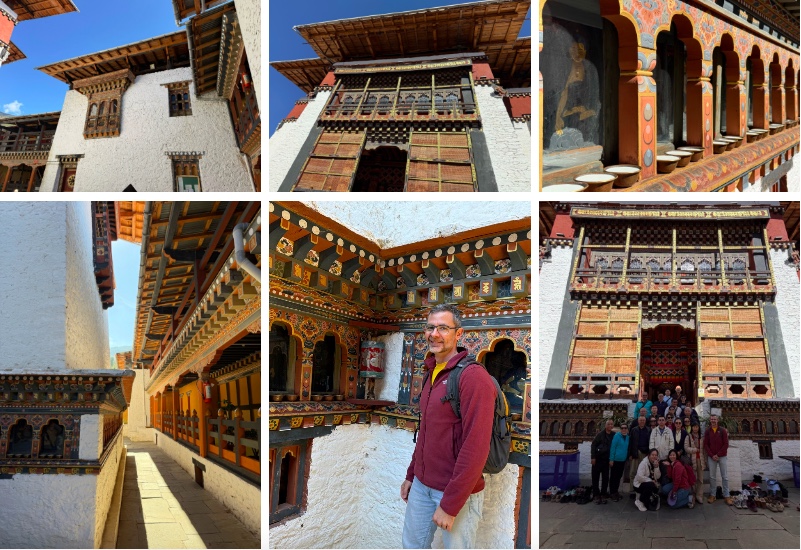
Impressions (in order): View into the courtyard, the magnificent entrance area, water bowls as offerings, the corridor with prayer wheels, myself inside, and our group on the entrance stairs.
Takin Preserve: The Creation of Drukpa Kunley
Bhutan is deeply rooted in its spiritual traditions, where the power of the Dharma also manifests in nature. We visited the Royal Preserve to see the national animal: the Takin. It is a fascinating creature, unique to the Himalayas, with an appearance that resembles a cross between a cow and a goat.
Its existence traces directly back to the miraculous activity of Drukpa Kunley, also known as the “Divine Madman.” In the 15th century, people asked him to perform a miracle to prove his realization. He requested to be served a cow and a goat. After consuming both, he placed the goat’s head upon the cow’s skeleton. With his supernatural powers, he brought this new being to life. This event stands as a powerful testament to the Master’s unconventional teaching methods and his ability to act beyond ordinary concepts.
Impressions (in order): The spacious forest area of the preserve, a resting Takin in the shade, and an animal by the stream.
Dochu La: Commemoration at the 108 Chortens
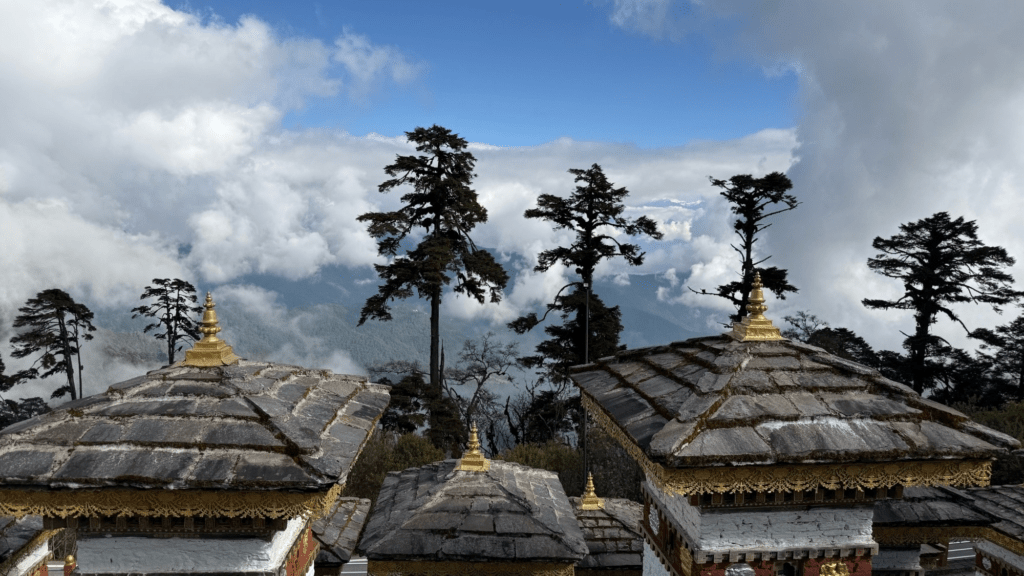
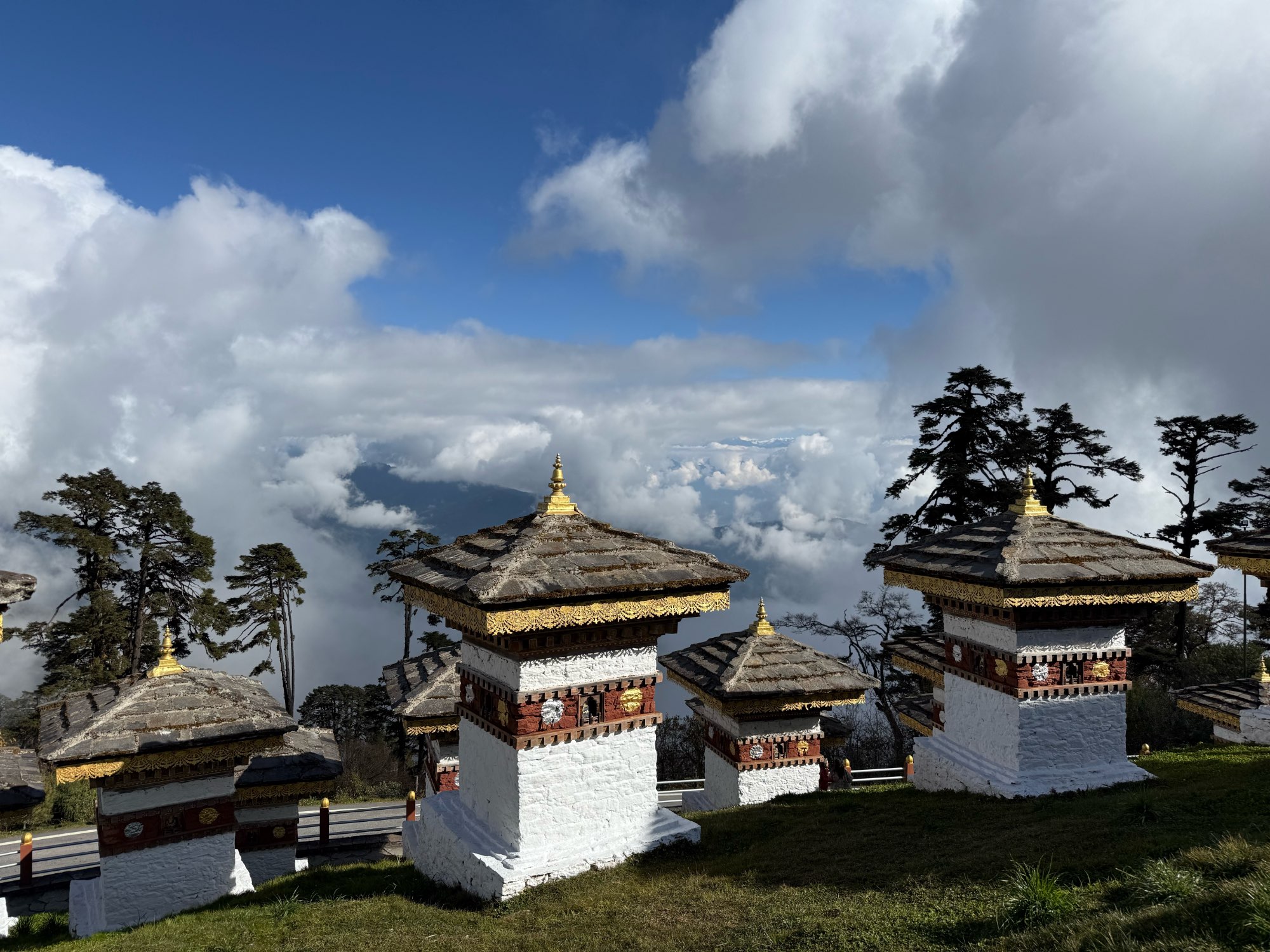
On the fourth day, we left the capital heading towards Punakha. The road led us over the Dochu La, a pass at an altitude of about 3,100 meters. Although a few clouds obscured the view of the very big ice giants of the Himalayas, gaps opened up again and again, through which we could see the snow-covered peaks.
The 108 Druk Wangyal Chortens against the backdrop of the Himalayas
Up on the pass stand the 108 Druk Wangyal Chortens. They are an important place of remembrance. They were not built to celebrate a military victory in 2003, but to commemorate the fallen. It is characteristic of the culture here that triumph is not put in the foreground, but rather compassion and remembrance.
Chimi Lhakhang: The Legacy of Drukpa Kunley
In the Punakha district, the legacy of the “Divine Madman,” Drukpa Kunley, is ever-present. Even in the surrounding villages, we noticed the many houses painted with phallic symbols. What may initially seem unusual to foreign eyes is regarded here as a powerful symbol of protection.
View into the Punakha Valley
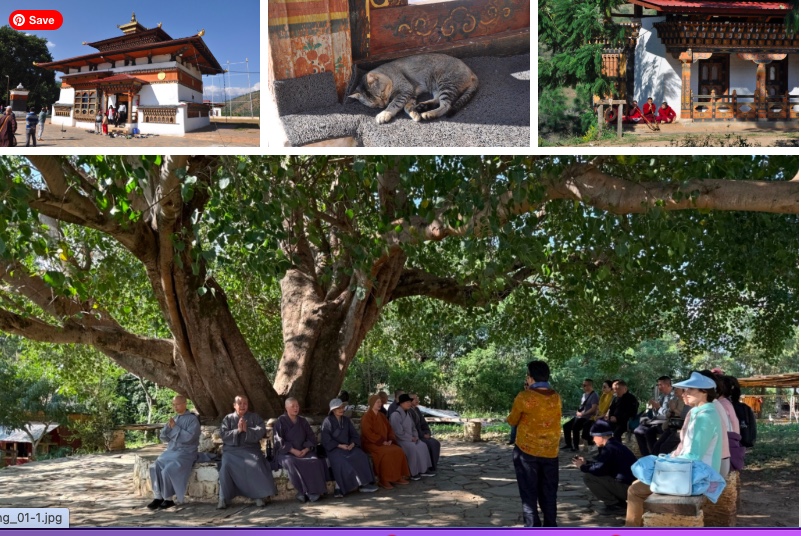
Our next destination was Chimi Lhakhang. The path there leads very picturesquely right through green rice fields. The temple itself stands exactly at the spot where the great master Drukpa Kunley manifested his power to subdue a demon that had taken the form of a dog. He did so with his “flaming thunderbolt of wisdom.” This also explains the paintings on the houses, as they represent this victorious thunderbolt. At the place of this subjugation, a small black stupa still stands today. Also, statues of the master can often be recognized by a dog lying at his feet. Today, the place is mainly known as the Temple of Fertility, to which couples from all over the world make pilgrimages. We used the peaceful atmosphere there to chant together under a large Bodhi tree in front of the temple.
Impressionen (der Reihe nach): Der Chimi Lhakhang Tempel mit der schwarzen Stupa, eine schlafende Tempelkatze, junge Mönche beim Üben der Dharma-Instrumente und unsere Gruppe beim gemeinsamen Chanten unter dem großen Bodhi-Baum.
Punakha Dzong: Palace of Great Bliss
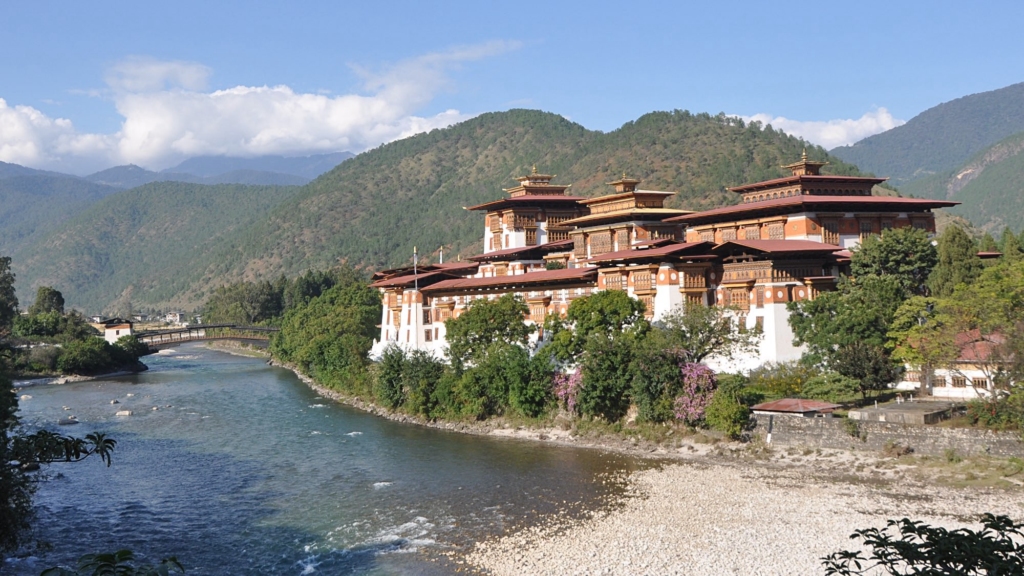
Afterwards, we continued to Punakha Dzong. It is situated very picturesquely right where the Pho Chhu (Father River) and the Mo Chhu (Mother River) meet. Its full name is Pungtang Dechen Photrang Dzong, which translates to “Palace of Great Happiness.” The building is not only huge but also historically of enormous importance. It was built as early as 1637 and for a long time formed the center of the then winter capital Punakha.
Punakha Dzong
Even today, the monastic community moves here during the cold months. Moreover, it is a historic place for the monarchy, as the first King of Bhutan was crowned here in 1907. Inside rest the mortal remains of the state founder Shabdrung Ngawang Namgyal. However, this area is strictly protected. Only the King and the Je Khenpo, as well as two guardian lamas, are allowed to enter the room with the relics.
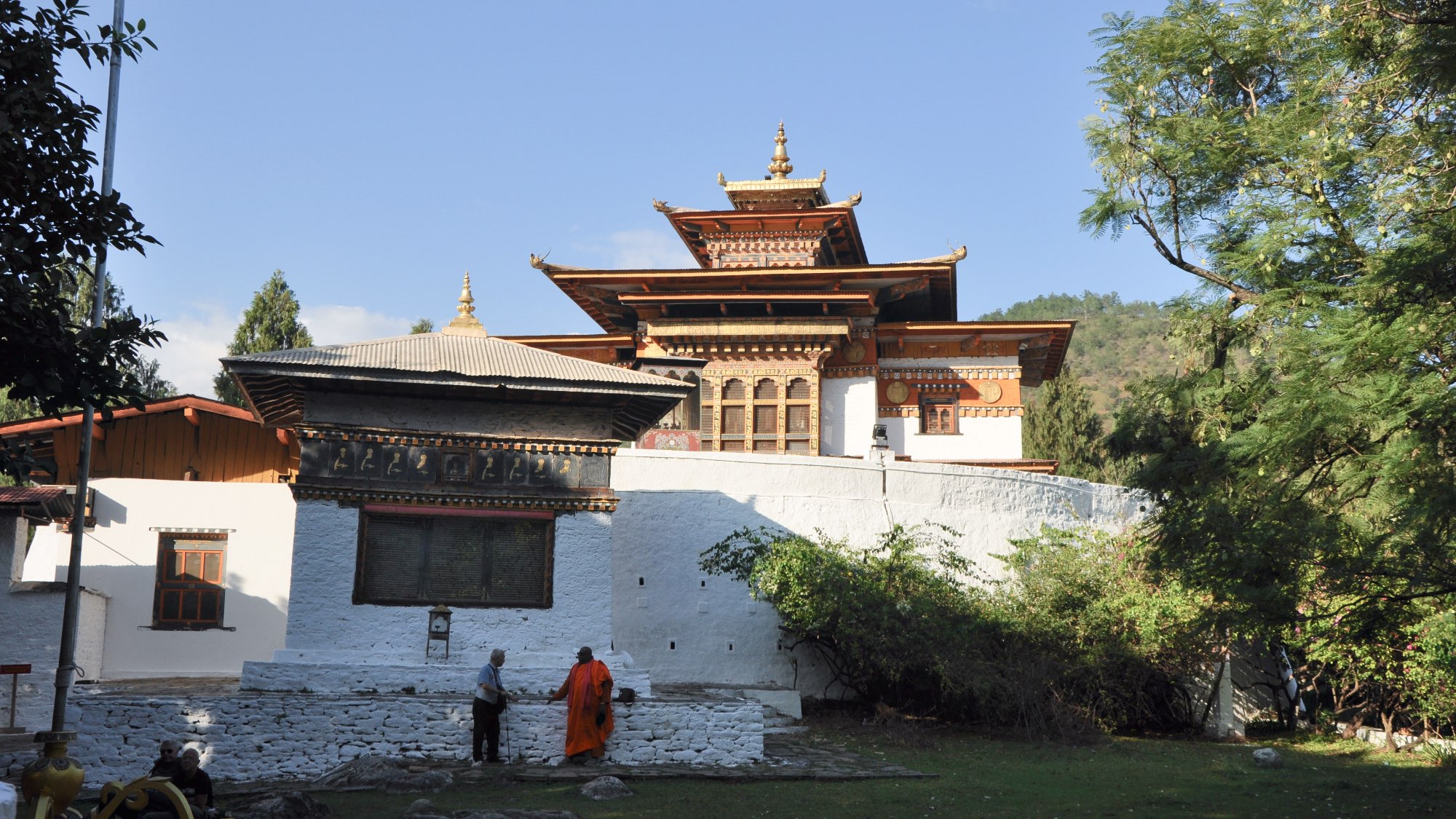
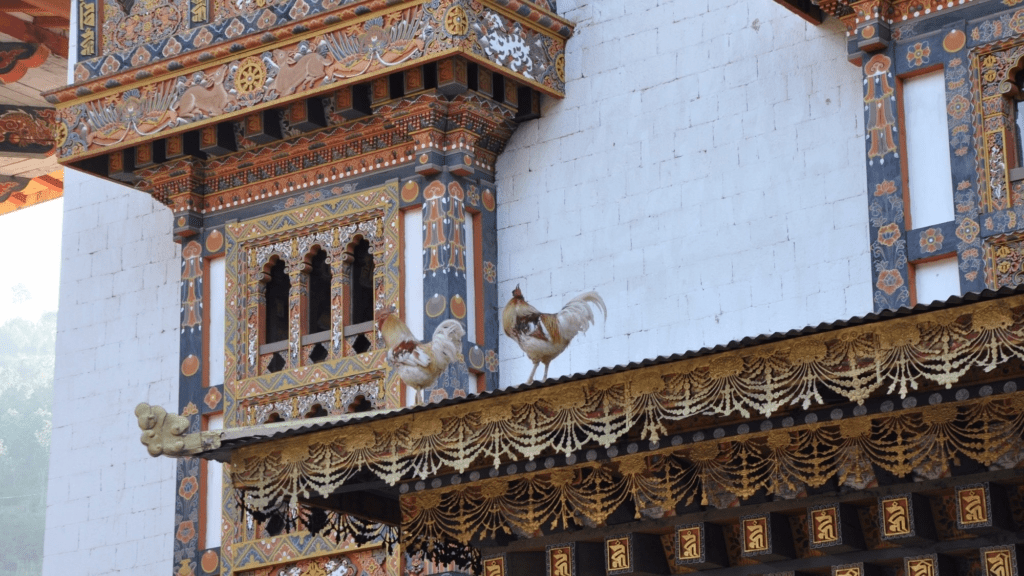
Impressions (in order): Conversations in front of white walls, roosters on the intricate roof ledge, and the entrance to the sacred temple area (Machen Lhakhang), where the relics of the state founder are kept.
Wangdue Phodrang: Rebuilding a Landmark
In the morning of the next day, we stopped at Wangdue Phodrang Dzong. This place has a moving history. It was founded in 1638 by Shabdrung Ngawang Namgyal under the auspicious name “Palace of the Four Cardinal Directions.” It sits strategically on a ridge that resembles a sleeping elephant and overlooks the confluence of two rivers.
Wangdue Phodrang Dzong
For a long time, it was considered the only Dzong that had never fallen victim to a fire in its almost 400-year history. But on June 24, 2012, fate struck: A technical defect triggered a fire in the early morning, and fueled by strong winds, the proud fortress burned out completely within a few hours.
But what we saw was not a place of mourning, but of hope. The reconstruction, which began in 2014, is an impressive testament to Bhutanese unity, but also to the deep friendship with neighboring India. Through close cooperation and generous support from India, this massive project could be realized. It wonderfully shows how modern engineering and cross-border solidarity are used not only to preserve traditional culture but to literally let it rise anew from the ashes.
Impressions (in order): Intricate carvings at the portal, colorful wall murals of guardian deities, the spacious courtyard, a monk at the staircase, and our group photo in front of the Dzong.
Drive through the Black Mountains
With this image of a new beginning in mind, we continued our journey towards the Phobjikha Valley. The drive was scenically very impressive. Our bus wound its way up the Black Mountains curve after curve. We had perfect weather. The sun was shining and allowed us a clear view that reached further with every meter of altitude. The road snaked along the partly steep mountain slopes in tight serpentines until we crossed the pass and finally drove down into the valley.
Phobjikha Valley: Winter Home of the Black-Necked Cranes
The Phobjikha Valley is a very special retreat. It serves as the wintering ground for the rare Black-necked Cranes from Tibet. There is a nice observation about this. When the birds arrive, they circle the local Gangtey Monastery three times. And apparently, they do the same when they leave again. Even the animals seem to have a connection to the Dharma here. We were lucky and some of us saw the first cranes that had already arrived.
Phobjikha-Tal
Our lunch was organized for us in an open field right in front of Khewang Lhakhang. We enjoyed it with a wide view into the valley. Afterwards, we visited the temple itself. Inside are still the original statues, which at a good 500 years old are as ancient as the building itself. One of these statues is particularly well-known, as it is said to have spoken twice already.
Khewang Lhakhang
I especially remember the story that’s connected to this place: A demon had taken the form of a young woman to deceive a young man. When the man died, the demon wanted to bring the body into the temple. But the Buddha statue spoke and denied him entry. The demon had to move on and was finally defeated by the deceased’s real girlfriend. A small stupa still stands at this spot today. Such events are not just fairy tales here; they are part of the living spiritual landscape.
Gangtey Goenpa: Spiritual Center of the Nyingmapa
The crowning conclusion of this day was Gangtey Goenpa. It sits on a ridge above the valley and is far more than just a beautiful building. It is the largest and most important Nyingmapa monastery in western central Bhutan and is considered the spiritual heart of the entire region.
The history of this place goes back a long way and begins with a vision. The great “Treasure Finder” (Terton) Pema Lingpa visited the valley in the late 15th century. He looked at the ridge and prophesied that one of his descendants would build a monastery there one day. This prophecy was fulfilled in 1613 when his grandson Rigdzin Pema Thinley founded the monastery.
Gangtey Goenpa
Architecturally, it is fascinating. At first glance, it looks like a Dzong, meaning one of the mighty fortresses we had seen before. But if you look closely, you notice a crucial difference. The military elements are missing. There are no arrow slits and no defensive walls. It was designed purely as a place of peace and practice. I was particularly impressed by the elaborate wood carvings visible everywhere, testifying to the high level of craftsmanship.
Impressions (in order): Wall mural of Dharmapala Gyalpo Pehar in the entrance area, the view up to the intricate wooden architecture, and the sunny courtyard.
Today, the monastery is a very lively place and acts as the seat of the Pema Lingpa tradition as well as the seat of the master’s ninth reincarnation. About 140 monks live here. Together with the nearby Shedra, the Buddhist college, they ensure that the teaching is not only preserved here but actively studied and lived.
I had a special experience inside the temple. We had gone in to pay our respects to the Buddhas and chant together. Scarcely had we entered the hall when the power went out and it became pitch dark instantly. In the light of our phones, we looked for a place to sit. For about ten minutes, we chanted in this darkness, illuminated only by the faint flickering of a few butter lamps. That created a very unique mood. Suddenly the light came back on. Only at that moment did I see what was directly on the wall opposite me. My gaze fell on a beautiful mural of the 21 Taras. That was an unexpected and deeply moving moment for me.
Actually, we had a specific hope in our hearts for our return to Thimphu and Paro: We wanted to try to get an audience with the King. But as so often in life, plans do not always go in a straight line. Karmic conditions had intended another encounter for us, which we had not expected in this way.
I will tell you about that and our ascent to the famous Tiger’s Nest in the next part.
About Author: Gongjue Tuji
As a committed Buddhist and initiator of the Xuanfa Dharmazentrum, Gongjue Tuji has made it his mission to help other people integrate the teachings of Buddhism into their daily lives. In this blog, he regularly provides insights into his experiences, current news and highlights fascinating aspects of the Buddha-Dharma.
Recently, I watched a short video that stayed with me far longer than I expected.
The scene took place in a small shop in Pakistan. A robber walked in, grabbed money and a phone, and prepared to leave. Sitting beside the shop owner was a little girl. She looked at the robber calmly, without screaming or hiding, and gently offered him the lollipop she was holding.
For a brief moment, everything seemed to stop.
The robber froze. He looked at the child, then slowly put the money and phone back down. Before leaving, he leaned over and kissed her on the forehead.
I don’t know whether the girl acted out of fear, nervousness, or pure instinct. But her simple, innocent gesture touched something deeply human in him. Perhaps, in that fleeting moment, his life took a different turn.
What moved me most was this realization: Even those who appear hardened or dangerous may still carry a seed of kindness within them. And sometimes, it only takes the smallest act to awaken it.
A single lollipop opened a door in the human heart.
Lately, I’ve been noticing more and more of these quiet sparks of goodness appearing around the world.
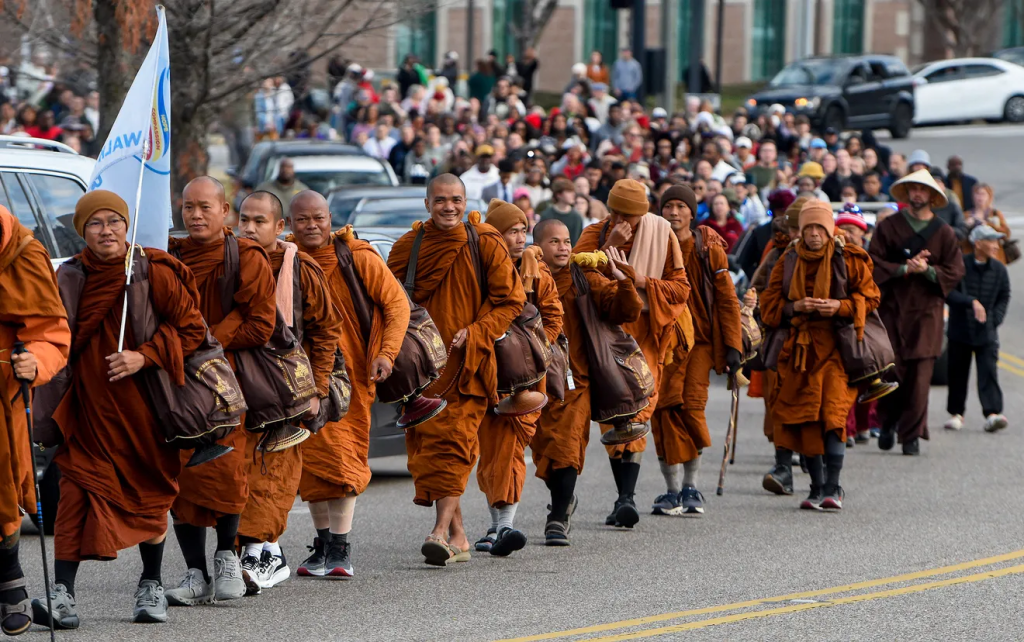
In the United States, a group of Buddhist monks has been walking on foot, praying for peace. Without slogans or confrontation, they offer presence, humility, and sincerity. Their journey has inspired many people to reflect on peace in a deeper way, and countless strangers have stepped forward to support them.
Guided by the teachings of Namo Dorje Chang Buddha III, and with deep respect for the great mercy and loving-kindness through which Buddhas and Bodhisattvas benefit all living beings, the World Buddhism Association Headquarters (W.B.A.H.), Holy Miracles Temple (at Pasadena CA) and Sanger Mission sincerely to carry out Charitable Acts to Benefit Our Community Together: 2026 Food and Goods Drive, to collectively plant goodness. All donations will be sent to support local food banks, homeless shelters, and animal shelters in the Los Angeles area.
I also read about Jon Stewart, who announced an extraordinary donation of $116 million to help address homelessness across the United States—providing housing and dignity to people who have long been forgotten by society. It was a reminder that compassion, when paired with courage, can bring real and lasting change.
And then there is the story that expanded my sense of hope even further.
Johan Eliasch, a Swedish billionaire, acquired approximately 400,000 acres of the Amazon rainforest by purchasing the company that held its logging rights. Instead of continuing operations for profit, he immediately halted all logging activities.
Just like that, the chainsaws stopped.
That vast stretch of forest was allowed to remain intact—continuing to absorb carbon, protect biodiversity, and sustain one of the planet’s most vital ecosystems. His action demonstrated something profound: that private ownership, when guided by conscience, can become a powerful force for environmental protection.
This act of kindness may not be immediately seen by everyone, yet it will have a profound impact on the Earth’s ecological balance—and it is, in its own quiet way, safeguarding a future our children and grandchildren will still be able to breathe in.
From a child offering a lollipop… to a monk walking for peace… to a philanthropist sheltering the homeless… to a forest saved from destruction—
These acts may differ in scale, but they arise from the same source: the human longing to protect, to heal, and to do what is right.
In Buddhist teachings, compassion is not passive emotion—it is action. It is wisdom expressed through kindness.
As a new year begins, I sincerely hope we will witness more of these compassionate and righteous choices—choices that quietly warm the world.
May we walk together, letting kindness extinguish the fires of war, allowing love to dissolve hatred and conflict, and using compassion to heal sorrow, fear, and pain.
The world does not change all at once. But every gentle act—no matter how small—adds light.
And sometimes, that light begins with something as simple as a child’s open hand.
Long ago, deep in the mountains, there lived a Zen master named Wuguo(无果), a practitioner wholly devoted to meditation. For more than twenty years, he was supported by a humble mother and daughter who offered him food and daily necessities so he could cultivate the Way without distraction.
As the years passed, Master Wuguo reflected deeply on his practice. Although he had dedicated his life to meditation, he felt he had not yet realized his true nature. A quiet fear arose in his heart: If I have not awakened, how can I truly repay the kindness of these offerings?
Determined to resolve the great matter of life and death, he decided to leave the mountain to seek instruction from other masters.
When the mother and daughter heard of his departure, they asked him to stay a few more days. They wished to sew him a monastic robe for his journey. At home, the two women worked carefully, chanting the name of Amitabha Buddha with every stitch, their hearts filled with sincerity. When the robe was finished, they also wrapped four silver ingots to serve as his travel funds.
Master Wuguo accepted their offerings and prepared to leave the next morning.
That night, as he sat quietly in meditation, a vision appeared. A young man dressed in blue stood before him, holding a banner. Behind him came a procession playing music and carrying a magnificent lotus flower.
“Zen Master,” the youth said, “please ascend the Lotus Seat.”
Master Wuguo remained calm. He reflected inwardly: I am a Zen practitioner, cultivating meditative concentration. I have not practiced the Pure Land path. I should not become attached to visions. Even for a Pure Land practitioner, such an experience could be a delusion.
He ignored the vision.
Yet the youth returned again and again, urging him earnestly not to miss this rare opportunity. Finally, Master Wuguo picked up his small hand-bell (yinqing) and placed it on the lotus seat. Soon after, the youth and the entire procession vanished.
The next morning, as Master Wuguo prepared to depart, the mother and daughter hurried toward him in distress. Holding the hand-bell, they asked anxiously:
“Master, is this yours? Something very strange happened last night. Our mare gave birth to a stillborn foal. When the groom cut it open, he found this bell inside. We recognized it immediately and rushed to return it—but we cannot understand how it came from a horse’s belly.”
Upon hearing this, Master Wuguo broke into a cold sweat. Deeply shaken, he composed a verse:
One monastic robe, one sheet of hide; Four silver ingots, four hooves inside. Had this old monk lacked the power of Zen, Your stable is where I would have been.
In that moment, he clearly understood the law of cause and effect. By accepting the robe and the silver, he had created a karmic debt. Had his mind been even slightly attached—to the vision, to the offerings, or to the idea of reward—he would have been reborn as a horse in that very household, laboring to repay what he had received.
Immediately, Master Wuguo returned the robe and the silver to the women and departed.
Because he did not cling to extraordinary visions, he escaped rebirth in the animal realm. An ordinary person, upon encountering such sights, would have grasped at them, fallen into delusion, and continued revolving in the cycle of rebirth.
This story reveals a profound truth: the realms are not distant places—they arise from the mind itself.
When the mind dwells in craving and greed, it becomes the realm of the Hungry Ghosts, endlessly desiring yet never satisfied. When the mind dwells in anger and resentment, it becomes the Asura realm, filled with conflict and struggle. When the mind is clouded by ignorance and confusion, it sinks into the Animal realm, driven by instinct and karmic habit.
In our daily lives, we often fixate on external things—lust, fame, wealth, comfort, indulgence—believing we cannot live without them. Yet we fail to see that all phenomena arise from causes and conditions. When conditions gather, things appear; when conditions disperse, they vanish. None possess a fixed or permanent essence.
Reflect carefully: Is there anything in this world we can truly hold onto forever?
Since nothing produced by conditions can be owned, lasting happiness cannot be found through possession or attachment. True happiness arises from non-attachment, from seeking nothing and clinging to nothing. When the mind releases its grasp, it becomes light, clear, and free.
So we may ask ourselves:
Can we remain at peace amid changing emotions? Can we stay calm in the face of conflict? Can we remain unmoved by fame and profit? And when the moment of death arrives, can our mind remain clear and mindful?
The law of cause and effect never errs. What we cultivate in the mind today shapes the world we inhabit tomorrow.
In the middle of a storm, most people look for shelter. But a rare few choose to stand in the rain to keep someone else’s home from washing away.
In 1942, the United States was a place of fear and suspicion. Following the attack on Pearl Harbor, Executive Order 9066 forced thousands of Japanese-American citizens into internment camps. They were given just days to pack what they could carry, leaving behind their businesses, their homes, and their life’s work.
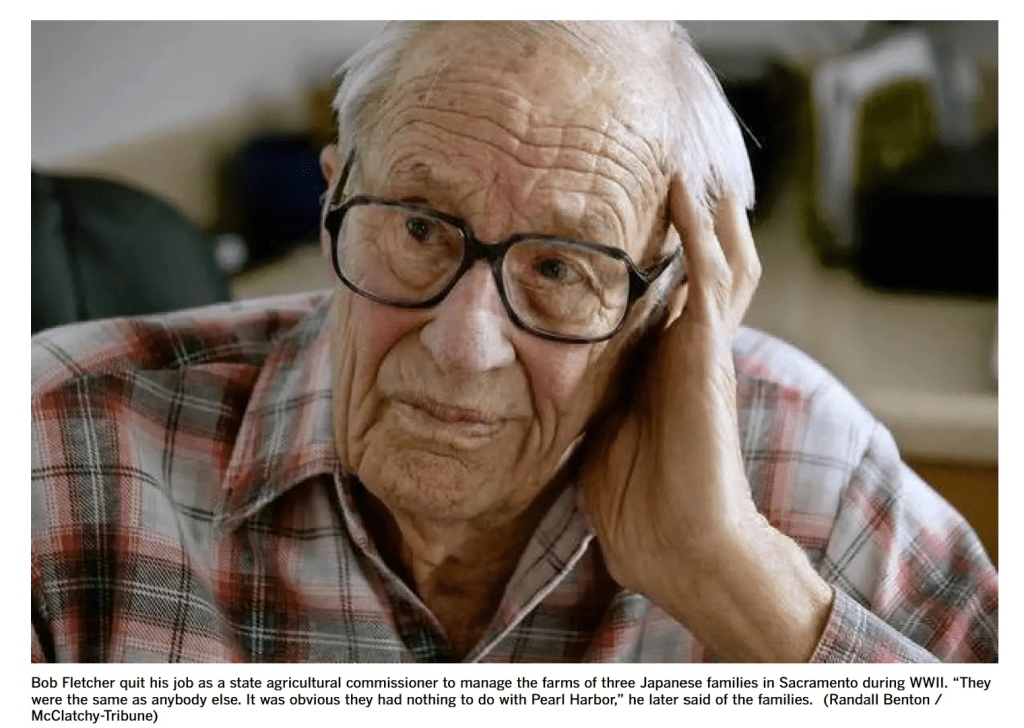
In Florin, California, most people looked away as their neighbors were taken. But an agricultural inspector named Bob Fletcher did something different. He stepped forward.
Note 1
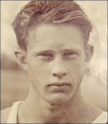
Bob Fletcher was 31 years old when his neighbors—the Tsukamoto, Nitta, and Okamoto families—were ordered to leave. They were strawberry and grape farmers who faced losing everything to foreclosure.
They asked Bob if he would manage their farms while they were gone. Bob didn’t just say yes; he quit his stable job with the state to become a full-time farmer for people who weren’t even allowed to be there.
For three years, Bob worked 18-hour days. He managed 90 acres of flame tokay grapes across three different farms.
The Cost of Doing the Right Thing
Doing the “right thing” is rarely easy. Bob wasn’t seen as a hero by his community at the time. He was called names, shunned by neighbors, and at one point, someone even fired a shot into the barn where he was working.
But Bob had a quiet, iron-clad integrity. He lived in the migrant bunkhouses rather than the families’ main homes. He paid their mortgages, their taxes, and their bills. When the families finally returned in 1945, they didn’t return to ruins—they returned to thriving farms and a bank account full of the profits Bob had saved for them.
Bob Fletcher lived to be 101 years old. For decades, he deflected praise, often saying:
“I don’t know about being a hero. I just did what I thought was right.”
His life leaves us with enduring lessons:
Integrity is a verb. It is not what we believe in private, but what we practice when no one is watching—and when it costs us something.
One person is enough. Bob couldn’t stop a national injustice, but he saved three families. Sometimes protecting one corner of the world is exactly what we are called to do.
Moral courage is quiet. It doesn’t announce itself. Sometimes it looks like long days, dirty hands, and the refusal to surrender compassion to fear.
We may not be living through a world war, but we all face moments where it is easier to go along with the crowd than to stand up for a neighbor. Bob Fletcher’s life asks us: Who are we looking out for? What are we willing to protect?

















 Peace LiLy