I have always loved being close to nature, and one of my greatest joys is walking through the forest. Living in Santa Cruz, I am surrounded by beautiful woods and mountain trails. Each time I wander beneath the trees and along winding paths, I arrive at the end feeling lighter, calmer, and deeply refreshed—as if my body and mind have been fully recharged.
I once came across an interesting idea: Mountains are places where we gain energy, which is why after hiking, we often feel alert and invigorated. Water, on the other hand, carries energy away. This may explain why spending long hours by the ocean or a lake can leave us feeling tired. Yet water also washes away emotional heaviness. When we feel sad, restless, or overwhelmed, a walk by the sea often brings a sense of release and ease.
Energy is constantly flowing through nature. We are simply quiet participants, allowing the natural world to gently adjust our inner frequency.
Discovering “Forest Bathing”
Recently, I was delighted to learn that the Japanese have a word that perfectly describes this healing experience: forest bathing.
In Japanese, it is called shinrin-yoku:
Shinrin means forest
Yoku means bathing
Together, shinrin-yoku means “bathing in the forest,” or allowing our entire being to absorb the atmosphere of the woods. As early as 1982, Japan officially incorporated forest bathing into its national public health program as a form of preventive and therapeutic care.
Suddenly, I realized that every breath I took in the forest had always been quietly nourishing me.
Japanese researchers have conducted extensive studies on forest bathing and found remarkable benefits for overall well-being. Research shows that forest bathing can:
Reduce stress
Strengthen the immune system
Lower blood pressure
Support recovery after illness or injury
Improve mood and concentration
For me personally, its most immediate effect is simple yet profound—it quickly lowers stress and brings my heart back to a place of calm.
Forest bathing is very different from running or brisk walking. It is not about exercise or distance; it is about presence. The key is to slow down and fully engage all your senses:
Touch the bark of trees—rough or smooth
Watch sunlight dance through layers of leaves
Breathe in the scent of earth and greenery
Listen to the wind moving through branches
Find a place to sit and feel your connection with the ground
In the past, most of my hikes were intense, goal-driven, almost like completing a task. Since practicing forest bathing, I now schedule at least one slow, mindful walk each week. By slowing down, I have discovered beauty I once overlooked—and I can’t help but smile at how much I missed before.
There is a subtle yet powerful presence in the forest. It does not announce itself, yet it gently soothes the heart.
Perhaps it is the oxygen released by the trees. Perhaps it is the steady, unhurried rhythm of the forest. Or perhaps it is simply that, among the trees, we can finally hear our own breath again.
When we walk in the forest, there is nothing we need to accomplish. Nothing to force. Nature naturally helps our hearts soften, open, and grow brighter.
If you feel tired, anxious, or lost in the busyness of everyday life, I invite you to find a nearby mountain trail and give yourself the gift of forest bathing.
Let nature, in its quiet way, remind you: You are doing your best—and you deserve to be healed. 🌲
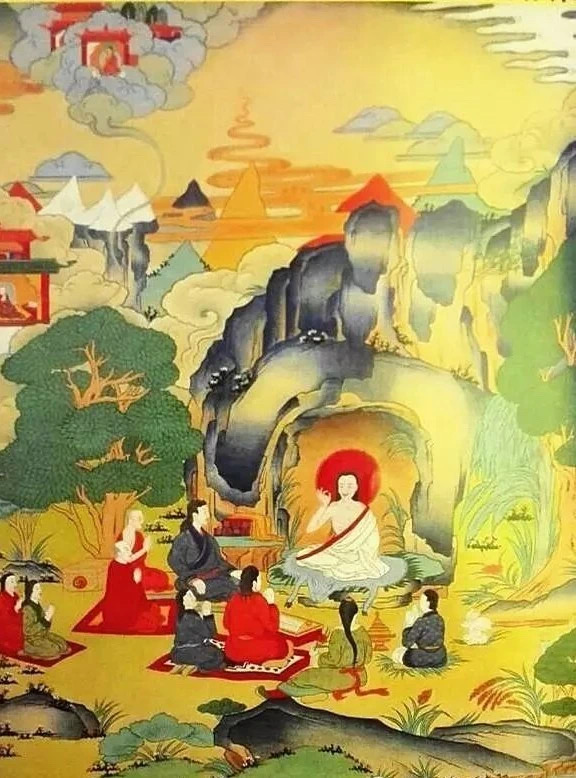
This ancient Buddhist narrative reveals a timeless truth: the value of spiritual wisdom far outweighs any material wealth. It is a powerful reminder to cherish the opportunity to hear and practice the true teachings.
The story begins with the aunt of Shakyamuni Buddha. Out of deep love and devotion, she wove a magnificent robe for him, intricately threaded with gold. It was a labor of heart, an offering fit for an enlightened one.
Yet when she presented it, the Buddha gently advised her to give the robe instead to the entire monastic community—the Sangha.
This puzzled her. The garment was made especially for him. Why give it away?
The Buddha explained with compassion:
“The Field of Merit provided by the Sangha is vast and boundless. Offer it to them, and the virtue you gain will be immeasurable. To give to the Sangha is to give to me.”
Moved by this wisdom, she offered the robe to the monks. Out of humility, none dared to accept it—except Bodhisattva Maitreya, the future Buddha.
Wearing the golden robe, Maitreya went into the city to receive alms. His majestic presence, radiant in that resplendent garment, astonished the townspeople. They were mesmerized—so much so that they forgot to offer him food.
Among them was a master bead-stringer. Captivated, he invited Maitreya to his home for a meal. Afterward, he requested a Dharma discourse.
The artisan listened with such joy and absorption that he forgot everything—including an urgent commission from a wealthy patron who had paid him generously to craft a wedding ornament worth one hundred thousand coins.
When the client’s messengers arrived repeatedly to collect the finished piece, they found him entirely engrossed in listening to the teachings. Enraged, the wealthy man demanded back his jewels and the full down payment.
The artisan’s wife was devastated. Facing such a financial loss, she scolded him bitterly:
“By simply finishing that order, you would have earned a great fortune. Instead, you threw it all away listening to philosophy!”
The artisan felt a wave of regret wash over him.
Sensing this inner turmoil, Maitreya gently asked, “Will you come with me to the monastery?”
The artisan nodded.
Back at the monastery, Maitreya posed a question to the venerable Arhats:
“Which carries greater merit: listening to the Dharma with a joyful heart, or earning a great fortune?”
One by one, the senior monks affirmed that nothing can compare to the merit of hearing the true teachings.
Venerable Kaundinya declared:
“Receiving ten thousand pounds of gold cannot compare to offering even a single bowl of food to a virtuous practitioner. And listening to the Dharma with pure faith—even for a moment—surpasses that merit by hundreds of millions of times.”
Four other Arhats repeated this profound truth.
Finally, Maitreya asked Venerable Aniruddha why this was so.
Aniruddha replied:
“In a past life, I offered just one bowl of food to a Pratyekabuddha. Because of that single offering, for ninety-one world cycles I was reborn as a Heavenly Emperor and a human King, enjoying peace and prosperity. In this life, I was born into the same clan as the Buddha, and came into this world with a natural treasure field forty li wide.”
Hearing this, the bead-stringer felt his regret dissolve. Joy filled his heart. He understood the treasure he had received was far beyond the hundred thousand coins he had lost.
This ancient story is far more than a tale. It invites us to reflect deeply on the power of the Dharma.
Listening to the Truth is not merely an intellectual exercise. It opens the heart. It awakens wisdom. It strengthens the willpower needed to transform our deepest flaws and afflictions.
Material wealth is limited and fleeting. The merit gained from receiving the Dharma is limitless, enduring, and life-changing.
And yet the opportunity to listen does not always come easily. Conditions shift. Circumstances change. None of us can guarantee the next moment of life, much less another chance to sit peacefully and hear teachings that can liberate us from suffering.
When the causes and conditions ripen—when the Dharma reaches our ears—we must listen wholeheartedly.
We must not assume tomorrow will come. We must not assume our hearts are already pure. We must not assume we know enough.
The greatest freedom comes only when we break the cycle of birth and death and attain effortless liberation. Every moment of listening, every spark of understanding, moves us closer to that awakening.
This story encourages us to treasure every opportunity to hear the teachings, to recognize that spiritual wisdom is the greatest wealth of all, and to remember that even a moment of true Dharma listening can bring blessings far beyond the measure of gold.
In this Dharma-ending age, we are truly blessed that an ancient Buddha has come into our world to reveal the authentic, uncorrupted Dharma. The recorded discourses of H.H. Dorje Chang Buddha III guide practitioners through a clear and progressive path of cultivation, offering incisive teachings that encompass the essence of the twelve divisions of the Tripitaka and the ten divisions of the esoteric scriptures. Nothing is diluted or lost—each teaching preserves the profound meaning of both the exoteric and esoteric Dharma. These discourses illuminate an extraordinary range of topics, from the principles of the Trikaya and the Four Wisdoms of a Buddha to the supreme vajra Dharma of the highest division. They reveal the true realization of the Great Perfection of Ultimate Wisdom, and through the Xian Liang Buddha Wisdom Great Perfection Dharma, disciples may even personally witness the rainbow-body state on the very day the Dharma is transmitted. In both theory and practice, the teachings of H.H. Dorje Chang Buddha III stand complete, perfect, and unparalleled—an immeasurable blessing in this age of fading Dharma.
The hourglass of every life is filled with grains of sand
And through the narrow neck of time our memories all land
Each grain a special yesteryear each grain a dream that’s passed
Lifelong castles built with care in hopes that they would last
Our trips around the dazzling sun are all too precious few
Whether they count twenty-one or even ninety-two
So live your life with purpose and seize each fleeting day
And heed the Good Book’s verses before life slips away
When all of today’s tomorrows have turned to yesterdays
And you add up the joys and sorrows that you faced along the way
In pursuit of life’s bright rainbows and the dreams you dared to dream
The brilliant shooting star shows beyond the moonlit beams
Don’t lose sight of the treasures from which you’d never part
The things that can’t be measured except within your heart
That offer your life meaning and lasting legacy
Your inspiration for dreaming for all the world to see
And as you bid this world adieu and say your last goodbyes
Get showered with the “I love yous” and head toward Heaven’s prize
Take a look around you and count yourself as blessed
For all that you’ve held onto that’s brought you happiness
Your life on Earth will carry on within the hearts and souls
Of the many lives you’ve met along this long and rocky road
From mountains high to ocean shores your journey here is done
So let your wings toward Heaven soar to that home beyond the sun!
“The years of our life are . . . soon gone, and we fly away . . . So teach us to number our days that we may get a heart of wisdom.” ~~ Psalm 90:10, 12 (ESV)
“Let us prepare our minds as if we’d come to the very end of life. Let us postpone nothing. Let us balance life’s books each day.” ~~ Seneca (First Century)
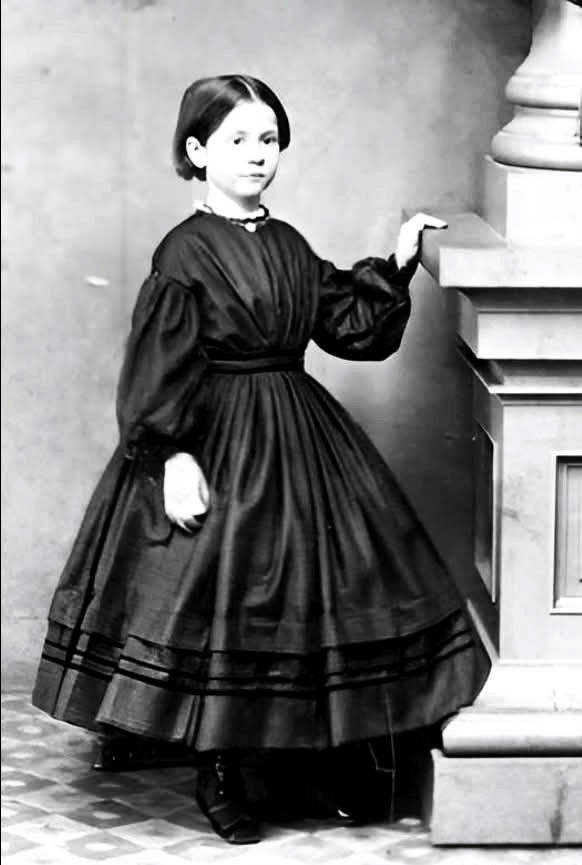
She was eight years old when her father gambled her away in a card game. Her older sister had three hours to win her back before the debt collector came.
Deadwood, Dakota Territory. 1877. A place where law came slow, danger came fast, and survival belonged to the ruthless.
Thomas Garrett had lost everything—his mining stake, his wages, his self-respect—and now, in a drunken haze at the Gem Saloon, he’d lost something far worse:
his daughter.
The man who won her was Bullock— not the sheriff, but a labor trafficker who “supplied” children to mining camps. Kids as young as six spent twelve-hour days sorting ore until their lungs failed or their fingers gave out. Most didn’t live past fourteen.
Thomas signed the paper without hesitation. Bullock would collect little Emma at noon.
When fifteen-year-old Sarah came home from the laundry and learned what her father had done, she didn’t cry. Didn’t scream. Didn’t fall apart.
She simply asked, “When?”
“Tomorrow. Noon.”
Three hours until dawn. Three hours to save her sister.
And Sarah had something her father never had:
clarity.
She knew Bullock.
Everyone did. A cruel man who hid behind paperwork and respectability.
He’d made her father sign a contract— which meant it could be challenged.
And Deadwood had something else:
A new federal judge who’d publicly declared that parents could not use their children to pay debts.
Sarah didn’t sleep. She didn’t blink.
At dawn she was already standing in the courthouse, breathless, determined.
The clerk tried to dismiss her— fifteen-year-old girls didn’t talk law.
But Sarah did.
Because before drink ruined him, her father had been a clerk… and she’d read every law book he left lying around.
She laid out the case with the precision of a trained lawyer:
The contract violated territorial labor laws.
It constituted debt bondage of a minor.
Thomas Garrett was legally incapacitated due to intoxication.
The clerk stared. Then nodded.
He woke the judge.
Judge Isaac Parker—who would one day be known as the “Hanging Judge”—read the contract, listened to Sarah, and did something extraordinary:
He issued an emergency injunction, blocking the transfer and summoning both Bullock and Thomas Garrett to court that afternoon.
When Bullock arrived at the Garrett cabin at noon, two men at his back, he found Sarah waiting on the porch.
Not shaking.
Not pleading.
Holding a federal court order in her hand.
Bullock turned red with fury but wasn’t stupid enough to defy a judge.
At the hearing, Judge Parker didn’t hesitate.
He voided the contract. Declared it an illegal attempt to traffic a minor. Warned Bullock that any further attempt to collect “payment” would end with him in chains.
Then he turned to Thomas Garrett.
A father who gambled his children away forfeits the right to be a father.
Parker stripped him of parental rights and— in a move that shocked the entire Dakota Territory— appointed fifteen-year-old Sarah as her sister’s legal guardian.
But victory didn’t fill their stomachs.
Sarah now had an eight-year-old to raise, no money, no home, and only her laundry work to survive.
What she did next became legend.
She went to five different businesswomen in Deadwood— laundry owners, seamstresses, boarding house keepers— and proposed a deal:
“I’ll work for reduced wages. You house and feed my sister and me. I’ll take the hardest jobs and the longest hours.”
Four said no.
The fifth— a widow named Martha Bullock (no relation to the trafficker)— said yes.
For the next three years, Sarah worked sixteen-hour days. Emma went to school— Sarah insisted on it.
She saved every coin.
By 1880, she’d saved enough to lease a small building and open her own laundry.
By 1882, she owned it.
She employed six women. Paid fair wages. Offered housing to those in need.
Emma, thirteen, kept the books.
When Emma turned eighteen, Sarah paid— entirely from her business profits— for her to attend normal school and become a teacher.
Emma later became a school principal and one of the fiercest advocates for child labor reform in the state.
Sarah never married.
“I raised one child already,” she’d say with a half-smile. “Did a better job than most with half the resources.”
She ran her business until 1910, providing work for over a hundred women across three decades.
Emma retired as the first female superintendent in her county.
When Sarah died in 1923, her obituary mentioned her “successful business career.”
Emma told the real story:
A fifteen-year-old girl who had three hours, a law book, and the unwavering conviction that her sister’s life was not for sale.
Judge Parker later said:
“Justice isn’t only about punishing the guilty. Sometimes it’s about recognizing competence where no one else looks for it.”
The line between tragedy and triumph is thin. Sometimes it’s nothing more than a teenage girl who refuses to accept that her sister can be traded like poker chips—
and who’s smart enough to find the one legal lever that can stop it.
Sarah Garrett didn’t have money. Didn’t have weapons. Didn’t have allies.
She had time running out. A mind trained by desperation. And love hard enough to fight the world.
In today’s world, our phones are never more than an arm’s length away, and our minds rarely get a moment of true rest. We scroll without thinking, click without choosing, and consume without noticing. But deep inside, many of us feel the same quiet truth—we are losing ourselves in the noise. This post is a small reminder that peace, clarity, and spiritual nourishment are still possible, if we begin to consciously take back our attention.
Instagram Reels, YouTube Shorts, Facebook browsing—what starts as a quick check so easily becomes an hour of mindless scrolling. It’s almost frightening how fast time disappears. Even without TikTok, I can feel the pull of the algorithm shaping my habits, my attention, even my thoughts.
Of course, technology brings wonderful conveniences. We can speak with loved ones across the world instantly, save treasured memories, learn anything we want, and make life easier in countless ways. But lately, I’ve realized something important:
My attention span is scattered. Silence feels uncomfortable. I reach for my phone without thinking. And I’ve begun to wonder—is this what addiction feels like? Knowing you don’t need it, yet still reaching for it anyway?
We all know we’re on our screens too much. But knowing doesn’t free us. Conscious action does.
The Real Cost: What Screen Time Is Stealing From You
This isn’t just about an hour lost to Instagram; it’s about the erosion of the most vital parts of our lives. The time we spend staring into a screen is time actively taken away from meaningful, real-world engagement.
Screen time is truly troubling our lives right now:
We have less time to exercise. The energy required for a twenty-minute workout is often sacrificed for twenty minutes of passive scrolling on the couch.
We have less time to play with kids. Those precious, unrepeatable moments of building a fort or kicking a ball are missed because we’re “just checking” a notification.
We have less time to talk to our parents/partners. Authentic, present conversation is replaced by parallel consumption, sitting next to a loved one while both are immersed in separate digital worlds.
We have less time for deep, restorative sleep. The blue light, the stimulating content, and the mental chatter we absorb right before bed actively hijack our ability to rest.
A Spiritual Perspective: Why Screen Addiction Makes Us Unhappy
In Buddhism and many spiritual traditions, the mind is described as a lake. When the surface is constantly stirred—by notifications, news, entertainment—it becomes muddy. We can no longer see clearly. Wisdom, compassion, and calmness all sink beneath the surface.
Excessive screen time:
scatters the mind through endless stimulation
drains our life-force through constant comparison and craving
steals the quiet moments where insight and peace are born
pulls us away from real presence—real people, real breath, real living
Spiritual masters remind us: “Where your attention goes, your life goes.” If our attention is constantly fragmented, our life becomes fragmented too.
Actionable Suggestions to Reduce Phone & Social Media Time:
Strategy
How It Works
The Friction Folder
Move all tempting social media/entertainment apps into one folder on the very last page of your phone screen. This adds just enough friction to make you pause before opening.
Grayscale Mode
Switch your phone display to black and white. Color is a primary driver of attention and addiction; removing it makes the screen less stimulating and less fun to look at.
Set App Limits
Use your phone’s built-in Screen Time settings to put a hard limit (e.g., 30 minutes) on all social media apps. Once you hit it, the app locks for the day.
The “Phone Bed”
Designate a charging spot outside your bedroom. Use a traditional alarm clock. Your bedroom should be a sanctuary for sleep and connection, not consumption.
The “Purpose-First” Rule
Before you unlock your phone, state out loud (or in your mind) what you are picking it up to do (“I am checking the weather,” “I am calling Mom”). Complete the task and immediately lock the screen.
Mindful Practices I’m Recommending:
These are small, spiritual steps to reclaim your mind:
Put the phone out of sight. What the eyes don’t see, the mind doesn’t crave.
Create “sacred screen-free hours.” Mornings or evenings where the mind can rest—like offering ourselves a daily meditation.
Return to the breath whenever the urge to scroll pops up. One breath. One pause. One moment of awareness.
Read again—slowly, intentionally. A physical book becomes a refuge, a temple for the mind.
Replace noise with mindfulness. Walk without headphones. Eat without a screen. Let silence become a friend again.
Remind yourself of impermanence. Every moment spent scrolling is a moment of life we never get back.
Little by little, I’m learning to soften the grip that screens have over me. Not by force, but by nurturing something deeper—presence, clarity, and spiritual freedom.
Do One thing mindfully and intentionally at a time. It’s time to be truly alive again.
The moment I heard that I would be going with Venerable Dharma Teacher Long Hui to Los Angeles, unspeakable joy arose in my heart. On the way to Los Angeles, a rainbow suddenly emerged from the drizzling sky, emitting beautiful lights of various colors. A white celestial crane seen in the distance flew near and landed at the side of the freeway gazing at us, as if paying us respect. All of these signs expressed auspicious blessings. I strongly sensed that what I had wished for so long was about to come true.
A notice arrived in the afternoon of December 28th. From Venerable Dharma Teacher Long Hui’s somewhat tense facial expression, I could tell this must be the time for me to pay my respects and visit the Buddha Master. Just as expected, when we stepped into the mandala, I saw H.H. Dorje Chang Buddha III Wan Ko Yeshe Norbu Holiest Tathagata sitting upright on the dharma platform. His Holiness appeared so dignified and had an expression of loving-kindness. As I sincerely prostrated myself to H.H. Dorje Chang Buddha III, all I heard was the cordial voice of His Holiness telling everyone to come sit toward the front. I sat beside Venerable Dharma Teacher Long Hui. Dharma Teacher Jue Hui and Dharma Teacher Ruo Hui also sat with us.
Venerable Dharma Teacher Long Hui reported to the Buddha Master regarding the Buddhist chanting work that had taken place at Hua Zang Si over the past two months. Next, the Buddha Master called my name: “Fa Hai, proceed with what you want to say.” Without knowing why, my mind went totally blank. I felt that my entire body was soaking in a kind of freshness. I remained kneeling with a very straight back, as if I had entered a state of meditation. At this time, I only heard the Buddha Master say, “It is all right. Just speak directly!” Yet, I still could not speak and was silent for another eight or nine minutes. I could sense that the Buddha Master was patiently waiting. Finally, a sound floated out of my mouth: “My karmic affinity with the Buddha Master should have begun ten years ago. Because I could not come to America, I was not able to visit His Holiness. I finally got a visa last year. Only this year did I have the opportunity to visit Hua Zang Si, where I respectfully listened to recorded dharma teachings of the Buddha Master. For more than one straight month, I have listened to the recorded dharma discourses without the slightest sense of tiredness.
This has been the most beneficial and rewarding time of my entire life. The beneficial effects I have experienced can never be expressed in words. I bring my body, speech, and mind to respectfully visit the Buddha Master at this time. Today, I would like to specially request a great dharma from H.H. Dorje Chang Buddha III. I would not hesitate to leap into boiling water or walk on fire in order to obtain this great dharma. I am willing to undergo any test in order to obtain such dharma. I am even willing to sacrifice my own life. It might sound like I am exaggerating, but I truly can do such things.”
Perhaps because I was too nervous or focused, I unexpectedly was not able to express exactly what I meant to say. However, I silently told myself that the Buddha Master definitely understands what I am trying to express and what dharma I am requesting. I still remember that I fasted for a full 21 days in the Philippines in order to obtain this great dharma. This is because I am very aware that in this world only H.H. Dorje Chang Buddha III can accomplish this task and announce to the world this great dharma in order to demonstrate the brightness of Buddha and enable the correct dharma to exist in this world forever.
At first, the Buddha Master did not answer my request directly but gave us a profound and important discourse. Only afterward did I realize that this discourse was actually the beginning of His Holiness’s response to my question. His Holiness specifically pointed out the various kinds of confusion and mistakes that have appeared within Buddhism in this current Dharma Ending Age. Some Buddhist sutras contain serious mistakes. What is even more serious is that there are some so-called eminent monks and great virtuous beings who, due to their erroneous understanding and views, seriously misguide others when giving discourses on the dharma. What is even sadder is that believers who do not understand the truth still fanatically follow them and prostrate to them in worship. H.H. Dorje Chang Buddha III does all He can to correct these heretical ideas and views. However, being limited by the karma of living beings, H.H. Dorje Chang Buddha III feels that it is very difficult to change the current situation despite His wish to do so. The Buddha Master gave some examples of these heretical ways within both esoteric Buddhism and exoteric Buddhism. These very worrisome examples left me not knowing whether to laugh or cry.
After finishing the discourse, the Buddha Master said to me directly, “Fa Hai, you did not say what great dharma you want to request. Let me say it for you. The dharma you want to request is to film a movie of the Buddha. There really is no one else besides me who can do this because I completely understand the teachings of the Buddha. I can write the script. This movie must be filmed. The only thing is that the karmic conditions this year are not quite mature enough because the script needs to be written and actors need to be found, especially actors who are qualified. As for funding, as long as there is a script, there will be people who will sponsor and invest. Besides, the movie of the Buddha will not be filmed as one undivided whole but will be divided into a series of 100 parts or episodes. Perhaps this is really the right channel. After all, the influence of a book is limited as it reaches fewer people than a movie, which has much more of an international impact. In addition, when we do this, many problems might be solved. We might even be able to build several temples this way!” At this moment, I understood that the discourse just given by H.H. Wan Ko Yeshe Norbu Holiest Tathagata on the current chaotic situation within Buddhism illustrated that it is impossible for anyone else to write in a script the authentic doctrines of the Buddha.
Listening to this point, I was really shocked in my heart. I used to pay respect and visit many eminent monks and great virtuous beings. I requested from them great dharma. None of them knew what this great dharma in my mind was that I wanted to request. H.H. Dorje Chang Buddha III is truly magnificent. I did not reveal in the slightest what great dharma I wanted to request. Nonetheless, what His Holiness stated was the exact great dharma in my mind that I wanted to request.
His Holiness then said, “Fa Hai, when you come back from mainland China, I will transmit to you dharma according to the formal rituals of Tibetan esoteric Buddhism. You still have some negative karma. At that time, I will perform an initiation for you and eliminate your karmic hindrances. You will see.” I was totally engulfed in the joy of the dharma. The Buddha Master further said, “On your way here, the rainbow and the celestial crane you saw augured that your future undertakings will be bright. However, behind the brightness lurks darkness, and there are twists and turns on the path. We will soon face some attacks and slander, although those who commit the slander will all end up losing. When A Treasury of True Buddha-Dharma is published, no force can obstruct or destroy us because what is in that book are facts.” The Buddha Master finished by saying, “The movie of the Buddha definitely has to be filmed. You see, Fa Hai, your wishes have all been fulfilled. How fortunate you are!”
Actually, there are no words that can express my happiness. There are also no words that can express my gratitude toward H.H. Dorje Chang Buddha III.
I only want to respectfully offer to the Dorje Chang Buddha III my most beautiful spirit, my most beautiful melody, my most beautiful singing voice, and my best wishes. May all those who hear this beautiful melody and singing voice be happy.
I would like to express my special thanks to an anonymous person who ten years ago sent me an express mail package in which a yellow silk scarf was wrapped around the book The Fruits of Pious Devotion and CD’s that had a picture of H.H. Dorje Chang Buddha III on their covers. It is because of this present that seeds planted ten years ago have borne fruit in the form of my taking refuge in the His Holiness as my Buddha Master and in the form of my witnessing the magnificence of the Buddha-dharma.
Everything I described above is true. I am a Buddhist nun. I accept the karmic responsibility for my words. If what I have stated is false, I will descend into the Vajra Hell. If what I have stated is true, I would like to dedicate the resulting merit to all living beings in the dharma realm so that they will soon realize enlightenment.
Respectfully written by disciple Fa Hai Shi December 30, 2006
The above account was written by Fa Hai Shi. We three humble Buddhist nuns provide the following testimonials.
Encountering an Unusual Occurrence
Basically, whenever people pay their respects and visit H.H. Dorje Chang Buddha III Wan Ko Yeshe Norbu Holiest Tathagata, they make good use of their short meeting time by posing prepared questions or by requesting the transmission of dharma. Some groups have really made the best use of their time by requesting answers to problems that have arisen.
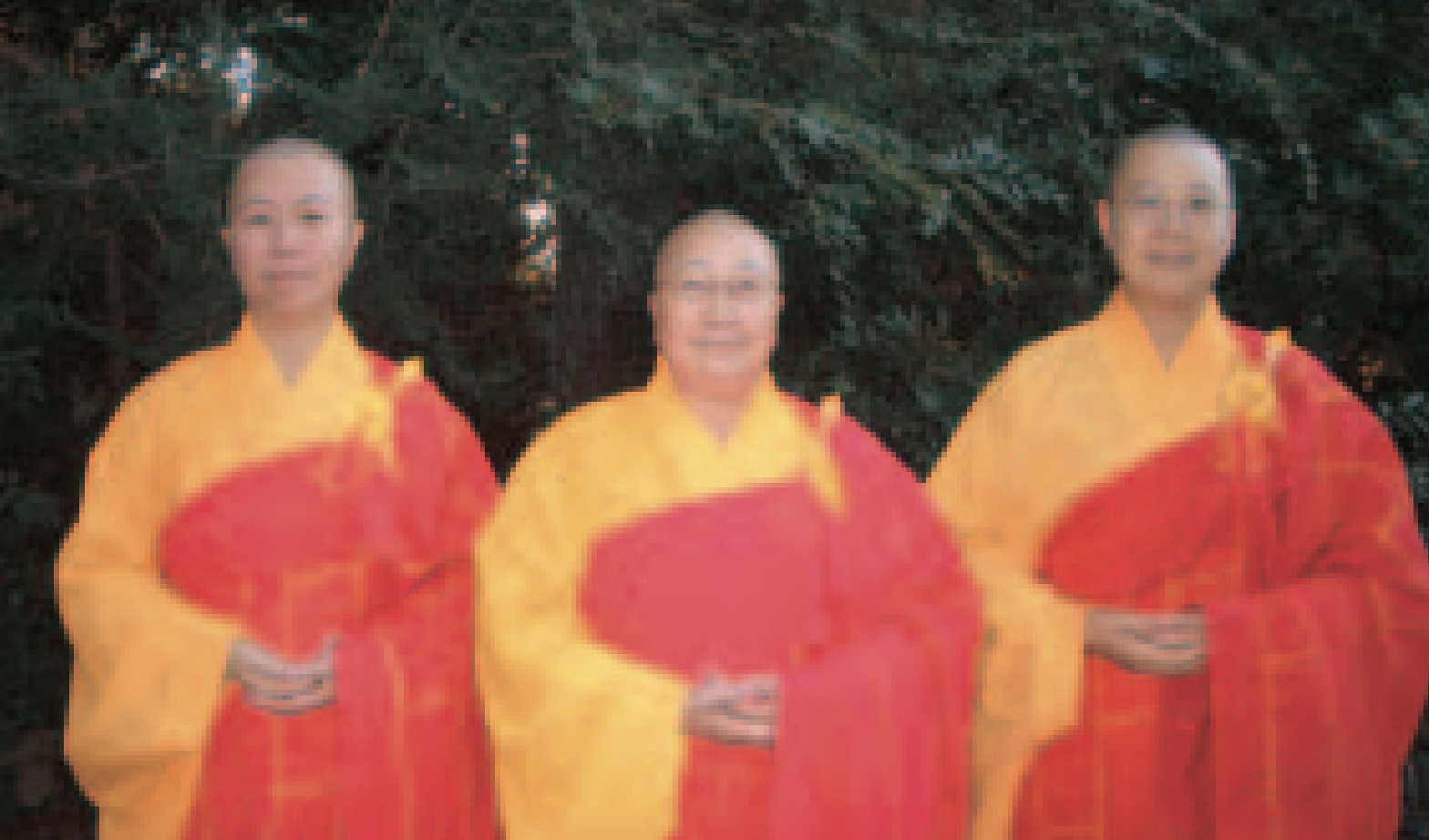
From left to right: Ruo Hui Shih, Long Hui Shih, and Jue Hui Shih
However, there was one particular occasion in the afternoon of December 28, 2006 when a dharma teacher from the Philippines, Fa Hai, came to the mandala from thousands of miles away. This was the first time she was granted an audience with H.H. Dorje Chang Buddha III. When H.H. Dorje Chang Buddha III asked her what question she had, I saw that Buddhist nun take a deep breath. She then unexpectedly remained silent as she stared at the Buddha Master with open eyes, sometimes lowering her head. Perhaps all of this was due to nervousness or other factors. At this time, the Buddha Master also did not speak. Seconds and then minutes passed by in silence. Then, that dharma teacher sighed once more and straightened her back, still looking at the Great Dharma King without uttering a sound. Strangely, Dorje Chang Buddha III also remained silent. A moment later, she sighed for the third time but still did not reply to the Buddha Master. The duration of this silence lasted more than eight minutes. This kind of situation had never happened before.
Finally, the dharma teacher spoke. She said she had come with a wish to request a great dharma. If her wish to obtain this great dharma were fulfilled, she said she would dedicate her life to the Buddha-dharma and living beings, even if it meant sacrificing her life. After uttering such words, she again fell into silence without mentioning what dharma she wished to request.
At this time, Dorje Chang Buddha III said, “Do not say anymore. I will give you a discourse.” The Buddha Master pointed out what request was in the mind of this Buddhist nun. That discourse not only enabled us disciples who were there to once again witness the supernatural powers of H.H. Dorje Chang Buddha III, it also enabled us to understand precious dharma principles.
Because I took Dharma Teacher Fa Hai to pay her respects to H.H. Wan Ko Yeshe Norbu Holiest Tathagata, I was there and personally witnessed everything that happened. Everything I described above is true. If what I have stated above contains false words, may I never become accomplished in the dharma. If what I have stated above is true, I dedicate the resulting merit to all living beings so that they may soon hear the correct dharma and soon attain liberation and accomplishment.
Buddhist disciple Long Hui Shih
I was present at the time. I hereby confirm that what is stated above is true. If what is stated above is false, I am willing to descend into hell and experience negative karmic retribution. If everything stated above is true, I dedicate the resulting merit to all living beings so that they may soon hear the correct dharma and soon realize enlightenment.
Buddhist disciple, Jue Hui Shih
Everything stated above is true. If what is stated above contains false words, I will not become accomplished in the dharma and will become impoverished and miserable. If what is stated above is true, I wish to dedicate the resulting merit to all living beings so that they may always see Buddha and attain liberation.
Buddhist disciple, Ruo Hui Shih
(This is a complete translation of the Chinese text that follows originally written and signed by Fa Hai Shih, Long Hui Shih, Jue Hui Shih, and Ruo Hui Shih.)
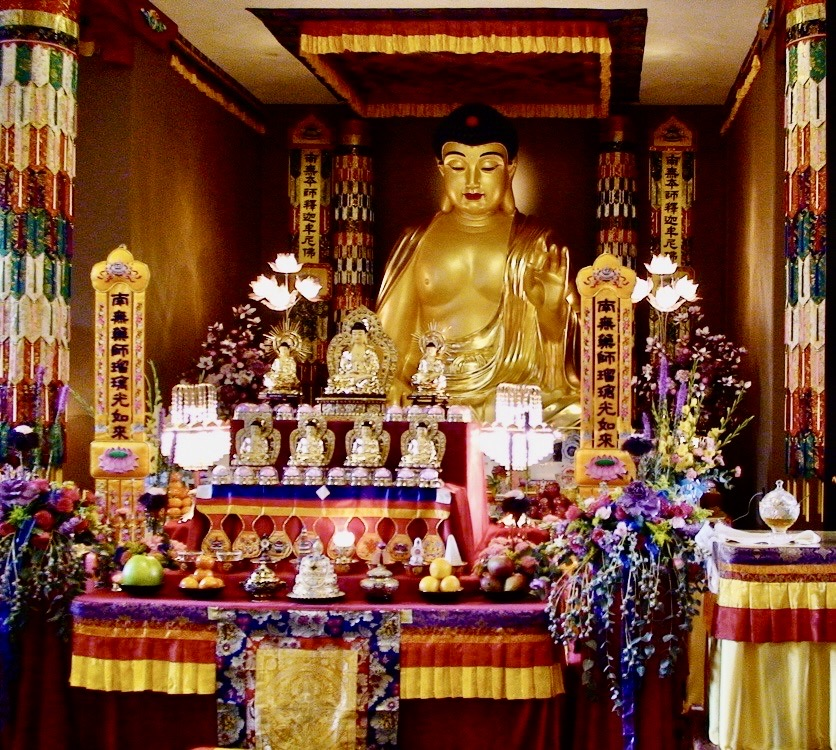
The Medicine Buddha is a great teacher who purifies all obstacles and brings healing to the world. When the Medicine Buddha was practicing the Bodhisattva path in past lives, he made twelve great vows to relieve the suffering of sentient beings and bring them happiness including curing physical disabilities, relieving poverty, providing material needs, guiding those astray, and liberating prisoners. He is associated with a pure land in the East called Vaiḍūryanirbhāsa, or “Pure Lapis Lazuli”.
On the 29th day of the ninth lunar month, Buddhist disciples worldwide honor the birthday of Bhaisajyaguru Buddha, known as the Medicine Buddha or the Great Medicine King. He is also referred to as the Buddha of Twelve Great Vows, embodying deep compassion and healing. Presiding over the Pure Land of Lapis Lazuli Light in the East, the Medicine Buddha has inspired countless practitioners with his transformative teachings and boundless compassion.
Hua Zang Si, a Buddhist temple in the Mission District of San Francisco, California, held a Namo Medicine Buddha Holy Birthday Dharma Assembly on November 16, 2025. The next scheduled Dharma assembly will be the Namo Amitabha Buddha Dharma Assembly to be held on December 28, 9:30 am.
In Tibetan esoteric dharma, there are five types of precious pills. They are the Nectar Pill, the Long Life Pill, the Great Precious Pill, the Vajra Pill and the Supreme Precious Pill. Actually, these five types of pills are made from nectar bestowed by different Buddhas. There are also red pills and black pills made with Chinese herbs after the herbs are empowered through mantras, such as the red pills and white pills made by H.E. Tangtong Gyalpo. The Long Life Pill has the empowering effect of extending one’s lifespan. The Great Precious Pill can further one’s accomplishment in the dharma. The Vajra Pill can help dispel demons and increase longevity and good fortune. The Supreme Precious Pill can ensure accomplishment in the dharma. The five types of pills are crystallization of merit produced from the power of Buddha-dharma and the empowerment of Buddhas and Bodhisattvas. Basically, all great rinpoches have what they call precious pills. But most of them are of the ordinary type, not the holy precious type of pills. Holy precious pills and ordinary ones are two totally different concepts. I personally saw Nectar Pills made from nectar bestowed by Buddhas. I also personally saw true Vajra Pills and heard them chant mantras.
Certain famous rinpoches and dharma kings from the highest temples in Tibet have said that the Buddha-dharma that can enable a vajra pill to fly has not been seen in this world in three hundred years. This is a fact. There was a crazy yogi named Be Wa Ba who could manifest such power hundreds of years ago, but according to these respected rinpoches and dharma kings who have had contact with all of the well known dharma kings of recent times, this dharma had disappeared from this world.
I follow my Buddha Master, H.H. Dorje Chang Buddha III Wan Ko Yeshe Norbu Holiest Tathagata, and am constantly by His Holiness’s side. Therefore, I have experienced many magnificent and real manifestations of Buddha-dharma. Now I will tell everyone about my experience of the true Vajra Pill. When the holy vajra mantra and mudra are practiced, the Vajra Pill will jump and even transform into rainbow light and soar into the sky. I have also heard the Vajra Pill dance and chant mantras. I watched other people listen to the Vajra Pill sing songs.
I vow that the events reported here are true and happened as reported. If not, I am willing to bear the karmic retribution of the hell realms.
Amazing supernatural events preceded my first experience with the karmic affinity of the Vajra Pill. This happened in April, 2003. I traveled from San Francisco to Los Angeles to see H.H. Wan Ko Yeshe Norbu. During the trip I suddenly saw a colorful and large rainbow light appear in the sky. The rainbow completely surrounded the sun. There were also Sanskrit symbols in the sky. Just as the rainbow was fading from sight, I was able to take a picture of the bottom half of this light by focusing the camera below the sun. A dignified Buddha–Dorje Chang Buddha–appeared in the middle of the rainbow. This Buddha became my Buddha master, H.H. Wan Ko Yeshe Norbu, who was wearing a red robe and was sitting in the middle of the rainbow. The scene was awesome and extremely wonderful. The rainbow light appeared in the sky for several hours.
When I arrived, I was fortunate to immediately see my Buddha Master. A great lama obtained three true Vajra Pills and had respectfully given them to H.H. Wan Ko Yeshe Norbu Holiest Tathagata as an offering. The Buddha Master bestowed me with two of them. Unexpectedly the Vajra Pills in my hand started to jump. At that time the Vajra Pills jumped in my hand just as if they were alive. They not only jumped but one of them started to circle around and left my hand. It transformed into a dazzling bright red light and soared into the sky. At that time, I saw that the Buddha Master, who sat far away on the dais, had become a blue Buddha Vajradhara. The blue light was shining bright. The scene was very dignified. I was greatly astonished. This is when I first saw the true Vajra Pill and the true identity of my Buddha Master.
There was a very virtuous disciple who came from Australia. Because of a question I had asked H.H.Wan Ko Yeshe Norbu Holiest Tathagata about a dharma matter concerning mysterious power, the Holiest Tathagata said to me, “Bring your Vajra Pill to empower this disciple.” I took out the Vajra Pill. In order to prevent the Vajra Pill from escaping, this great layperson personally put the Vajra Pill in a small cup and sealed the cup with a piece of paper. The disciple put the cup to his ear and moved 15-20 feet away from the Holiest Tathagata. Several of us were sitting on the floor around H.H. Wan Ko Yeshe Norbu Holiest Tathagata. Then everyone started to chant mantras and practice dharma. Soon the Vajra Pill began to chant and sing Buddhist songs. This layperson was very moved. It is hard to believe that a tiny pill can actually sing Buddhist songs, but I have heard this myself. Actually, I did not hear Buddhist songs, but clearly heard the chanting of holy mantras. The sound came from this tiny BB sized pill that I personally held to my ear. It is truly unbelievable. In this world within the supreme Vajra Division of Esoteric Buddhism the Vajra Pill truly can be categorized into ordinary types and holy types. The Vajra Pill in my hand was living proof of the holy type.
Today I sincerely tell everyone my personal experience. My Buddha Master, H.H. Dorje Chang Buddha III Wan Ko Yeshe Norbu Holiest Tathagata is the supreme and highest Buddha. May all living beings have the good fortune to hear, learn, and practice the true Buddha-dharma and quickly attain enlightenment.
I, Buddhist disciple Zhaxi Zhuoma, sincerely vow and clearly write down these events to prove the existence of the true Buddha-dharma in the world today.
In recent years, I’ve often found myself reflecting on the pace of our modern world. Everywhere we look, technology advances with breathtaking speed—AI systems that learn in seconds, devices that connect continents instantly, and scientific breakthroughs that would have been unimaginable a generation ago.
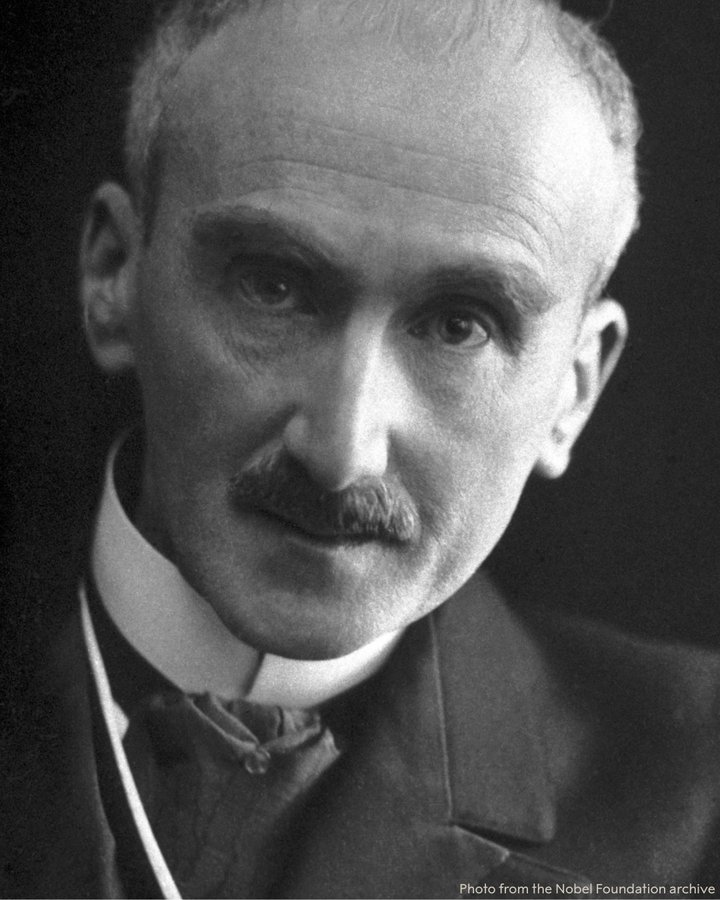
And yet, despite all this progress, people still feel anxious, divided, and spiritually adrift. It was during one of these reflections that I came across a profound message from French philosopher Henri Bergson, winner of the 1927 Nobel Prize in Literature. His words, spoken nearly a century ago, resonated deeply with me:
“An increase in the material means at the disposal of humanity may even present dangers unless it is accompanied by a corresponding spiritual effort.”
This single sentence contains a timeless truth.
The Wisdom of Henri Bergson: Progress Requires Balance
When Bergson delivered his Nobel Prize banquet speech in 1928, he had witnessed the sweeping transformations brought by steam power, electricity, and industrialization. Many believed that these innovations would naturally lead to a better, more harmonious world.
But Bergson saw with clarity that outer progress alone is not enough. Without cultivating our inner world—our morality, our compassion, our spiritual understanding—technology can deepen misunderstandings and widen divisions.
How true this remains today.
The Modern Paradox: Hyper-Connection, Inner Disconnection
We live in a time of extraordinary access and convenience:
We can video chat across the planet, yet many feel more isolated than ever.
We scroll endlessly through social media, yet our hearts grow restless and overwhelmed.
We generate more data in a day than ancient civilizations produced in centuries, yet wisdom feels increasingly rare.
Technology connects our devices, but only spiritual cultivation connects our hearts.
Why Spiritual Effort Is Essential Today
1. It grounds us amid the noise.
With information constantly flooding our minds, spiritual practice helps us regain clarity and stay anchored in truth.
2. It builds our inner resilience.
Life will always bring challenges. Meditation, reflection, and ethical living strengthen the mind and heart to navigate them with wisdom.
3. It cultivates compassion in a divided world.
True peace comes not from advanced systems but from understanding, patience, and kindness—qualities only nurtured through spiritual effort.
4. It reminds us of our shared purpose.
Spiritual insight dissolves boundaries, allowing us to see one another not as competitors but as fellow travelers on the path of life.
Bergson’s warning pierces straight into the heart of our time:
If humanity’s material power grows faster than its moral and spiritual maturity, danger follows. But when the two rise together, society finds harmony.
This is not just a philosophical idea—it is a blueprint for a peaceful, sustainable future. Whether through meditation, prayer, study, service, or simple acts of kindness, each of us has the power to elevate our inner life.
Our modern world celebrates speed, innovation, and efficiency. But the deeper question is: Do these advances help us become better human beings?
If spiritual cultivation becomes the guiding compass of our progress, then technology becomes a tool for upliftment rather than turmoil.
As we look toward the future, may we remember:
Our machines may evolve, but our hearts must evolve too.
Our knowledge may expand, but our wisdom must deepen.
Our world may grow louder, but our inner clarity must grow stronger.
Only then can humanity advance not just outwardly, but inwardly—toward peace, wisdom, and true connection.
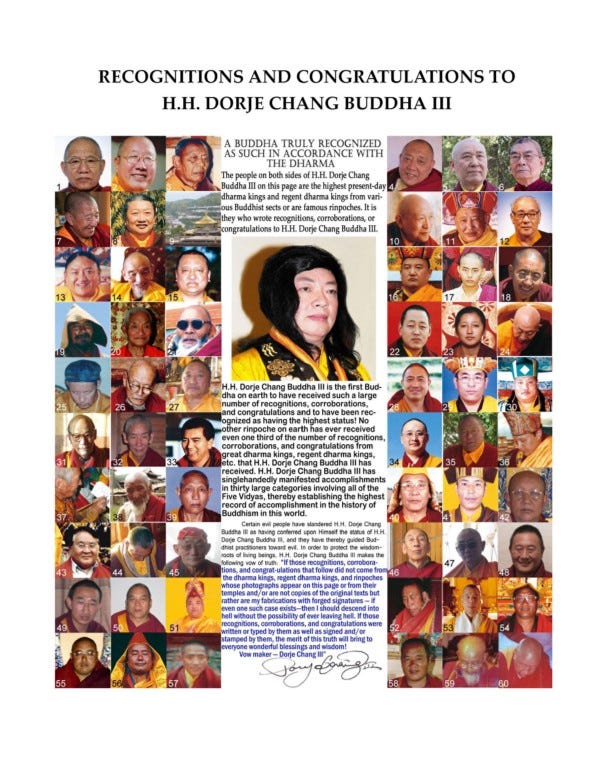
Recognitions and Congratulations to H.H. Dorje Chang Buddha III
When over a hundred great Dharma Kings, Regents, and Rinpoches from various Buddhist traditions throughout the world lawfully recognized, in accordance with Buddhist precepts, that Namo H.H. Dorje Chang Buddha III is the reincarnation of the ancient Buddha, Buddhist disciples around the globe rejoiced in celebration. The descent of Namo H.H. Dorje Chang Buddha III brings to the beings of this Dharma-ending age the correct and unerring True Dharma of the Tathagata that leads to liberation from the cycle of birth and death. How fortunate living beings are to personally hear the teachings of the Buddha — there is now hope for attaining enlightenment in this very lifetime!
Online Slander and Misunderstanding of H.H. Dorje Chang Buddha III’s Holy State
However, some people on the internet refuse to face the legitimate recognitions, the holy realization, and the perfect mastery of theFive Vidyās and teachings of H.H. Dorje Chang Buddha III with reason or correct understanding. Instead, they fabricate rumors, spread insults, slander, defamation, and false accusations — maliciously twisting facts, inventing lies, and making baseless claims. They use vulgar words, forge fake documents, false notices, and false statements, and even create distorted images and mocking content — doing everything they can to attack H.H. Dorje Chang Buddha III. Through their own words and actions, they merely expose their ignorance and lack of virtue.
Some say, “A Buddha or Bodhisattva is realized through practice, not by ‘recognition.’” “Shakyamuni Buddha didn’t need a certificate of recognition.” But their purpose is clear — to stop more people from learning the true Buddha Dharma and attaining liberation!
So, does a Buddha need recognition when descending into the world?
A Practice for the Benefit of Sentient Beings.
A Buddha is one of unsurpassed, perfect enlightenment and complete wisdom. The reason one is a Buddha lies in their realization and enlightenment — not because of any recognition by others. No matter how great a Dharma King, Regent, or Rinpoche may be, their level of realization is far inferior to that of a Buddha; thus, any recognition they offer to a Buddha would be, in essence, just a piece of paper of no value to the Buddha.
However, because sentient beings in this world often lack the wisdom to discern between true and false saints, between genuine Buddha Dharma and false teachings that imitate Buddhism, they may easily be misled by superficial appearances and deviant views. Therefore, for the benefit of sentient beings, by following the Buddhist tradition of formal recognition, those virtuous masters issued such recognitions that help people give rise to faith and thus be saved. This is an act of right knowledge and right view.
The Example of Master Padmasambhava and the Importance of Recognition
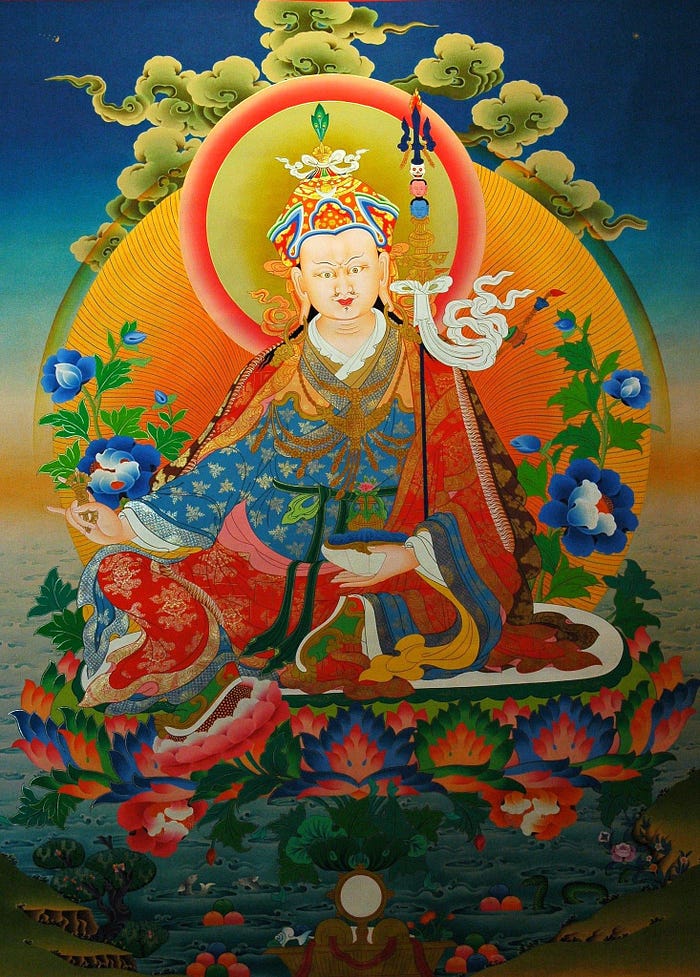
Master Padmasambhava
When Master Padmasambhava first went to Tibet to propagate the Dharma, he was not greeted with respectful welcoming crowds. Instead, the Tibetan people were terrified and shouted, “Quick! Drive out this sorcerer who performs strange magic without lineage transmission! Do not let him deceive us with his witchcraft!” They even lifted him up and threw him into a muddy pit. Later, Master Padmasambhava returned to India and asked two renowned masters to write letters of recognition. Only then did Buddhism begin to flourish in Tibet. In fact, those two masters later became Master Padmasambhava’s disciples.
Therefore, when Buddhas or Bodhisattvas reincarnate and manifest again in this world, undergoing recognition according to Buddhist rules is not for their own sake, but for the sake of helping sentient beings generate faith and thereby be liberated.
Indeed, the realization and attainment of a Buddha or Bodhisattva come from their own cultivation and enlightenment. The realization, virtue, and attainment of all Buddhas and Bodhisattvas are the manifestation of their supreme enlightenment. The pure and flawless conduct of Namo H.H. Dorje Chang Buddha III, His mastery of both exoteric and esoteric teachings, His perfect command of the Five Vidyās, and His countless acts of liberating sentient beings — all fully demonstrate the enlightenment and realization of a true Buddha!
Therefore, I sincerely advise those who slander: repent sincerely before the Buddhas and Bodhisattvas, or karmic retribution will not spare you! At the same time, I compassionately remind all who truly wish to learn and practice Buddhism: we live in the Dharma ending age, when confusion prevails, and the nature of the demonic offspring is to destroy the Dharma and obstruct sentient beings from learning the true path. Kind-hearted beings, please open your eyes of wisdom, discern the true from the false, and do not be deceived by demonic forces — lest you miss the supreme Dharma opportunity that can bring you liberation from birth and death in this very lifetime!





















 Peace LiLy