Recently, a Western friend asked me why I believe that H.H. Dorje Chang Buddha III is the true Buddha. He told me that when he searched online, he found many negative comments, and even saw that some Rinpoches claimed they did not recognize the Buddha at all. Sadly, certain people with evil intentions have slandered H.H. Dorje Chang Buddha III, falsely accusing Him of conferring the title upon Himself, thereby misleading Buddhist practitioners and causing great harm.
I feel deeply saddened that so much true and authentic information about the Buddha has been buried under falsehoods and misunderstandings. To help clarify, I would like to share selected passages from the publicly available book H.H.Dorje Chang Buddha III (A Treasury of True Buddha-Dharma). In it, many Bodhisattvas, Dharma Kings, Rinpoches, Dharma Teachers, as well as renowned monasteries, issued official certificates and congratulatory letters confirming the identity of H.H. Dorje Chang Buddha III.
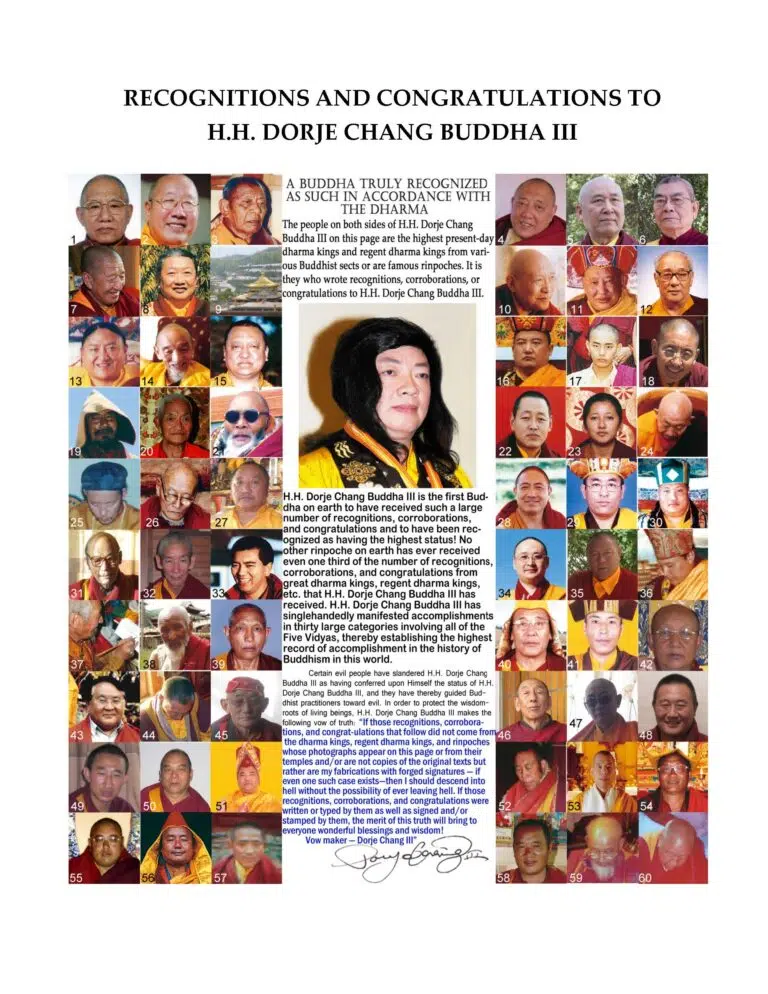
The above photo of sixty such dharma kings, rinpoches, and temples, many of whom are shown below. Photos of some of these dharma kings and rinpoches actually signing or stamping their letters are also included. Although this is only a small portion of those who have recognized H.H. Dorje Chang Buddha, the following list does represent the highest present-day dharma kings and regent dharma kings from various temples or famous rinpoches in current times. It is they who recognized or corroborated, or sent congratulations to H.H. Dorje Chang Buddha III.
For more information and more detailed biographies on many of these great holy beings as well as their letters of certification and congratulation see A Treasury of True Buddha-Dharma . That book also explains how many of these holy beings had their identities.
1. H.H. Dharma King Dodrupchen, the world’s sole holder of the highest rainbow body accomplishment dharma
2. H.H. Dharma King Penor, the third supreme world-leader of the modern Nyingma sect
3. H.H. Dharma Achuk, the most pre-eminent greatly virtuous one in present-day Tibet
4. H.E. Dharma King Gongbao Dumu Quji,the Yidam-dharma initiation Master of the 17th Karmapa
5. H.E. Kaichu, the greatly accomplished practitioner of tummo (inner-heat) and vajra meditation dharma
6. H.E. Dharma King Gar Tongstan, a Xian Liang Great Perfection Rainbow Body accomplished one
7. H.H. Dharma King Jigme Dorje, supreme world-leader of the Jonang sect
8. H.H. Sleep Yoga Dharma King Mindroling Trichen, the fourth supreme world-leader of the modern Nyingma sect and Master of the Dalai Lama
9. Kumbum Monastery, place where Lord Tsongkhapa was born
10. H.H. Dharma King Trulshik, the fifth supreme world-leader of the modern Nyingma sect and Master of the Dalai Lama
11. H.H. Dharma King Taklung Tsetul, the sixth supreme leader of the Nyingma sect and Master of the Dalai Lama
12. H.H. Dharma King Jigdal Dagchen Sakya, supreme leader of the Sakya sect.
13. H.H. Sakya Trizin, the one who succeeded to the title of supreme leader of the Sakya sect.
14. H.E. Dharma King Chogye Trichen.
15. H.H. Regent Dharma King Shamarpa, Master of the 17th Karmapa
16. H.E. Regent Dharma King and National Master Goshir Gyaltsab, Master of the 17th Karmapa
17. H.E. Dharma King Tangtong Gyalpo, father of medicine, ferryboats, bridges, and opera in Tibet in a previous life
18. H.E. Luozhuo Nima Rinpoche, who in previous lives was both Master and disciple of the Karmapas
19. H.E. Dharma King Xiazhu Qiuyang of the Geluk sect
20. H.E. Dharma King Renzeng Nima, Master of Nianlong Rinpoche
21. H.E. Dharma King Ngagwang Pedma Namgyal Palzangpo of the Jonang sect
22. H.E. Mindroling Khenchen Rinpoche
24. H.E. Dzogchen Ganor Rinpoche
25. H.E. Urgyen Xirao Rinpoche
26. H.E. Dorje Rinzin Rinpoche, Master of one of the 7th Dzogchen dharma kings
27. H.E. Luokunsang Rinpoche, Master of the famous actor Jet Li
28. H.E. Sechen Rabjam Rinpoche
29. H.E. Renqing Rongbo Barongbo Rinpoche, Eastern Tibet Dharma King of the Nyingma Sect
30. H.E. Green Jewel Crown Dharma King Jiezhong
31. H.E. Banma Luozhu Rinpoche
32. H.E. Dharma King Zongkang of the Kumbum Monastery
33. H.E. the 7th Dzogchen Dharma King Jigme Losel Wangpo–India
34. H.E. the 7th Dzogchen Dharma King Tenzin Longdock Nyima–China
35. H.E. Saiba Rinpoche
36. Ven. Junmai Baima Dorje Rinpoche
37. Ven. Angwang Khyentse Rinpoche
38. Ven. Yundeng Jiangcuo Rinpoche
39. Ven. Abbot Kalsang Gyaltsen
41. Ven. Bamba Tuben Geleg Gyatso Rinpoche
42. Ven. Mengjia Rinpoche
43. Ven. Sogyal Rinpoche, author of The Tibetan Book of Living and Dying
44. Ven. Baima Rongzhu Rinpoche
45. Ven. Angwen Zhaba Rinpoche
46. Ven. Dongpeng Rinpoche
47. Ven. Suoquie Rinpoche
48. Ven Suoma Rinpoche
49. Ven. Tangrang Jiawa Rinpoche
50. Ven. Gexie Rinpoche
51. Respected Eba Rinpoche, of the Sakya sect
52. Respected Wangzhi Tudeng Jigmei Rinpoche
53. Respected Bishop Seicho Asahi
57. Gongbo Rinpoche
58. Great Khenpo Gongcheng
59. Duozhu Tinpoche
60. Pengcuo Rinpoche
H.H. Dodrupchen Dharma King
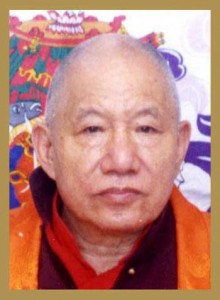
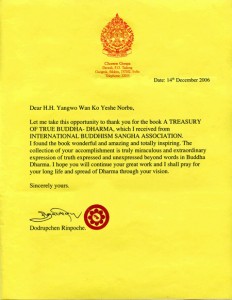
H.H. Dodrupchen Rinpoche (1927- ), a famous great dharma king of the Nyingma sect who is the sole holder of the complete Longchen Nying-thik, said the following in his letter congratulating the publication of A Treasury of True Buddha-Dharma: “I found the book wonderful and amazing and totally inspiring. . . [It is a] truly miraculous and extraordinary expression of truth expressed and unexpressed beyond words in Buddha Dharma.”
An incarnation of Guru Padmasambhava, H. H. Dodrupchen Rinpoche IV, Thupten Thrinle Palzang, is the holiest great dharma king within the Nyingma lineage. His Holiness is the greatest living Dzogchen or Great Perfection master and the main lineage holder of the Longchen Nyingthik lineage, the highest dharma in Tibet for perfecting the rainbow body. The first Dodrupchen, Jigme Thrinle Oser (1745-1821), was the greatest disciple of Jigme Lingpa (1730-1798). The Third Dodrupchen Jikmé Tenpé Nyima (1865-1926), was both a great scholar and a remarkable yogi.
The Dharma King’s main seat is at Chorten Gonpa Monastery, which His Holiness founded in the outskirts of Gangtok, Sikkim. His Holiness is also the spiritual director of the very small isolated Sera Gonpa (Nubri Monastery) in Kylmo Lung (Peaceful Valley), Nepal. It is unique in that the 50 monks and 50 nuns that study there have identical programs. H. H. Dodrupchen Rinpoche IV is represented in the USA by the Mahasiddha Nyingmapa Center, Kunzang Choling Temple, in Hawley, MA.
H.H. Dharma King Penor Rinpoche


H.H. Dharma King Penor (1932-2009), a supreme dharma king of the Nyingma sect, wrote the following in a letter to rinpoches: “H.H. Dorje Chang Buddha III Yangwo Wan Ko Yeshe Norbu. . . has been recognized by numerous greatly virtuous and eminent monastics. . . A Treasury of True Buddha-Dharma. . .will provide the karmic conditions for living beings to . . . attain the ultimate state of Buddhahood.”
An incarnation of Vajrapani Bodhisattva, the eleventh lineage holder of the Nyingma Palyul tradition, Kyabje Drubwang Pema Norbu Rinpoche, was born in December 1932 in the Kham region of eastern Tibet and left this world in March 2009. After H. H. Dilgo Khyentse departed in 1991, H. H. Penor Rinpoche became the Supreme Head of the Nyingma Sect. In 2001 he resigned from that position to devote more time to his extensive global network of monasteries and dharma centers, recommending that H. H. Mindrolling Trichen Rinpoche assume that position. His Holiness Karma Kuchen Rinpoche IV, is the current head of the Palyul subsect.
His Holiness’s Main seat was at Palyul Monastery in Tibet, one of the six main Nyingma monasteries. His Main seat outside of Tibet was at Namdroling (Thegchog Namdrol Shedrub Dargyeling) Monastery, Bylakuppe in Karnataka State, South India, close to the sacred Drekar Pungwa Stupa where Buddha first taught the Kalachakra Tantra. In 1978 the Ngagyur Nyingma Institute for Higher Buddhist Studies was added along with a nunnery and college for women. His Holiness had a number of branch temples in the US and a retreat center in McDonough, New York. During the 2008 Dharma Propagation Tour, Zhaxi Zhuoma Rinpoche and other tour members were able to have an audience with His Holiness and hear His Holiness Penor Rinpoche praise H.H. Dorje Chang Buddha III. The rinpoche said that it was good that such a holy being would incarnate in these dharma-ending days.
H.H. Jamyang Lungdok Gylatsen Rinpoche
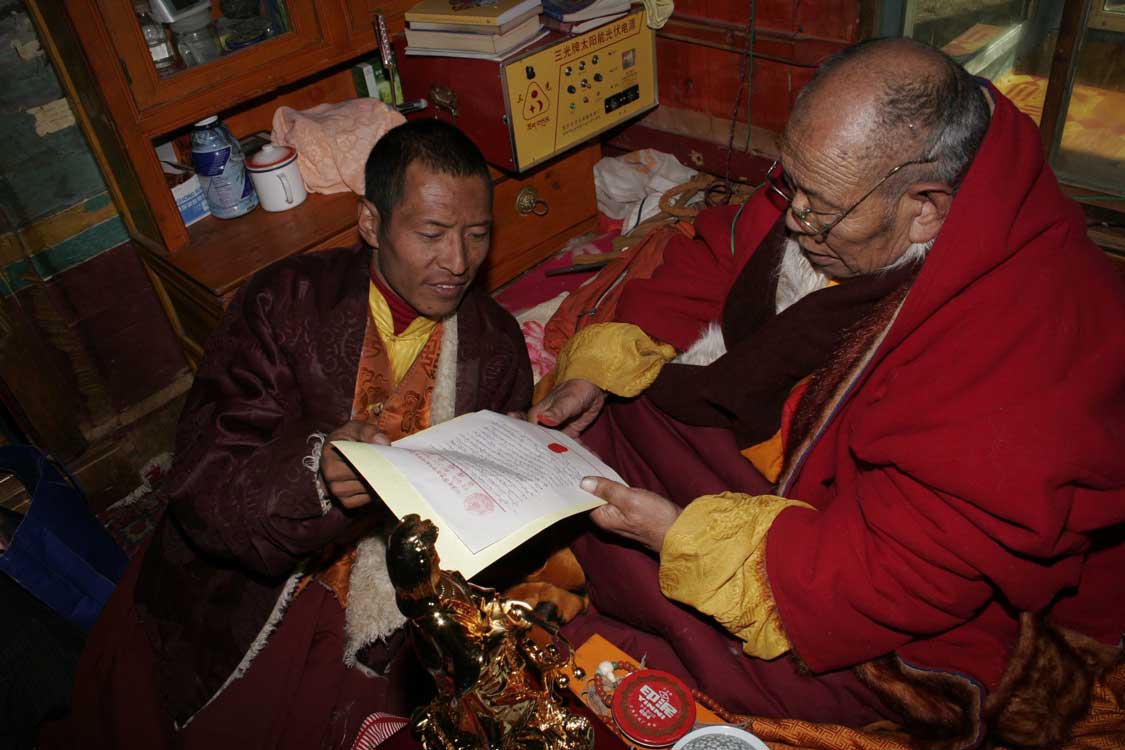
H.H. Dharma King Omniscience Jamyang Lungdok Gyaltsen (Lama Achuk 1927-2011),who is the incarnation of Venerable Longsal Nyingpo, stated in his recognition certificate, “. . . H.H. Master Wan Ko Yee . . . is the incarnation of Vimalakirti. . . is Dorje Chang Buddha III. . . .”
H. H. Jamyang Lungdok Gyaltsen or Lama Achuk (Also referred to as Khenpo Achuck Brioche or Achiu Kamabu or Lama A-chos) is an incarnation of the great terton Rigdzin Longsal Nyingpo (1625-1682) of Kathok Monastery. He was the head of the Nyingma Sect in China and the foremost person of great holiness and virtue in all Tibet.
He was born in 1927 in Eastern Tibet and spent 43 years in retreat with his master, Tulku Arik Rinpoche. On July 23, 2011 he entered into paranirvana. His Holiness lived at Yarchen

Uddiyana Meditation Monastery, an encampment (gar) of thousands of monks, nuns, and lay practitioners, that he established in an isolated valley near Ganzi (Kandze) in Baiyu (White Jade) County, in Sichuan Province, China. This was the largest concentration of rinpoches and lamas in the entire world. The cremation ceremony of Lama Achuk commenced on August 29, 2011. The body of Lama Achuk shrunk from a height of almost six feet (1.8 meters) to about 1 inch tall, a sign of very high realization. From time of Lama Achuk’s paranirvana to the cremation, many auspicious signs appeared, five colored rainbows were often sighted in the sky and five colored pure lights often appeared in the area surrounding Lama Achuk’s body. More than 100,000 sangha members and lay devotees attended the puja and paid respect to the sacred body of Lama Achuk.
One of his disciples, Khenpo A-chos, achieved the rainbow body earlier in 1998. Father Tiso, a Catholic priest who went to Tibet to investigate the rainbow body phenomena at the suggestion of the Benedictine monk David Steindl-Rast, found evidence that H. H. Lama Achuk himself had already achieved the rainbow body as well.
H.H. Dharma King Jigme Dorje
On behalf of the Jonang sect, H.H. Dharma King

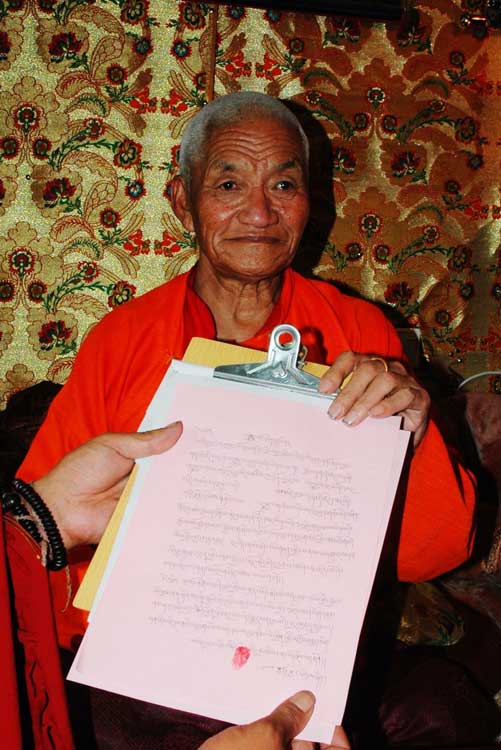
H.H. Dharma King Jigme Dorje stamps his seal onto his congratulatory letter to H.H. Dorje Chang Buddha III that he had already signed.
Jigme Dorje (1944- ), who is the Supreme Dharma King of the Jonang sect, respectfully congratulated H.H. Dorje Chang Buddha III Wan Ko Yeshe Norbu with the following words: “Such superlative accomplishments are truly unprecedented in the past few thousand years, outshining the accomplishments of all
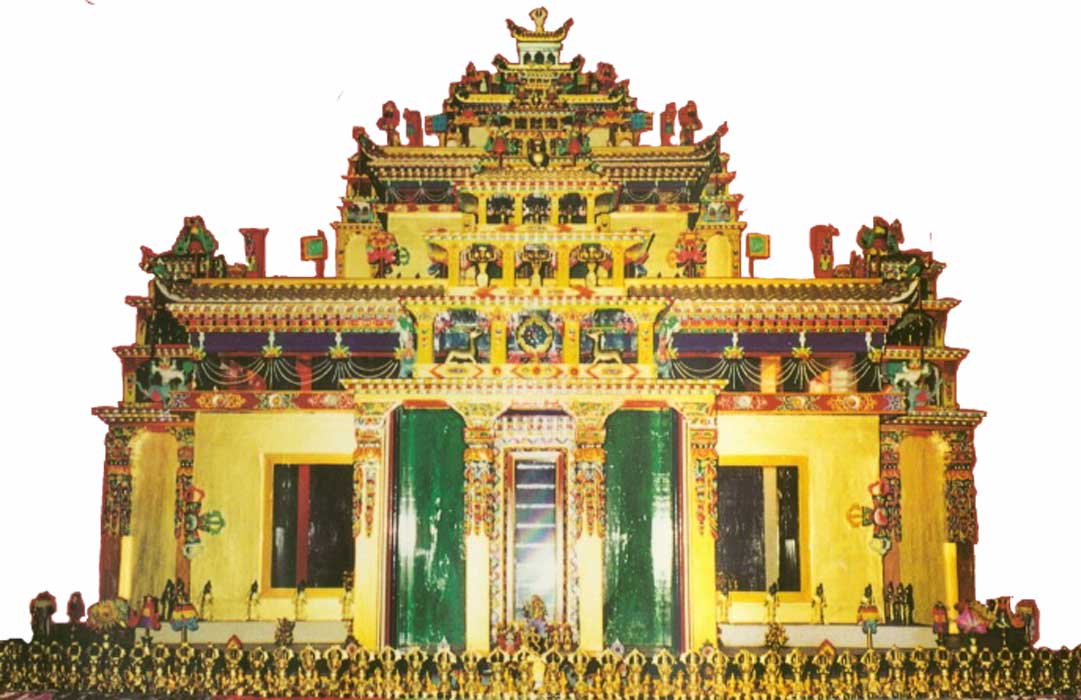
Kalachakra Mandala created by Jonang monks at Jamdha Monastery, Golok Region, Amdo, Tibet
others, both ancient and modern. His Holiness is a shining paragon among Buddhas.”
The supreme dharma king of the Jonang sect, H. H. Jigme Dorje is an incarnation of the Shambhala King, Suchandra, who was the first to receive the Kalachakra tantra from Shakyamuni Buddha. His Holiness continues to hold the highest teachings of the Kalachakra dharma. H. H. Jigme Dorge was born in 1944 and is head of the Zangwa (Tsangwa) Dazang Monastery in Eastern Tibet.
H.H. Dharma King Mindrolling Trichen
The chief secretary for H.H. Dharma King Mindrolling Trichen (1031-2008) of the Nyingma sect, Ven. D. G. Khochhen Rinpoche, sent a congratulatory letter on behalf of Dharma King Mindrollling Trichin and the Mindrolling Sangha in which he wrote, “. . . H.H. Wan Ko Yeshe Norbu Dorje Chang brings good fortune and wisdom to all living beings.”
Trichen Jurme Kunzang Wangyal, Mindrolling (Mindling) Trichen Rinpoche XI (1931-2008), was the supreme head of the Nyingma sect. Although the original seat of Mindrolling, one of the six major Nyingma monasteries founded in 1876 by Rigzin Terdak Lingpa on the south side of the Tsangpo River, is near Lhasa, Tibet, a new Mindrolling Monastery has been established at Dehra Dun, in Uttranchal State, India. The Nagyur Nyingma College, Mindrolling’s Institute of Advanced Buddhist Studies. (Five Vidyas University) is also located there. His Holiness’s daughter, H.E. Khandro Rinpoche has a retreat center in the USA and continues the Jetsunma lineage of female masters there and at Samten Tse, her nunnery in India.
H.H. Dharma King Trulshik

The famous H.H. Dharma King Trulshik Rinpoche (1924-2011), who is a master of H.H. the Dalai Lama and the root master of several Tibetan Buddhist dharma kings and lineage holders, wrote the following words respectfully congratulating Buddha Vajradhara Yangwo Wan Ko Yeshe Norbu: . . . “A Treasury of True Buddha- Dharma. . .will become the cause whereby each sentient being who has descended into the abyss of the six realms of reincarnation leaves suffering and attains happiness.”
H. H. Nyingma Dharma King Zhadeu Trulshik (Trulshig) Chenpo Ngawang Chokyi Lodro Rinpoche (1924-2011), who resided in the Everest region of Nepal, was an incarnation of Maitreya Bodhisattva and a lineage holder from the first Dodrupchen, Jigme Thrinle Oser. His Holiness was considered the closest and most accomplished disciple of H. H. Dilgo Khyentse Rinpoche and like Khyentse Rinpoche a leading proponent of the Rime or non-sectarian movement in Tibet. He was entrusted with the responsibility of finding and recognizing the incarnation of Khyentse Rinpoche after he passed on in 1991 as well as Tulku Urgyen Rinpoche after he left this world in 1996. Dharma King Trulshik founded a remote monastery and retreat center in Nepal at Tubten Choling. He was the fifth Supreme Leader of the Nyingma Sect until his death in 2011.
H.H. Taklung Tsetrul Rinpoche
The highest dharma king of the Northern Treasure lineage of the Nyingma sect, H.H. Dharma King Taklung Tsetrul (1926-2015), wrote the following words of congratulations: “His Holiness Dorje Chang Buddha III Wan Ko Yeshe Norbu possesses the true dharma of the Buddhas . . .
H. H. Taklung Kyabgon Tsetrul Thupaten Gyaltsen Rinpoche is the Dharma King of the Drak Dorje (Vajra or Indestructible Rock) Monastery, one of the six main Nyingma Monasteries, founded in 1610 by Rigdzin Ngakgi (Aji) Wangpo (1580-1639). This monastery specialized in the changter or jangter tradition of Rigdzin Godem (1337-1408). Rigdzin Godem was the master of the “northern terma (treasures)” tradition of the Nyingma school. Rigdzin Godem literally means “the vidyadhara with the vulture feather.” He received this name because three vulture feathers grew from his head when he was twelve years old, and five more when he was twenty-four. A reincarnation of Dorje Dudjom of Nanam, one of the nine close Tibetan disciples of Guru Padmasambhava, he is also counted among the five king-like tertons and one of the three nirmanakayas of Guru Padmasambhava. In 2011 he became the Supreme Leader of the Nyingma Sect.
H.H. Dharma King Jigdal Dagchen Sakya
H.H. Dharma King Jigdal Dagchen Sakya (1929- ), the second highest leader of the Sakya order, offered the following congratulations: “Many masters praise H.H. Dorje Chang Buddha III Wan Ko Yeshe Norbu and his book about his Dharma activities. The book’s name is A Treasury of True Buddha-Dharma.”
H. H. Jigdal Dagchen Sakya Rinpoche is the head of the Phuntshok Phodrang branch of the Khon dynasty, the main lineage of the Sakya tradition. The leadership of the Sakya sect has rotated between the Phuntshok Phodrang branch and the Dolma Phodrang branch, currently headed by H. H. Sakya Trizin. H. H. Jigdal Dagchen Sakya founded and serves as the main teacher of Sakya Monastery of Tibetan Buddhism in Seattle, WA. He has given teachings and empowerments in other parts of the United States and Canada as well as various European and Asian countries.
H.H. Dharma King Sakya Trizin
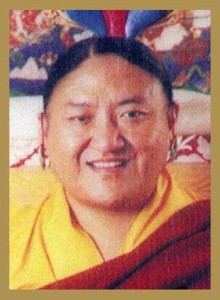
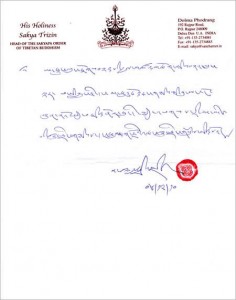
H.H. Great Vehicle Dharma King Sakya Trizin (1945- ), who is the supreme leader of the Sakya order and the nirmanakaya of Manjushri Bodhisattva, wrote the following recognition concerning the descent into this world of H.H. Dorje Chang Buddha III: “. . . H.H. Yangwo Wan Ko Yeshe Norbu . . . is . . .Buddha Vajradhara Dorje Chang Buddha III.”
A true nirmanakaya of Manjushri Bodhisattva, The 41st Patriarch of the Khon lineage of the Sakya tradition was born September 7, 1945 in Tsedong near Shigatse, Tibet. While maintaining temples and dharma centers all over the world, His Holiness lives in Rajpur in Northern India with his wife and two sons.
The main seat of H. H. Sakya Trizin, the Sakya Centre at Tsechen Tenpai Gatsal Monastery, and the Sakya College are located north of New Delhi in Rajpur, Dehradun, India. Another major Sakya monastery exists at Sa Magon in Puruwalla, Himachal Pradesh, a state in northwest India, along with the Sakya Institute for Higher Buddhist Studies.
The seat of H. H. Sakya Trizin in the United States is located at Tsechen Kunchab Ling, the Temple of All-Encompassing Great Compassion, in Walden, New York. His older sister, H.E. Sakya Jetsun Chimey Luding (1938-), lives in North America.
H.E. Chogye Trichen Rinpoche
H.E. Dharma King Chogye Trichen, Ngawang Khyenrab Thupten Lekshe Gyatso (1920-2007), who was Dharma King of the Tsharpa branch of Sakya sect and the root master of H.H. the Dalai Lama, offered the following respectful congratulations: “H.H. Buddha Vajradhara (Dorje Chang) Yangwo Wan Ko Yeshe Norbu: A Treasury of True Buddha-Dharma. . . is the guidepost leading to true Buddha- dharma and the gateway of the dharma leading to benefiting and providing happiness to sentient beings.” H.E. Dharma King Chogye Trichen and Ven. Shabdrung Rinpoche are seen here reading the manuscript copy of A Treasury of True Buddha-Dharma, which has now been published as H.H. Dorje Chang Buddha III.
H. E. Chogye Trichen RInpoche, Ngawang Khyenrab Thupten Lekshe Gyatso, was the dharma king and head of the Tsharpa (Tsar) sub-sect of the Sakya Sect and thought to be an incarnation of Mahasiddha Virupa. He was enthroned as the 26th patriarch of Phenpo Nalendra Monastery in North Lhasa, Central Tibet, that was founded in 1425 by the great Sakya master Rongton Sheja Kunrig (1367-1459). The “Whispered-Lineage of Tshar” founded by Tsharchen Losel Gyatso (1502-1566) considered this to be the seat of their lineage. H. E. Chogye Trichen rebuilt the Nalendra Monastery in Nepal, which became the seat of the Tsharpa sub-sect. His Eminence established the Tashi Rabten Ling Monastery in Lumbini, the birthplace of Lord Buddha, as well as the Jamchen Lhakhang Monastery and retreat center in Boudha, Katmandu where he resided until his death in 2007. He also established centers in Hong Kong, Taiwan, Australia, and New Zealand. His Eminence taught in the West and started dharma centers in America as well.
H.E. Sharmapa
The Red Jewel Crown Dharma King H.E. Shamarpa Rinpoche (1952-2014) is the nirmanakaya of Kuan Yin Bodhisattva and is the chief of the four regents of the Kagyu sect. He offered his respectful congratulations with the following words: “H.H. Yangwo Wan Ko Yeshe Norbu . . . the third incarnation of Vajradhara . . . all his accomplishments . . . will benefit sentient beings. . .”
H. E. Mipham Chokyi Lodro of the Kagyu Sect, an incarnation of Avalokiteshvara, is the present Shamarpa and the second nirmanakaya of the Karmapa. The second Karmapa, Karma Pakshi (1204 – 1283), predicted that “future Karmapas shall manifest in two nirmanakaya forms.” The Karmapa would continue to incarnate at different times as two beings and one would recognize and teach the other. One would be known as the Black Jewel Crown Karmapa and the other as the Ruby-red Jewel Crown Shamarpa. The Shamarpa, in the absence of the Karmapa, is the lead regent with responsibility over both administrative and Buddha-dharma matters. His Eminence was born in 1952 in Derge, Tibet. The main seat of the Karma Kagyu lineage has been at Tsurphu Monastery in central Tibet where it was established in 1159 by the First Karmapa, Dusum Khyenpa (1110-1193). After leaving Tibet, the 16th Karmapa established the main seat of the Karmapa outside of Tibet at Rumtek Monastery.
His Holiness, the 14th Shamar Rinpoche or Shamarpa has established many dharma centers in the West.
H.E. Goshir Gyaltsab Rinpoche
H.E. Goshir Gyaltsab Rinpoche (1954- )is the incarnation of Patriarch Gampopa. He is the only regent for the Karmapa Great Jewel Dharma King who has the title of “National Master.” He respectfully praised the incomparable Master, H.H. Yangwo Wan Ko, as Vimalakirti and stated: “. . . .I sincerely wish that . . . the multitudinous living beings who have the karmic affinity to read A Treasury of True Buddha-Dharma. . . will attain the supreme fruits of perfect enlightenment, omniscience, and Buddhahood!”
The Vajra Regent and caretaker for the Karmapas, H. E. Goshir, is the current incarnation of the founder of the Kagyu Sect, Master Gampopa (1079-1153). He lives in Sikkim where he oversees Rumtek, the main monastery of the Karma Kagyu as well as his own monastery Ralang, also in Sikkim. He was born in Nyimo, near Lhasa, in 1954. In 1959, the 16th Gwalya Karmapa, Rangung Rigpe Dorje, carried the dharma king on his back as he left Tibet. The Orange Jewel Crown Dharma King along with The Ruby-red Jewel Crown Dharma King Shamarpa, Situpa Rinpoche, and Jamgon Kongtrul Rinpoche are considered the four princes or regents for the Black Crown Karmapa. There are currently two incarnations considered to be the 17th Black Crown Karmapa, Urgyen Trinley Dorje (1985– ), who is recognized by H. E. Goshir Gyaltsab Rinpoche and H. E. Tai Situ Rinpoche, and Trinley Thaye Dorje (1983– ), who is recognized by H. E. Shamarpa Rinpoche. The North American seat of the Karma Kagyu, Karma Triyana Dharmachakra, is located in Woodstock, NY.
Tangtong Gyalpo Bodhisattva
The name Tangtong Gyalpo Bodhisattva has gone down in Buddhist history. In the past, this Bodhisattva was the leader of the four main sects of esoteric Buddhism in India, Bhutan, Sikkim, Mongolia, and eastern Tibet. The people of Tibet call this Bodhisattva the father of medicine, the father of bridges, the father of Tibetan opera, and the father of ferryboats. During a dharma assembly held at Hua Zang Si in San Francisco of the United States in which Buddha-dharma realization was manifested, H.E. the sixteenth Tangtong Gyalpo Bodhisattva saw the realization and virtue of H.H. Dorje Chang Buddha III Wan Ko Yeshe Norbu. He was astounded and immediately prostrated before His Holiness, formally acknowledging His Holiness as his Master. In his congratulatory letter to His Holiness, he stated the following: “. . . H.H. Wan Ko Yeshe Norbu is . . . the Master of the Five Buddhas, and has for the first time in the history of Buddhism in the human realm truly manifested complete proficiency in exoteric and esoteric Buddhism and perfect mastery of the Five Vidyas. This is a goal of Buddhism that all other Buddhists have not been able to achieve. This goal has finally been achieved by H.H. Wan Ko Yeshe Norbu.”
H.E. the sixteenth Tangtong Gyalpo Bodhisattva (Thangtrul Rinpoche) took birth in Bhutan. His physical appearance resembles that of Guru Padmasambhava. Even when he sleeps, his eyes remain open. He saw H.H. Wan Ko Yeshe Norbu during a Dharma Assembly that took place in 2005 at Hua Zang Si in San Francisco, U.S.A. In a supernatural state of samadhi, he instantly saw that H.H. Dorje Chang Buddha, the highest ancient Buddha in the dharma realm, had already come to this world again. He at once formally acknowledged H.H. Dorje Chang Buddha III Wan Ko Yeshe Norbu as his master. H.H. Dorje Chang Buddha III asked him, “Did you follow and learn dharma under Guru Padmasambhava? Why have you come here?” H.E. Tangtong Gyalpo answered that he had received teachings directly from Guru Padmasambhava and from H.H. Sakya Trizin. He also said that he had come to request the highest dharma in order to save living beings. H.H. Dorje Chang Buddha III immediately snapped His fingers, and a dharma bowl manifested awesome power. H.H. Dorje Chang Buddha III then accepted H.E. Tangtong Gyalpo as one of his disciples who is on the level of a great venerable one and performed an initiation for him. H.E. Tangtong Gyalpo took that dharma bowl back to his home country.
He later learned that the book A Treasury of True Buddha-Dharma about the H.H. Dorje Chang Buddha III Wan Ko Yeshe Norbu Holiest Tathagata was about to be published. He thereupon organized many rinpoches to practice the Kuan Yin Dharma one billion times as an offering to His Holiness Dorje Chang Buddha III.
H.E. Xiazhu Quiyang Rinpoche
H.E. Xiazhu Qiuyang Rinpoche, who is the incarnation of Venerable Naropa, respectfully congratulated the highest and holiest Wish Fulfilling Jewel Dharma King Wan Ko as follows: “. . .the book A Treasury of True Buddha-Dharma. . . is the highest authentic dharma that is of benefit to living beings.”

H. E. Xiazhu Qiuyang Rinpoche of the Geluk Sect is a current incarnation of the great Mahasiddha Naropa (1016-1100), the venerable leader of 100,000 dakinis. Naropa, a former abbot at the famous Nalanda University in north-east India, was Master Marpa’s guru and the disciple of Tilopa. Master Tilopa received the dharma directly from Dorje Chang Buddha as did Naropa’s sister, Lady Niguma. H. E. Xiazhu Qiuyang was born in 1945, and has become greatly accomplished in Dakini Dharma, having received guidance and empowerment from Vajrayogini herself.
H.E. Renzeng Nima Rinpoche
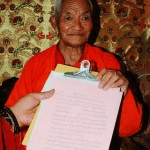
H.E. Dharma King Renzeng Nima is holding the congratulatory letter he wrote to H.H. Dorje Chang Buddha III.
H.E. Mighty Lion Dharma King Renzeng Nima previously vowed to stay in a mountain valley engaged in solitary meditation for the rest of his life. He possesses supernatural powers, inspires awe throughout Tibet, and is the reincarnation of King Gesar. He wrote the following words of recognition: “. . . H.H. Master Wan Ko Yee . . . is the true incarnation of Dorje Chang Buddha.”
H.E. Dharma King Renzeng Nima of the Nyingma Sect is a great terton and the current nirmanakaya of King Tuiba Gawa Gesar, the hero of Tibet’s great epic saga.
H.E. Ngagwang Pedma Namgyal Palzangpo

His Eminence Ngagwang Pedma Namgyal Palzangpo stamps his seal onto his congratulatory letter to H.H. Dorje Chang Buddha III that he had already signed.
H.E. Dharma King Ngagwang Pedma Namgyal Palzangpo, who is a dharma king of the Jonang sect, respectfully congratulated H.H. Dorje Chang Buddha III Wan Ko Yeshe Norbu with the following words: “The body and lifespan of the Buddha Vajradhara of the dharma realm never comes to an end. His Holiness manifests Mahayana states and has the most wondrous powers of great compassion.”
The Jonang Dharma King, H. E. Ngagwang Pedma Namgyal Palzangpo (Penam Rinpoche), was born in 1925 near Amnhymachen, the holy Mountain of the protector Machen Pomra, in Amdo, Tibet. He has been recognized as an incarnation of Duqin Langwa, an incarnation of a close disciple of Guru Padmasambhava, Gelong Namuke Niangbo. His Eminence taught the Kalachakra Dharma in the United States and established Dorje Ling Dharma Centers in New York City and Atlanta, Georgia.
H.E. Mindrolling Khenchen Rinpoche
H.E. Mindrolling Khenchen Rinpoche of the Mindrolling Monastery wrote the following congratulations: “His Holiness Buddha Vajradhara III Yangwo Wan Ko Yeshe Norbu[’s] . . . A Treasury of True Buddha-Dharma. . . will restore dharma that had faded and will cause the growth of dharma that has not yet faded.”
The ninth Mindrolling Khenchen Rinpoche, Venerable Jigmey Namgyal, was born in 1970. His lineage began with the great translation master Lochen Dharmashri (1654-1717), the younger brother of Rigzin Terdak Lingpa, the founder of the original Mindrolling Monastery, located south of Lhasa in the Drachi Valley of central Tibet.
Since 1992, His Holiness has been the president of Nagyur Nyingma College, Mindrolling’s Institute of Advanced Buddhist Studies. (Five Vidyas University) at Dehra Dun, in Uttranchal State, India. The college was founded in conjunction with the new Mindrolling Monastery also located at that location.
H.E. Khandro Rinpoche
H.E. Jetsun Khandro Rinpoche of the Mindrolling lineage within the Nyingma sect is the incarnation of Yeshe Tsogyal. She sent a congratulatory letter expressing her deep gratitude toward H.H. Wan Ko Yeshe Norbu Dorje Chang Buddha for the book A Treasury of True Buddha-Dharma.
As an incarnation of Yeshe Tsogyal, the advanced disciple of Guru Padmasambhava, Her Eminence is part of the Jetsunma lineage of female masters at Mindrolling Monastery, which was founded in 1676 by Rigzin Terdak Lingpa. Her father, H. H. Trichen Jurme Kunzang Wangyal, the XI Mindrolling Trichen Rinpoche, was the head of the Nyingma sect.
Khandro Rinpoche has a North American retreat center in the Northern Shenandoah Valley adjoining the Blue Ridge Mountains in Virginia as well as Samten Tse, a nunnery in India.
H.E. Dzogchen Ganor Rinpoche
The famous H.E. Dzogchen Ganor Rinpoche offered the following congratulations: “. . . A Treasury of True Buddha-Dharma is the wish-fulfilling true dharma that the Buddha expounded.”
H. E. Ganor Rinpoche (1942- ) is the 14th reincarnation of Terton Ratag Pelsang (Karma Lekshe Drayang). He was born near the town of Palpung in the Derge District in eastern Tibet. Because of his level of realization and practices, he was able to perform many supernatural feats like leaving his footprint in rocks and tying swords into knots as if they were rope. He was also able to communicate with non-humans like nagas and devas. He was a great terton who revealed many hidden treasures.
H.E. Urgyen Xirao
H.E. Urgyen Xirao Woxiu, who is a great terton revered by all four types of monastic and lay Buddhists in the land of the Han- Chinese and the land of the Tibetans, wrote in his recognition certificate the following: “. . . Buddha Vajradhara assisted Sakyamuni Buddha in teaching the five hundred monks and other holy ones. . . . H.H. Master Wan Ko Yee, Yangwo Wan Ko Yeshe Norbu, is the incarnation of Buddha Vajradhara.”
Ven. Ugyen Xirao Woxiu of the Nyingma Sect is an incarnation of Ugyen Pema Lingpa (1450-1521), the fourth and most controversial of the Five Terton Kings. Guru Padmasambhava prophesied that Pema Lingpa would recover 108 sacred texts as termas, but due to inauspicious circumstances he only recovered 32. He was known for his spectacular and daring methods in recovering these texts. Once he dived into a lake in Bhutan holding a lighted butter lamp. He told onlookers that the lamp would go out if he were a false spirit. After he disappeared in the dark pool and all thought that he had drowned, he returned to the surface with his butter lamp still brightly burning and with a new terma. He is considered the greatest spiritual master of Bhutan and the immediate incarnation of Master Longchenpa (1308-1364).
H.E. Dorje Rinzin Rinpoche
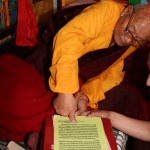
H.E. Dorje Rinzin Rinpoche, master of the seventh Dzogchen Dharma King in China, stamps his fingerprint onto the congratulatory letter he wrote to H.H. Dorje Chang Buddha III.
H.E. Dorje Rinzin Rinpoche is the incarnation of Rigzin Terdak Lingpa Unchanging Vajra, who was the founder the Mindrolling monastery. H.E. Dorje Rinzin Rinpoche, a holy being of great enlightenment, is now the master of many great rinpoches. He said the following in his congratulatory letter: “. . . the accomplishments contained in A Treasury of True Buddha-Dharma. . . are those of Dorje Chang Buddha Wan Ko Yeshe Norbu, the Master of the Five Buddhas.”An incarnation of Rigzin Terdak Lingpa Unchanging Vajra Being (1646-1714) who was the great terton and founder of the Mindrolling monastery and lineage, H. E. Dharma King Dorje Rinzin Rinpoche of the Nyingma Sect was a model for eminent monastics to follow and emulate.
H.E. Dharma King Rabjam
H.E. Shechen Rabjam Rinpoche, the dharma king of the Shechen monasteries of the Nyingma sect, offered the following words of congratulations: “. . . H.H. Dorje Chang Buddha III Yangwo Wan Ko Yeshe Norbu, the Wish-Fulfilling Jewel Holy One, has taken action that spreads and makes grander the true Buddha- dharma. How wonderful!”H. E. Shechen Rabjam Rinpoche VII (1966- ) is the grandson of H. H. Dilgo Khyentse Rinpoche. The second Rabjam Rinpoche founded Shechen Monastery, one of the six main Nyingma Monasteries in Tibet, in 1695 in Kham. H. E. Shechen Rinpoche VII is the abbot and dharma king of Shechen Tennyi Dargyeling Monastery in Nepal, one of the largest and most beautiful monasteries outside of Tibet. It is located near the Great Stupa of Boudhanath, a suburb of Kathmandu and is noted for its ceremonies and sacred dances.
H.E. Renqing Rongbo Barongbo Rinpoche
H.E. Renqing Rongbo Barongbo Rinpoche, an eastern Tibetan Dharma King of the Nyingma sect, respectfully praised H.H. Wan Ko Yeshe Norbu with the following words: “The Master is the magnificent sambhogakaya Buddha who has descended into the human world again. . . . His Holiness’s accomplishments are unprecedented in this world and reflect the pinnacle of wisdom. May H.H. Dorje Chang Buddha boundlessly save living beings. . .”
H.E. Dharma King Renqing Rongbo Barongbo Rinpoche (1969- ) of the Nyingma Sect is a current incarnation of Venerable Ananda.
H.E. Green Jewel Crown Karmapa Dharma King Jiezhong
The Green Jewel Crown Karmapa, H.E. Great Jewel Dharma King Jiezhong, prostrated to H.H. Yangwo Wan Ko Yeshe Norbu, the Buddha Vajradhara, and wrote the following words: “A Treasury of True Buddha-Dharma about the Buddha Vajradhara is a concrete expression of the highest Buddha-dharma wisdom and abilities.”
The sixth Karmapa Green Jewel Crown Dharma King was born in 1967 in Tibet amidst wonderful auspicious signs. The 16th Karmapa, H. H. Great Jewel Dharma King Rangjiong Rigpe Dorje in India, recognized him as a previous incarnation of the Green Jewel Crown Dharma King Jiezhong Rinpoche.
H.E. Jigme Losel Wangpo

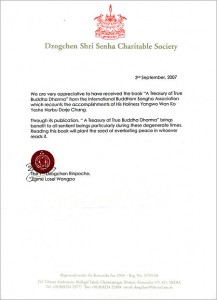
H.E. Jigme Losel Wangpo, the seventh Dzogchen Dharma King who resides in India, wrote the following words of congratulations: “. . . A Treasury of True Buddha-Dharma brings benefit to all sentient beings. . . .”
There are two incarnations recognized as the seventh Dzogchen Rinpoche of the Nyingma Sect: H. E. Jigme Losel Wangpo, born in 1964 in Gangtok, Sikkim, and H. E. Tenzin Longdock Nyima, born in Qinghai Province in the Bare Region of lower Amdo in 1974.
The original Dzogchen Monastery in Tibet, one of the six main Nyingma monasteries, was established in 1684 by Pema Rigdzin. More than 60,000 people have attained the rainbow body and become Buddhas in that lifetime while practicing at that monastery. H. E. Dharma King Tenzin Longdock Nyima Dzogchen Rinpoche VII is the current throne holder of Dzogchen Monastery in Tibet.
The official seat of H. E. Dharma King Jigme Losel Wangpo Dzogchen Rinpoche VII is at the new Dzogchen Monastery in Dhondenling, South India.
H.E. Tenzing Longdock Nyima
H.E. Tenzin Longdock (Lungdok) Nyima, the seventh Dzogchen Dharma King who resides in China, respectfully congratulated the ancient Buddha who saves all sentient beings in the three spheres, H.H. Yangwo Wan Ko Yeshe Norbu, as follows: “. . . A Treasury of True Buddha-Dharma. . . is like the. . . Wish-Fulfilling Jewel in that it outshines all ancient or modern, Chinese or non-Chinese books. . . . The book also opens up and develops the spiritual wisdom of people.”
Ven. Junmai Baima Dorje Rinpoche
Ven. Junmai Baima Dorje Rinpoche of the Shechen Temple is a nirmanakaya of Vajravarahi. He wrote a letter expressing his respect for the Three Bodies and Four Wisdoms of H.H. Yangwo Wan Ko Yeshe Norbu, the Dharma King of the Three Spheres. In that letter, he stated, “H.H. Great Dharma King is the first holy being who used true realization to display fully in the dharma realm the teachings of the Buddha! H.H. Great Dharma King is the true Buddha Vajradhara, the teacher of both humans and celestial beings!”
Ven. Junmai Baima Dorje Rinpoche VI of the Shechen Monastery in Tibet is a nirmanakaya of Vajravarahi. The first Junmai Baima Dorje was a famous terton and the second achieved the rainbow body. As a small child, the rinpoche could transform a thick knife into a knot. That knife is currently at Hua Zang Si in San Francisco as one of the many holy objects that they hold for public display and veneration.
Ven. Angwang Khyentse Rinpoche
Venerable Angwang Khyentse Rinpoche was the closest disciple of H.H. Dzongsar Khyentse Chokyi Lodro. He is the head of the Gensa Temple of the Sakya sect and has been in retreat for a long period of time. He possesses supernatural powers and is praised throughout the snowy plateaus of Tibet for his cultivation. In his congratulatory letter, he stated, “Greatest leader of Buddhism, H.H. Wan Ko Yeshe Norbu: . . . .Only the wisdom of the ancient Buddha, Dorje Chang Buddha, could produce such a textbook [as A Treasury of True Buddha-Dharma] . . . !”
Ven. Angwang Khyentse (Qinzhe) Rinpoche is the Head of the Sakya Gensa Temple in Tibet. He has been in retreat for many years. He is a successor to the dharma lineage of the second Jamyang Khyentse, Dzongsar Chokyi Lodro, the former abbot of the Dzongsar Monastery in Tibet and later the guru of the royal family of Sikkim. Dzongsar Khyentse was one of the incarnations of Jamyang Khyentse Wangpo (1820-1892), the great nonsectarian(rime) master and terton of the nineteenth century.
Ven. Yundeng Jiangcuo Rinpoche
The eighty-year-old Ven. Yundeng Jiangcuo Rinpoche, who is the incarnation of Patriarch Milarepa, respectfully offered the following congratulations on the publication of A Treasury of True Buddha-Dharma about Buddha Vajradhara: “This book manifests great Buddha-dharma based wisdom and contains accomplishments that no other person in history has achieved. Only H.H. Wan Ko Yeshe Norbu has attained such accomplishments.”
Ven. Abbot Kalsang Gyaltsen
Ven. Kalsang Gyaltsen, who represents H.H. the Dalai Lama and is fully authorized to exercise control over the Geluk sect in Nepal, stated in his congratulatory letter the following: “I am sure the works of Venerable Vajradhara Master Wan Ko will inspire all the sentient beings to a better understanding of both the theoretical and practical aspects of the Buddhist philosophy.”
Ven. Zangxia Rinpoche
The famous Zangxia Rinpoche prostrated to the ancient Buddha and greatest leader of Buddhism, H.H. Dorje Chang Buddha III, and stated, “. . . led us to find Dorje Chang Buddha, our supreme ancient Buddha, and thereby enabled all living beings to have the ultimate refuge in this Dharma-Ending Age!”
Ven. Bamba Tuben Geleg Gyatso Rinpoche
The famous Respected Bamda Tubten Geleg Gyatso Rinpoche stated: “. . . [I] beseech the magnificent and holy Dorje Chang Buddha III to bless all sentient beings in the six realms of reincarnation so that they may realize enlightenment soon, hear of and read A Treasury of True Buddha-Dharma, . . . and attain the perfect, supreme, and complete enlightenment of a Buddha.”
Ven. Baima Rongzhu Rinpoche
Ven. Baima Rongzhu Rinpoche is widely respected in India and is revered by the people who live along the banks of the Jinsha River. Having prostrated to H.H. Wan Ko Yeshe Norbu, he wrote, “Having read A Treasury of True Buddha-Dharma, I learned that the ancient Buddha, Dorje Chang Buddha, has descended to the human world again. This is truly our greatest blessing!”
Respected Eba Rinpoche
Respected Eba Rinpoche Danba Wangxu, the fifth dharma king of his temple, used the following words to express on behalf of other rinpoches deep gratitude to the most venerable H.H. Wan Ko Yeshe Norbu: “The supreme Dorje Chang Buddha has brought to us A Treasury of True Buddha-Dharma!”
Respected Khenpo Chucheng Qupei

 Respected Khenpo Chucheng Qupei, whose status as khenpo was conferred upon him by H.H. Dharma King Sakya Trizin, respectfully praised H.H. Dorje Chang Buddha III Wan Ko Yeshe Norbu, as follows: “His Holiness is the supreme holder of the 84,000 Buddha-dharmas, the one who is in charge of all dharma methods of Buddhism. His Holiness was the first sambhogakaya Buddha in the dharmadhatu.”
Respected Wangzhi Tudeng Jigmei Rinpoche
Respected Wangzhi Tudeng Jigmei Rinpoche, the famous abbot of the Tsangtsang Temple, expressed his gratitude to the most venerable ancient Buddha, H.H. Dorje Chang Buddha III Wan Ko Yeshe Norbu, as follows: “The most honorable ancient Buddha has perfectly and flawlessly brought to this world the Buddha-dharma of Tibet’s four main sects as well as the exoteric Buddha-dharma.”
Respected Bishop Seicho Asahi
Respected Bishop Seicho Asahi is the supreme leader of the headquarters of the Koyasan Shingon-shu North American Mission. He praised H.H. Dharma King Wan Ko Yeshe Norbu, the Buddha Vajradhara, with the following words: “. . . Your Holiness’s great accomplishments on Buddhism . . . have never been seen before in the world. Your Holiness is truly the primordial Buddha who incarnated to this world to save living beings and to transmit the authentic Buddha-dharma of Tathagata.”
Bishop Seicho Asahi is the supreme leader of the of the Koyasan Shingon-shu North American Mission which has its headquarters in Los Angeles, CA. He was born in Hiroshima, Japan and came to California as a Buddhist minister in 1981. He has been active in community work, the Buddhist Peace Fellowship, interfaith activity, and developing a prison sangha at maximum security Folsom Prison near Sacramento, where he served as Buddhist chaplain prior to becoming Bishop.
The main headquarters of this sect of Esoteric Buddhism, Kongobu-ji (Vajra Peak Temple), is located at Koyasan (Mount Koya) in Wakayama perfecture, Japan. It has been designated as a World Heritage site by UNESCO. The temple was constructed in 1593 and rebuilt in 1863.
Gele Sanbu Rinpoche
Gele Sanbu Rinpoche prostrated to the supreme H.H. Yangwo Wan Ko Yeshe Norbu and stated, “H.H. Great Dharma King thoroughly understands the true causes and effects concerning all things in the universe. His Holiness is the first great holy being in the history of Buddhism to truly manifest in the human realm complete proficiency in exoteric and esoteric Buddhism and perfect mastery of the Five Vidyas!”
Luozhu Jiangcuo Rinpoche
Luozhu Jiangcuo Rinpoche prostrated to H.H. Wan Ko Yeshe Norbu and wrote, “I was fortunate to have respectfully read A Treasury of True Buddha-Dharma about the greatest leader of Buddhism, H.H. Yangwo Wan Ko Yeshe Norbu. . . . we see that a true Buddha has again descended into this world!”
Lama Renzhen Rinpoche
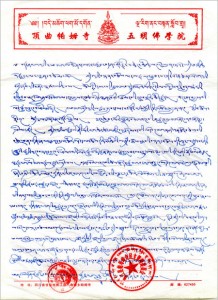
Lama Renzhen Rinpoche of the Five Vidyas Buddhist Institute prostrated to H.H. Wan Ko Yeshe Norbu and praised the accomplishments of the Vajra Dharma King of Great Holiness with the following words: “We have respectfully read A Treasury of True Buddha-Dharma about H.H. Buddha Vajradhara Great Dharma King and were truly astounded! . . . H.H. Great Dharma King represents the Buddha-dharma!”




















 Peace LiLy