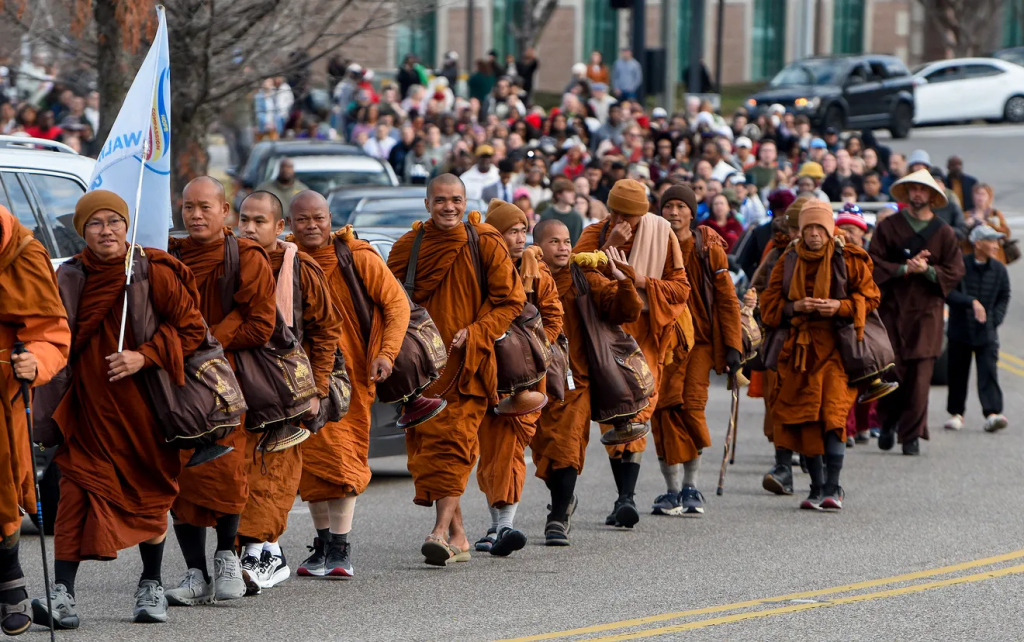
The Buddhist monks from the Huong Dao Vipassana Bhavana Center in Fort Worth, who are undertaking a 2,300 mile pilgrimage of Walk for Peace, arrive for a welcome ceremony at Hong Kong City Mall in Houston Friday, Nov. 14, 2025. Houston Chronicle/Hearst Newspapers via Getty Images
In a world that often feels rushed, divided, and relentlessly loud, there is something quietly revolutionary about the act of walking.
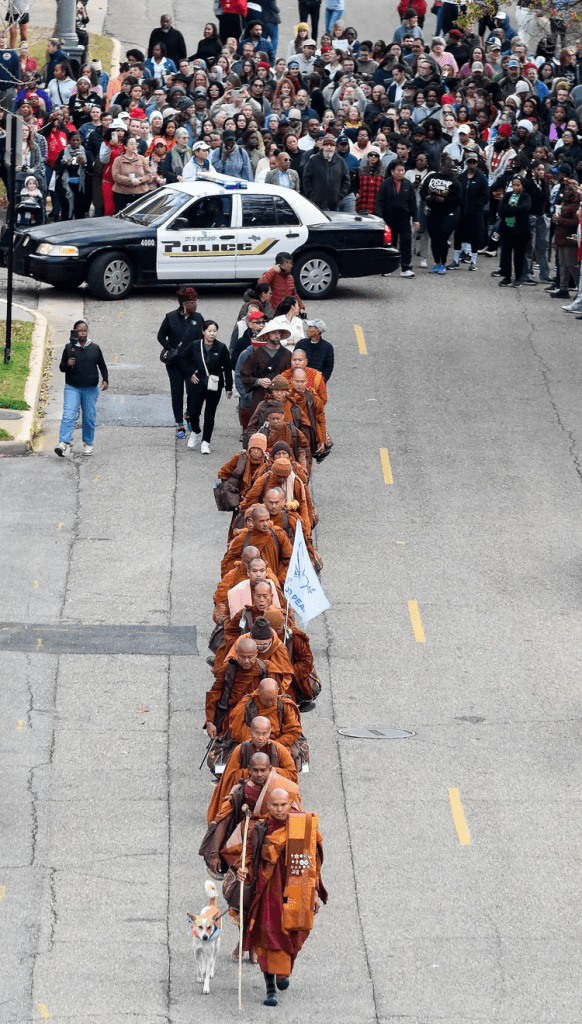
Recently, a group of Buddhist monks began a long, demanding pilgrimage across the United States. Their mission is simple yet profound: to promote peace. Their journey began in Fort Worth, Texas, on October 26. Since then, they have faced the literal “wear and tear” of the road, including a harrowing incident where two monks were injured after a truck struck their escort vehicle.
Yet, they did not stop.
With perseverance and a calm, unshakable resolve, the group of two dozen monks has reached Georgia. They are still moving, one step at a time, toward their final destination in Washington, D.C. Their pace is slow, deliberate, and intentional—and that may be exactly what our world needs right now.
Buddhism has a long history of “engaged mindfulness”—the idea that compassion isn’t just felt in meditation, but lived in the world. These monks are not just praying for peace; they are embodying it.
As they navigate highways and back roads, they offer a living reminder that peace isn’t a destination we reach once and for all. It is a practice. It is something we choose moment by moment, breath by breath, step by step.
Watching their progress brings me back to a book I read nearly 30 years ago: Peace Pilgrim.
I remember being deeply moved by her story—how she walked across countries carrying almost nothing, guided by the conviction that peace begins within the individual. At the time, I wished I could have met her in person, just to thank her for the way her simplicity and courage planted a seed in my heart.
Though she is gone, her spirit feels remarkably present today. I see her legacy in the orange robes of these monks as they crest the hills of the American South.
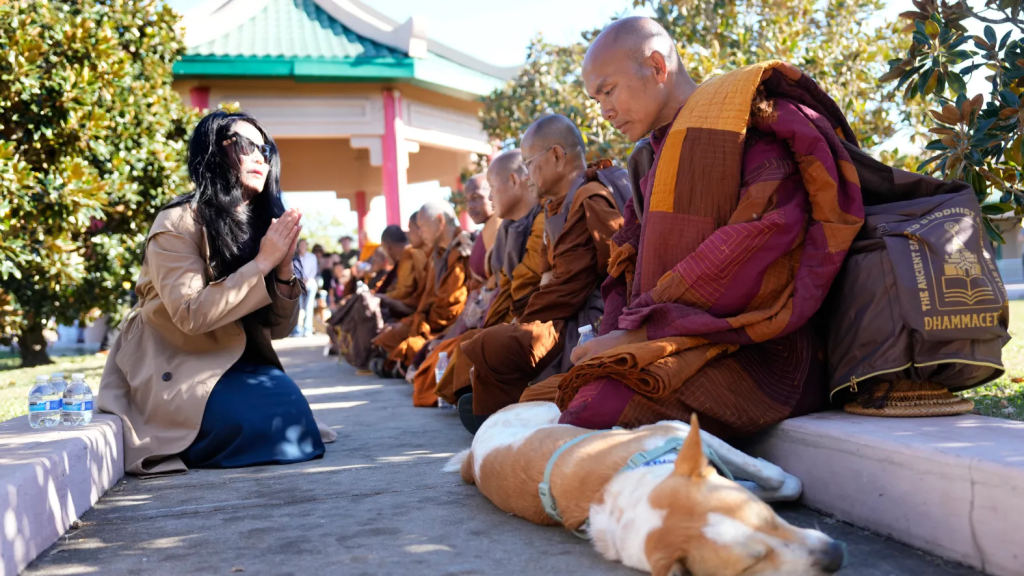
Monks rest at Hong Kong City Mall in Houston Friday, Nov. 14, 2025. Melissa Phillip/Houston Chronicle via Getty Images
Igniting Kindness, One Heart at a Time
There is something profoundly moving about a walking pilgrimage in the age of instant communication. There are no hashtags here. No viral outrage. Just human beings placing one foot in front of the other, trusting that their presence alone can soften the world.
And it works.
Along the way, the “ordinary” world reacts. Drivers slow down. Strangers stop to ask questions. People offer water, a meal, or a simple smile. In these small, unscripted exchanges, something gentle is awakened. We are reminded that beneath our political and social differences, we all share a basic human longing for safety, understanding, and harmony.
The monks may be the ones doing the walking, but the kindness they ignite along the way belongs to all of us. As they recently shared on their Facebook page:
“We do not walk alone. We walk together with every person whose heart has opened to peace, whose spirit has chosen kindness, whose daily life has become a garden where understanding grows.”
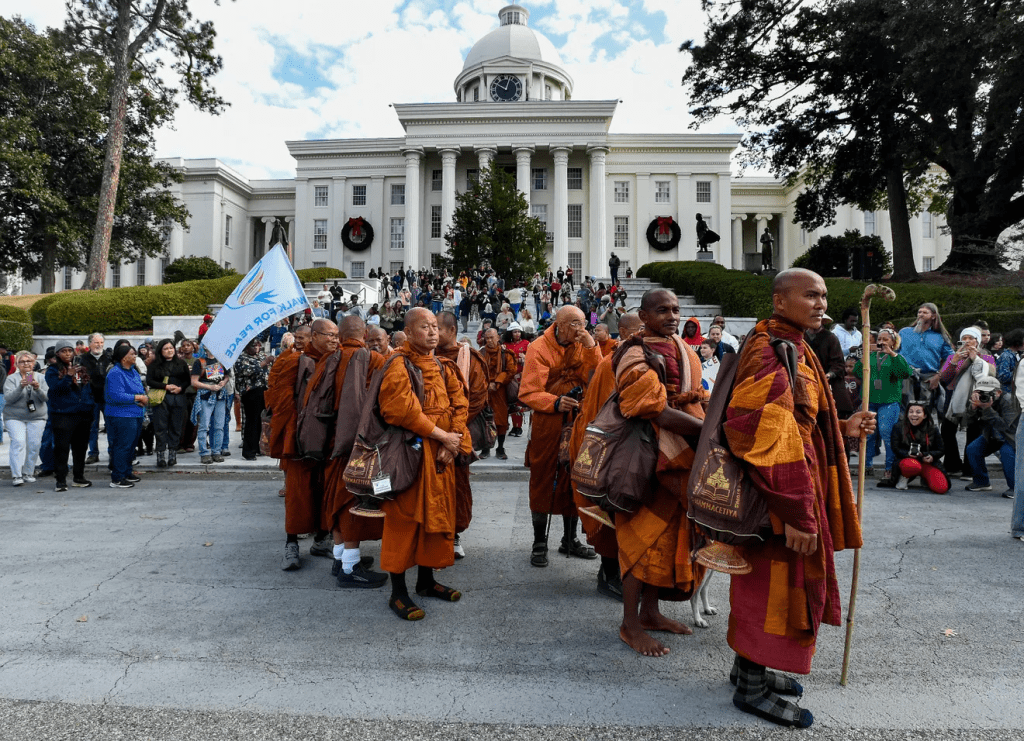
A group of Buddhist Monks and several hundred local community members take part in the Walk for Peace in Montgomery, Ala., on Tuesday December 23, 2025. The Monks are walking from Texas to Washington, D.C. to promote peace and compassion.
Most of us cannot drop everything to walk across a continent. But all of us can “walk for peace” in the geography of our own lives.
We can pause before we react in anger.
We can choose compassion over the reflex of judgment.
We can listen more deeply than we speak.
Watching these monks continue their journey despite injury and uncertainty reminds me that peace isn’t achieved through grand, sweeping gestures. It is built patiently through humility and love.
Step by step.
May their walk remind us to slow down, to soften our hearts, and to keep moving—together—toward a more peaceful world.
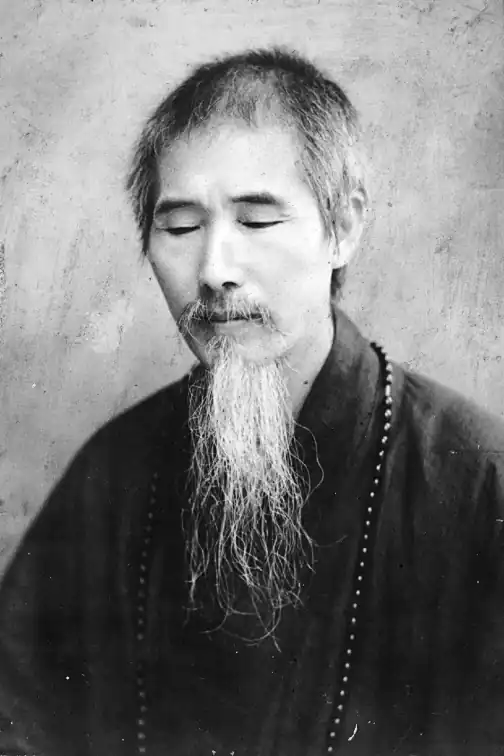
In the annals of spiritual history, few figures are as revolutionary as Huineng (慧能), the Sixth Patriarch of Zen (Chan) Buddhism. His life story is a profound testament to the idea that enlightenment is not reserved for the elite or the scholarly, but is the inherent birthright of every human being.
Known for the iconic verse you mentioned—“Bodhi originally has no tree”—Huineng transformed Zen from a complex Indian philosophy into the direct, spontaneous practice we recognize today.
Huineng’s journey did not begin in a monastery. He was born into a poor family in 7th-century China and worked as an illiterate woodcutter to support his widowed mother.
His life changed in an instant when he overheard a traveler reciting the Diamond Sutra. Upon hearing the line, “Depending upon nothing, the mind arises,” Huineng experienced a sudden moment of clarity. This “sudden awakening” became the hallmark of his future teachings.
Driven by this experience, he traveled to the Dongshan Monastery to seek guidance from the Fifth Patriarch, Hongren.
Huineng’s status as an illiterate outsider meant he was initially assigned to the kitchen to hull rice. When the time came for the Fifth Patriarch to choose a successor, he asked his disciples to write a “mind-verse” to demonstrate their understanding.
The lead disciple, Shenxiu, wrote a verse emphasizing constant, diligent practice:
“The body is the Bodhi tree; the mind is like a bright mirror on a stand. Take care to wipe it always, and let no dust collect.”
Huineng, hearing the verse, realized it missed the ultimate truth of emptiness. He dictated his now-famous response to be written on the wall:
“Bodhi originally has no tree.The bright mirror on a stand is also not real.From the beginning, not a single thing exists.Where, then, can dust collect?”
Hongren recognized Huineng’s superior realization and secretly passed him the robe and bowl—the symbols of the Patriarchy—in the middle of the night, instructing him to go into hiding until the time was right to teach.
Huineng eventually emerged from hiding and began teaching at Nanhua Temple. His impact on Buddhism was so immense that his teachings were recorded in the Platform Sutra of the Sixth Patriarch. This is the only Buddhist scripture not spoken by a Buddha to be officially granted the title of a “Sutra.”
His major achievements include:
The Southern School of Zen: He founded the “Southern School,” which emphasizes “Sudden Enlightenment” (Dunwu) over gradual study.
Democratizing Wisdom: He taught that the “Buddha-nature” is present in everyone, regardless of literacy or social status.
The Foundation of Zen: Nearly all surviving Zen lineages (including Japanese Zen and Korean Seon) trace their ancestry back to Huineng.
A Living Legacy: The Whole-Body Relic
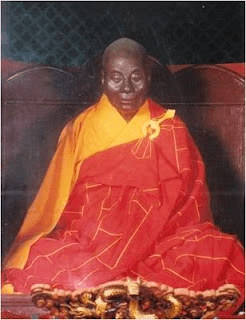
Perhaps the most miraculous aspect of Huineng’s story is his physical departure from this world. In 713 AD, Huineng entered Nirvana, but his body did not decay.
To this day, his whole-body relic (mummy) is enshrined and preserved at Nanhua Temple in Shaoguan, Guangdong Province. For over 1,300 years, devotees have traveled to the temple to pay respects to the Sixth Patriarch. His physical presence remains a powerful symbol of the “Diamond Body”—the incorruptible nature of a truly enlightened mind.
Huineng reminds us that we do not need to look outside ourselves for wisdom. As he famously taught, our original nature is pure, and enlightenment is simply the act of seeing through the “dust” to the emptiness that was there all along.
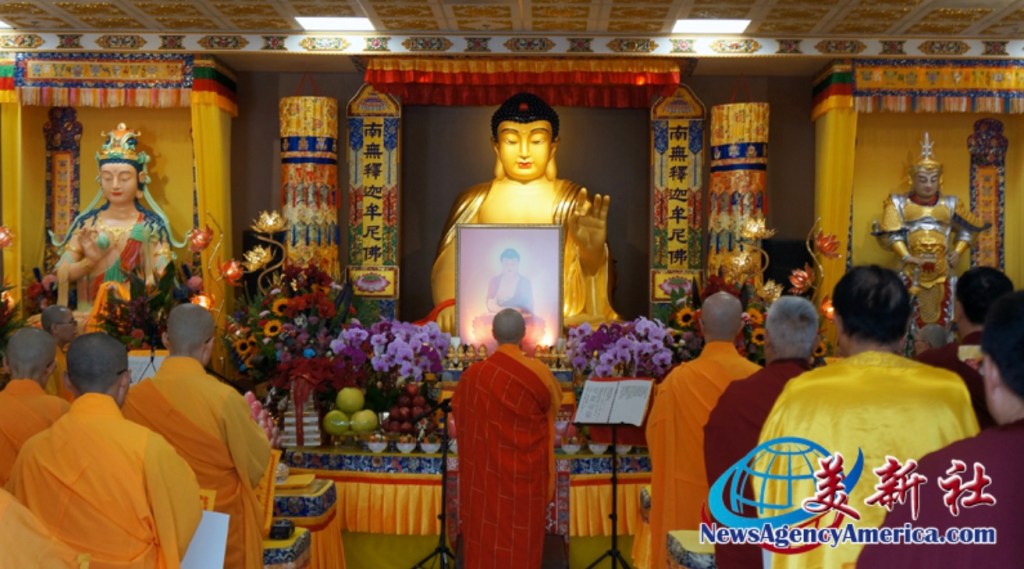
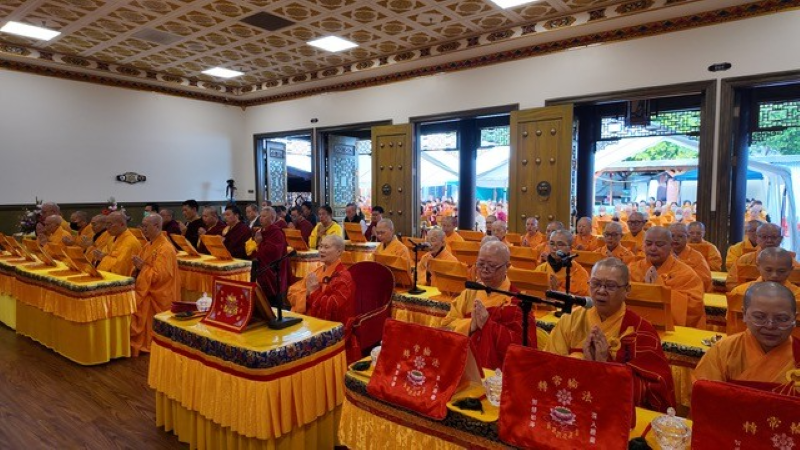
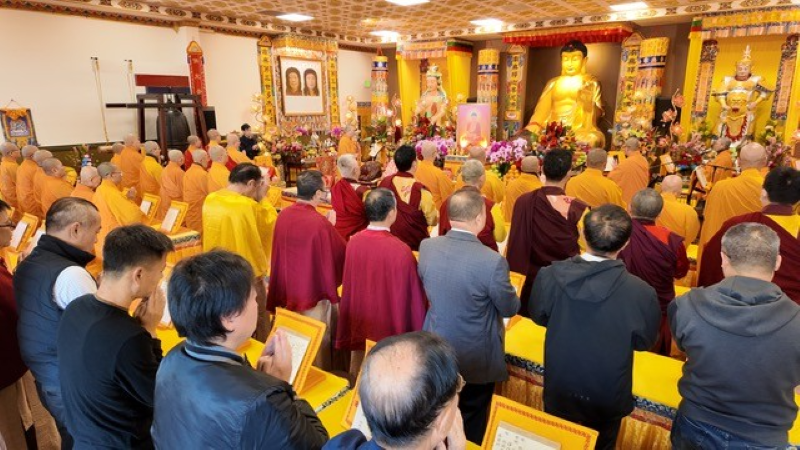
PASADENA, CA — Four major Buddhist organizations—the World Buddhism Association Headquarters (W.B.A.H.), Holy Miracles Temple, Hongfa Temple, and Sanger Mission—recently held a joint Dharma Assembly at the Grand Hall of Holy Miracles Temple in Pasadena to celebrate the Holy Birthday of Namo Amitabha Buddha, the Lord of the Western World of Ultimate Bliss.
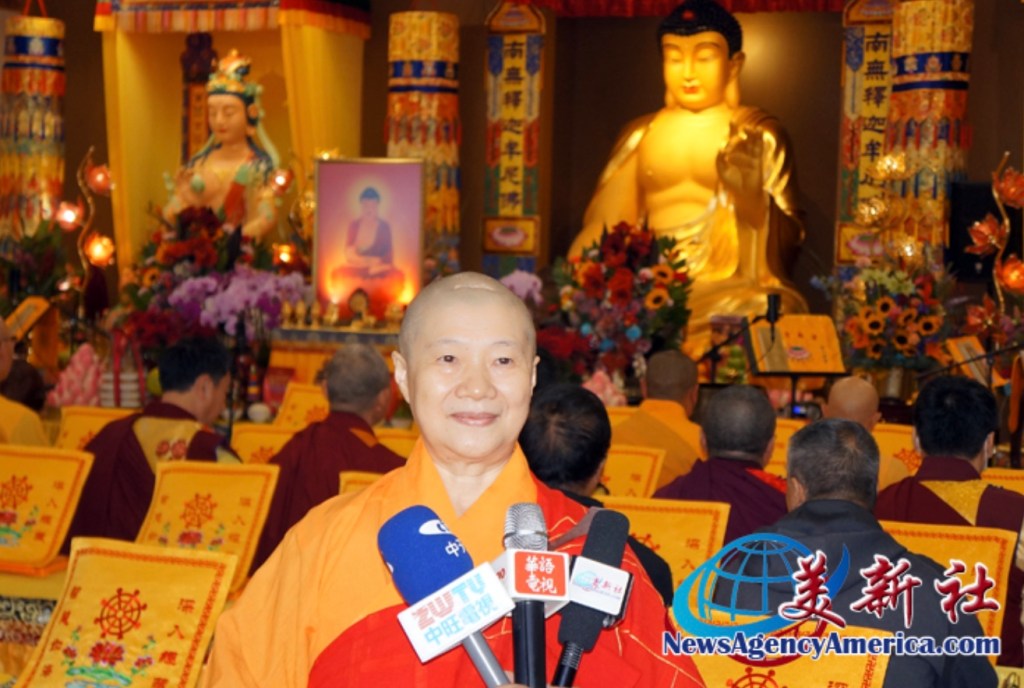
The assembly was presided over by Venerable Dharma Teacher Zhengda, Vice Chair of the W.B.A.H. and a Holy Virtuous One of Gold Button Grade II. Hundreds of devotees from across California and overseas attended the ceremony.
The assembly officially commenced at 10:00 AM. Inside the Grand Hall, the sounds of bells, drums, and rhythmic chanting filled the air, creating a solemn and serene atmosphere. Led by Venerable Dharma Teacher Zhengda and Venerable Ruohui, Abbot of Hua Zang Si and Hongfa Temple (a Holy Virtuous One of Gold Button Grade I), the monastics and Rinpoches guided the congregation in prostrations and the sincere recitation of the Amitabha Sutra.
Following the recitation, a Grand Offering was performed. Incense, flowers, lamps, fresh fruit, and various offerings were presented before the Buddha. With pure and respectful hearts, the faithful prayed for all sentient beings to be free from suffering and attain happiness. The organizers stated that beyond celebrating the Holy Birthday, the merits of the sutra chanting and offerings were dedicated to world peace, the cessation of war, social harmony, and the longevity, health, and spiritual growth of all beings.
The Compassionate Vows of Amitabha Buddha
According to Buddhist scriptures, Namo Amitabha Buddha is the “Amitabha Buddha of the West” among the Five Dhyani Buddhas and is a disciple of the primordial Buddha, Namo Dorje Chang Buddha. During his past cultivation, Amitabha Buddha made 48 Great Vows to deliver sentient beings from the sea of suffering to the Pure Land. Upon the perfection of his vows and attainment of Buddhahood, he established the pure and majestic Western World of Ultimate Bliss. He is currently the Lord of that realm and the Head of the Lotus Section of the Vajrayana teachings.
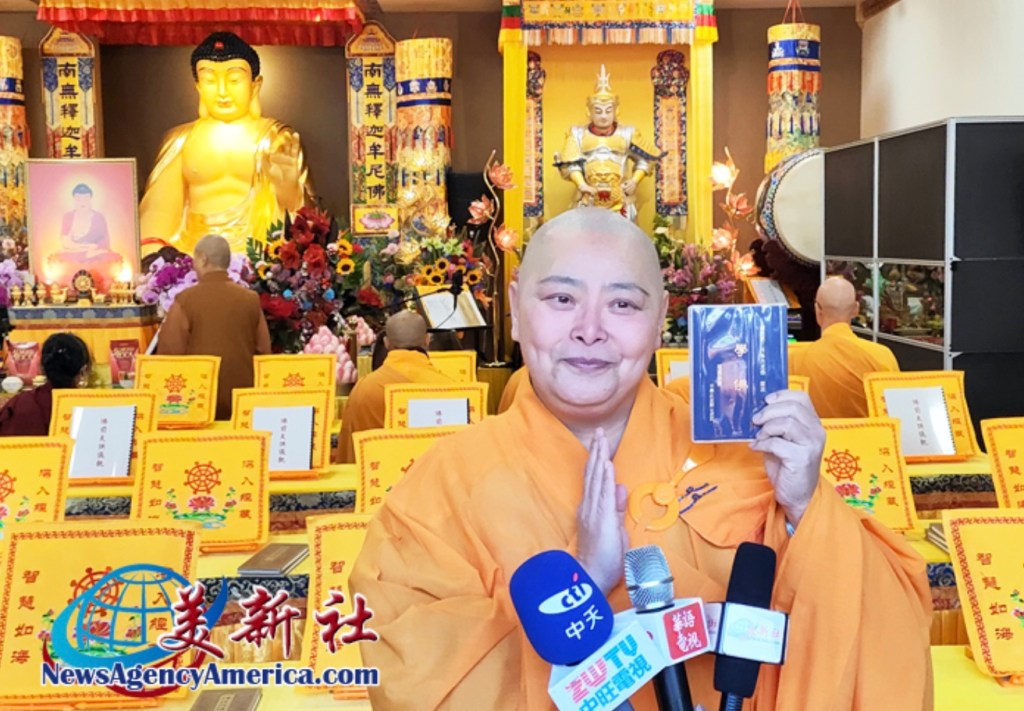
During an interview, Venerable Dharma Teacher Zhengda remarked:
“Today, we gathered to recite the Amitabha Sutra and pray for blessings. The devotees showed great sincerity in their chanting and repentance, expressing deep gratitude for Amitabha Buddha’s salvation. We should emulate the vast compassion of Amitabha Buddha and all Buddhas of the ten directions. We pray that Namo H.H. Dorje Chang Buddha III, Namo Amitabha Buddha, and all Buddhas and Bodhisattvas bless the world with peace and prosperity, protecting all beings from disaster.”
Bhikkhuni Zhengqin of Hongfa Temple shared her reflections on cultivation, noting that after facing many hardships in life, studying the true Buddha Dharma provided her with inner peace. She highlighted the book Learning from Buddha as a “treasured guide” that offers clear direction for practitioners.
Another attendee, Ms. Wu Guangling, shared that over ten years of practice have taught her to face life’s challenges with equanimity. She quoted an ancient virtuous saying to describe her mindset: “Face negative karmic effects with composure, while planting good causes as if treading on thin ice.”
Jon, a first-time attendee, was moved by the experience:
“Seeing everyone chanting so sincerely was impressive. I’ve never chanted with so many people before, and I hope to have the chance to attend such an assembly again.”
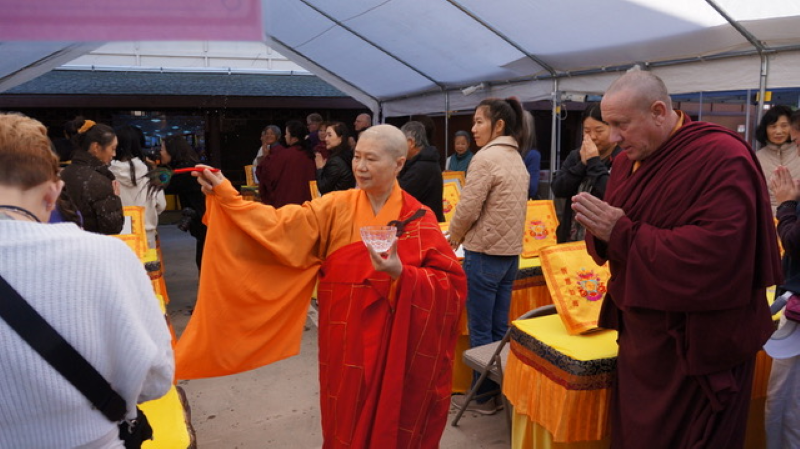
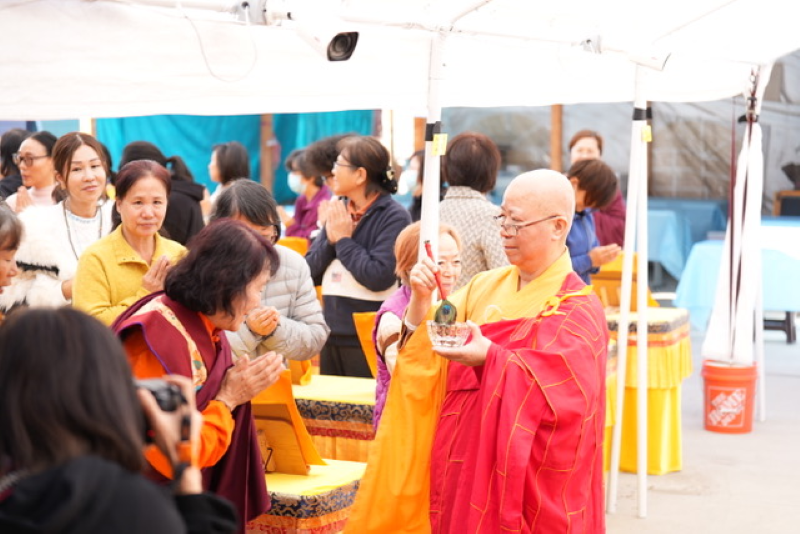
As the assembly concluded, the monastics sprinkled holy water over the crowd, blessing them with longevity and wisdom. The organizers noted that the event not only allowed the faithful to draw closer to the Dharma but also united the community in a spirit of goodness. The W.B.A.H. expressed gratitude to all participants and encouraged everyone to integrate the Buddha’s teachings into their daily lives to contribute to social harmony and world peace.
Zhenru Chan Temple is nestled on the southwestern slopes of Yunju Mountain in Jiangxi Province. Surrounded by peaks said to resemble unfolding lotus petals, the landscape is poetically described as “lotus peaks clustering around Huatai.” Huatai, the mountain’s central peak, anchors this natural harmony. Here, architecture, terrain, and spiritual intention merge seamlessly, creating a setting that feels both grounded and quietly transcendent.
Even before understanding its history, one senses that this is a place shaped not to dominate nature, but to listen to it.
The name Zhenru (真如) means “True Suchness”—a fundamental concept in Chan Buddhism that points to ultimate reality as it is, beyond words, labels, or conceptual thinking. It is not something to be grasped intellectually, but something to be directly experienced.
Founded during the Tang Dynasty (806–810), Zhenru Chan Temple is regarded as the cradle of the Caodong School of Chan Buddhism, which later spread to Japan as the Soto Zen tradition. Revered as one of China’s three great model Chan monasteries, the temple has long been a center for authentic practice. Though the present structures were rebuilt in the 1950s, they preserve the simplicity and elegance of traditional Chinese monastic architecture.
Chan in Action: Meditation and Farming as One Path
One of Zhenru Temple’s defining characteristics is its embodiment of the Chan principle that “agriculture and meditation are equally emphasized.” Monks here did not retreat from life; they engaged it fully.
Alongside meditation, monks cultivated tea fields and farmed the land. This was not merely practical—it was spiritual. Farming ensured self-sufficiency in the remote mountains, freeing the monastery from reliance on external donations. More importantly, working the soil was understood as a form of Chan practice: repetitive, mindful, intimate with the rhythms of nature.
In the Caodong tradition, there is no division between the sacred and the ordinary. Plowing a field is no less sacred than chanting a sutra. The monks alternated between sitting meditation and physical labor, living out the Chan maxim:
“A day without work is a day without food.”
This principle is traditionally attributed to the Tang-dynasty Chan master Baizhang Huaihai (720–814), a disciple of Mazu Daoyi and a key figure in establishing Chan monastic regulations. His teaching reminds us that awakening is not found apart from daily life, but revealed within it.
Master Xu Yun: Reviving the Living Dharma
Zhenru Chan Temple is also inseparably linked to Master Xu Yun (1840–1959), one of the most revered Chan masters of modern China, often described as a rare master who embodied and transmitted the lineages of five Chan schools in a single lifetime.
When Master Xu Yun arrived at Zhenru in the early 20th century, the temple lay largely in ruins. With unwavering resolve, he led an extensive restoration—rebuilding halls, pagodas, and monastic quarters with the support of disciples and lay donors. More than physical reconstruction, he revived strict monastic discipline and rigorous meditation practice, restoring the temple’s spiritual vitality.
Zhenru ultimately became the place where Master Xu Yun passed away, completing a life devoted to the Dharma.
Earlier in his life, Master Xu Yun experienced a profound awakening during intensive meditation at Gaomin Temple in Yangzhou at the age of fifty-six. In his autobiography, he described the experience with clarity and restraint:
“In the purity of my single-mindedness, I forgot my body entirely. After twenty days, my illness disappeared. From that moment on, my practice continued day and night without interruption… One evening after meditation, I opened my eyes and saw a brightness like broad daylight, in which everything inside and outside the monastery was clearly visible.”
Yet what makes his account especially powerful is what followed. Master Xu Yun did not cling to the experience. He recognized it as a mental state—not an ultimate attainment—and continued his investigation with humility and perseverance, asking relentlessly:
“Who is mindful of the Buddha?”
Later, he commemorated a moment of deep insight triggered by the simple sound of a teacup breaking in the Chan hall, capturing Chan’s direct and unadorned wisdom in a verse:
A cup fell to the ground, The sound rang clear and sharp. Space itself shattered— The restless mind came to rest.
This is primarily a video demonstration of the moving meditation practiced at Zhen Ru Chan Temple.
Zhenru Chan Temple is more than a historical site. It is a living reminder that Chan practice is not confined to silence or retreat, but woven into how we walk, work, and meet the ordinary moments of life.
Xiaoxitian, originally known as Qianfo’an (The Hermitage of a Thousand Buddhas), was founded in the second year of the Chongzhen reign of the Ming Dynasty (1629). It stands atop Phoenix Mountain, about one kilometer west of Xixian County in Linfen, Shanxi Province.
Built entirely in harmony with the mountain, the temple unfolds in layers, as if it had grown naturally from the slope itself. Stone steps lead visitors upward, passing through courtyards divided by arched cave-like gateways. The upper, middle, and front courtyards are connected yet distinct, creating a spatial rhythm that is winding, intimate, and quietly profound. As one walks through the complex, footsteps instinctively slow, and time itself seems to soften.
The architecture of Xiaoxitian is restrained rather than ostentatious, yet its mastery reveals itself everywhere. Painted beams are elegant and dignified, and many of the halls are ingeniously built as two-story structures, creating a rich sense of vertical space within the limited mountain terrain. The bell and drum towers stand in stillness, inviting the imagination to wander back to an age when morning bells and evening drums echoed through the valley.
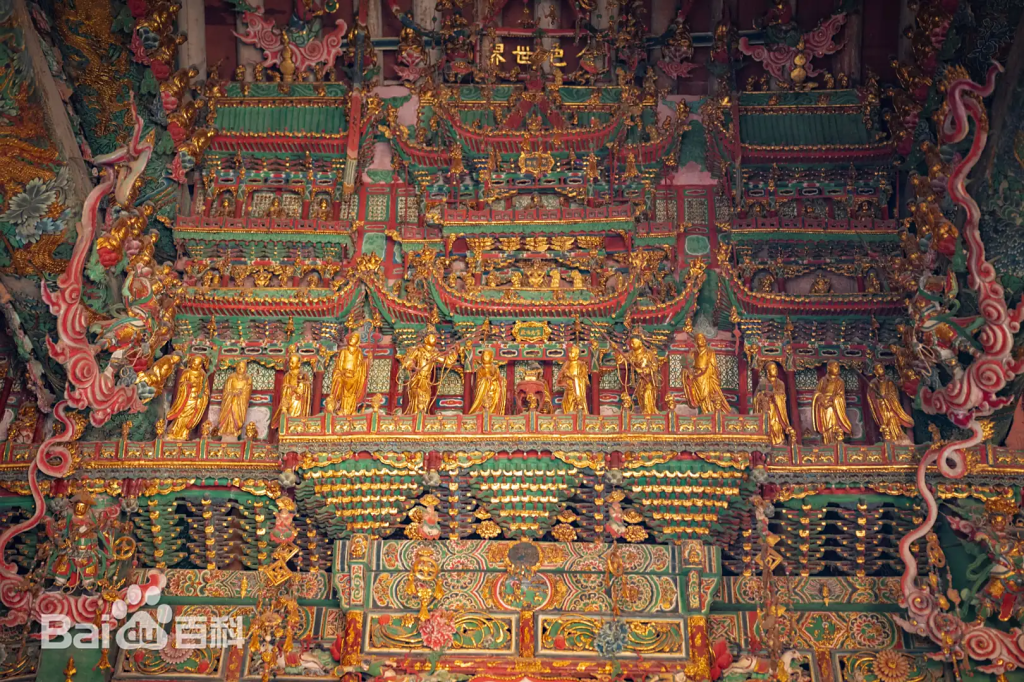
Stepping into the Mahavira Hall is a moment of sudden awe. Nearly the entire interior is filled with suspended polychrome sculptures—more than 1,900 figures, layered from floor to ceiling. From towering Buddhas over three meters high to figures no larger than a thumb, the sculptures are densely arranged yet never chaotic, solemn yet vibrantly alive. In that instant, one understands why Xiaoxitian is revered as the “Museum of Chinese Hanging Sculpture Art.”
Unlike many Buddhist temples that draw attention primarily to their principal Buddhas, the Mahavira Hall at Xiaoxitian is celebrated for the immersive world it creates as a whole. At its core stand the Medicine Buddha, Amitabha, Shakyamuni, Vairocana, and Maitreya, but surrounding them unfolds an entire celestial realm: the Ten Great Disciples, six young novices, the Ten Wisdom Kings, the Six Desire Heavens, and countless heavenly musicians dancing through the air.
Most unforgettable are the celestial musicians suspended within the tiered “sky pavilions” above the altars. Their figures are light and graceful, sleeves flowing as if caught in an eternal breeze, frozen in a moment of unending heavenly music. Some play the pipa, others hold flutes, while some seem to dance midair. One pipa-playing figure, leaning slightly forward with fingers poised on the strings, radiates such focus and elegance that one can almost hear the melody drifting across centuries.
Looking up toward the roof, the tri-colored glazed chiwen ornaments—yellow, green, and blue—gleam softly in the light. Their refined brilliance reflects the unmistakable aesthetic of the Ming Dynasty. Here, architecture, sculpture, and color merge seamlessly, and one forgets that this is a mountain temple at all. It feels instead like stepping into a floating Buddha realm, suspended between earth and sky.
That these sculptures have survived nearly four hundred years in such vivid detail inspires deep reverence. They represent not only the pinnacle of craftsmanship, but also a profound devotion—to faith, to beauty, and to a harmonious vision of the cosmos.
Perhaps what truly moves the heart at Xiaoxitian is not only the astonishing number of its hanging sculptures or the rare Ming Yongle Northern Buddhist Canon once preserved here, but something more enduring: a spiritual presence that has remained vibrant across centuries. It quietly reminds us that beyond the noise of the modern world, there still exists a place of serenity and dignity—carefully upheld by time itself.
A Buddha Truly Recognized as Such in Accordance with the Dharma
The people on both sides of H.H. Dorje Chang Buddha III on this page are the highest present-day dharma kings and regent dharma kings from various Buddhist sects or are famous rinpoches. It is they who wrote recognitions, corroborations, or congratulations to H.H. Dorje Chang Buddha III.
H.H. Dorje Chang Buddha III is the first Buddha on earth to have received such a large number of recognitions, corroborations, and congratulations and to have been recognized as having the highest status! No other Rinpoche on earth has ever received even one third of the number of recognitions, corroborations, and congratulations from great dharma kings, regent dharma kings, etc. that H.H. Dorje Chang Buddha III has received. H.H. Dorje Chang Buddha III has singlehandedly manifested accomplishments in thirty large categories involving all of the Five Vidyas, thereby establishing the highest record of accomplishment in the history of Buddhism in this world.
Certain evil people have slandered H.H. Dorje Chang Buddha III as having conferred upon Himself the status of H.H. Dorje Chang Buddha III, and they have thereby guided Buddhist practitioners toward evil. In order to protect the wisdom roots of living beings, H.H. Dorje Chang Buddha III makes the following vow of truth: “If those recognitions, corroborations, and congratulations that follow did not come from the dharma kings, regent dharma kings, and rinpoches whose photographs appear on this page of from their temples and/ or are not copies of the original texts but rather are my fabrications with forged signatures – if even one such case exists – then i should descend into hell without the possibility of ever leaving hell. If those recognitions, corroborations, and congratulations were written or typed by them as well as signed and/ or stamped by them, the merit of this truth will bring to everyone wonderful blessings and wisdom! Vow Maker- Dorje Chang Buddha III“
FATHER OF MEDICINE, FERRYBOATS, BRIDGES, AND OPERAS IN TIBET IN A PREVIOUS LIFE: H.E. DHARMA KING TANGTONG GYALPO
H.E. Tangtong Gyalpo is a greatly accomplished person within Tibetan esoteric Buddhism who attained the rainbow body. In a prior life in Tibet, he was the supreme dharma king of the four main sects esoteric Buddhism. He is a great Bodhisattva known and respected by one and all in Tibet. He is also a person of great holiness who has made huge contributions to the Tibetan people. It was this great Bodhisattva who was the father of medicine, ferryboats, bridges, and operas in Tibet. To this day, Tibetan temples and families continue to worship H.E. Tangtong Gyalpo Bodhisattva.
H.E. the 16th Tangtong Gyalpo Bodhisattva (Thangtrul Rinpoche) took birth in Bhutan. His physical appearance resembles that of Guru Padmasambhava. Even when he sleeps, his eyes remain open. During a Dharma Assembly that took place in 2005 at Hua Zang Si in San Francisco, he entered a supernatural state of samadhi in which he saw H.H. Dorje Chang Buddha. H.E. Tangtong Gyalpo said to H.H. Dorje Chang Buddha III that he had received teachings directly from Guru Padmasambhava. He also said that he specially came to formally acknowledge H.H. Dorje Chang Buddha III as his Master and to request the highest dharma in order to save living beings. H.H. Dorje Chang Buddha III immediately accepted H.E. Tangtong Gyalpo as one of his disciples who is on the level of a great venerable one and performed an initiation for him. H.E. Tangtong Gyalpo organized many rinpoches to practice the Kuan Yin Dharma one billion times as an offering to the treasure book about H.H. Dorje Chang Buddha III. He also sent his written congratulations stating that the magnificence of H.H. Dorje Chang Buddha III is supreme and that no other holy being in history can compare with this master of the Buddhas.
H.E. Dharma King Tangtong Gyalpo, the Father of Medicine, Ferryboats, Bridges, and Operas in Tibet in a previous life, acknowledged H.H. Dorje Chang Buddha III (H.H. Dharma King Wan Ko Yeshe Norbu) as his Master, who is unanimously recognized by great holy beings as the true incarnation of Dorje Chang Buddha, the Master of the Five Buddhas, having manifested complete mastery of exoteric and esoteric Buddhism and the Five Vidyas.
During a Dharma Assembly held by the International Buddhism Sangha Association at the Hua Zang Si temple in San Francisco, I saw the awe-inspiring and peerless powers and realization of the Master. Bodhi nectar went through the walls of the bowl unhindered as it left and entered the bowl. That nectar can make a person’s body change involuntarily in an instant. H.H. Dharma King Wan Ko Yeshe Norbu bestowed upon me that holy bowl. H.H. Dharma King Sakya Trizin; Dharma King Omniscience Jamyang Lungdok Gyaltsen; Lama palchug Ugyen Sherab; Dharma King Renzeng Nima; the Eastern Tibetan Dharma King of the Nyingma sect, Renqing Rongbo Barongbo Rinpoche; the Green Jewel Crown karmapa, Dharma King Jiezong; and other great, holy and virtuous beings who are on the levels of Buddhas and Mahasattvas unanimously acknowledge that H.H. Wan Ko Yeshe Norbu is the true incarnation of Dorje Chang Buddha, the Master of the Five Buddhas, and has for the first time in the history of Buddhism in the human realm truly manifested complete proficiency in exoteric and esoteric Buddhism and perfect mastery of the Five Vidyas. This is a goal of Buddhism that all other Buddhists have not been able to achieve. This goal has finally been achieved by H.H. Master Wan Ko Yeshe Norbu. This is an honor to Buddhism and a blessing to living beings.
May the seven types of Buddhist disciples hear the true dharma taught by H.H. Great Dharma King Wan Ko Yeshe Norbu, and may they soon realize enlightenment!
This ancient Buddhist narrative reveals a timeless truth: the value of spiritual wisdom far outweighs any material wealth. It is a powerful reminder to cherish the opportunity to hear and practice the true teachings.
The story begins with the aunt of Shakyamuni Buddha. Out of deep love and devotion, she wove a magnificent robe for him, intricately threaded with gold. It was a labor of heart, an offering fit for an enlightened one.
Yet when she presented it, the Buddha gently advised her to give the robe instead to the entire monastic community—the Sangha.
This puzzled her. The garment was made especially for him. Why give it away?
The Buddha explained with compassion:
“The Field of Merit provided by the Sangha is vast and boundless. Offer it to them, and the virtue you gain will be immeasurable. To give to the Sangha is to give to me.”
Moved by this wisdom, she offered the robe to the monks. Out of humility, none dared to accept it—except Bodhisattva Maitreya, the future Buddha.
Wearing the golden robe, Maitreya went into the city to receive alms. His majestic presence, radiant in that resplendent garment, astonished the townspeople. They were mesmerized—so much so that they forgot to offer him food.
Among them was a master bead-stringer. Captivated, he invited Maitreya to his home for a meal. Afterward, he requested a Dharma discourse.
The artisan listened with such joy and absorption that he forgot everything—including an urgent commission from a wealthy patron who had paid him generously to craft a wedding ornament worth one hundred thousand coins.
When the client’s messengers arrived repeatedly to collect the finished piece, they found him entirely engrossed in listening to the teachings. Enraged, the wealthy man demanded back his jewels and the full down payment.
The artisan’s wife was devastated. Facing such a financial loss, she scolded him bitterly:
“By simply finishing that order, you would have earned a great fortune. Instead, you threw it all away listening to philosophy!”
The artisan felt a wave of regret wash over him.
Sensing this inner turmoil, Maitreya gently asked, “Will you come with me to the monastery?”
The artisan nodded.
Back at the monastery, Maitreya posed a question to the venerable Arhats:
“Which carries greater merit: listening to the Dharma with a joyful heart, or earning a great fortune?”
One by one, the senior monks affirmed that nothing can compare to the merit of hearing the true teachings.
Venerable Kaundinya declared:
“Receiving ten thousand pounds of gold cannot compare to offering even a single bowl of food to a virtuous practitioner. And listening to the Dharma with pure faith—even for a moment—surpasses that merit by hundreds of millions of times.”
Four other Arhats repeated this profound truth.
Finally, Maitreya asked Venerable Aniruddha why this was so.
Aniruddha replied:
“In a past life, I offered just one bowl of food to a Pratyekabuddha. Because of that single offering, for ninety-one world cycles I was reborn as a Heavenly Emperor and a human King, enjoying peace and prosperity. In this life, I was born into the same clan as the Buddha, and came into this world with a natural treasure field forty li wide.”
Hearing this, the bead-stringer felt his regret dissolve. Joy filled his heart. He understood the treasure he had received was far beyond the hundred thousand coins he had lost.
This ancient story is far more than a tale. It invites us to reflect deeply on the power of the Dharma.
Listening to the Truth is not merely an intellectual exercise. It opens the heart. It awakens wisdom. It strengthens the willpower needed to transform our deepest flaws and afflictions.
Material wealth is limited and fleeting. The merit gained from receiving the Dharma is limitless, enduring, and life-changing.
And yet the opportunity to listen does not always come easily. Conditions shift. Circumstances change. None of us can guarantee the next moment of life, much less another chance to sit peacefully and hear teachings that can liberate us from suffering.
When the causes and conditions ripen—when the Dharma reaches our ears—we must listen wholeheartedly.
We must not assume tomorrow will come. We must not assume our hearts are already pure. We must not assume we know enough.
The greatest freedom comes only when we break the cycle of birth and death and attain effortless liberation. Every moment of listening, every spark of understanding, moves us closer to that awakening.
This story encourages us to treasure every opportunity to hear the teachings, to recognize that spiritual wisdom is the greatest wealth of all, and to remember that even a moment of true Dharma listening can bring blessings far beyond the measure of gold.
In this Dharma-ending age, we are truly blessed that an ancient Buddha has come into our world to reveal the authentic, uncorrupted Dharma. The recorded discourses of H.H. Dorje Chang Buddha III guide practitioners through a clear and progressive path of cultivation, offering incisive teachings that encompass the essence of the twelve divisions of the Tripitaka and the ten divisions of the esoteric scriptures. Nothing is diluted or lost—each teaching preserves the profound meaning of both the exoteric and esoteric Dharma. These discourses illuminate an extraordinary range of topics, from the principles of the Trikaya and the Four Wisdoms of a Buddha to the supreme vajra Dharma of the highest division. They reveal the true realization of the Great Perfection of Ultimate Wisdom, and through the Xian Liang Buddha Wisdom Great Perfection Dharma, disciples may even personally witness the rainbow-body state on the very day the Dharma is transmitted. In both theory and practice, the teachings of H.H. Dorje Chang Buddha III stand complete, perfect, and unparalleled—an immeasurable blessing in this age of fading Dharma.
Most religions have moral and ethical rules and commandments. Buddhism has Precepts, but it’s important to understand that the Buddhist Precepts are not a list of rules to follow.
In some religions, moral laws are believed to have come from God, and breaking those laws is a sin or transgression against God. But Buddhism doesn’t have a God, and the Precepts are not commandments. However, that doesn’t exactly mean they’re optional, either.
The Pali word most often translated as “morality” is sila, but sila has many connotations that go beyond the English word “morality.” It can refer to inner virtue such as kindness and truthfulness as well as the activity of those virtues in the world. It can also refer to the discipline of acting in a moral way. However, sila is best understood as a kind of harmony.
Being in Harmony
The Theravadin teacher Bikkhu Bodhi wrote,
“The Buddhist texts explain that sila has the characteristic of harmonizing our actions of body and speech. Sila harmonizes our actions by bringing them into accord with our own true interests, with the well-being of others, and with universal laws. Actions contrary to sila lead to a state of self-division marked by guilt, anxiety, and remorse. But the observance of the principles of sila heals this division, bringing our inner faculties together into a balanced and centered state of unity.” (“Going for Refuge and Taking the Precepts “)
It is said that the Precepts describe the way an enlightened being naturally lives. At the same time, the discipline of upholding the Precepts is part of the path to enlightenment. As we begin to work with the Precepts we find ourselves “breaking” or defiling them over and over. We can think of this as something like falling off a bicycle, and we can either beat ourselves up about falling—which is disharmonious—or we can get back on the bicycle and start pedaling again.
The Zen teacher Chozen Bays said, “We just keep on working, we are patient with ourselves, and on and on it goes. Little by little our life comes more into alignment with the wisdom that gives rise to the precepts. As our minds get clearer and clearer, it’s not even a matter of breaking or maintaining the precepts; automatically they are maintained.”
The Five Precepts
Buddhists don’t have just one set of Precepts. Depending on which list you consult, you might hear there are three, five, ten, or sixteen Precepts. Monastic orders have longer lists.
The most basic list of Precepts is called in Pali the pañcasila, or “five precepts.” In Theravada Buddhism, these Five Precepts are the basic precepts for lay Buddhists.
A more literal translation from the Pali for each of these would be “I undertake to observe the precept to abstain from [killing, stealing, misusing sex, lying, abusing intoxicants].” It’s important to understand that in maintaining the Precepts one is training oneself to behave as a buddha would behave. It’s not just a matter of following or not following rules.
The Ten Grand Precepts
Mahayana Buddhists generally follow a list of Ten Precepts that are found in a Mahayana Sutra called the Brahmajala or Brahma Net Sutra (not to be confused with a Pali sutra of the same name):
Some Mahayana Buddhists also vow to uphold the Three Pure Precepts, which are associated with walking the path of a bodhisattva. These are:
To do no evil
To do good
To save all beings
The Pali words usually translated as “good” and “evil” are kusala and akusala. These words can also be translated “skillful” and “unskillful,” which takes us back to the idea of training. Very basically, “skillful” action takes oneself and others closer to enlightenment, and “unskillful” action leads away from enlightenment.
To “save all beings” is the bodhisattva’s vow to bring all beings to enlightenment.
The Sixteen Bodhisattva Precepts
You will sometimes hear of the Bodhisatva Precepts or the Sixteen Bodhisattva Vows. Most of the time, this refers to the Ten Grand Precepts and Three Pure Precepts, plus the Three Refuges:
I take refuge in the Buddha. I take refuge in the Dharma. I take refuge in the Sangha.
The Eightfold Path
To fully understand how the Precepts are part of the Buddhist path, begin with the Four Noble Truths. The Fourth Truth is that liberation is possible through the Eightfold Path. The Precepts are connected to the “ethical conduct” part of the Path—Right Speech, Right Action and Right Livelihood.
Listening to your body can be something as simple as going to bed when you are tired, stop eating before you are overstuffed, or releasing a yoga posture when you’ve gone beyond your edge. It can also involve more serious things, like preventing your stress levels from exploding into chest pain by saying no, averting an acute pain situation or chronic disease by knowing when to slow down, and respond to pain or discomfort in your body.
For me, theessence of yoga is about listening to your body, mind and emotions and honouring where they are at, because this changes from day to day, hour to hour, minute to minute. This listening may involve noticing how your body feels in a particular pose-are your muscles tight, are you feeling a sense of release? How is your breath-do you notice times when you are holding it or breathing faster than you should? How are your emotions-what’s coming up for you; sadness, anger, impatience, or boredom?
I learn so much about myself while on my yoga mat. Through stillness, movement and breath, I have increased awareness of where I’m holding muscle tension and how my nervous system is doing. This mindfulness helps me move through negative emotions, practice self-compassion and often find sweetness underneath the negativity.
Our body and emotions are always communicating, and sometimes it’s very subtle, and unfortunately, we often ignore it. This has happened to me twice in the last year, and honestly, I should have known better. In the spring, during the first lockdown – (what # are we at now?) I continued with my weight workout because my gym was closed. I used light weights and after a few weeks felt they were too light and increased the amount. I started to notice an occasional throbbing pain in my left triceps. I ignored this and continued to ignore it, not making the connection that the heavier weights were taxing my muscles. One night I was awoken by the most excruciating pain, exactly where I felt the original throbbing pain, and it was radiating up to my neck and down to my wrist. Luckily, I was able to see my physiotherapist and chiropractor for treatment, and they felt the pain was connected to an aggravated radial nerve. My doctor prescribed me an anti-inflammatory, and I felt better after the first treatment; however, it took several months until I fully recovered.
You think this would have been a massive wake up call for me to pay attention to subtle changes in my body-the whispers. Nope. Since the recent lockdown, state of emergency, whatever we’re at these days, I committed to going for a long walk or hike every single day because my spirit needed this connection to nature. After a few longer hikes of 2-3 hours through a local conservation area, I noticed a pain in my right glute. It wasn’t severe pain and didn’t last long, so it was easy to brush off. However, it did happen at least 4-5 times, and I completely ignored it, and just over a week ago, I paid for this BIG TIME!!!!
After an active day on January 15th, I noticed a pain in my right hip flexor, went to bed, but didn’t stay long because the pain became too intense. By Saturday afternoon the pain had increased with a vengeance, and I didn’t sleep on Saturday night and woke my husband up at 3 am on Sunday informing him that he had to take me to emergency because I was in that much pain. At the ER they ruled out a few things and thought that diagnosis was piriformis syndrome-irritation of the piriformis muscle. They suggested rest, anti-inflammatories, extra-strength Tylenol and physiotherapy to get back on track. The pain wasn’t being managed, and on Tuesday morning, I had to go to the ER once again because the pain became so severe that I couldn’t walk. This time they focused on pain management and gave me morphine via IV and a script. The pain subsided, and I was able to walk and go home.
By this time, I hadn’t slept for 4 nights and saw my physiotherapist for the first time. He performed a full assessment and didn’t think I had piriformis syndrome and felt that my joint and muscles were functioning well. He thought that I might have overdone it with my hikes and aggravated some muscles and nerves.
I continued with the pain management meds and physiotherapy, and last Saturday afternoon, I noticed that the pain had left entirely. I haven’t had any pain since and still have no idea what caused it, but have some ideas. I believe that my enthusiastic hikes irritated the muscles and nerves in my right hip, and I had plenty of warning that something was up.
I’m so grateful to be pain-free and have the most profound compassion and empathy for anyone dealing with chronic pain. I honestly don’t know how anyone deals with it.
I don’t want to go through something like this again, and I’ve learned my lesson about the importance of listening to my body, not just on my yoga mat, but always.
Our body, breath and emotions are always communicating to us and sending us messages. They usually start as little whispers, and if you don’t pay attention, your body will yell at you loud and clear and force you to listen.
Off the yoga mat, it’s essential to take time throughout your day to slow down, be still and tune in. How does your body feel? Do an emotional check-in. Honour your body, and give it the attention and nurturing that it deserves. Trust your body, its’ wisdom and healing abilities.
The moment I heard that I would be going with Venerable Dharma Teacher Long Hui to Los Angeles, unspeakable joy arose in my heart. On the way to Los Angeles, a rainbow suddenly emerged from the drizzling sky, emitting beautiful lights of various colors. A white celestial crane seen in the distance flew near and landed at the side of the freeway gazing at us, as if paying us respect. All of these signs expressed auspicious blessings. I strongly sensed that what I had wished for so long was about to come true.
A notice arrived in the afternoon of December 28th. From Venerable Dharma Teacher Long Hui’s somewhat tense facial expression, I could tell this must be the time for me to pay my respects and visit the Buddha Master. Just as expected, when we stepped into the mandala, I saw H.H. Dorje Chang Buddha III Wan Ko Yeshe Norbu Holiest Tathagata sitting upright on the dharma platform. His Holiness appeared so dignified and had an expression of loving-kindness. As I sincerely prostrated myself to H.H. Dorje Chang Buddha III, all I heard was the cordial voice of His Holiness telling everyone to come sit toward the front. I sat beside Venerable Dharma Teacher Long Hui. Dharma Teacher Jue Hui and Dharma Teacher Ruo Hui also sat with us.
Venerable Dharma Teacher Long Hui reported to the Buddha Master regarding the Buddhist chanting work that had taken place at Hua Zang Si over the past two months. Next, the Buddha Master called my name: “Fa Hai, proceed with what you want to say.” Without knowing why, my mind went totally blank. I felt that my entire body was soaking in a kind of freshness. I remained kneeling with a very straight back, as if I had entered a state of meditation. At this time, I only heard the Buddha Master say, “It is all right. Just speak directly!” Yet, I still could not speak and was silent for another eight or nine minutes. I could sense that the Buddha Master was patiently waiting. Finally, a sound floated out of my mouth: “My karmic affinity with the Buddha Master should have begun ten years ago. Because I could not come to America, I was not able to visit His Holiness. I finally got a visa last year. Only this year did I have the opportunity to visit Hua Zang Si, where I respectfully listened to recorded dharma teachings of the Buddha Master. For more than one straight month, I have listened to the recorded dharma discourses without the slightest sense of tiredness.
This has been the most beneficial and rewarding time of my entire life. The beneficial effects I have experienced can never be expressed in words. I bring my body, speech, and mind to respectfully visit the Buddha Master at this time. Today, I would like to specially request a great dharma from H.H. Dorje Chang Buddha III. I would not hesitate to leap into boiling water or walk on fire in order to obtain this great dharma. I am willing to undergo any test in order to obtain such dharma. I am even willing to sacrifice my own life. It might sound like I am exaggerating, but I truly can do such things.”
Perhaps because I was too nervous or focused, I unexpectedly was not able to express exactly what I meant to say. However, I silently told myself that the Buddha Master definitely understands what I am trying to express and what dharma I am requesting. I still remember that I fasted for a full 21 days in the Philippines in order to obtain this great dharma. This is because I am very aware that in this world only H.H. Dorje Chang Buddha III can accomplish this task and announce to the world this great dharma in order to demonstrate the brightness of Buddha and enable the correct dharma to exist in this world forever.
At first, the Buddha Master did not answer my request directly but gave us a profound and important discourse. Only afterward did I realize that this discourse was actually the beginning of His Holiness’s response to my question. His Holiness specifically pointed out the various kinds of confusion and mistakes that have appeared within Buddhism in this current Dharma Ending Age. Some Buddhist sutras contain serious mistakes. What is even more serious is that there are some so-called eminent monks and great virtuous beings who, due to their erroneous understanding and views, seriously misguide others when giving discourses on the dharma. What is even sadder is that believers who do not understand the truth still fanatically follow them and prostrate to them in worship. H.H. Dorje Chang Buddha III does all He can to correct these heretical ideas and views. However, being limited by the karma of living beings, H.H. Dorje Chang Buddha III feels that it is very difficult to change the current situation despite His wish to do so. The Buddha Master gave some examples of these heretical ways within both esoteric Buddhism and exoteric Buddhism. These very worrisome examples left me not knowing whether to laugh or cry.
After finishing the discourse, the Buddha Master said to me directly, “Fa Hai, you did not say what great dharma you want to request. Let me say it for you. The dharma you want to request is to film a movie of the Buddha. There really is no one else besides me who can do this because I completely understand the teachings of the Buddha. I can write the script. This movie must be filmed. The only thing is that the karmic conditions this year are not quite mature enough because the script needs to be written and actors need to be found, especially actors who are qualified. As for funding, as long as there is a script, there will be people who will sponsor and invest. Besides, the movie of the Buddha will not be filmed as one undivided whole but will be divided into a series of 100 parts or episodes. Perhaps this is really the right channel. After all, the influence of a book is limited as it reaches fewer people than a movie, which has much more of an international impact. In addition, when we do this, many problems might be solved. We might even be able to build several temples this way!” At this moment, I understood that the discourse just given by H.H. Wan Ko Yeshe Norbu Holiest Tathagata on the current chaotic situation within Buddhism illustrated that it is impossible for anyone else to write in a script the authentic doctrines of the Buddha.
Listening to this point, I was really shocked in my heart. I used to pay respect and visit many eminent monks and great virtuous beings. I requested from them great dharma. None of them knew what this great dharma in my mind was that I wanted to request. H.H. Dorje Chang Buddha III is truly magnificent. I did not reveal in the slightest what great dharma I wanted to request. Nonetheless, what His Holiness stated was the exact great dharma in my mind that I wanted to request.
His Holiness then said, “Fa Hai, when you come back from mainland China, I will transmit to you dharma according to the formal rituals of Tibetan esoteric Buddhism. You still have some negative karma. At that time, I will perform an initiation for you and eliminate your karmic hindrances. You will see.” I was totally engulfed in the joy of the dharma. The Buddha Master further said, “On your way here, the rainbow and the celestial crane you saw augured that your future undertakings will be bright. However, behind the brightness lurks darkness, and there are twists and turns on the path. We will soon face some attacks and slander, although those who commit the slander will all end up losing. When A Treasury of True Buddha-Dharma is published, no force can obstruct or destroy us because what is in that book are facts.” The Buddha Master finished by saying, “The movie of the Buddha definitely has to be filmed. You see, Fa Hai, your wishes have all been fulfilled. How fortunate you are!”
Actually, there are no words that can express my happiness. There are also no words that can express my gratitude toward H.H. Dorje Chang Buddha III.
I only want to respectfully offer to the Dorje Chang Buddha III my most beautiful spirit, my most beautiful melody, my most beautiful singing voice, and my best wishes. May all those who hear this beautiful melody and singing voice be happy.
I would like to express my special thanks to an anonymous person who ten years ago sent me an express mail package in which a yellow silk scarf was wrapped around the book The Fruits of Pious Devotion and CD’s that had a picture of H.H. Dorje Chang Buddha III on their covers. It is because of this present that seeds planted ten years ago have borne fruit in the form of my taking refuge in the His Holiness as my Buddha Master and in the form of my witnessing the magnificence of the Buddha-dharma.
Everything I described above is true. I am a Buddhist nun. I accept the karmic responsibility for my words. If what I have stated is false, I will descend into the Vajra Hell. If what I have stated is true, I would like to dedicate the resulting merit to all living beings in the dharma realm so that they will soon realize enlightenment.
Respectfully written by disciple Fa Hai Shi December 30, 2006
The above account was written by Fa Hai Shi. We three humble Buddhist nuns provide the following testimonials.
Encountering an Unusual Occurrence
Basically, whenever people pay their respects and visit H.H. Dorje Chang Buddha III Wan Ko Yeshe Norbu Holiest Tathagata, they make good use of their short meeting time by posing prepared questions or by requesting the transmission of dharma. Some groups have really made the best use of their time by requesting answers to problems that have arisen.
From left to right: Ruo Hui Shih, Long Hui Shih, and Jue Hui Shih
However, there was one particular occasion in the afternoon of December 28, 2006 when a dharma teacher from the Philippines, Fa Hai, came to the mandala from thousands of miles away. This was the first time she was granted an audience with H.H. Dorje Chang Buddha III. When H.H. Dorje Chang Buddha III asked her what question she had, I saw that Buddhist nun take a deep breath. She then unexpectedly remained silent as she stared at the Buddha Master with open eyes, sometimes lowering her head. Perhaps all of this was due to nervousness or other factors. At this time, the Buddha Master also did not speak. Seconds and then minutes passed by in silence. Then, that dharma teacher sighed once more and straightened her back, still looking at the Great Dharma King without uttering a sound. Strangely, Dorje Chang Buddha III also remained silent. A moment later, she sighed for the third time but still did not reply to the Buddha Master. The duration of this silence lasted more than eight minutes. This kind of situation had never happened before.
Finally, the dharma teacher spoke. She said she had come with a wish to request a great dharma. If her wish to obtain this great dharma were fulfilled, she said she would dedicate her life to the Buddha-dharma and living beings, even if it meant sacrificing her life. After uttering such words, she again fell into silence without mentioning what dharma she wished to request.
At this time, Dorje Chang Buddha III said, “Do not say anymore. I will give you a discourse.” The Buddha Master pointed out what request was in the mind of this Buddhist nun. That discourse not only enabled us disciples who were there to once again witness the supernatural powers of H.H. Dorje Chang Buddha III, it also enabled us to understand precious dharma principles.
Because I took Dharma Teacher Fa Hai to pay her respects to H.H. Wan Ko Yeshe Norbu Holiest Tathagata, I was there and personally witnessed everything that happened. Everything I described above is true. If what I have stated above contains false words, may I never become accomplished in the dharma. If what I have stated above is true, I dedicate the resulting merit to all living beings so that they may soon hear the correct dharma and soon attain liberation and accomplishment.
Buddhist disciple Long Hui Shih
I was present at the time. I hereby confirm that what is stated above is true. If what is stated above is false, I am willing to descend into hell and experience negative karmic retribution. If everything stated above is true, I dedicate the resulting merit to all living beings so that they may soon hear the correct dharma and soon realize enlightenment.
Buddhist disciple, Jue Hui Shih
Everything stated above is true. If what is stated above contains false words, I will not become accomplished in the dharma and will become impoverished and miserable. If what is stated above is true, I wish to dedicate the resulting merit to all living beings so that they may always see Buddha and attain liberation.
Buddhist disciple, Ruo Hui Shih
(This is a complete translation of the Chinese text that follows originally written and signed by Fa Hai Shih, Long Hui Shih, Jue Hui Shih, and Ruo Hui Shih.)











 Peace LiLy