In a recent episode of “Expounding the Absolute True Through the Heart Sutra,” a longtime disciple, Layman Qi, shared his personal experiences of serving and accompanying H.H.Dorje Chang Buddha III for more than twenty years. What he described was not merely a teacher’s routine—it was a life of tireless, wholehearted service to all living beings.
Layman Qi has followed H.H.Dorje Chang Buddha III for over two decades, often driving for Him and staying close to Him in daily life. Through these years, he witnessed something that left a deep impression on his heart:
“In all these twenty-plus years,” he said, “I have never truly seen the Buddha rest. I do not even know when He rests.”
From early dawn, instructions are already being given. Throughout the day, the Buddha meets disciples, expounds the Dharma, grants empowerments, and resolves spiritual questions. Frequently, these activities continue until one, two, or even three o’clock in the morning.
Some may assume that after leaving the temple, He returns home to rest. According to Layman Qi, this is not so. Even when returning late—sometimes at three or four in the morning—His Holiness still carefully instructs disciples to ensure that even the dogs have been fed, water prepared, and that animals, including wildlife, are properly cared for.
Layman Qi describes H.H. Dorje Chang Buddha III as the most hardworking person he has ever encountered. Not only does the Buddha care for disciples, but He also performs Dharma services, dedications of merit, and liberative practices for countless sentient beings—including beings of the Six Realms whom ordinary eyes cannot see.
Meals are simple and often delayed. Breakfast is typically just a small bowl of porridge with a bit of pickled vegetables. Many days, even by seven or eight in the evening, lunch has still not been taken.
Disciples sometimes travel thousands of miles to seek an audience. Layman Qi understands their sincerity. Yet he gently reminds fellow practitioners: if one truly seeks the Buddha, the purpose should be to learn how to cultivate, how to transcend birth and death, and how to receive authentic Dharma teachings—not to occupy time with mundane disputes or worldly concerns.
Layman Qi reflects deeply on this point. In worldly life, one may seek employment for financial gain. But a Buddhist disciple seeking the Buddha should seek liberation, wisdom, and genuine cultivation.
Worldly difficulties—business setbacks, family discord—arise from karma. As the Buddha teaches, even a cool breeze in summer or the loss of a single hair operates within cause and effect. Understanding this principle, disciples should focus on transforming their karma through practice, rather than burdening the Buddha with worldly entanglements.
When countless disciples seek meetings daily, even a few minutes of casual worldly conversation multiplied many times over would prevent the Buddha from guiding those sincerely seeking liberation. For Layman Qi, this understanding has become an essential lesson in cultivation itself.
Perhaps the most moving detail is what happens after disciples finally rest for the night.
Layman Qi explains that stacks of requests—for blessings, dedications, and liberation rites—are presented to the Buddha. While others sleep, His Holiness continues performing practices and dedicating merit for sentient beings.
“To us,” Layman Qi reflects, “rest means sleep. But for the Buddha, there seems to be no such thing as rest. Twenty-four hours a day, His life is for living beings.”
What Layman Qi shares is only a glimpse. He openly admits that what he has seen is just a small portion of the Buddha’s boundless effort and compassion. Yet even this small portion, he says, is already beyond what ordinary people could endure.
In his words, the Buddha “never considers Himself.” Every action is directed toward benefiting living beings. This, he believes, is not only an expression of supreme compassion but also a profound lesson for all practitioners.
To serve without seeking return. To give without calculating personal gain. To work tirelessly for the liberation of others.
This is the example he has witnessed for over twenty years.
This post is translated and edited from Interview with a Buddhist Disciple (62): AM1300 Chinese Radio Station – Exclusive Interview with U.S. Layman Qi Pengzhi 《佛弟子訪談(六十二):AM1300中文廣播電臺-專訪美國 戚朋直居士》by Linda Chang. For original records, please click here.
Click here to Wikitia page on H.H. Dorje Chang Buddha III that list major accomplishments and teachings with links.
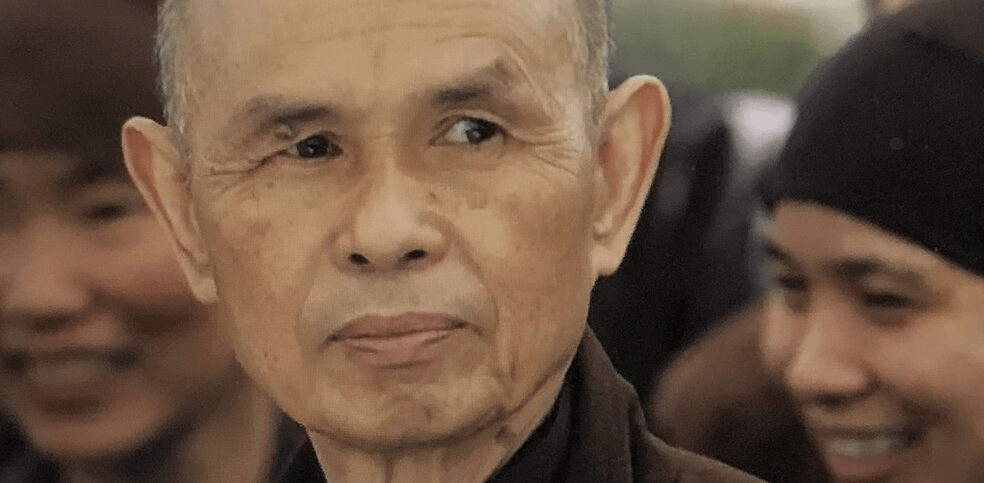
In times of uncertainty and turmoil, the voice of compassion becomes more precious than ever. Thich Nhat Hanh was a world-renowned Vietnamese Zen Buddhist monk, teacher, poet, author, and peace activist whose life embodied mindfulness and nonviolence. His profound influence reached far beyond the Buddhist community; he was nominated for the Nobel Peace Prize by Martin Luther King Jr., who recognized in him “an apostle of peace and nonviolence.”
Today, as the world feels divided and restless, his poem “Call Me by My True Names” invites us to look deeply into our shared humanity. It challenges us to see beyond separation—beyond “us” and “them”—and to recognize that within each of us lives both suffering and compassion. Reading his words now feels like a gentle but powerful reminder: true peace begins when we awaken to our interconnectedness.
Call Me by My True Names
Do not say that I’ll depart tomorrow because even today I still arrive.
Look deeply: I arrive in every second to be a bud on a spring branch, to be a tiny bird, with wings still fragile, learning to sing in my new nest, to be a caterpillar in the heart of a flower, to be a jewel hiding itself in a stone.
I still arrive, in order to laugh and to cry, in order to fear and to hope. The rhythm of my heart is the birth and death of all that are alive.
I am the mayfly metamorphosing on the surface of the river, and I am the bird which, when spring comes, arrives in time to eat the mayfly.
I am the frog swimming happily in the clear pond, and I am also the grass-snake who, approaching in silence, feeds itself on the frog.
I am the child in Uganda, all skin and bones, my legs as thin as bamboo sticks, and I am the arms merchant, selling deadly weapons to Uganda.
I am the twelve-year-old girl, refugee on a small boat, who throws herself into the ocean after being raped by a sea pirate, and I am the pirate, my heart not yet capable of seeing and loving.
I am a member of the politburo, with plenty of power in my hands, and I am the man who has to pay his “debt of blood” to, my people, dying slowly in a forced labor camp.
My joy is like spring, so warm it makes flowers bloom in all walks of life. My pain is like a river of tears, so full it fills the four oceans.
Please call me by my true names, so I can hear all my cries and laughs at once, so I can see that my joy and pain are one.
Please call me by my true names, so I can wake up, and so the door of my heart can be left open, the door of compassion.
Each time I read “Call Me by My True Names” by Thich Nhat Hanh, I feel both unsettled and awakened.
The poem asks us to see what we often refuse to see—that we are not separate from the suffering of the world. We are not only the compassionate helper, but also, in some deep and interconnected way, the frightened child, the victim, and even the one who causes harm. This is not an easy truth to hold. Yet it is a profoundly liberating one.
The poem gently dissolves the illusion of “us” and “them.” It invites us to return to our true humanity—tender, vulnerable, and deeply connected.
And perhaps, in remembering this, we take one small but meaningful step toward peace.
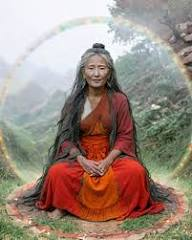
In the rich tapestry of Tibetan Buddhism, there are extraordinary practitioners whose lives themselves become teachings. Among them, Ayu Khandro (阿玉康卓) — also known by her Dharma name Dorje Peldron — stands as one of the most inspiring yoginis of the Nyingma tradition. Her life is not merely a story; it is a living example of devotion, perseverance, and profound realization.
Born in 1839 in the remote region of Kham, eastern Tibet, Ayu Khandro began her spiritual journey at a young age. She received teachings from many of the greatest masters of her time, including Jamyang Khyentse Wangpo, Jamgon Kongtrul, Chokgyur Lingpa, Nyala Pema Dundul, Adzom Drukpa, and Togden Rangrig — figures who were central to the non-sectarian Rimé movement in Tibetan Buddhism.
Unlike many who seek comfort or recognition, Ayu Khandro chose a life of renunciation and yogic discipline. She wandered widely across Tibet, lived in caves and hermitages, and devoted herself to decades of intense meditation. She spent more than fifty years in retreat, including prolonged periods of dark retreat, known in Tibetan as Yangti Nagpo — an advanced Dzogchen practice where the meditator withdraws from external light to focus inwardly on the nature of mind.
Dzogchen — The Great Perfection
Ayu Khandro’s life was profoundly rooted in Dzogchen (Great Perfection) — a teaching that points directly to the intrinsic, luminous nature of consciousness. Rather than seeking external accomplishments, she focused entirely on direct inner realization.
She was recognized as a terton — a revealer of hidden teachings — and was particularly known for transmitting sacred practices and giving initiations to practitioners, including the renowned master Chogyal Namkhai Norbu Rinpoche, who later wrote her biography based on her own oral account.
Ayu Khandro lived to the remarkable age of 115. In 1953, near the end of her life, she received visitors, gave away her precious possessions, and continued to teach and encourage those around her. After she passed away, it is reported in Tibetan Buddhist biography that her body remained in meditation posture for about two weeks before any signs of physical change occurred. By the end of this period, her body had shrunk to a fraction of its original size — an occurrence some traditions associate with deep spiritual attainment in Dzogchen practice, where the physical elements dissolve into subtler states.
This remarkable account, while extraordinary, is part of how her life has been transmitted in spiritual biographies — not as a spectacle, but as a sign of the depth and authenticity of her practice.
What makes Ayu Khandro’s life especially compelling is not just her longevity or her meditative achievements, but her steadfast devotion to the Dharma. She never sought fame or comfort. Instead, she walked the rugged paths of realization, teaching through action rather than words, presence rather than proclamation. Her retreats, pilgrimages, and meditation practices were not about escape, but about coming fully home to the true nature of mind.
Although few of us will ever undertake decades of meditation in darkness or faraway hermitages, Ayu Khandro’s life still speaks directly to modern seekers. In an era filled with distraction and ambition, her example invites us to ask:
What is true commitment?
How deeply can we trust the path we walk?
Can we place inner understanding above outer achievement?
Her life encourages us to remember that spiritual depth is not measured by loud accomplishments, but by quiet fidelity to practice.
Ayu Khandro remains a powerful reminder that liberation is not found on the surface of life, but in its quiet depths. Her unwavering dedication, her silent courage, and her embrace of the path offer inspiration — not as myth, but as a living reminder of what is humanly possible when devotion meets discipline.
In the clinic, I often hear patients say, “Doctor, my cholesterol is normal, so I don’t need to worry about my heart, right?”
It’s a common belief. For decades, we’ve been trained to look at cardiovascular health through a few familiar numbers. We assume that if our blood pressure is stable and our lipids are low, we are in the clear.
However, modern clinical science is revealing a deeper truth: Cardiovascular disease isn’t just a “fat” problem—it is driven by a hidden engine of chronic inflammation.
What is hsCRP? The Body’s “Systemic Broadcast”
High-sensitivity C-reactive protein (hsCRP) is a protein produced by the liver. It isn’t a hormone or an immune cell; think of it as a broadcast signal for systemic inflammation.
Whenever there is tissue damage, oxidative stress, or immune irritation anywhere in the body, immune signaling molecules (specifically Interleukin-6) tell the liver to start churning out this protein. Therefore, this number doesn’t point to one specific organ; it reflects the current state of your entire immune system.
Many people mistake hsCRP for a passive bystander. In molecular medicine, we know it is an active participant in disease. Under chronic low-grade inflammation, hsCRP actively interferes with your vascular system:
Vascular Lining: It makes immune cells “sticky,” causing them to adhere to vessel walls.
Immune Amplification: It keeps the immune system on high alert, preventing the body from entering a “repair” mode.
Lipid Oxidation: It promotes the formation of oxidized LDL, accelerating the creation of plaque.
Energy Failure: It impairs mitochondrial function, reducing the ability of vascular cells to heal themselves.
This doesn’t happen overnight. It’s a slow accumulation of damage—arteries lose elasticity, plaques become unstable, and eventually, this leads to a heart attack or stroke.
The 2025 Study: A Crystal Ball for Heart Health
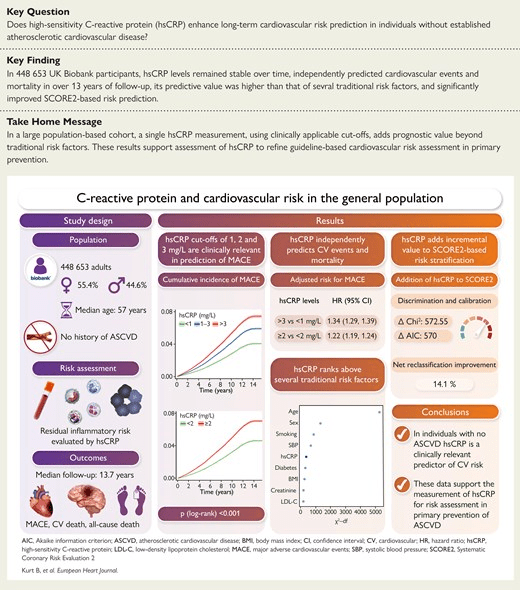
A landmark study published in the European Heart Journal (2025) analyzed 448,653 adults with no prior history of heart disease, following them for over 13 years. The researchers categorized hsCRP levels into three risk tiers:
Low Risk: $< 1$ mg/L
Moderate Risk: $1 – 3$ mg/L
High Risk: $> 3$ mg/L
The results were a wake-up call. Compared to those in the “Low Risk” group, individuals with hsCRP $> 3$ mg/L saw:
34% increase in major cardiovascular events.
61% increase in cardiovascular death.
54% increase in all-cause mortality.
In short, a high hsCRP isn’t just “slightly elevated”—it correlates with a more than 50% increase in the risk of death.
The Key Takeaway: While cholesterol tells us how much “oil” is in the system, hsCRP tells us if the “engine is overheating.” Studies suggest hsCRP can be 2 to 3 times more predictive of future heart events than LDL cholesterol alone.
High inflammation is rarely a single-issue problem. It is usually a “molecular shift” involving several systems:
Oxidative Stress: The body’s cleanup crew can’t keep up with metabolic waste.
Fatty Acid Imbalance: Diets high in pro-inflammatory oils.
Chronic Stress: Elevated stress hormones dysregulate the autonomic nervous system.
Gut Health: A compromised gut barrier keeps the immune system in a state of constant irritation.
Your body knows when this is happening. You might feel chronically tired, have fluctuating moods, sensitive digestion, or notice that you take longer to recover after exercise. These aren’t random symptoms; they are the signals of a system under inflammatory load.
How to “Cool Down” the Inflammation
The goal isn’t to “fix” the number with a pill, but to shift the body’s internal environment:
Prioritize Circadian Health: Consistent sleep schedules allow stress hormones to drop, giving the immune system a chance to reset.
Intermittent Gut Rest: Avoid constant grazing. Reducing the frequency of food intake (and cutting out ultra-processed sugars) lowers the daily “immune burden” on your gut.
Mitochondrial Recovery: Instead of high-intensity “grind” workouts, focus on low-to-moderate intensity movement that your body can actually recover from.
Anti-Inflammatory Nutrition: Shift your fat intake toward Omega-3s and antioxidant-rich whole foods to change the molecular structure of your cells.
Here are some Top Anti-Inflammatory Food Groups:
Fruits: Berries (blueberries, strawberries), cherries, citrus fruits, and oranges.
Vegetables: Dark leafy greens (kale, spinach, Swiss chard), broccoli, cabbage, and peppers.
Healthy Fats & Oils: Extra virgin olive oil, avocado, and nuts like walnuts and almonds.
Fatty Fish: Salmon, mackerel, sardines, and anchovies, which are high in omega-3 fatty acids.
Spices & Herbs: Turmeric, ginger, garlic, and cinnamon.
Whole Grains: Oats, quinoa, brown rice, and buckwheat.
Legumes & Seeds: Lentils, black beans, chia seeds, and flaxseed.
Other: Green tea, dark chocolate, and fermented foods like kefir or sauerkraut.
Heart disease isn’t a sudden accident; it’s the result of molecular systems moving in the wrong direction for years.
The beauty of the hsCRP marker is that it allows us to see the “hidden fire” before the building burns down. It gives us the power to change direction while the damage is still reversible.
Understanding your “internal weather” is the first step toward a longer, healthier life. If you found this helpful, feel free to share it with someone who only looks at their cholesterol!
Since the time of Shakyamuni Buddha, it has been a long-established tradition in Buddhism for disciples to make offerings to their masters or teachers from whom they receive the Dharma. This practice is clearly stipulated in Buddhist teachings and has been followed for over two thousand years across cultures and countries. Making offerings is regarded as both an expression of gratitude and a means of cultivating merit.
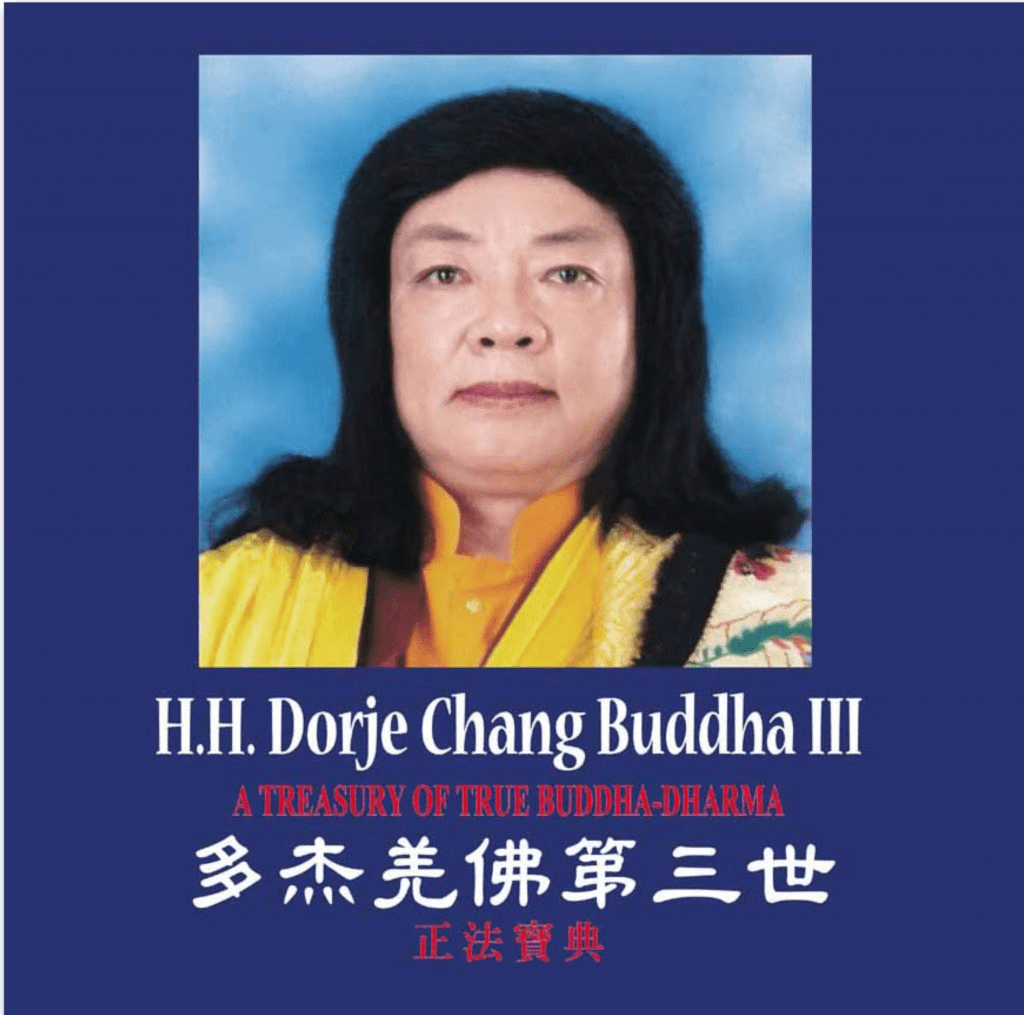
Yet, in striking contrast to this universal custom, H.H. Dorje Chang Buddha III made an extraordinary vow very early in His life: to never accept any offering from anyone.
Rather than receiving support, He has chosen to give unconditionally. Rather than being served, He serves others. H.H. Dorje Chang Buddha III has repeatedly said with humility, “I am a servant of living beings.”
This is not a symbolic statement—it is a lifelong practice.
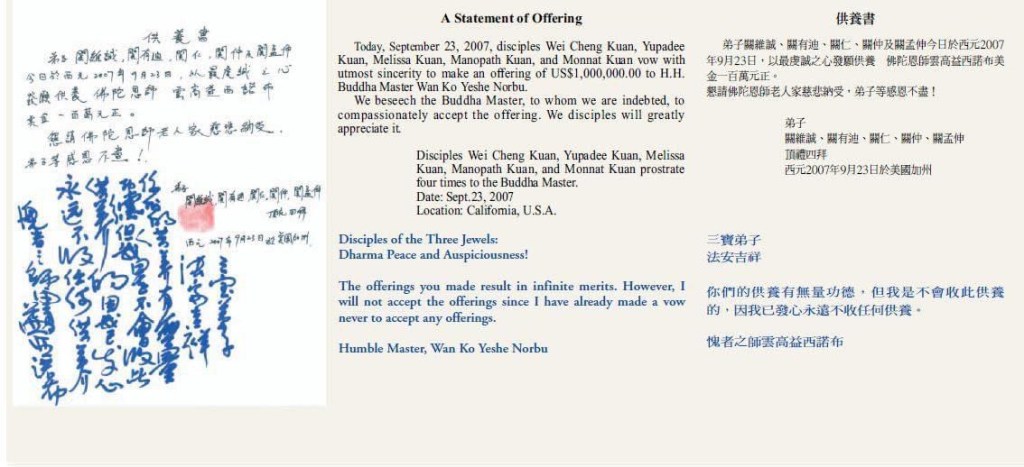
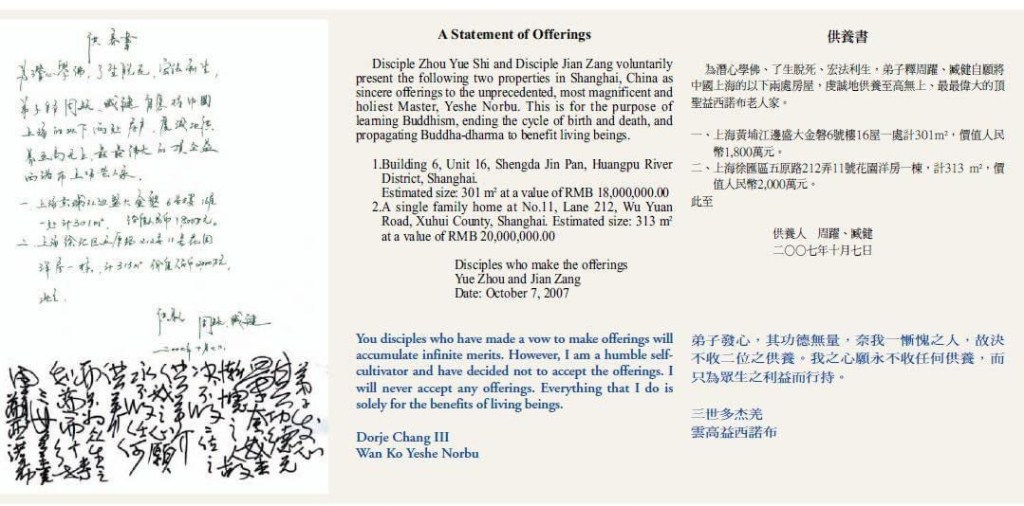
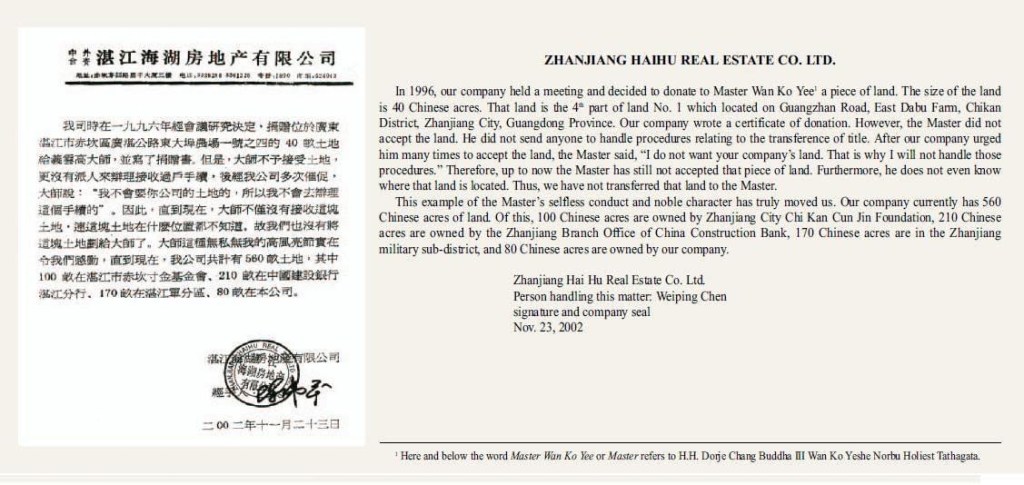
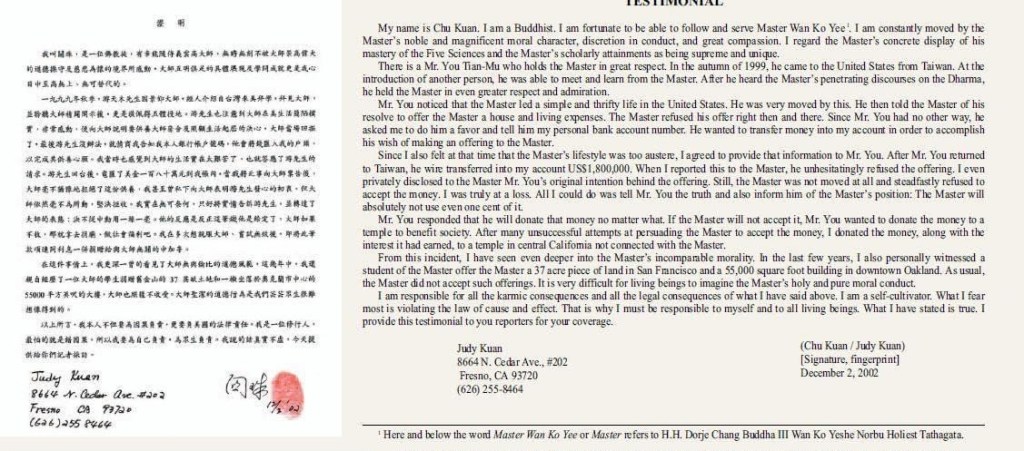
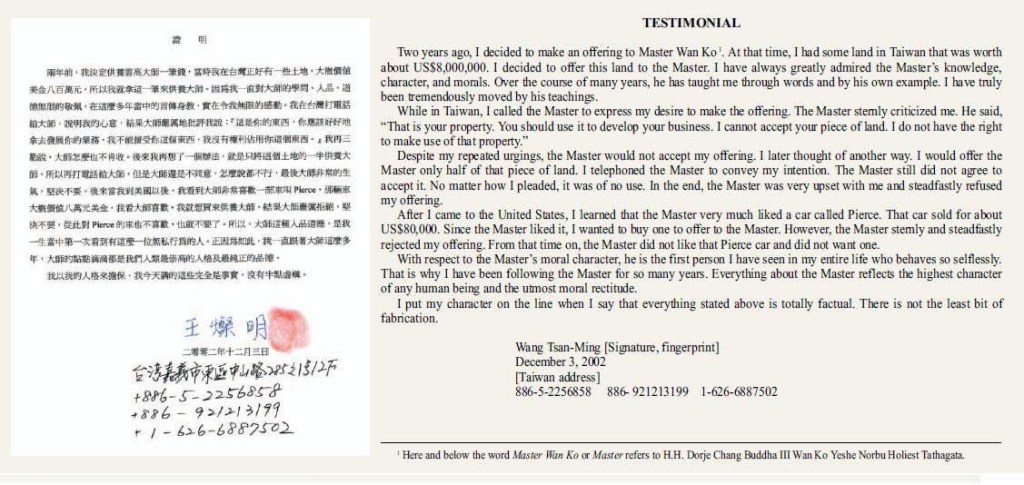
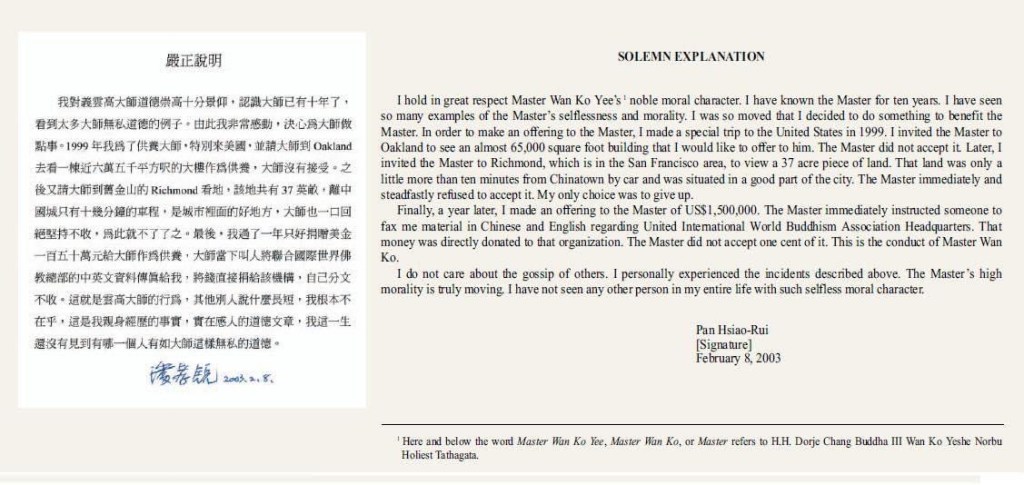
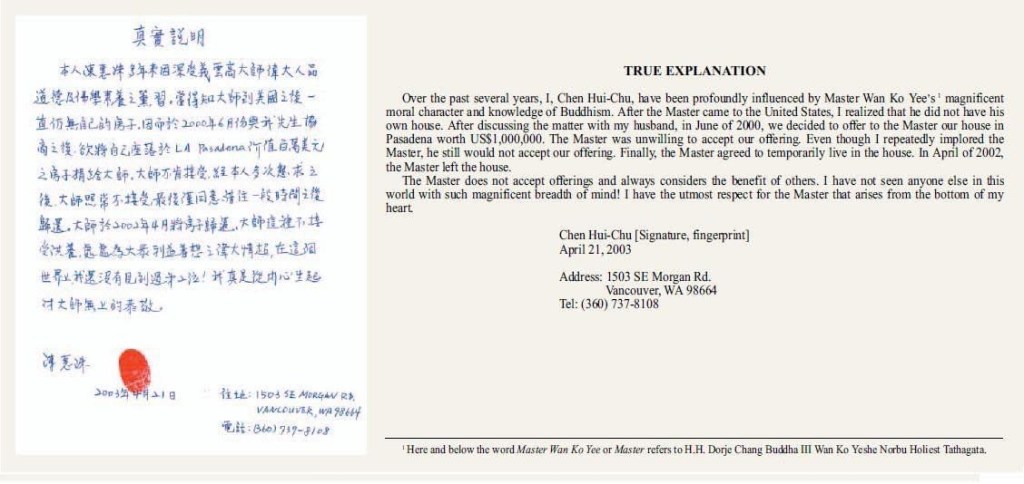
Throughout His life in China, and from the time He first settled in the United States to the present day, countless Buddhist disciples have sincerely attempted to make offerings to Him. These were not small gestures. Some offerings reached millions, even tens of millions of U.S. dollars, given voluntarily and without condition. Yet without exception, H.H. Dorje Chang Buddha III has steadfastly refused every offering, remaining absolutely faithful to His vow.
Many disciples, deeply moved by this experience, have written open and notarized testimonials describing how their offerings were respectfully but firmly declined. These accounts stand as living evidence of a level of integrity that is rare in any age.
In early 2018, at the Holy Miracles Temple, Ms. Judy Kuan—whose Dharma name is Dunzhu—solemnly made a public vow before Shakyamuni Buddha and Skanda Bodhisattva. Standing in the Grand Hall, she revealed a truth she had kept private for many years: her personal experience witnessing H.H. Dorje Chang Buddha III’s absolute refusal to accept offerings, regardless of their magnitude.
This invites us to pause and reflect. Imagine being faced with vast wealth—gold, land, and enormous sums of money—freely offered, unconditionally given, without demand or obligation. Could any ordinary person truly reject it all? Not a portion. Not even a single cent. And do so consistently, over decades, without wavering?
Could we remain completely untainted?
For many decades, H.H. Dorje Chang Buddha III has lived exactly in this way—helping others entirely on a voluntary basis, never seeking reward, recognition, or material gain. From early morning until late into the night—often two or three o’clock in the morning—He continues to work tirelessly to resolve the suffering of living beings, to address Dharma matters, and to guide others on the path of righteousness and compassion.
This is not occasional generosity. It is unceasing selflessness.
In a world where spiritual authority is too often entangled with wealth and power, the conduct of H.H. Dorje Chang Buddha III stands as a rare and powerful example. His life demonstrates that true cultivation is not spoken—it is lived. True compassion does not ask for return. And true realization naturally manifests as service to others.
Further supporting this truth, several Buddhist disciples have publicly released notarized letters, now translated into English, testifying that their offerings were refused. These documents exist not to persuade, but to allow people to see for themselves.
In the end, the question is not whether we admire such selflessness—but whether we allow it to awaken something within our own hearts.
For those who reflect deeply, the life of H.H. Dorje Chang Buddha III offers a quiet yet profound reminder: the highest virtue is to give without taking, to serve without asking, and to live entirely for the benefit of others.
Click here to Wikitia page on H.H. Dorje Chang Buddha III that list major accomplishments and teachings with links.
Click here for recognitions from Dharma Kings and Rinpoches
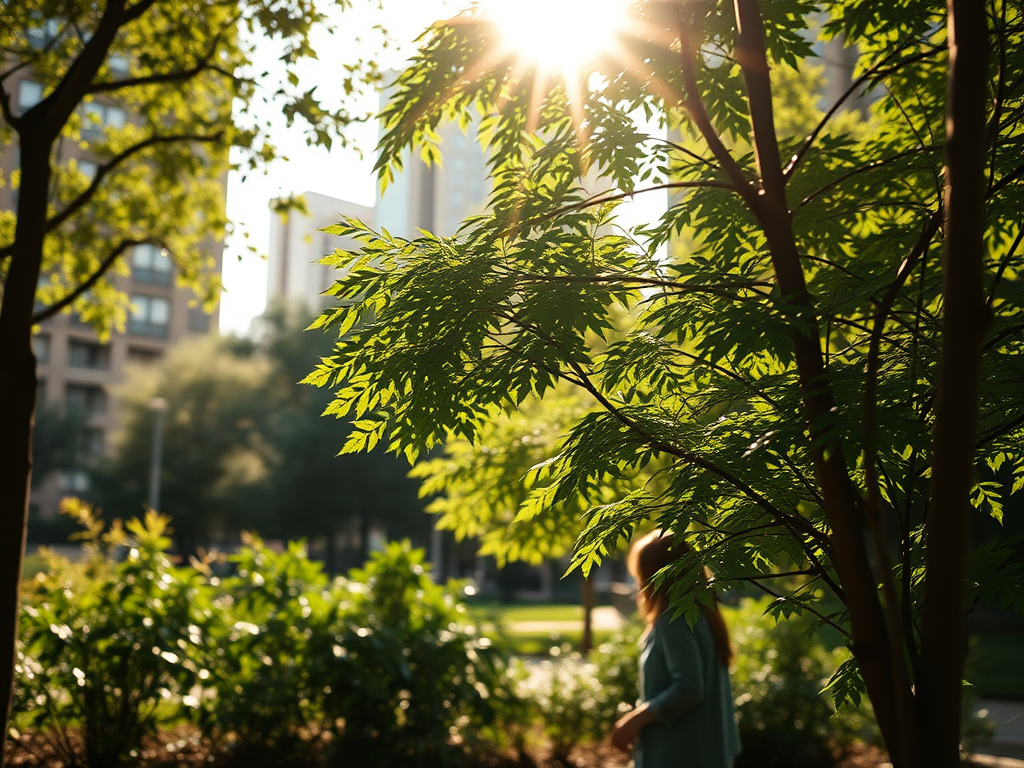
Creating Your Own “Micro Forest Bathing” in the City
Not everyone lives in a place like Santa Cruz, surrounded by forests and winding mountain trails. Most of us live in cities—enclosed by traffic, fast-paced workdays, concrete buildings, and endless schedules. It can feel as though nature is far away, almost out of reach.
But the truth is, we don’t need to escape deep into the mountains to reconnect with nature. Even in the heart of the city, we can create our own “Micro Forest Bathing” moments.
At its core, forest bathing has never been about a specific location. It is about slowing down and reconnecting with nature through all our senses. When we shift our attention, the city reveals many small places where we can breathe again and feel gently held by the natural world.
Here are a few simple and practical ways to experience the healing presence of nature—right where you are.
1. Find a Small Green Oasis
Even the busiest city has pockets of quiet greenery: a neighborhood park, a cluster of trees, a riverside path, a campus corner, or a small community garden.
The place doesn’t need to be grand. A couple of trees, a patch of grass, or a few flowering bushes are enough to soften the heart.
What matters is not the size of the space—but whether you allow yourself to pause.
2. Walk in the Spirit of Forest Bathing
Whether you’re in a city park or walking along a tree-lined street, you can bring the rhythm of forest bathing into your steps:
Slow your pace
Notice the color of the leaves
Feel the temperature of the wind against your face
Watch how sunlight filters through branches and falls on the ground
Listen for birds, even if there are only one or two
Gently touch the bark of a tree
When you do this, the city softens—and your mind grows quiet.
3. Create Your Own “Green Route”
You can weave nature into your daily routine in small, intentional ways:
Choose a street with more trees on your commute
Take a five-minute walk in a nearby park during breaks
Stroll through your neighborhood after dinner and notice changes in plants and seasons
With time, this route becomes your personal path of restoration—a place where your mind learns to rest.
4. Bring a Mini Forest Into Your Home
Even without stepping outside, you can invite nature indoors:
Keep a few easy-to-care-for plants (ferns, ivy, or monstera work beautifully)
Open your windows to let in light, air, and natural sounds
Light a wood-based scent such as sandalwood or cedar
Play gentle forest soundscapes in the background, sip a cup of tea, imagine yourself being embraced by the forest—the steady presence of trees around you, the earthy scent of soil, the calm rhythm of nature moving without urgency. Let your shoulders soften. Let your breath deepen.
Even a small touch of green can soften emotions and calm the nervous system.
5. Practice “Green Meditation”
Sit near a plant or by a window. Do nothing except observe:
The sheen of leaves
The movement of light and shadow
The patterns in stems and veins
Breathe slowly.
Five minutes of this will calm your mind far more deeply than ten minutes of scrolling on your phone.
6. Let Nature Become a Habit
Forest bathing is not something we do once in a while—it is a way of staying connected to life itself. You might:
Take a weekly green walk
Spend three minutes a day looking at the sky
Touch a tree when you feel overwhelmed
Sit quietly in a park when stress builds
Even a few minutes of this mindful pause can soothe the nervous system, quiet the mind, and restore inner balance. Sometimes, the forest we need most is the one we allow ourselves to enter inwardly.
These small acts, repeated gently, become powerful sources of renewal.
Whether you live near a forest, by the ocean, or in the center of a city, nature is always there, patiently waiting—for you to breathe, to slow down, and to be healed.
And when you finally grow still enough, you may discover this quiet truth:
Even within the city, the forest is never truly absent. 🌿
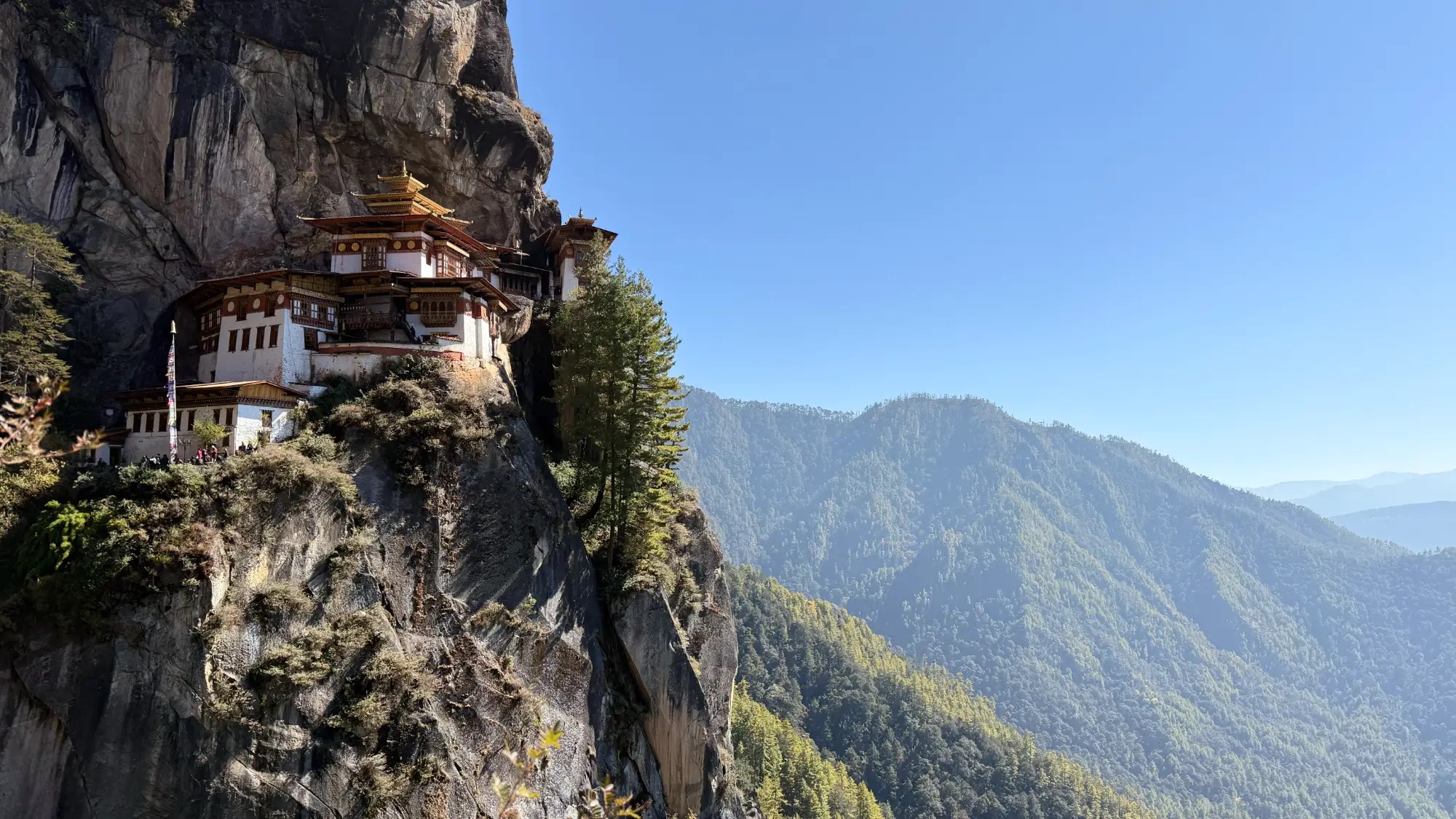
The goal of the ascent in sight: Taktsang Monastery is perched high on the steep cliff face
On a pilgrimage to holy places, one rarely follows a rigid plan. Rather, one engages with a flow of events. Our last days in Bhutan reminded us how valuable it is to let go of expectations. We learned that special doors often open exactly when one is ready to leave the original path.
Change of Plans in Punakha: Trusting the Flow of Things
The sixth day showed us this very clearly. Actually, we had a fixed plan: We wanted to drive from Punakha back to Paro. There, we had donated 3,000 butter lamps which we wanted to light ceremonially in a temple.
But then we received news on short notice that an audience with His Holiness the Je Khenpo, the highest religious head of the country, would be possible. Such an opportunity is a great blessing. However, there was a restriction: Our entire travel group was simply too large for this spontaneous audience.
So we had to split up in Punakha. One part of the group drove directly on to Paro, while the other part drove to Thimphu, where His Holiness the Je Khenpo was staying at the time. I traveled with this group.
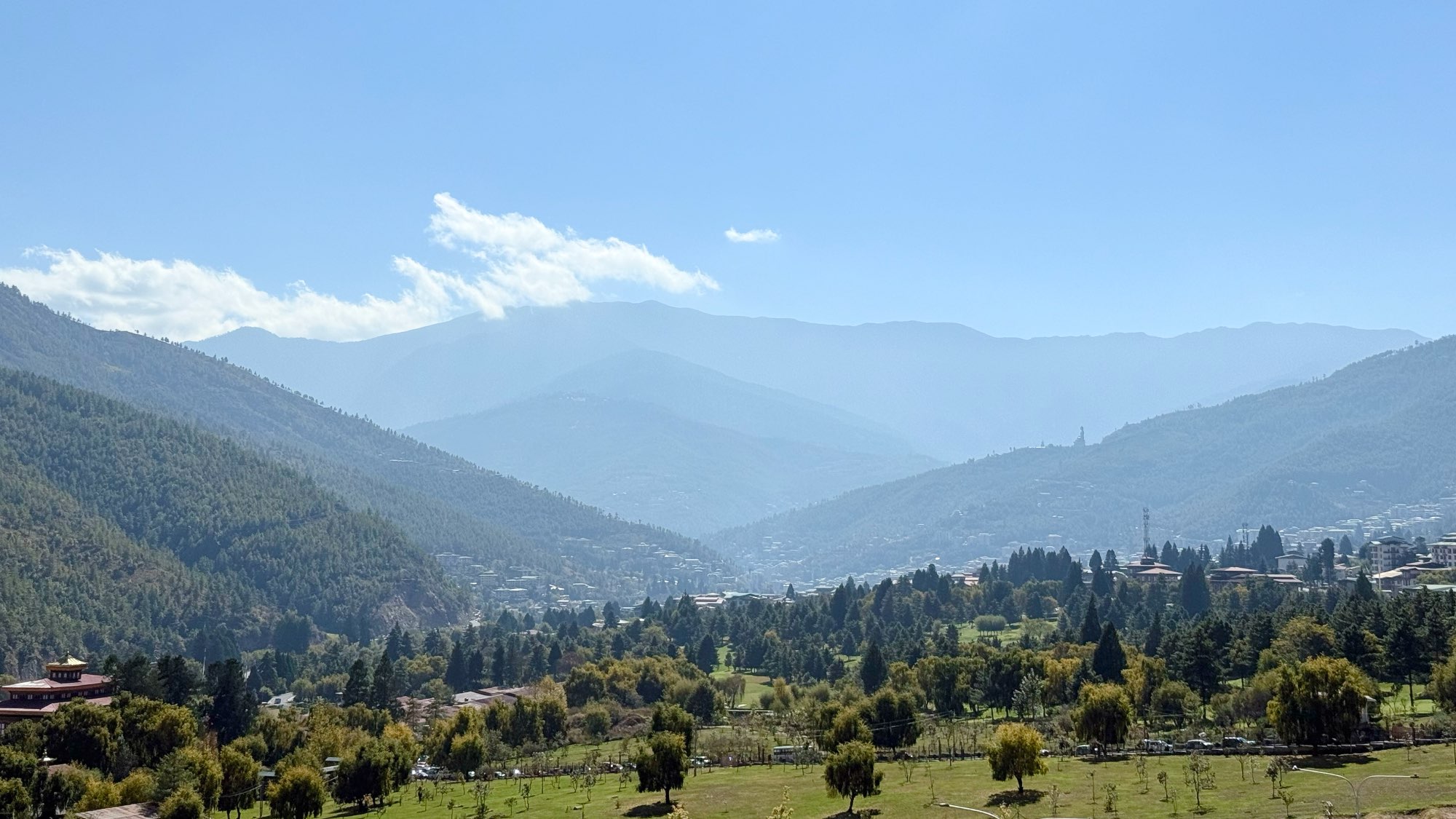
View of Thimphu with the Buddha Dordenma statue in the background
Thangton Dewachen Nunnery: Legacy of the Iron Bridge Monk
Arriving in Thimphu, we still had some time before the appointment. We visited the Thangton Dewachen Duthop Nunnery. It is the only one of its kind in the capital and goes back to the legendary Thangtong Gyalpo. He was a fascinating personality: A great Mahasiddha and at the same time an ingenious engineer who lived in the 15th century. He is famous as the “Iron Bridge Monk,” as he built dozens of suspension bridges made of iron chains throughout the Himalayas to allow pilgrims and travelers to cross raging rivers. Many of his constructions withstood the centuries. We were welcomed very warmly at this place: We were served tea in the courtyard of the monastery, and we could enjoy the peaceful atmosphere for a moment before we had to leave.
Visiting the Thangton Dewachen Duthop Nunnery
Kalachakra Initiation: Encounter with H.H. the Je Khenpo
After lunch, we made our way to the stadium. There, H.H. the Je Khenpo was leading the conclusion of the Kalachakra initiation. The crowds were immense. The stadium itself was packed to capacity, but that was far from enough. Countless people had also gathered on the grounds outside to partake in the event. It was a very impressive image. The ceremony was also being broadcast live on Bhutanese television. We initially had to wait before the gates until we were allowed into the stadium.
After some time, we were able to enter and were led to a separate waiting area inside the stadium. During this time, a chance but wonderful encounter occurred. We met the young Vairochana Rinpoche (Ngawang Jigme Jigten Wangchuk). He is a highly revered Tulku and the son of Her Royal Highness Princess Sonam Dechan Wangchuk. He is revered as the reincarnation of the great translator Vairochana from the 8th century, one of the most important disciples of Guru Padmasambhava.
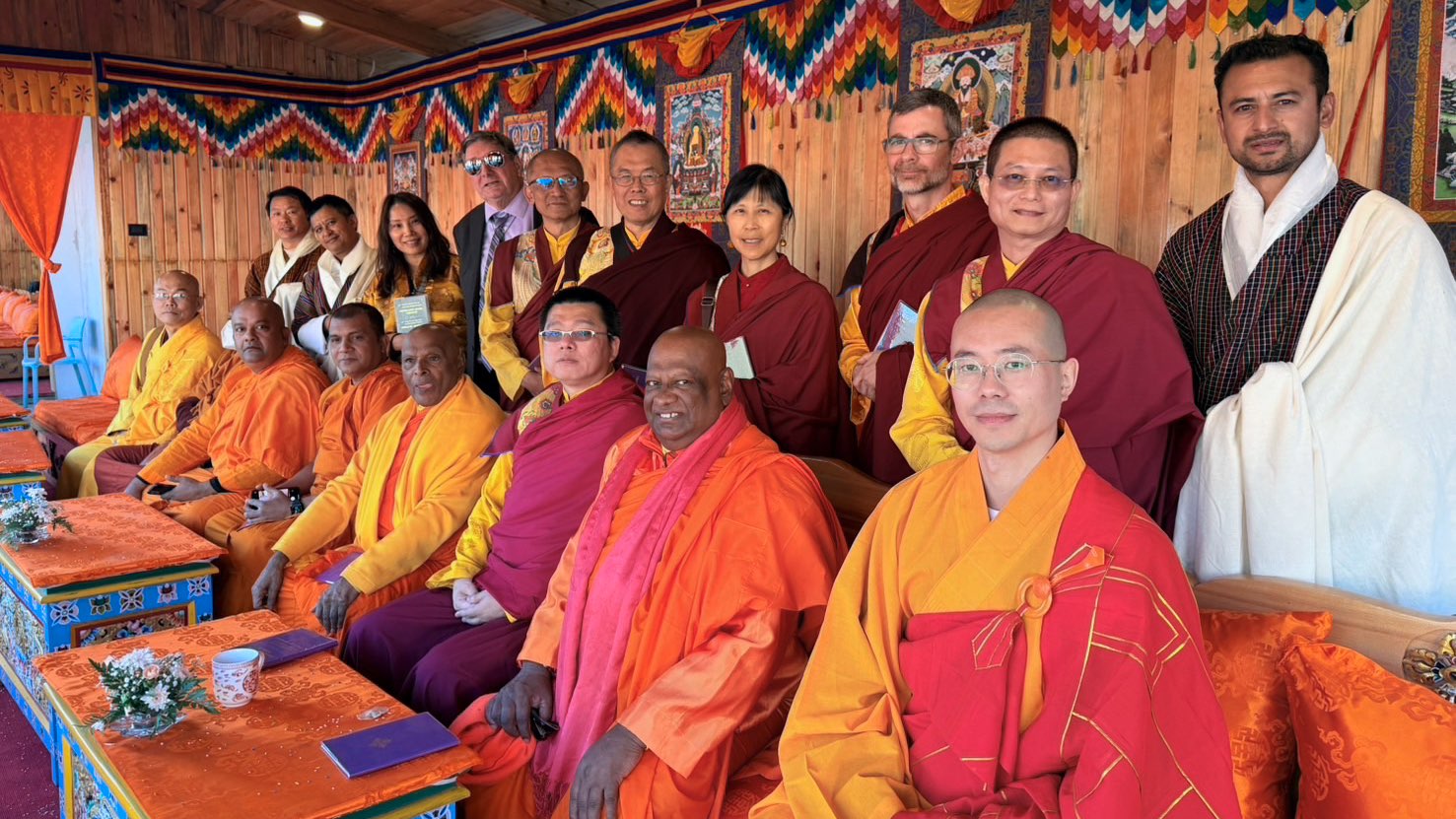
Following this, we were granted an audience with H.H. the Je Khenpo. Filled with gratitude, we presented him with a Khata (white scarf) as a token of our deep respect. In this special setting, we also had the opportunity to present His Holiness with information regarding the ‘Holy Heavenly Lake Buddhist Town’ project. Each of us then received a personal blessing, and upon our departure, he presented us with a text of the Amitabha Sadhana for our own practice.
Our group after the audience with H.H. the Je Khenpo
After the meeting with the Je Khenpo, a further great honor was completely unexpectedly offered to us: Actually, we were supposed to meet the young Vairochana Rinpoche and the Queen Mother for an official audience afterwards. But when the Kalachakra initiation ended, thousands of people streamed out of the stadium at the same time. Traffic in Thimphu came to a complete standstill. There was no getting through, and we could not reach the agreed location in time. Such are the karmic conditions sometimes. But we did not quarrel with fate: After everything we had experienced that day and the blessing we were allowed to receive, we felt richly gifted.
The Tiger’s Nest: Ascent to Guru Rinpoche’s Cave
On the last day of our trip, November 15th, the arguably most famous landmark of Bhutan was on the agenda: Paro Taktsang, widely known as the Tiger’s Nest. It is not only architecturally deeply impressive, but one of the holiest sites in the entire Himalayas.
Paro Taktsang Monastery (Tiger’s Nest)
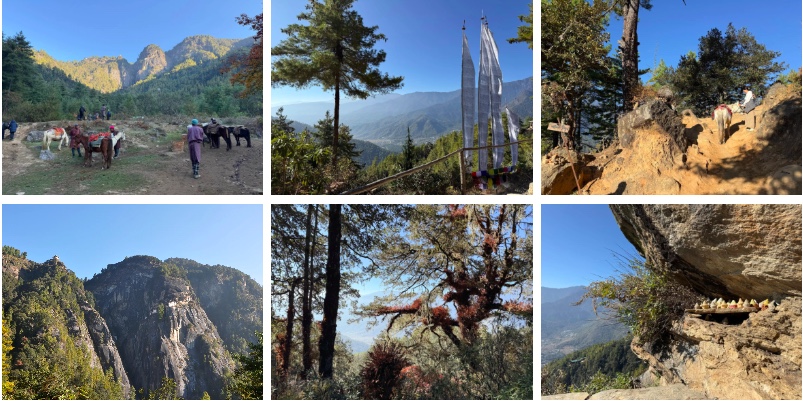
We set off very early to reach the base camp, the parking lot at 2,300 meters. From there, it is about 800 vertical meters up to the monastery, which sits at 3,120 meters. For visitors who do not quite trust themselves with the steep climb, there is generally the option to be carried by a horse or mule for the first part of the route. Our group, however, decided to cover the entire path on foot under our own power.
The ascent took just under three hours. The path is beautiful, but also demanding. It leads through a dense pine forest where rhododendrons grow and the trees are draped with moss. Again and again, prayer flags flutter in the wind. Halfway up, we took a short rest at a café. From there, you already have a first, breathtaking view of the monastery, which literally clings to the steep rock.
Impressions (in order): Resting horses at the starting point, fluttering prayer flags against the mountain backdrop, pack animals on the dusty trail, the first distant view of the cliffside monastery, the moss-covered mountain forest, and Tsa-Tsa offerings in a rock niche.
The history of this place is closely connected to Guru Rinpoche, the great Master Padmasambhava. He is revered by the Bhutanese as the “Second Buddha,” as he brought and firmly established Tantric Buddhism, the Vajrayana, in Bhutan in the 8th century. He manifested his supernatural powers and flew to this very spot on the back of a tigress to subdue a demon. Some say that the tigress was his tantric consort Yeshe Tsogyal in a transformed state. In the cave known as Taktsang Senge Samdup, around which the monastery was later built, he then meditated for exactly three years, three months, three weeks, and three days.
Once at the top, we had to hand in our cameras and bags at the entrance, as photography inside is strictly forbidden. We visited several small temples within the complex. In a special room that is guarded around the clock, I lit a butter lamp. This is the only place in the monastery where open fire is still permitted after a devastating fire destroyed large parts of the complex in the past. In Buddhism, lighting these lamps is a meritorious central ritual.
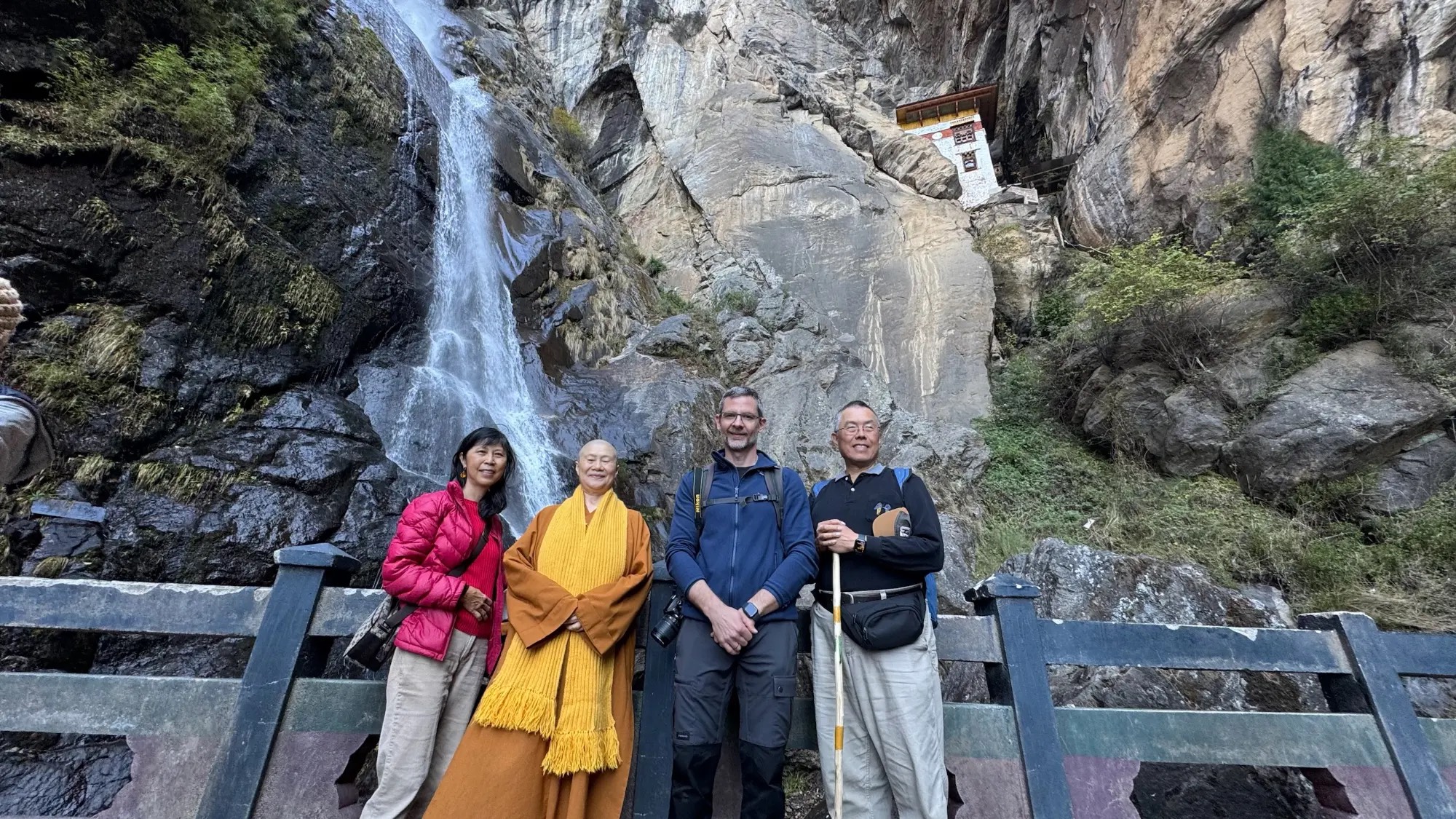
With Venerable Master Shi Zheng Da in front of the Taktsang Waterfall
Farewell in Paro: A Promise to Return
Back at the hotel in Paro, a special guest awaited us in the evening: Dasho Passang Dorji, the former Speaker of the National Assembly of Bhutan. He had been instrumental in organizing the official appointments and came by personally to apologize politely that the meeting with the King had not taken place due to the commotion. He promised us: “Next time I will arrange, this time the King and the Queen have been too busy.”
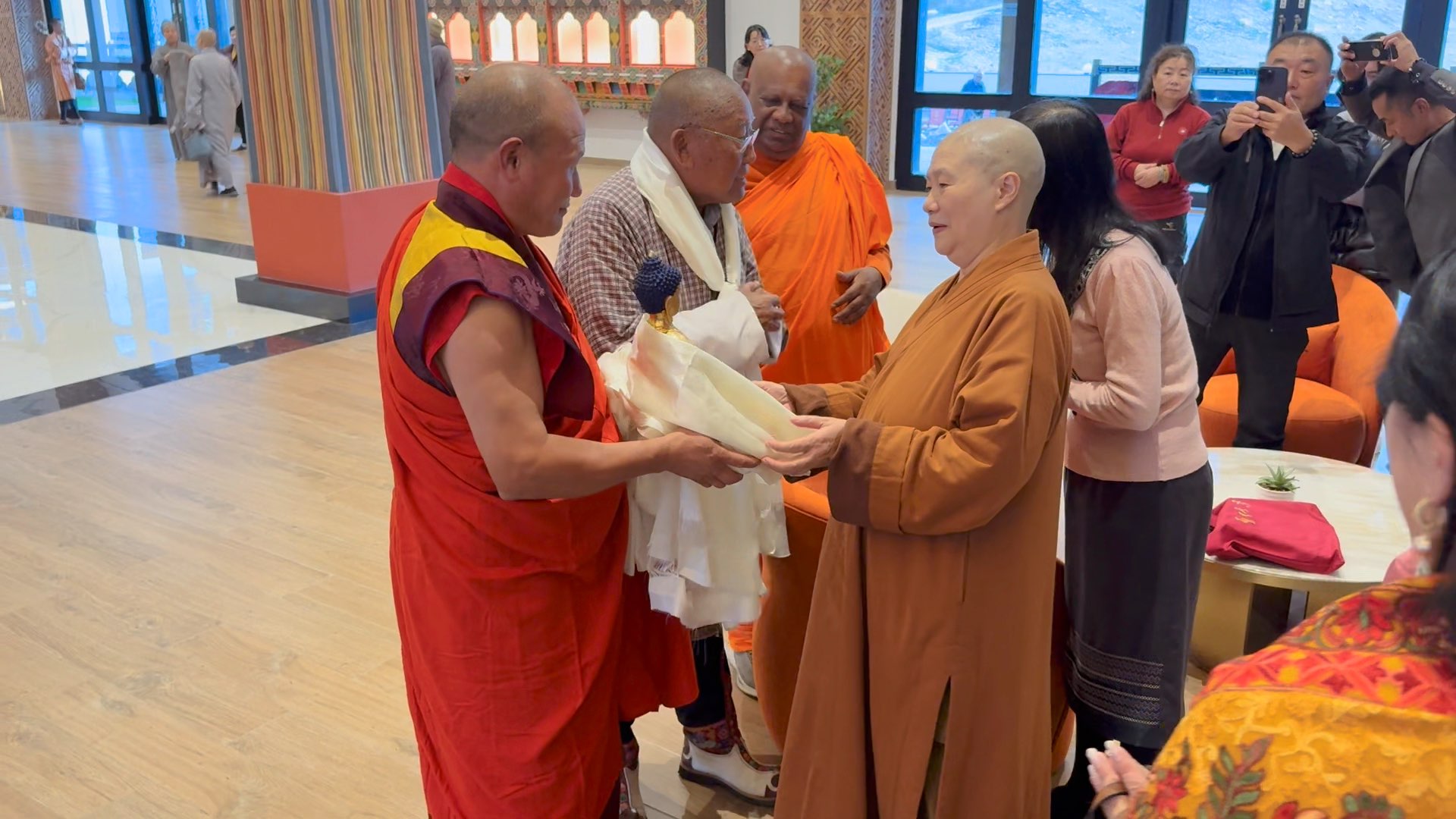
Exchange of gifts with Dasho Passang Dorji
In a very friendly atmosphere, an exchange of gifts took place. The Venerable Master Shi Zheng Da presented him with a special art object, a luminous three-dimensional picture of a Yun sculpture designed by H.H. Dorje Chang Buddha III. In return, he gave the Master a large golden Shakyamuni Buddha statue. It was a worthy moment of connection.
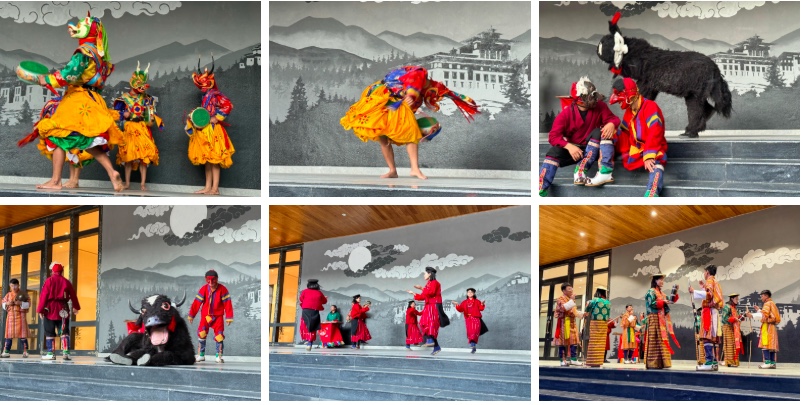
Scenes from the performance (in order): The famous Drametse Ngacham (Dance of the Drums), a solo dancer bowing deep, the performers of the yak scene, the humorous interaction of the yak with the audience, the women’s dance group in red garments, and finally a traditional performance with bows and arrows combining song and dance.
Afterwards, we watched a cultural performance together with Dasho Passang Dorji. There were traditional dances and songs whose gentle, flowing movements radiated great calm and peace. There were also humorous interludes, like the dance of a yak, where the performers visibly had fun. Even though I did not understand the language, the joy was contagious. After this show, we all gathered for a large group photo to capture this beautiful final evening.
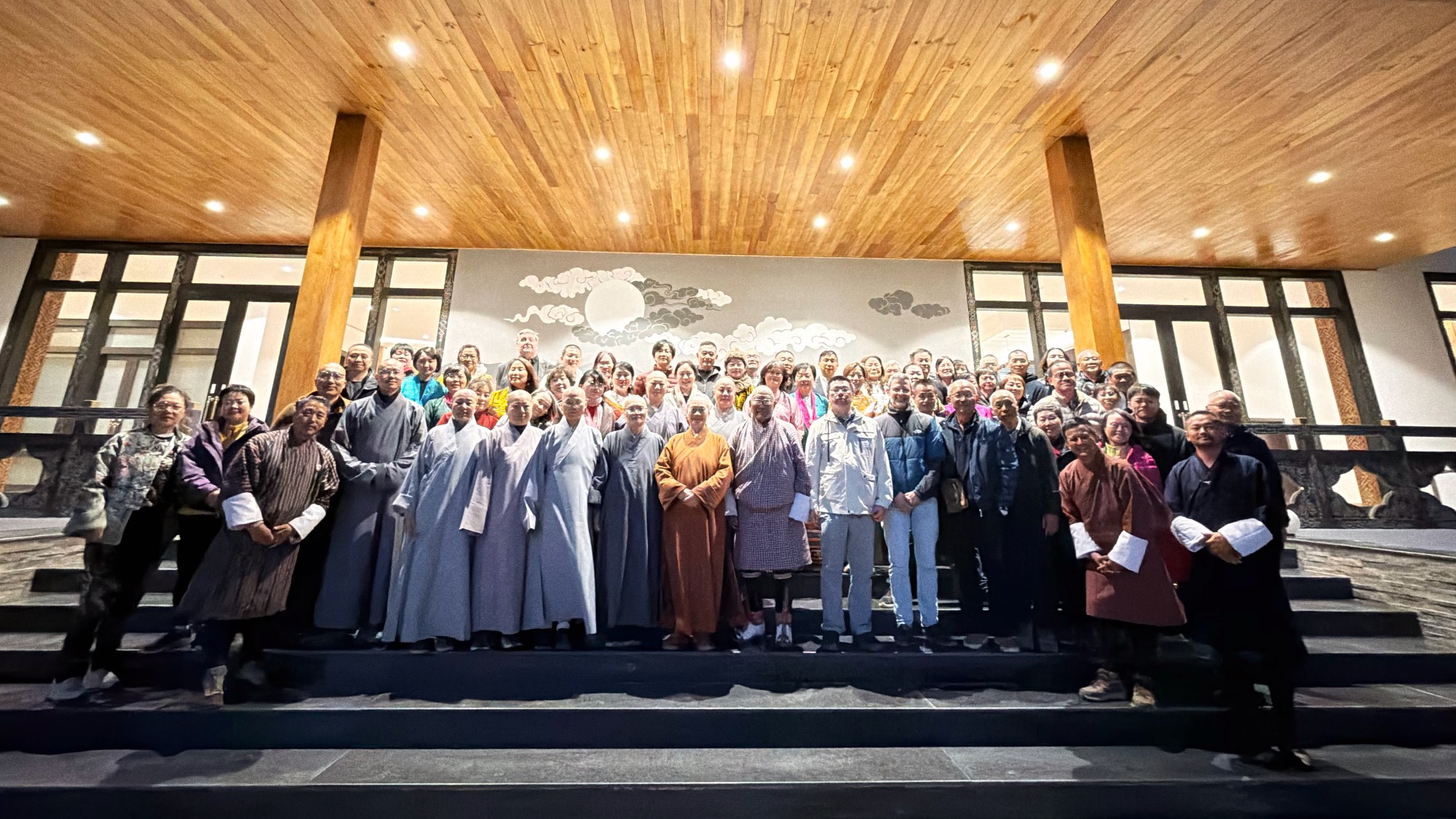
Our entire group with Dasho Passang Dorji and our guides
The next morning, November 16th, it was time to say goodbye. From the hotel, we could look directly at the airport. We had arrived to make a contribution with our donation and our plans. But as I boarded the plane now, I felt that we ourselves were taking away far more than we had given. I took with me not only memories of the mighty mountains and venerable monasteries, but the feeling of a deep connection with our travel group and the people in Bhutan. I return with much inspiration and a heart full of gratitude for the blessing I was allowed to experience in this country.
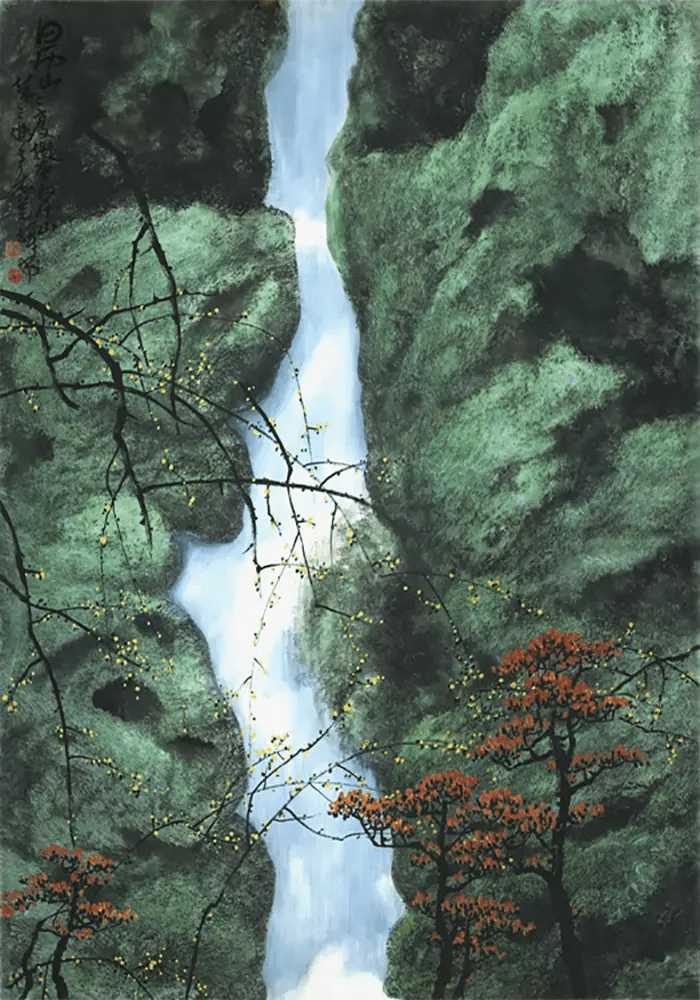
Created in 1993, Xing Garden at Mount Rili stands as a masterful expression of the artist’s profound understanding of nature and brushwork. The painting presents a dramatic world of steep cliffs and cascading water, inviting the viewer into a landscape that feels both monumental and intimate.
Dominated by vibrant greens, the work vividly captures moss and grasses spreading freely across rocky surfaces. These lush tones breathe life into the cliffs, softening their ruggedness while emphasizing the quiet vitality that thrives within seemingly harsh terrain. Nature here is not static; it pulses with energy and renewal.
The painting employs the refined “Miaoxie” (妙写) technique—a style that reveals its true depth through careful observation. At first glance, the composition appears fluid and effortless. Yet upon closer inspection, the brushstrokes intertwine like delicate wires, layered and interwoven with extraordinary precision. These subtle lines create constant movement and variation, generating emotional richness and visual intrigue through their complexity.
One of the most captivating aspects of this work lies in its masterful use of illusory watery ink, where solidity and transparency coexist. Ink seems to flow and dissolve at the same time, offering a boundless sense of depth and atmosphere. Whether viewed from afar or examined up close, the painting reveals a bottomless waterfall, rendered with meticulous detail yet infused with powerful momentum.
What is especially striking is the contrast between refinement and strength. From a distance, the scene appears serene and orderly; yet when the viewer studies the brushwork closely, the strokes reveal unexpected vigor and boldness. Within apparent emptiness, there is substance; within seeming chaos, there is profound order. This balance embodies the highest level of artistic cultivation.
Through free yet disciplined brushwork, the artist transforms a simple natural motif—a waterfall between two cliffs—into a scene of extraordinary aesthetic depth. The power of each stroke carries both physical strength and spiritual presence, allowing the painting to transcend mere representation and enter the realm of lived experience.
Xing Garden at Mount Rili is more than a landscape painting. It is a quiet dialogue between nature and the artist’s inner world, revealing how true mastery lies not in excess, but in the ability to uncover profound beauty within simplicity.
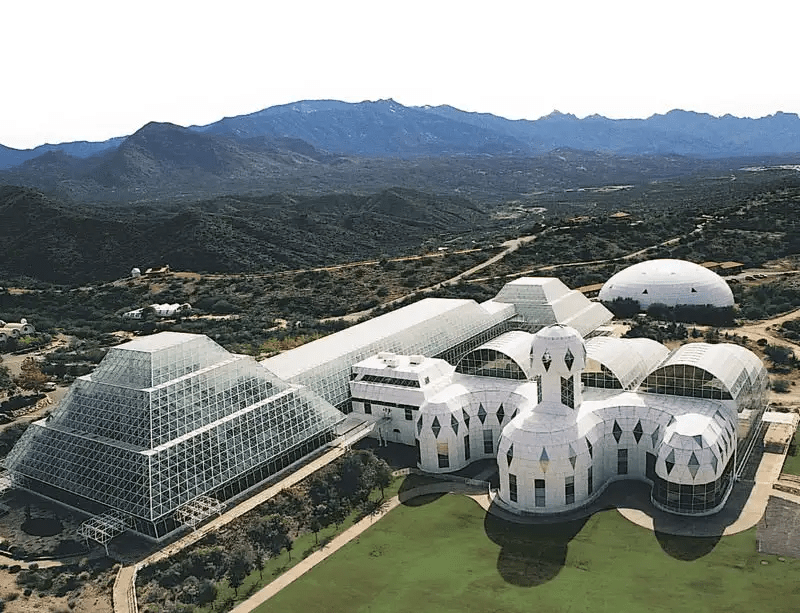
In 1991, deep in the Arizona desert, an unprecedented experiment quietly began—one that captured the imagination of the world and, in time, revealed a powerful lesson about humanity’s relationship with nature.
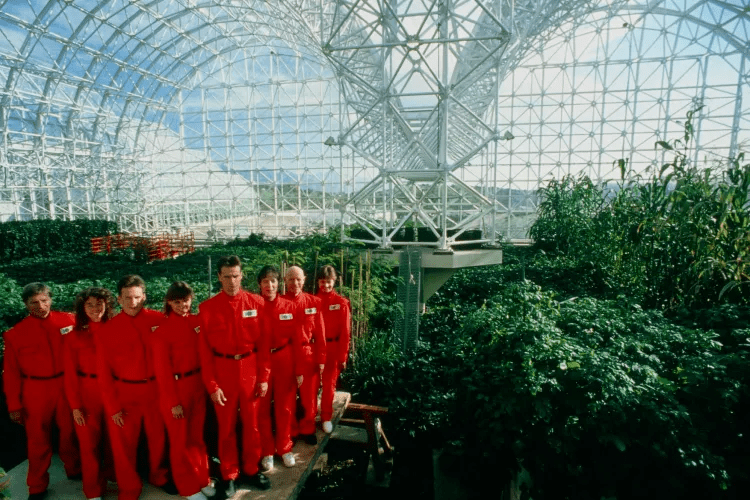
Eight people—four men and four women—were sealed inside a massive glass-and-steel structure known as Biosphere 2. Inside this enclosed world were recreated ecosystems meant to mirror Earth itself: a tropical rainforest, an ocean with coral reef, a desert, savanna, wetlands, farmland, and living quarters. For two full years, the inhabitants were to live completely self-sufficiently, growing their own food, recycling their air and water, and surviving without outside assistance.
The ambition was breathtaking. Biosphere 2 was envisioned as a blueprint for the future—an experiment to test whether humans could survive in closed ecosystems, potentially paving the way for space travel and the colonization of other planets. Behind this vision stood oil tycoon Edward Bass, who invested nearly $200 million into the project. It was, at once, a serious scientific endeavor and a meticulously choreographed public spectacle, drawing intense global attention from scientists, media, and the public alike.
Yet as the months passed, the experiment revealed something far more profound than plans for Mars.
Despite advanced engineering, cutting-edge technology, and idealistic human determination, the biosphere began to falter. Oxygen levels dropped unexpectedly. Crops failed. Certain species flourished too aggressively while others vanished. Tiny imbalances multiplied into serious problems. Even the soil—something often overlooked—absorbed oxygen in ways scientists had not fully anticipated.
What became clear was this: Earth’s ecological system is far more complex, delicate, and interconnected than human intelligence can fully replicate or control.
Biosphere 2 did not fail because of a lack of effort or intelligence. It faltered because nature is not a machine that can be perfectly engineered. It is a living, breathing system shaped by countless relationships that have evolved over billions of years. When humans attempt to dominate or redesign nature without deep humility, unforeseen consequences inevitably arise.
Looking back today, Biosphere 2 feels less like a rehearsal for escaping Earth and more like a gentle warning.
Rather than asking how we can leave this planet, perhaps the deeper question is how we can live more respectfully upon it. The experiment reminds us that technology, no matter how advanced, cannot replace the wisdom embedded in natural laws. Human ambition, when detached from reverence, can easily turn into overconfidence.
We are not masters of Earth—we are tenants.
To live well on this planet requires humility: listening to nature rather than overriding it, cooperating with ecological rhythms rather than forcing outcomes, and recognizing that every action ripples through an intricate web of life. True progress is not measured by how much we can control, but by how well we can coexist.
More than three decades later, Biosphere 2 still stands in the Arizona desert, now used for research and education. Its greatest contribution may not be scientific data alone, but the quiet reminder it offers to humanity:
Respect nature. Honor complexity. Live humbly. And follow the laws of the Earth that has always sustained us.
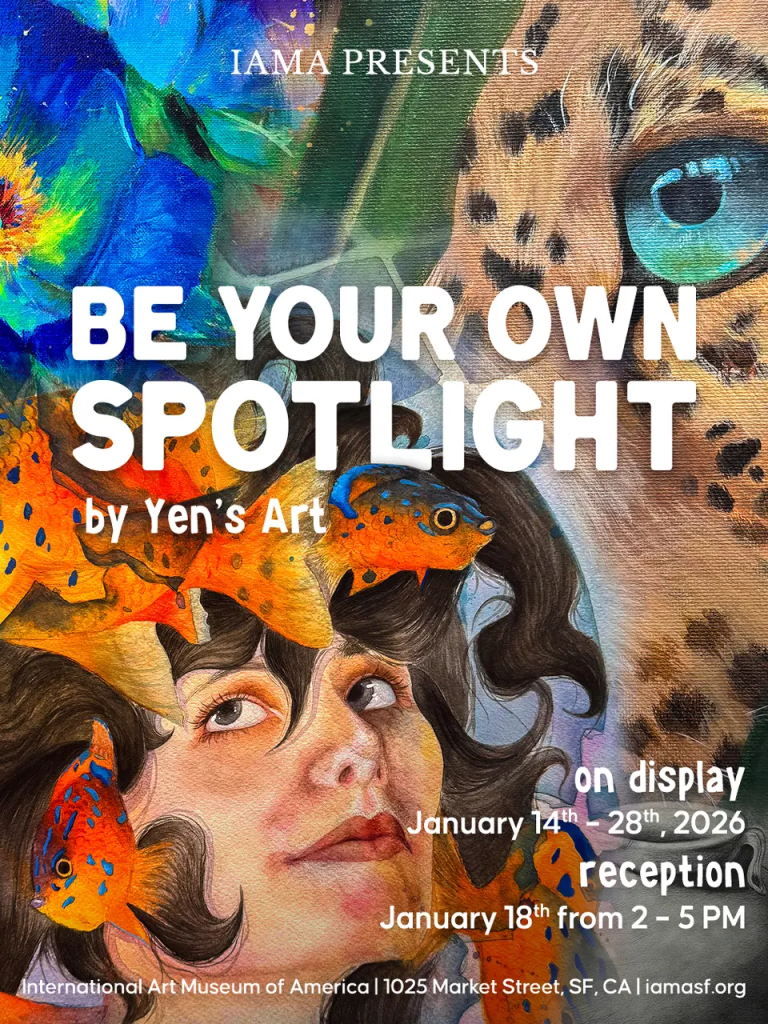
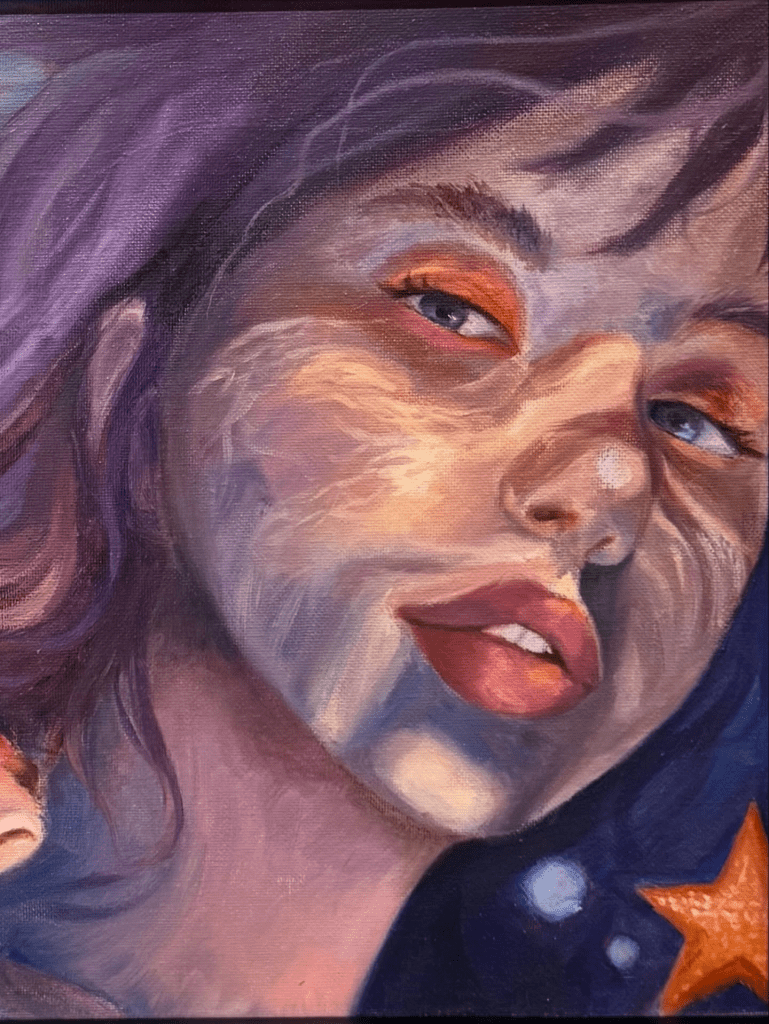
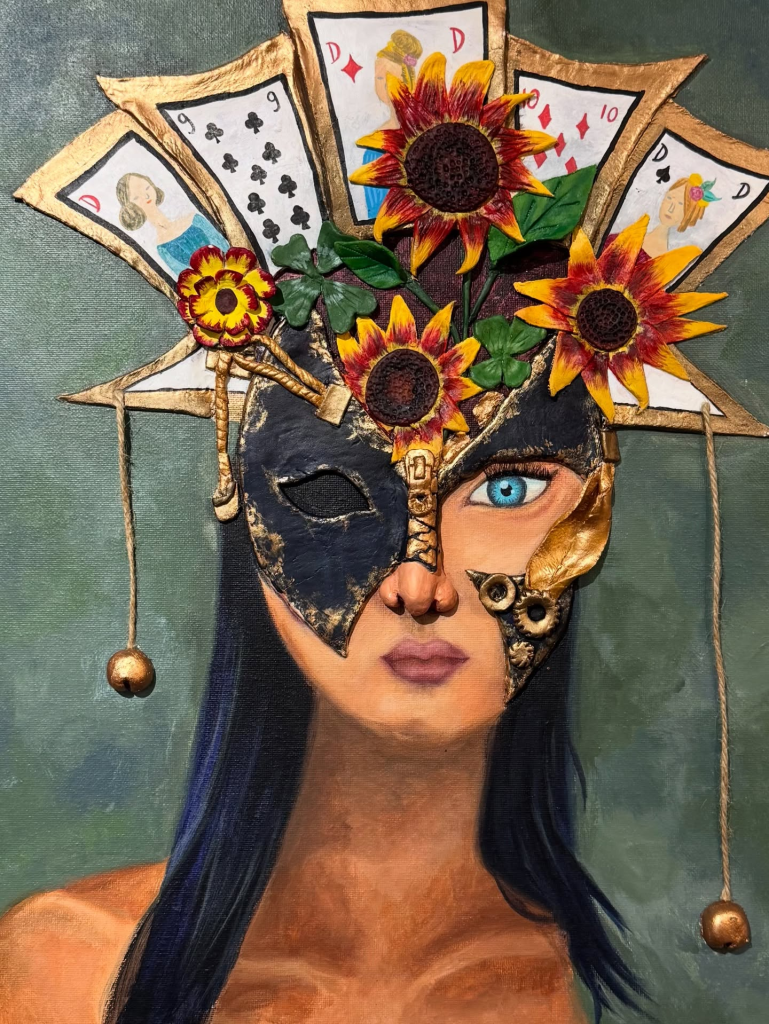
IAMA presents Be Your Own Spotlight by Yen’s Art Studio
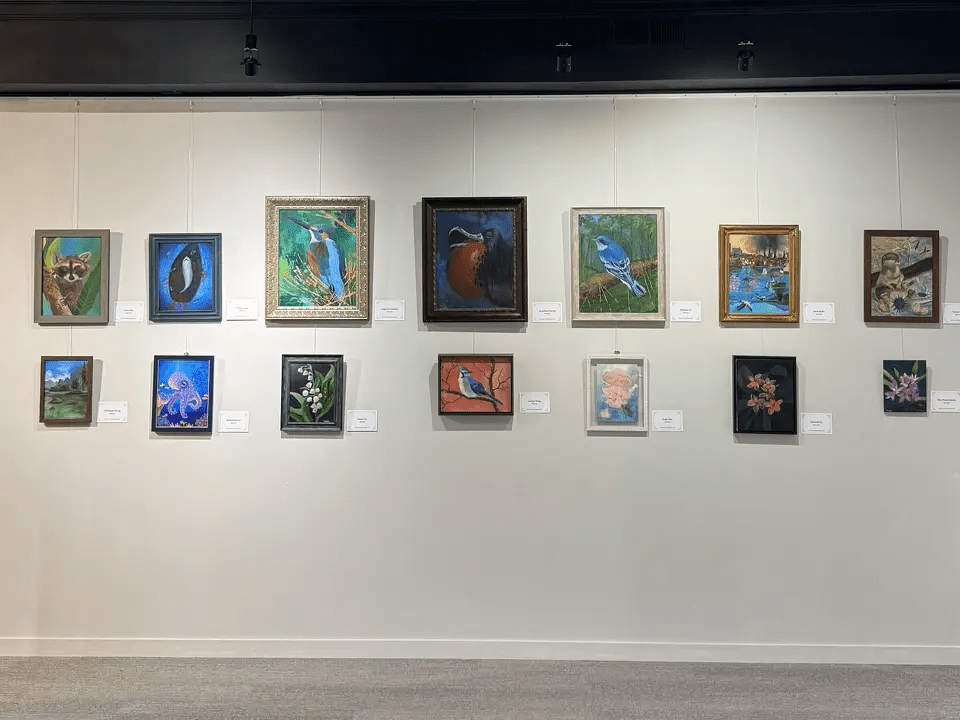
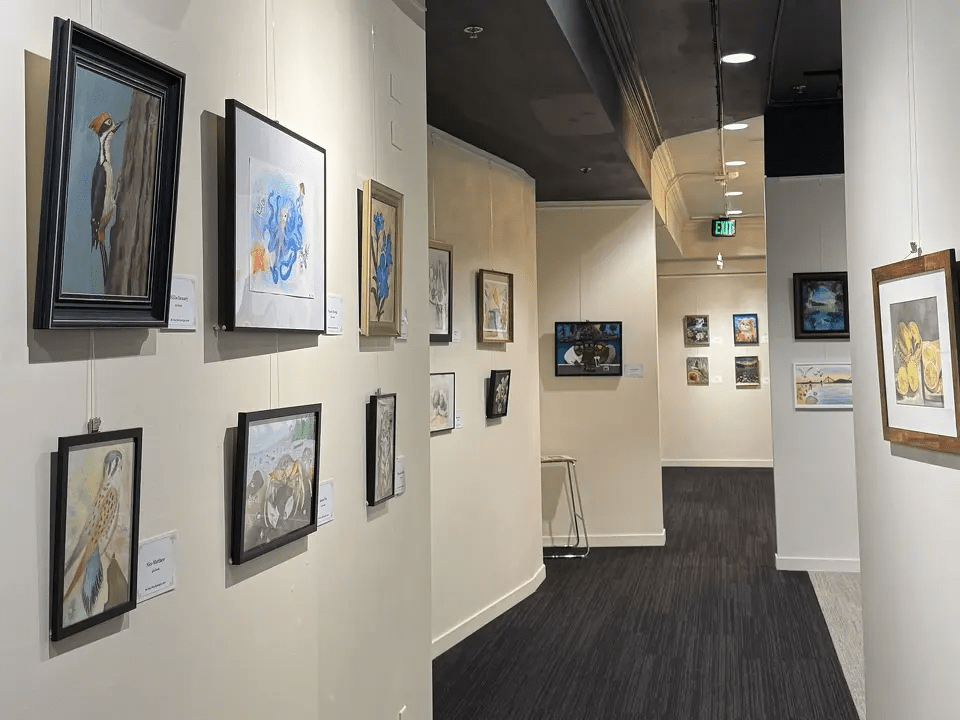
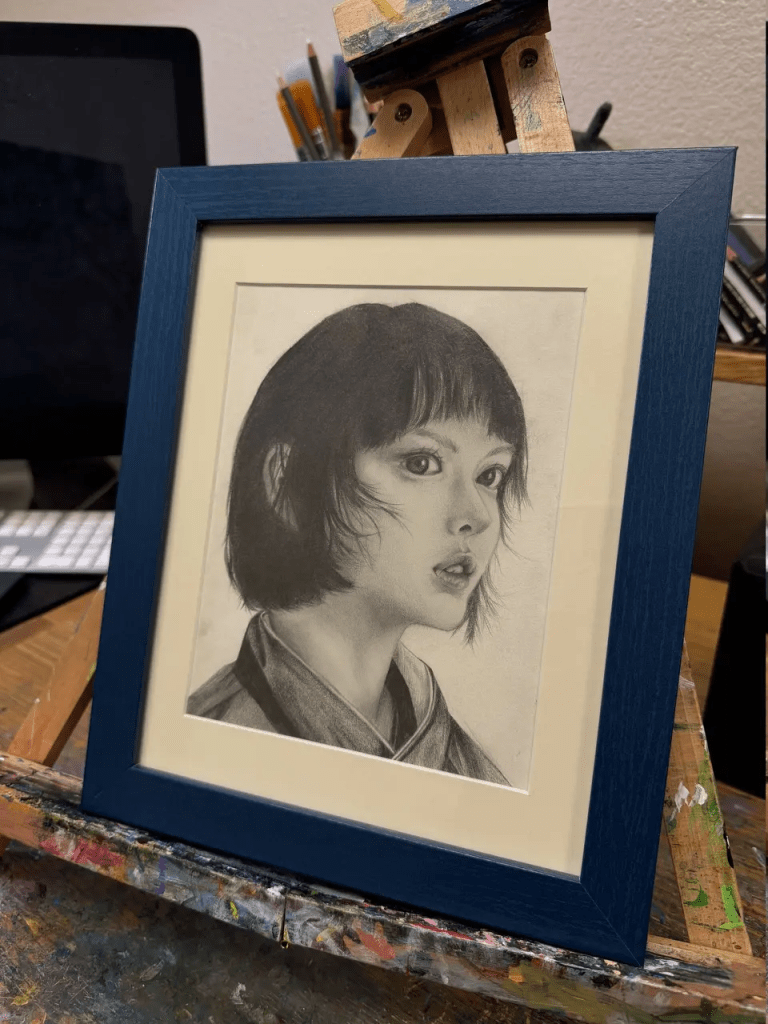
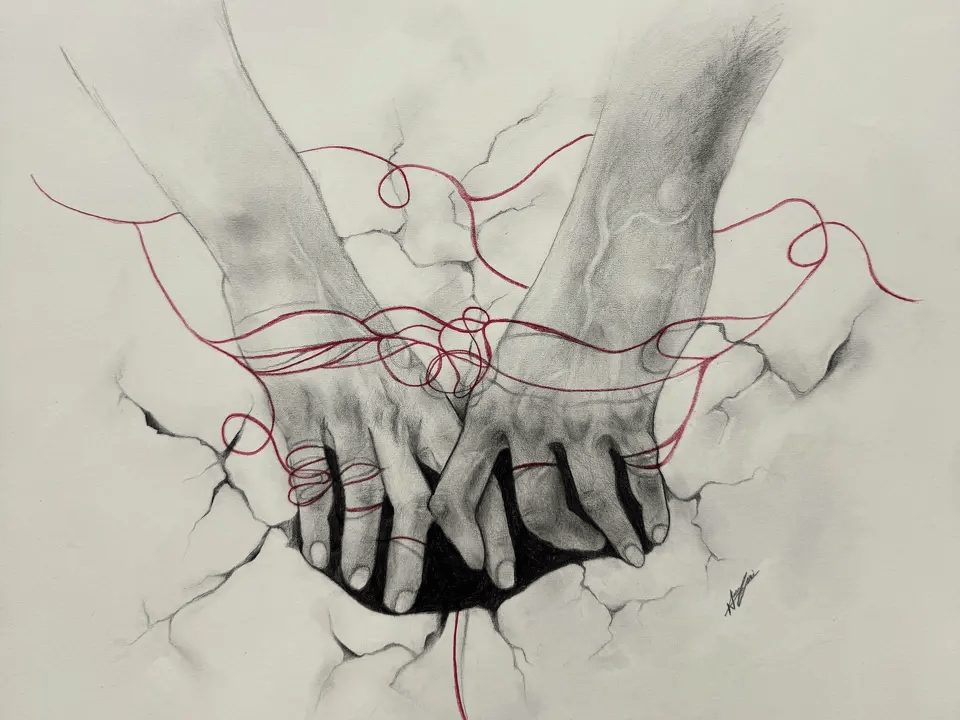
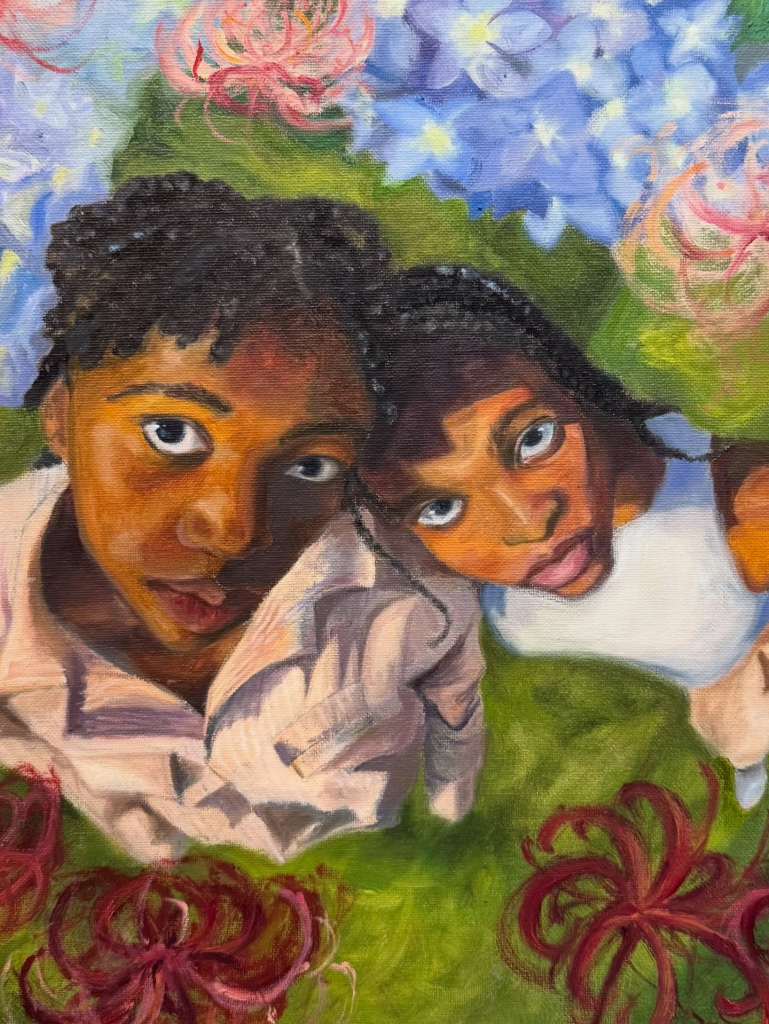
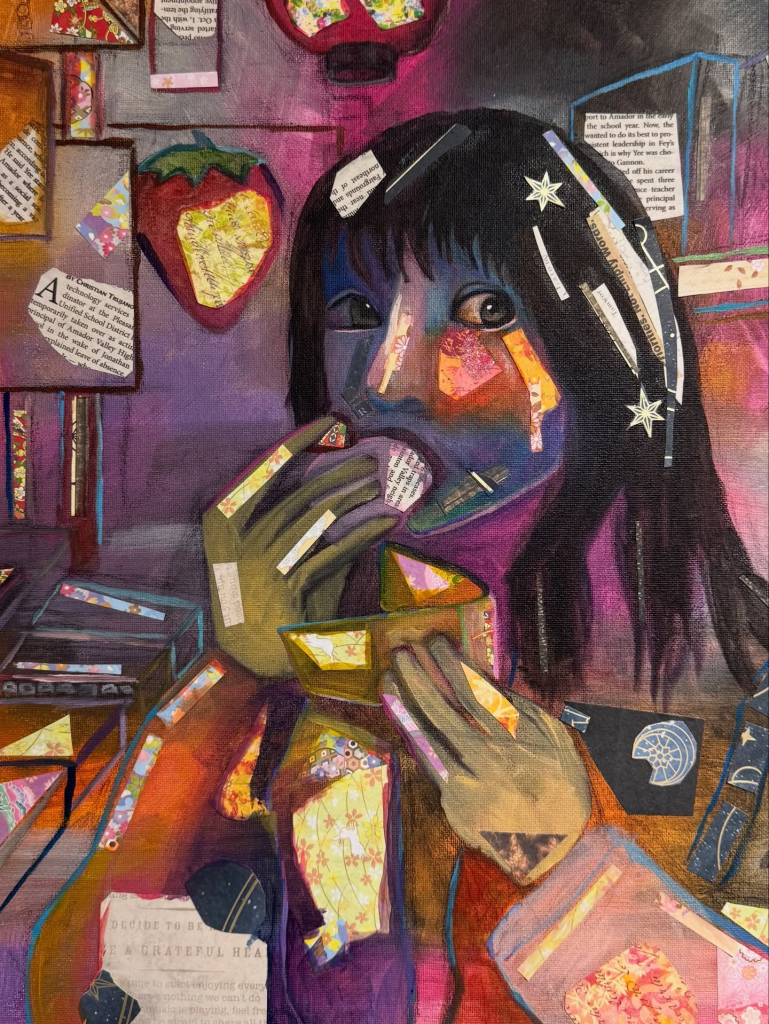
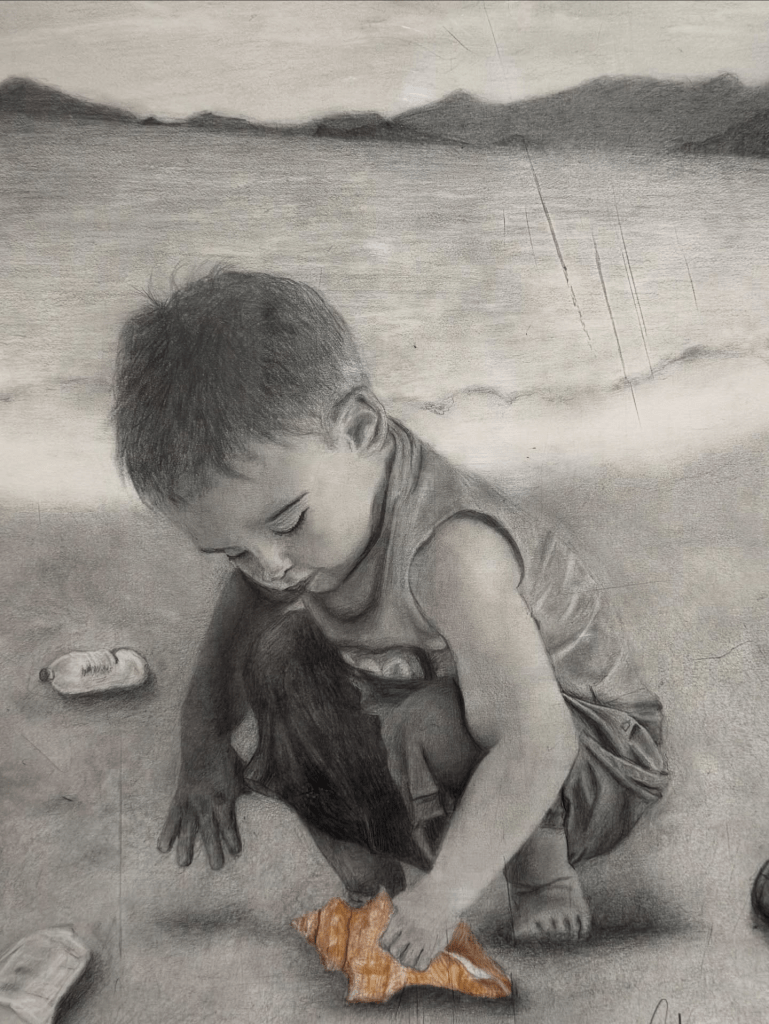
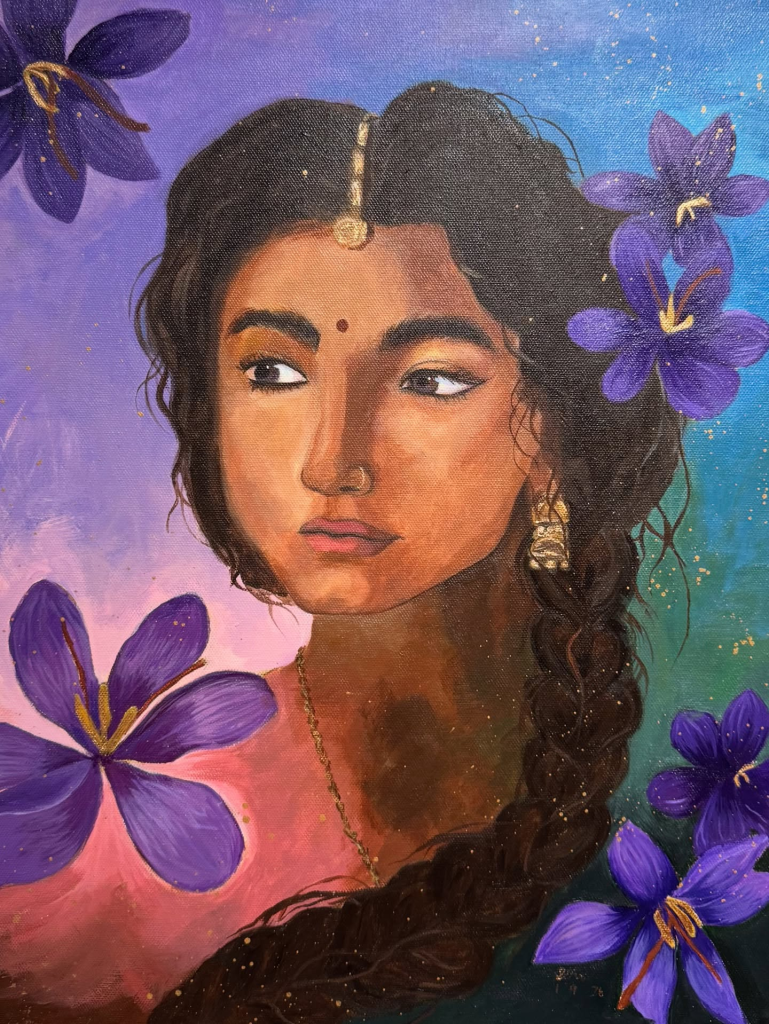
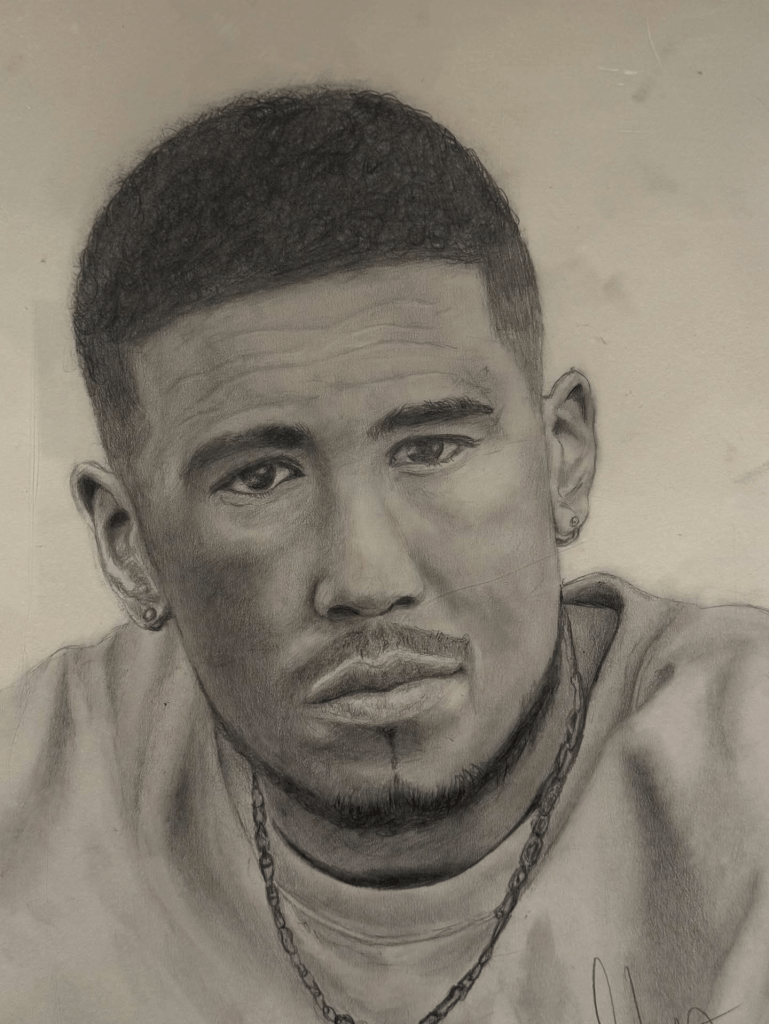
Walking into Be Your Own Spotlight, presented by Yen’s Art Studio, at IAMA (The international Art Museum of America), I didn’t feel like I was entering a typical student art exhibition. Instead, it felt more like stepping into 150 honest conversations—each one visual, brave, and deeply personal.
The exhibition features 150 outstanding works by young students, created across a wide range of mediums—acrylic, watercolor, pencil, and mixed media. But what moved me most was not the variety of techniques; it was the sense that every piece quietly declared: this is who I am right now.
These students are not just learning how to paint or draw. They are learning how to trust their voices, how to take up space, and how to stand behind what they create. Their works reflect growth, self-discovery, and the joy—and sometimes uncertainty—of becoming. Whether you are a parent, an educator, a collector, or simply someone searching for inspiration, this exhibition offers something meaningful to feel, not just something pleasant to see.
As I moved through the gallery, I was delighted by the sheer range of imagination: striking portraits, fantastical worlds, playful animals in sunglasses, thoughtful reflections on global issues, and moments of pure joy. The diversity of themes reminded me of a beautiful truth that Yen’s Art Studio expresses so well: “In the world of art, there are no boundaries of age or race. Children’s artwork can reach—and sometimes surpass—the technical ability and creative understanding typically associated with adults.”
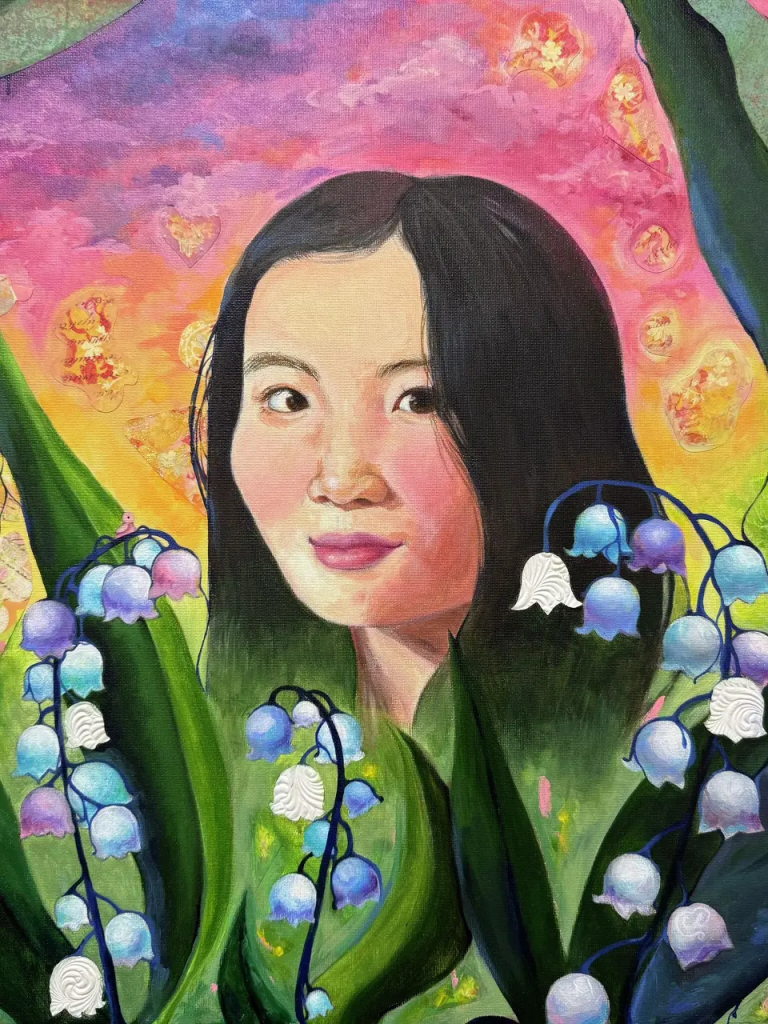
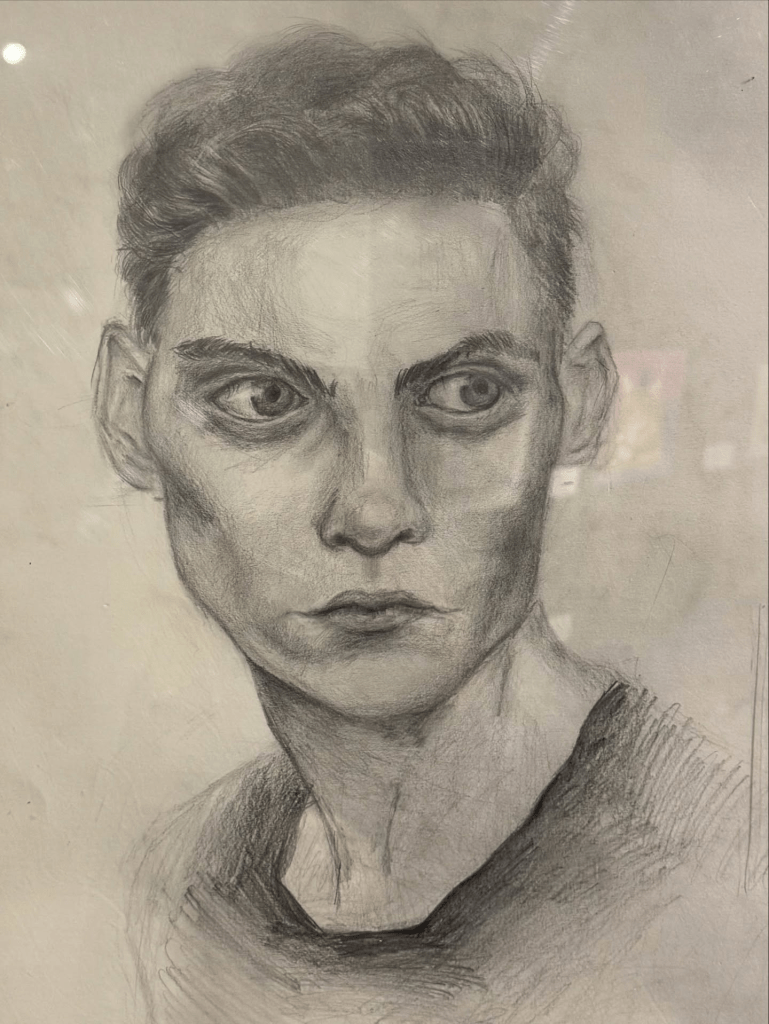
One piece that stayed with me was a self-portrait by 8th-grade student Cynthia Liu. It stood out not only for its technical sensitivity, but for its emotional depth. Cynthia is known for her perfectionist nature, something many of us—artists or not—can relate to. Her work quietly reflects a universal truth: no artwork is ever truly finished. Without a clear endpoint, a piece can be revised endlessly, sometimes at the cost of the original vision.
Self-Portrait by Cynthia Liu, 8th grade Yen’s Art Studio
Hanni from Newjeans by Sophie Sun, 9th grade. Yen’s Art Studio
Another story that deeply touched me was Sophie’s. Once a shy student who nearly gave up on art altogether, she found her way back through the creative process at the studio. Through painting, Sophie rediscovered calmness, confidence, and inner strength—one of the most meaningful transformations I learned about in this exhibition. Her journey reflects the studio’s commitment not only to technical excellence, but to nurturing the inner lives of its students.
Lovers by Nova Cui, 9th grade Yen’s Art Studio
Among the more than 150 works, one painting stood out to me for its quiet presence rather than immediate visual impact. Created by Nova, a student dedicated to becoming a professional ballet dancer, the piece carries a sense of discipline, restraint, and inner resolve. Acknowledging the intensity of her dance training, her art education focused less on technical display and more on observation, sensitivity, and emotional understanding.
Her painting reveals genuine emotion and determination, qualities she will undoubtedly carry into her future as a dancer, where movement and art meet as a shared language of expression.
Be Your Own Spotlight is ultimately not just about showcasing talent. It is about honoring courage—especially the quiet kind. It reminds us that every young artist is learning not only how to create, but how to believe in themselves. And as viewers, we are fortunate to witness these moments of bravery, growth, and becoming.
Don’t miss the museum’s permanent exhibition, where world-class artworks offer far more than visual beauty. Here, art becomes a quiet refuge—inviting tranquility, reflection, and a subtle elevation of the spirit. Especially moving are the paintings by H.H. Dorje Chang Buddha III, whose works gently awaken the mind, soothe the heart, and leave the soul deeply inspired long after you depart.











 Peace LiLy