Remembering Our Belonging to the Earth

Dear friends on this beautiful Earth,

I recently came across these words, and they felt less like something to read—and more like something to remember. In a time when the world often feels filled with urgency and uncertainty, this message gently invites us to pause, to listen, and to reconnect with the quiet heartbeat of our Mother Earth… and with one another.

May we breathe a little more deeply, walk a little more gently, and allow love—simple, steady, and sincere—to guide us back to what truly matters.

I hope these words bring you a moment of peace, reflection, and connection, just as they did for me 🌿

Mother Earth’s Humming

By Yuria Celidwen

Now, She still ripples. She still hums, pulses, quivers. She still sighs, murmurs under the Skies.

We pay attention, and all we hear is urgency. Waters whirl, winds rise, fires rage, irate. The challenges are innumerable, but also infinite are the opportunities. Our grief is daunting, but also heartening is our compassion. We course a cosmic webbing holding awe and horror, wonder and doubt, creation and transition . . . us and all others.

This abysmal relentless weaving is love in all its myriad forms.

We listen whole our Mother Earth’s humming, Her calling, Her heartbeat throbbing, and Her ails. We, as made of soil ourselves, are porous. Enacting love flows—throughout— quenching the cracked soils of hopelessness, helplessness, and isolation.

Breathing in, we return, expanding full gratitude.

Breathing out, we connect, unfolding kindness and care.

It is love who guides grief to meaning, anger to action, despair to transformation, fear to safety. Thus, from love, all injuries heal; they repair, restore . . . and bridges open.

Because our beings—whole—open.

Trust becomes.

Relatives, recall those early steps of unknowing and discovering!

Yes.

Those first steps we walk again right here, right now.

Today, we walk our steps attentive and intentional. Our past brings forth sensible alertness now. Tomorrow is right here— made of us—right now.

Yes.

Bring to heart the time we walked barefoot. When our feet caressed the skin of our Lands, concerned little of thorns and pebbles, seeking first to play and connect.

Relatives, evoke the gentle holding of our Mother Earth, Her caring gaze, and Her smiling.

We smile back because we are indeed listening.

Now, we ripple. We hum, pulse, quiver. We sigh, murmur under the Skies.

Earth floating amidst glowing turbulent waves under a vibrant starry sky with aurora and galaxy

Source: https://www.awakin.org/v2/read/view.php?tid=2623

Link:https://peacelilysite.com/2026/04/12/remembering-our-belonging-to-the-earth/

Where Compassion Lands: The Silent Rescue of a Hive

Two beekeepers in protective suits collecting honey from a large hanging hive at sunset

When a Home Was Lost, Compassion Found a Way—A Quiet Act That Redefined the Value of Every Living Being

There are moments in life when compassion is no longer an idea, but a living force—quiet, unwavering, and profoundly transformative.

This is the story of such a moment.

Shared by lay practitioner Qi Pengzhi(戚鹏直), it recounts an act of extraordinary care by Namo Dorje Chang Buddha III and Namo Yuhua Shouzhi Wang Buddha Mother—an act not directed toward kings or crowds, but toward a fragile colony of bees, hidden on the rooftop of an ordinary home.

It was 2011, a year marked by an unexpected turning point. The house in which they resided had been sold, and the new owner intended to demolish it. Time was short. Departure was inevitable.

And yet, above their heads, life was quietly unfolding.

A vast hive of bees had taken refuge beneath the roof—thousands of tiny lives bound together in delicate harmony. To most, this would have been an inconvenience, perhaps even a nuisance. The simplest solution, as suggested by the landlord, was extermination.

But compassion does not choose the convenient path.

“Under no circumstances should they be harmed,” came the firm and gentle instruction. “Their lives are no different from ours.”

In that moment, the fate of the hive was no longer incidental—it became a responsibility.

What followed was not a symbolic gesture, but a meticulous and determined effort. Beekeeping specialists were consulted. Plans were drawn. A new hive was carefully constructed in advance, shaped not by haste but by respect for the natural rhythms of the bees.

Time pressed on. The day of relocation arrived.

There is a quiet tension in handling something so easily broken. Bees do not understand human urgency; they respond only to the subtle language of instinct and survival. At the heart of their world lies the queen—without her, the colony dissolves into silence.

So every movement mattered.

The disciples stood watch as professionals gently removed the hive from the rooftop. No detail was overlooked. No life dismissed as insignificant. It was a scene both practical and deeply reverent—an unspoken recognition that even the smallest existence carries its own dignity.

Yet the journey did not end with removal.

True compassion does not abandon halfway.

They followed the bees—literally—escorting them to their new home. The destination was a secluded mountainside, where wildflowers stretched across the land and human disturbance faded into absence. It was a place where life could continue as it was meant to: freely, quietly, and whole.

Only after ensuring the bees were safely settled did they return.

What remains is not merely the memory of an act, but the echo of its meaning.

Knight resting against a maiden inside a glowing magical shield protecting them from dark and fiery creatures

In an age where humanity grapples with ecological imbalance, the significance of such care becomes ever more apparent. Bees, as science now repeatedly reminds us, are vital to the continuity of life. Their silent labor sustains ecosystems, nourishes crops, and binds the intricate web of nature together.

To protect them is, in truth, to protect ourselves.

And yet, beyond science, there is a deeper understanding—one that transcends utility.

It is the recognition that life, in all its forms, is not hierarchical but shared.

That the boundary between “us” and “them” is far thinner than we imagine.

That a single act of protection, offered without condition, can restore a fragment of harmony to a fractured world.

Perhaps true compassion is not measured by grand gestures, but by the willingness to pause… to notice… and to protect even that which the world has overlooked.

On a rooftop, in a fleeting moment before demolition, a choice was made.

Not to destroy—but to preserve.

Not to disregard—but to honor.

And in that choice, something far greater than a hive was saved.

This post is translated and edited from Interview with a Buddhist Disciple (64): AM1300 Chinese Radio Station – Exclusive Interview with U.S. Layman Qi Pengzhi 《佛弟子訪談(六十四):AM1300中文廣播電臺-專訪美國 戚朋直居士》 by Linda Chang. For original records, please click here.

Click here to Wikitia page on H.H. Dorje Chang Buddha III that list major accomplishments and teachings with links.

Link:https://peacelilysite.com/2026/04/09/where-compassion-lands-the-silent-rescue-of-a-hive/

A Glimpse Beyond the Ordinary: Faith, Humility, and the Inconceivable

Glowing figure meditating on a floating island surrounded by ethereal spirits and cosmic energy.

The following account is excerpted from a post published by Holy Miracles Temple on April 15, 2022, titled “Recent Talk Records of Venerable Zhai Mang.”

Sometimes, in the course of spiritual practice, there are moments that quietly remind us how limited our ordinary understanding truly is. What we see, hear, and reason through the lens of everyday experience may only be a small fragment of a far greater reality.

Venerable Zhai Mang once shared a personal experience that deeply illustrates this truth.

In January 1996, he accompanied the Buddha and the Holy Mother to Shenzhen. At that time, Brother Li Dehe, the general manager of the Luohu Hotel, arranged a temporary Dharma altar on the 16th floor, where teachings were given and disciples gathered.

One day around noon, it was time to invite the Buddha and the Holy Mother for a meal. Yet, to everyone’s surprise, the Buddha could not be found.

Venerable Zhai Mang went up to the altar to look—no one was there. Another disciple went, and then another. Each time, the result was the same: the room was empty.

Finally, Sister Liu Ge went to check. Unlike the others, she did not leave immediately. She stood quietly by the doorway, facing a large mirror. Behind her was a sealed window, reflected clearly in the glass.

Then, something extraordinary happened.

In the mirror, she suddenly saw a foot appear near the window—seemingly out of nowhere. In the next moment, she witnessed the Buddha step into the room from midair.

Startled beyond words, she cried out.

Everyone rushed over. Inside the altar, the Buddha was already seated calmly, as if nothing unusual had occurred. Sister Liu Ge then recounted what she had just witnessed.

When sharing this story, Venerable Zhai Mang did not focus on the miraculous itself. Instead, he pointed to something far more important.

In simple terms, he reminded us: the realization and abilities of the Buddha and the Holy Mother are beyond the comprehension of ordinary minds. Trying to measure the enlightened with our limited understanding is like trying to contain the vast sky within the palm of a hand.

What, then, should we do?

Not to speculate. Not to doubt blindly.
But to turn inward.

With sincerity, we reflect on ourselves. With humility, we cultivate. With a heart of repentance and reverence, we create the conditions to receive true guidance.

Moments like this are not merely stories of the extraordinary. They are gentle awakenings—reminding us that the path of spiritual practice is not built on curiosity about miracles, but on the transformation of our own hearts.

In a world that often demands proof for everything, perhaps the deeper wisdom lies in recognizing what cannot be fully explained, yet can be quietly felt.

To walk the path is to let go of arrogance, to open the heart, and to trust that there are dimensions of truth far beyond what we can see.

And perhaps, when the mind becomes still and sincere, what once seemed unimaginable may no longer feel so distant.

The Legacy of Venerable Denma Tsemang

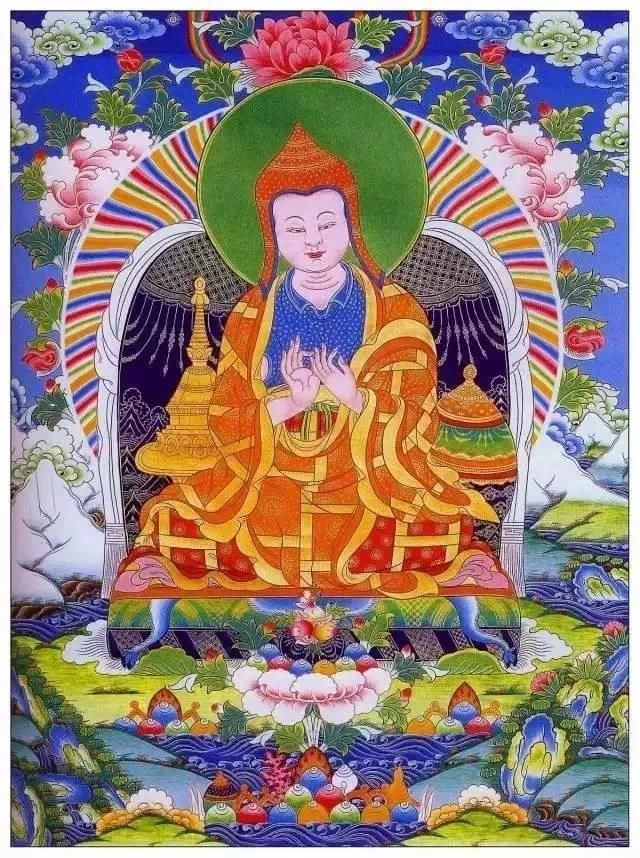
Venerable Denma Tsemang was one of the twenty-five great Dedengbas under Guru Padmasambhava when he journeyed to Tibet over a thousand years ago to spread the Dharma. During that same period, Shakyamuni Buddha dispatched Denma Tsemang to descend into this world to assist Guru Padmasambhava in propagating the Buddha-Dharma.

According to the traditional biographies of Guru Padmasambhava’s twenty-five foremost disciples, Denma Tsemang was highly accomplished in transcription and writing. He possessed extraordinary wisdom and was especially skilled in translation. Under the guidance of the great ācārya Guru Padmasambhava, he received numerous esoteric teachings, including secret mantras and profound Dharma instructions.

He attained remarkable realization, great spiritual powers, abundant merit, and deep wisdom. It is said that he never forgot any teaching he received, retaining everything completely. Many important terma (hidden treasure texts), including the Collection of Eight Sadhana Teachings, were transcribed by him. In addition, Denma Tsemang, together with other great Bodhisattvas, participated in translating the sutras and treatises contained within the Tripitaka.

In this present lifetime, Denma Tsemang has reincarnated as H.E. Longzhi Tanpe Nyima, a devoted disciple of H.H. Dorje Chang Buddha III. He remains by His Holiness’s side throughout the year, serving as an attendant with unwavering dedication.

His strengths in this life closely mirror those of his previous incarnation. He diligently transcribes and organizes the recorded Dharma discourses of H.H. Dorje Chang Buddha III, preserving these teachings for the benefit of future generations.

During a sacred inner tantric initiation known as “Drawing Lots from a Golden Vase and Casting a Lot,” performed personally by H.H. Dorje Chang Buddha III, the lot revealed the mandala of Guhyapada Vajra—a powerful vajra being of immense spiritual strength. Following this, he demonstrated extraordinary ability by telekinetically moving a vajra pill, clearly revealing the level of realization of a true reincarnated great Dedengba.

Yet despite these remarkable signs, H.E. Longzhi Tanpe Nyima humbly said:

“I am just a Buddhist disciple sincerely cultivating myself.”

Link:https://peacelilysite.com/2026/04/03/a-glimpse-beyond-the-ordinary-faith-humility-and-the-inconceivable/

I willingly accept the karmic retribution of cause and effect for everything I have stated

Longzhi Danbei Nima Rinpoche

A Personal Account of Extraordinary Events

The return of H.H. Dorje Chang Buddha III, Yun Gao Yixi Nuo Bu, to this world is widely recognized. His supreme moral virtue and mastery of the Five Vidyas are unparalleled—there is no second holy being who can be compared to Him. This is something well known to many.

As for the extraordinary spiritual states that people often find astonishing, such manifestations occur frequently in His presence. Those of us who have served closely around H.H. Dorje Chang Buddha III have witnessed so much that, over time, we have almost grown accustomed to these sacred phenomena—perhaps even somewhat numb to them.

However, the two events I wish to share here are not significant simply because I personally experienced them. Rather, they are directly connected to the karmic blessings of all sentient beings in this world.

The First Event: A Mysterious Earthquake

The first incident took place on the afternoon of July 30, 1999, at around 4:00 PM.

Due to changing circumstances, H.H. Dorje Chang Buddha III decided to leave China. At that time, the departure could not be made public, so I was the only one accompanying Him. We stood outside the South Entrance of Meijing Building in Luohu District, Shenzhen, waiting for a car to take Him to the airport.

Suddenly, I felt my body shake. Behind me, the thirty-story building began to sway. Even the heavy streetlights fixed onto the granite base rattled loudly, their glass covers clattering continuously for dozens of seconds.

I immediately realized that the earth was trembling—an earthquake. Yet my heart felt heavy, and I remained silent.

After a moment, H.H. Dorje Chang Buddha III asked calmly,
“Was that the earth shaking?”

I simply replied, “Yes.”

His expression remained composed. He clearly understood that the buildings would not collapse, for this was no ordinary earthquake—it arose from a profound karmic cause connected to the Dharma.

According to the scriptures, the earth trembles only when a Buddha descends into the world or enters parinirvana. At that time, however, I did not fully comprehend the deeper significance of what had occurred.

Only later did I come to realize:
beings in the Western world were about to receive great blessings—they would have the opportunity to encounter the true Dharma.

The Second Event: A Manifestation Beyond Imagination

The second event occurred on the very day I first paid homage to H.H. Dorje Chang Buddha III.

Beginning that day, a grand Dharma assembly was held over many consecutive days. During this assembly, H.H. Dorje Chang Buddha III expounded profound teachings, including “Debates Between Monastics and Laypeople” and “What I Have Seen and Reflected Upon,” addressing beings of different capacities and karmic conditions.

Before the teachings began, an elderly practitioner, Huang Huibang, shared his personal experience of receiving blessings from the Buddha that very day.

Huang Huibang was a highly respected figure in China, formerly serving as Vice Chairman of the Jiangxi Buddhist Association, and was often referred to as the “Living Buddha of Jiangxi.”

From a young age, while studying in Japan, he encountered Buddhism and devoted himself wholeheartedly to its practice. For over seventy years, he maintained a vegetarian lifestyle and rarely parted from the scriptures. His lifelong dedication and sincerity were deeply moving.

Even at nearly ninety years old, he traveled alone to Tibet in search of the Dharma. The revered master Jigme Phuntsok was profoundly touched by his devotion and told him:

“Your roots of virtue are exceedingly deep. You should go and study higher Dharma under H.H. Dorje Chang Buddha III.”

He then informed him where to find the Buddha.

Huang Huibang recounted that on that day, he personally partook of sacred offerings bestowed through H.H. Dorje Chang Buddha III. He was also told that his wish could be fulfilled—that he could behold a Buddha.

Yet at the moment when this was about to happen, Huang Huibang hesitated and said he would rather see a Dharma protector instead.

At that instant, H.H. Dorje Chang Buddha III casually called out.

Mahakala Vaja Protector

Suddenly, a Dharma protector appeared out of thin air—towering like an iron pillar, clad in black armor, with a thunderous roar. The sheer presence overwhelmed Huang Huibang, and he fell backward onto the ground before he could react. (A recording of Huang Huibang recounting this event exists.)

One may ask: who could summon such a being with a single call?

Only a Buddha possesses such majestic power and virtue.

A Solemn Affirmation

These two events are entirely true.

If I have spoken falsely to deceive others, may I bear all negative consequences. But if what I have shared is true, then may all be auspicious, and may all beings have the opportunity to hear the true Dharma of H.H. Dorje Chang Buddha III, increasing in both merit and wisdom, and ultimately attaining liberation.

Disciple of the Buddha: Longzhi Danbei Nima
November 15, 2007

This article has been translated from Chinese by Linda Chang for your reference. Please click https://changhuaxxx.blogspot.com/2017/06/blog-post_0.html to view the original Chinese version.

Link:https://peacelilysite.com/2026/03/27/i-willingly-accept-the-karmic-retribution-of-cause-and-effect-for-everything-i-have-stated/

From Palace Walls to Boundless Freedom

There is a story from the time of Gautama Buddha that beautifully reveals what true happiness really means.

After the Buddha renounced royal life and attained enlightenment, his son, Rahula, followed his path and became a monastic as well. Seeing both his son and grandson leave the palace, the king—concerned that the royal lineage would end—appointed a relative named Bhaddiya as the new ruler.

However, not long after ascending the throne, Bhaddiya witnessed the instability and danger that accompanied power. Before the kingdom was overtaken by enemies, he too chose to renounce worldly life and became a disciple of the Buddha.

From that point on, Bhaddiya devoted himself wholeheartedly to spiritual practice. Yet, something curious caught the attention of the other monks: every day, he would joyfully proclaim three times,
“I am truly happy! I am truly happy! I am truly happy!”

Hearing this, some monks misunderstood him. They wondered if he was still attached to the pleasures of his former life as a king, and reported their concerns to the Buddha.

To clarify the truth, the Buddha gathered the community and gently asked Bhaddiya,
“Do you still long for the happiness you once had as a king?”

Bhaddiya replied,
“World-Honored One, I do not recall those pleasures at all.”

The Buddha then asked,
“Then why do you proclaim your happiness three times each day? What is this happiness you speak of?”

Bhaddiya answered with sincerity:

“When I was a king, my palace was guarded day and night by layers of soldiers. Yet despite all that protection, my heart was never at peace. Every sound in the night startled me. I lived in constant fear—afraid of rebellion, invasion, and loss. I was surrounded by luxury, but I had no freedom, no true rest.

Now, as a monastic, I eat one simple meal a day. I sit beneath the open sky, resting under trees. I hear no anxious signals in the night, and I live in harmony with nature. My heart is free from worry, free from attachment. I have nothing, yet I lack nothing. This is my true happiness.

Out of gratitude for the Buddha, who showed me this path to freedom, I proclaim my joy each day.”

This story invites us to reconsider what happiness truly means.

Is happiness found in what we possess—or in what we are no longer bound by?

So often, we chase success, security, and recognition, believing they will bring us peace. Yet, like King Bhaddiya, we may find that the more we accumulate, the more we have to fear losing.

True happiness does not arise from external conditions, but from inner freedom—
a mind unburdened, a heart at ease, and a life aligned with simplicity and clarity.

Perhaps real happiness begins not when we gain more,
but when we finally learn to let go.

Link:https://peacelilysite.com/2026/03/20/from-palace-walls-to-boundless-freedom/

From Fear to Love: Consciousness, Compassion, and Humanity’s Inner Awakening

In times when the world feels overwhelmed by conflict, division, and uncertainty, many people are searching for deeper answers about human consciousness and the true purpose of life. One thinker whose work has inspired millions to reflect on these questions is Gary Zukav, a writer and former physicist known for exploring the relationship between science, consciousness, and spiritual growth.

Zukav first gained recognition through his book The Dancing Wu Li Masters, which introduced complex ideas of modern physics to general readers. Later, his bestselling book The Seat of the Soul shifted the conversation toward a deeper exploration of human consciousness and spiritual evolution. In this work, Zukav proposes a powerful idea: humanity is undergoing a transformation from seeking external power to discovering authentic power—the power that arises from the soul.

His message can be summarized in three simple yet profound movements of the human spirit:

  • Humanity must move from fear to love
  • from control to compassion
  • from external power to inner wisdom

Although Zukav approached these ideas through the lens of psychology and consciousness, they resonate deeply with teachings that have existed for thousands of years within Buddhism.

In Buddhist teachings, the mind is the source of both suffering and liberation. According to Gautama Buddha, our thoughts, intentions, and actions shape our experience of the world. This principle is closely connected to the law of Karma, which teaches that every action—whether physical, verbal, or mental—creates corresponding results.

When people act from fear, anger, or greed, they plant seeds of suffering. When they act from compassion, generosity, and wisdom, they create causes for peace and happiness.

Seen in this light, Zukav’s idea of moving from external power to authentic power reflects a timeless Buddhist insight: true strength does not arise from domination or control, but from the transformation of the mind.

In the modern world, success is often measured by status, wealth, or influence. Yet Buddhism reminds us that these forms of external power are temporary and unstable.

The Buddha taught that genuine freedom comes from cultivating inner qualities such as:

  • compassion
  • mindfulness
  • wisdom
  • loving-kindness

When these qualities grow within us, our consciousness naturally changes. Instead of reacting with fear or anger, we begin to respond with understanding and care. This is the beginning of authentic power—the same inner power Zukav describes.

Zukav believes humanity is evolving toward a new level of awareness, where people become more conscious of their intentions and the effects of their actions. This idea echoes the Buddhist path of awakening, where individuals gradually develop greater awareness of their thoughts and emotions.

Each moment offers a choice: to act from fear or from love, from control or from compassion.

If enough people choose compassion, the collective consciousness of humanity can also change. In this sense, spiritual transformation is not only personal—it is also global.

A Gentle Reminder for Our Time

In a world often shaken by conflict and division, Zukav’s words serve as a gentle reminder that true change begins within the human heart.

Humanity must move
from fear to love,
from control to compassion,
from external power to inner wisdom.

These movements are not only philosophical ideals; they are practical steps toward creating a more peaceful world. When we cultivate compassion and awareness in our own lives, we are already contributing to the transformation of human consciousness.

As the Buddha taught, peace in the world begins with peace in the mind. And when one heart awakens to compassion, it quietly lights the path for many others.

Link:https://peacelilysite.com/2026/03/12/from-fear-to-love-consciousness-compassion-and-humanitys-inner-awakening/

Compassion Is Stronger Than Violence

“In a gentle way, you can shake the world.”
— Mahatma Gandhi

A Reflection Inspired by Gandhi and Buddhist Wisdom

Throughout history, great spiritual teachers have reminded humanity that true strength does not come from violence, but from compassion. One of the most powerful voices for this truth was Mahatma Gandhi, whose philosophy of nonviolence transformed not only India’s independence movement but also the moral thinking of the modern world.

Gandhi believed deeply that responding to hatred with hatred only multiplies suffering. One of his most famous reminders is:

“An eye for an eye only ends up making the whole world blind.”

These words echo a truth that has been taught for thousands of years in Buddhist philosophy. The teachings of Gautama Buddha emphasize that violence and anger inevitably create more suffering through the universal law of cause and effect, often described as karma.

When people act with hatred, harmful consequences naturally follow. But when people act with compassion, patience, and kindness, they plant seeds of peace that can transform the future.

Gandhi understood this deeply. He once said:

“Non-violence is the greatest force at the disposal of mankind.”

At first glance, nonviolence may seem passive or weak. Yet both Gandhi and Buddhist teachings reveal the opposite: choosing compassion when faced with anger requires tremendous inner strength. It means resisting the instinct to retaliate and instead responding with wisdom and humanity.

Another powerful statement from Gandhi reminds us of this inner strength:

“The weak can never forgive. Forgiveness is the attribute of the strong.”

In Buddhist practice, forgiveness and compassion are essential qualities for spiritual growth. When we release anger and cultivate compassion, we stop feeding the cycle of negative karma. Instead, we create positive causes that lead to harmony and healing.

The world today often appears filled with conflict, division, and hostility. Yet the teachings of Gandhi and the Buddha remind us that lasting peace cannot be built through force. Peace grows from the transformation of the human heart.

Every act of kindness, every moment of patience, and every compassionate choice becomes a small but powerful step toward a more peaceful world.

Gandhi expressed this hopeful vision beautifully:

“Where there is love there is life.”

His words remind us that true change does not always come from power or domination. Often, it begins quietly—with compassion, moral courage, and the determination to do what is right.

When we choose compassion over anger, forgiveness over revenge, and wisdom over violence, we participate in a timeless spiritual truth: good causes create good results. In this way, every compassionate action becomes a seed of positive karma that can gradually transform both our own lives and the world around us.

And perhaps this is the deepest lesson shared by both Gandhi and the Buddha:
compassion may appear gentle, but in the end, it is stronger than violence.

In recent days, my heart has been unsettled by the wars, conflicts, and endless scandals that seem to surround our world. In such turbulent times, the gentle wisdom of Gandhi becomes like a quiet lamp in the darkness, calming my mind and reminding me to return to inner peace.

I make a sincere vow to guard the peace within my own heart and not allow anger or despair to take root. Instead, I choose to pray for those who are suffering and to let the love and compassion within me flow outward. My voice may be small in this vast world, but I believe that every sincere prayer carries its own power, and the divine will surely hear it.

May the blessings of all the divine beings in the universe embrace this world. May compassion arise in human hearts, hatred dissolve, and may peace and harmony gently return to our shared home.

Link:https://peacelilysite.com/2026/03/11/compassion-is-stronger-than-violence/

Appreciation of the Western Painting of H.H. Dorje Chang Buddha III — “The Rhythm of Water Bubbles”

A supernatural abstract color work

Through his brushwork, H.H. Dorje Chang Buddha III renders the subtle life cycle of a water bubble—its emergence, transformation, and eventual dissolution—with remarkable vitality. Though the medium is static, the painting evokes a striking sense of movement and immediacy. One almost senses the gentle drifting of bubbles across the surface, and even imagines the delicate sound that might accompany the instant when a bubble touches the ground and quietly disappears.

Beyond its visual beauty, the work carries a deeper contemplative resonance. In the fleeting rhythm of the bubbles, one cannot help but see a metaphor for the human condition. The trajectory of a bubble—from its brief formation to its silent vanishing—mirrors the arc of human life: birth, growth, aging, and departure. Life itself unfolds within the span of a breath, fragile and transient, reminding us of the importance of awareness and presence in each passing moment.

From an artistic perspective, the painting also demonstrates a remarkable command of impressionistic expression. The composition operates not only as a unified whole but also as a constellation of smaller visual worlds. Any isolated fragment of the canvas could stand independently as an exquisite impressionist study, rich in color, light, and atmosphere. This structural richness gives the work a dreamlike, almost illusory quality—where forms appear to emerge and dissolve within layers of color and movement.

In this way, the painting invites the viewer to linger, not merely to observe, but to reflect. It transforms a simple natural phenomenon into a meditation on impermanence, perception, and the delicate beauty of existence.

Click here to Wikitia page on H.H. Dorje Chang Buddha III that list major accomplishments and teachings with links.

Link: https://peacelilysite.com/2026/03/04/appreciation-of-the-western-painting-of-h-h-dorje-chang-buddha-iii-the-rhythm-of-water-bubbles/

What Is an Arhat or Arahant in Buddhism?

By Barbara O’Brien

In early Buddhism, an arhat (Sanskrit) or arahant (Pali) — “worthy one” or “perfected one” — was the highest ideal of a disciple of the Buddha. He or she was a person who had completed the path to enlightenment and achieved nirvana. In Chinese, the word for arhat is lohan or luohan.

Arhats are described in the Dhammapada:

“There is no more worldly existence for the wise one who, like the earth, resents nothing, who is firm as a high pillar and as pure as a deep pool free from mud. Calm is his thought, calm his speech, and calm his deed, who, truly knowing, is wholly freed, perfectly tranquil and wise.” [Verses 95 and 96; Acharya Buddharakkhita translation.]

In early scriptures, the Buddha is sometimes also called an arhat. Both an arhat and a Buddha were considered to be perfectly enlightened and purified of all defilements. One difference between an arhat and a Buddha was that a Buddha realized enlightenment on his own, while an arhat was guided to enlightenment by a teacher.

In the Sutta-pitaka, both the Buddha and arhats are described as being perfectly enlightened and free from fetters, and both achieve nirvana. But only the Buddha is the master of all masters, the world teacher, the one who opened the door for all others.

As time went on, some early schools of Buddhism proposed that an arhat (but not a Buddha) might retain some imperfections and impurities. Disagreement over the qualities of an arhat may have been the cause of early sectarian divisions.

The Arahant in Theravada Buddhism

Today’s Theravada Buddhism still defines the Pali word arahant as a perfectly enlightened and purified being. What, then, is the difference between an arahant and a Buddha?

Theravada teaches there is one Buddha in each age or eon, and this is the person who discovers the dharma and teaches it to the world. Other beings of that age or eon who realize enlightenment are arahants. The Buddha of the current age is, of course, Gautama Buddha, or the historical Buddha.

The Arhat in Mahayana Buddhism

Mahayana Buddhists may use the word arhat to refer to an enlightened being, or they may consider an arhat to be someone who is very far along the Path but who has not yet realized Buddhahood. Mahayana Buddhist sometimes use the word shravaka — “one who hears and proclaims” — as a synonym for arhat. Both words describe a very advanced practitioner worthy of respect.

Legends about sixteen, eighteen, or some other number of particular arhats can be found in Chinese and Tibetan Buddhism. It is said these were chosen by the Buddha from among his disciples to remain in the world and protect the dharma until the coming of Maitreya Buddha. These arhats are venerated in much the same way Christian saints are venerated.

Arhats and Bodhisattvas

Although the arhat or arahant remains the ideal of practice in Theravada, in Mahayana Buddhism the ideal of practice is the bodhisattva — the enlightened being who vows to bring all other beings to enlightenment.

Although bodhisattvas are associated with Mahayana, the term originated in early Buddhism and can be found in Theravada scripture as well. For example, we read in the Jataka Tales that before realizing Buddhahood, the one who would become the Buddha lived many lives as a bodhisattva, giving of himself for the sake of others.

The distinction between Theravada and Mahayana is not that Theravada is less concerned with the enlightenment of others. Rather, it has to do with a different understanding of the nature of enlightenment and the nature of the self; in Mahayana, individual enlightenment is a contradiction in terms. 

Link: https://www.learnreligions.com/arhat-or-arahant-449673

When the Miraculous Manifests: A Testament to Supreme Realization

The president of the International Zhengfa Buddhist Institute, Layman Zheng Zhenhuang, a Taiwanese who served for many years as the head of Huiju Publishing House, and who also worked as an on-site interpreter for Tenzin Gyatso (the Dalai Lama), is a deeply devoted Buddhist practitioner. He has accumulated profound merit through his sincere dedication to Buddhist affairs and is known as a filial son.

In order to help his father quickly attain rebirth in a Buddha-land, he, together with Dharma Master Guangxin and others, journeyed across rugged mountains and snowy grasslands to seek an audience with the Great Dharma King Yangwo Yeshe Norbu (H.H. Dorje Chang Buddha III), the supreme Vajrayana upholder.

Before the Great Dharma King (H.H. Dorje Chang Buddha III) knelt three Rinpoches, twelve Dharma masters, over twenty virtuous lay practitioners including Zheng Zhenhuang, as well as dakinis, Dharma protectors, and various visible and invisible beings. At that time, the Great Dharma King announced:

“Now that you have come, nothing is more important than liberating the deceased. The deliverance of Zhenhuang’s father will be presided over by Vajravārāhī A Wang Norbu Pamu. Though she is thousands of miles away, she will use the miraculous powers of Buddhadharma to draw your father’s conscious spirit into her mandala. Within three days, he will be sent to the Western Pure Land of Ultimate Bliss, attaining rebirth at the middle grade of the middle level. Later, when you watch the video and look at the sky, you will know.”

After speaking, the Great Dharma King took out a videotape of Pamu’s Dharma image and said:

“First, you must understand how great Pamu is. Watch this tape.”

Layman Zhenhuang personally rewound the tape and operated the machine himself. As everyone watched, they repeatedly exclaimed that the merit was immeasurable and inconceivable. The true form of Vajravārāhī manifested—how could it possibly resemble an ordinary worldly appearance? It was incomparably majestic and solemn.

An alliance of eighty-three universities in the United States and around the world had jointly conferred upon Pamu the world’s first and only Triple-Body Doctorate along with the highest Golden Crown and Royal Robe. Seated upon the Dharma throne, Pamu received the certificate, the doctoral royal robe, and a diamond-studded golden crown valued at over twenty million U.S. dollars. These were presented after the American conferral chairman, the British vice chairman, and great living Buddhas performed formal prostrations.

Wearing the diamond crown, Pamu gave a teaching:

“Although you have done much, I will not say thank you. For me, this is merely a skillful means in carrying out Dharma activities. In truth, all conditioned phenomena are illusory and unreal, just like your bodies. Though they appear to exist, they are falsely existent—unreal.”

At that very moment, the diamond crown atop Pamu’s head suddenly vanished—in less than a hundredth of a second, it disappeared without a trace. When she then said she would bestow blessings upon everyone, the diamond crown instantly reappeared on her head. The chairmen and the great Rinpoches witnessed this transformation of impermanence in a single instant. Hearing her profound exposition of ultimate truth, their discursive thoughts were stilled, wisdom opened suddenly, and all generated the Mahayana bodhicitta.

After the viewing, Layman Zhenhuang removed Pamu’s Dharma-image tape from the camera, wrapped it in a khata (ceremonial scarf), and hung it around his neck for blessing.

At that moment, the Great Dharma King (H.H. Dorje Chang Buddha III) instructed him to immediately write out his father’s birth data. Then Layman Zhenhuang took from his pocket a brand-new, unused videotape and recorded the birth information along with the scene of the Rinpoches, Dharma masters, monks, nuns, and lay disciples present. After filming, he removed that newly recorded tape and placed it securely in his jacket pocket.

The Great Dharma King (H.H. Dorje Chang Buddha III) then pointed to the Pamu tape hanging around Zhenhuang’s neck and said:

“Pamu possesses unsurpassed merit. She is the great and compassionate Holy Mother. Now, through the great miraculous powers of Buddhadharma, Pamu has gathered all the images you just recorded into the Dharma tape hanging around your neck.”

Though everyone held the Great Dharma King (H.H. Dorje Chang Buddha III) in the highest respect, several people harbored serious doubts. They had just watched Pamu’s tape from beginning to end and had seen none of the present assembly in it. Moreover, after playing it, Zheng had hung it around his neck without removing it even for a second. The newly recorded tape had been kept separately in his pocket—how could its images possibly enter the tape around his neck?

The Great Dharma King then said:

“Watch Pamu’s tape again.”

Zheng removed the tape from his neck, rewound it the same way, and played it a second time. Instantly, everyone exclaimed in unison, “Wow!” They were stunned and deeply moved. The entire scene that had just been recorded—and was still in Zheng’s pocket—now appeared clearly and identically on Pamu’s tape. They played it a third time; it remained perfectly clear and unchanged.

Most crucially, after the first viewing, Pamu’s tape had not come into contact with any machine. Everyone had seen Zheng hang it around his neck immediately, without it leaving him for even a second. How could completely unrelated footage have entered that tape? The true Buddhadharma is profoundly great and wondrous—whether radio waves, cables, computers, or anything in the universe, all realms can transform in accordance with the mind.

After watching again, the tape remained in the machine. The Great Dharma King (H.H. Dorje Chang Buddha III) then said:

“Now I request Pamu to gather your father and everyone’s images into her Dorje mandala for blessing.”

With just that sentence, they played the tape a fourth time. The clear scenes of the assembly had vanished without a trace, leaving only Pamu’s original footage. At that moment, Rinpoche Bodi Wentu shouted:

“Everyone, look! There is Buddha-light in the sky!”

All present saw multicolored Buddha-light flashing across the boundless heavens, radiating warm streams of blessing upon the assembly. They were filled only with awe and praise. Pamu had indeed gathered them for blessing—only their images had been removed; Pamu’s own image remained as before.

The Great Dharma King (H.H. Dorje Chang Buddha III) then said:

“I will convey a few words from Pamu to you. These are also my words: When miraculous powers manifest, once the event has passed, let it pass. Do not cling to it. It should be understood as illusion, encompassed by emptiness. Therefore, one should give rise to the mind without abiding anywhere. If you have the opportunity, study my ‘The Supreme and Unsurpassable Mahamudra of Liberation,’ and everything will become clear.”

After speaking, the Great Dharma King (H.H. Dorje Chang Buddha III) closed his eyes and remained unmoving.

You may reflect on this: in today’s world, who possesses such realization and spiritual attainment? You may ask Layman Zheng. He has encountered many great Rinpoches and Dharma masters, and especially has had deep karmic connections translating Dharma for the Dalai Lama. If any other Dharma King possessed such realization, he would surely have sought the Dalai Lama’s assistance. He would not have crossed mountains and grasslands to seek this Great Dharma King to liberate his father.

More importantly, this Great Dharma King (H.H. Dorje Chang Buddha III) is untouched by worldly fame and profit. His Dharma virtue rises to lofty peaks, transcending past and present. He is supremely proficient in both the Exoteric and Esoteric teachings and the Tripiṭaka, and is a great upholder of Buddhadharma in today’s world. Thus, his correction of the treatises attributed to Bodhidharma is an invaluable treasure, worthy of the utmost reverence and study. You should also read The Essence of Buddhadharma, recorded by Venerable Guangxin. Only after reading and realizing will you truly understand. To say more would be of little use—let it end here.

(This post is translated and excerpted from the preface to On Correcting the Treatises of Patriarch Bodhidharma, written by Lama Dorje Losang for your reference only. For the original Chinese version, please click here.)

Click here to Wikitia page on H.H. Dorje Chang Buddha III that list major accomplishments and teachings with links.

Link:https://peacelilysite.com/2026/02/26/when-the-miraculous-manifests-a-testament-to-supreme-realization/