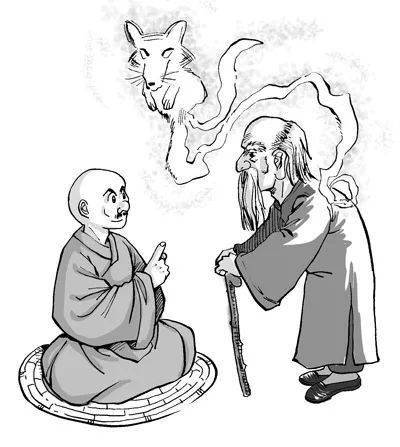
In the annals of Chinese Buddhist teachings, a narrative known as the “Wild Fox Koan” imparts profound insights into the principles of karma and its undeniable consequences.
According to legend, during the Tang Dynasty in China, Master Bai Zhang Huai Hai, a venerable monk and the third-generation disciple of the Sixth Patriarch Master Huineng, played a pivotal role in this story. During his sermons, he consistently noticed an unfamiliar old man attentively listening to his teachings on Buddhism. The mysterious visitor would only depart after the session concluded. One day, after another sermon, the old man lingered, prompting the puzzled monk to inquire, “Who is standing there without leaving? Who are you?”
Huaihai, curious, asked, “Do you have something on your mind?” The old man got straight to the point, confessing, “I am not a human; I am a wild fox on this mountain. Five hundred years ago, I was a monk and once gave a Dharma talk here. One day, a junior monk asked me if enlightened beings fall under the law of cause and effect. I replied, ‘They do not fall under cause and effect.’ Unfortunately, I gave the wrong answer and fell into the realm of a fox. Today, I want to ask a question in front of you, venerable teacher. Would you be willing to enlighten me?” Huaihai replied, “Please go ahead.” The old man asked, “Do enlightened beings fall under the law of cause and effect?” Huaihai responded, “They do not ignore cause and effect.” The old man paused for a moment, then prostrated himself, saying, “Teacher, I have attained enlightenment. I have now transcended the realm of the fox. I am beneath the big stone on the back mountain. I hope that you, as a monk, will bury me according to the proper rites.” After saying this, he disappeared without a trace.
Accompanied by monks, Master Huaihai went to the back mountain and found, under a large stone, a dead black fox. Master Huaihai instructed them to light torches and cremate the fox. They then chanted sutras together, performing rites to help the fox monk attain liberation.
The Fox Zen Master, due to a single mispronounced word, uttered a great falsehood, resulting in five hundred lifetimes as a wild fox. The principle of cause and effect is unfailing, as it does not discriminate between the ordinary and the saintly. Advanced practitioners maintain a profound reverence for the law of karma. Hence, there is the notion that bodhisattvas fear the cause, while ordinary beings fear the effect. A bodhisattva contemplates the emptiness and tranquility of all phenomena, harboring no attachment or grasping. Due to their wisdom, they do not give rise to undesirable consequences such as ignorance or darkness.
If one were to claim that a bodhisattva “transcends cause and effect,” it would imply an annihilationist view. It is only by “not obscuring cause and effect” that a bodhisattva, within the profound samadhi of deep prajna paramita, can attain the ultimate wisdom.
“To keep things secret, refrain from doing them unless by oneself.” This is a commonly heard phrase advising people to do good, implying that whatever one does, there will always be someone who knows. Moreover, secrets are bound to be exposed sooner or later. Therefore, it is essential to reflect on one’s actions regularly, ensuring they align with goodness. Never assume that no one is watching, as actions that go against the laws of cause and effect will eventually come to light.

Two other frequently heard sayings are: “Within three feet, there are gods” and “Every step leaves a mark.” These cautionary words remind individuals that every action leaves an imprint, and nothing done will vanish into oblivion over time. In the realm of cause and effect, if one sows seeds of negativity, they must ultimately bear the consequences, adhering to the principle of “unobscured cause and effect.”
During the Three Kingdoms period, the king of Su, Liu Bei, offered sagacious advice to his son, Liu Shan, before his passing, saying, “Do not commit small evils, and do not refrain from doing small acts of goodness.” This counsel underscores the importance of consistently engaging in virtuous deeds, regardless of their scale, while avoiding any participation in wrongdoing. The admonition implies that accumulating small wrongs over time can lead to significant consequences.
Conversely, it’s not uncommon to encounter individuals who, despite their kindness and numerous good deeds, face repeated disasters and misfortunes. Understanding why such outcomes occur can be challenging, leading to a lack of comprehension about the concept of doing good. Some may even develop biases, assuming that avoiding wrongdoing in this life is sufficient and that there’s no need to help others since there’s no apparent reward for good deeds. This perspective represents a clear form of biased and distorted understanding, lacking insight into the law of cause and effect and focusing on one aspect without considering the other.
Applying the concept of the threefold law of cause and effect, we realize that positive causes we sow may not yield immediate results. Karmic consequences from past lives need to be accounted for and repaid. We cannot solely judge our current situation based on what we see in this lifetime. Holding the belief that “I haven’t done anything wrong, so why is life more difficult for me than for others?” is a narrow perspective. Observing others who seemingly haven’t done much good yet are living well, we might not realize that they sowed positive causes in past lives—an aspect our ordinary eyes cannot perceive, akin to the monk descending to a fox in many lifetimes.
If the notion of avoiding wrongdoing but not engaging in virtuous deeds takes root, the future may only bring unbearable misery. Reflect on whether we’ve never taken a life. Insects, ants, cockroaches, spiders—all are living beings, and consciously or unconsciously, we’ve all caused harm to one at some point. Furthermore, injuring a life means we will have to repay in kind in future lives. Without cultivating positive causes in this life, how can we expect to have a good future?
Therefore, it is crucial to firmly believe in the universal truth of “cause and effect.” You reap what you sow—good actions bring good results, and harmful actions bring harm. It’s not a matter of if, but when the time comes!

Unveiling Insights Through the Wild Fox Koan: Understanding the Law of Cause and Effect
#Buddhism #BuddistTeaching #ZenBuddhism #ZenKoan #LawofCauseandEffect#MasterBaiZhang HuaiHai #FoxKoan #WildFox #Liberation #Enligthen

 Peace LiLy