
In my eyes, Yunnan Province is the most beautiful province in China. Its mild climate throughout the four seasons and its unique geographical location give Yunnan breathtaking natural scenery. The numerous ethnic minorities in Yunnan add to its diverse cultural customs. Yunnan is both romantic and passionately exotic, yet also elegant and graceful. It is truly charming and enchanting. Jizu Mountain is one of my favorite places there.
Mount Jizu (Chicken-foot Mountain) is situated in Dali Prefecture. The mountain is located to the northeast of Erhai and forms the tripoint of three counties: Heqing, Binchuan, and Dali City. With three mountain ranges to the front and one range to the rear, it resembles a chicken’s foot, hence its common name is Mount Cock’s Foot or Mt. Cock’s Claw. Yet another name for this mountain is Nine Strata Cliffs.
Mount Jizu is a famed holy mountain in Buddhism. Its main peak, Tianzhu Peak, rises some 3,240 metres above sea level. The mountain is vegetated with dense forests and bamboo groves.

From it, visitors can see the sunrise in the east, floating clouds to the south, Cangshan Mountain to the west and Jade Dragon Snow Mountain in the north. They are described as the “four wonders seen from the mountain top.”
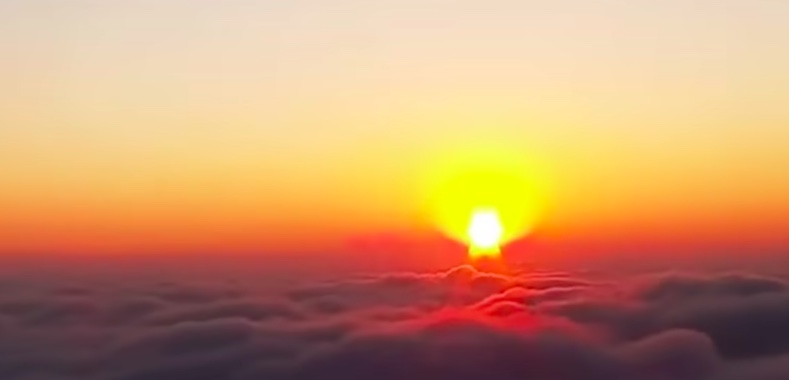
The best viewing spot for the four wonders of Jizu Mountain is at its highest point, the Golden Top Temple. The view from the temple is wide and open, with visibility for more than ten kilometers. Watching the sunrise in the east is the king of the four wonders. Early winter mornings are the best season to witness the sunrise, as the reduced moisture increases visibility.
Before dawn in winter, the stars in the sky gradually dim, and the eastern horizon begins to whiten. A hint of orange appears on the just-yellowing horizon. In just a few minutes, the orange-red sun leaps above the horizon, and its dazzling rays spread across the entire landscape. If there are rolling clouds, they turn into a dazzling orange-red color within seconds. The sun’s rays, like an arrow carrying a force of ten thousand pounds, fly straight at everyone. In an instant, a huge spark bursts open in one’s heart. The ruddy morning sun is so bright that it’s hard to keep one’s eyes open. However, once you get used to it, the earth has already begun to revive, welcoming a new day in the dawn.


The best season to view the silver Cangshan and jade Erhai from the west is still in winter and spring. In these two seasons, snow accumulates on the peaks of Cangshan. Looking west from Golden Top Temple, you’ll see the plateau’s pearl, Erhai Lake, which runs between the mountains and valleys, reflecting silver waves. It’s as if pearls are dancing on the water’s surface. At the place where the water meets the mountains, you’ll find the nineteen peaks of Cangshan neatly arranged. The pure white snow on the mountain peaks becomes even more noble silver under the sunlight. The mountains and the sea echo each other, with the mountains towering and magnificent, and the water soft and charming. This is a masterpiece of beauty that cannot be drawn!

The best time to view the colorful clouds from the south is in the evening when the sun is about to set. Try to choose a time when the clouds are most densely gathered. Standing at the Golden Top Temple and looking south, you’ll see the undulating mountains covered in mist, which either wraps around or disperses in clouds, drifting freely in the blue sky, transforming into various shapes. The afterglow of the setting sun is scattered among the light and leisurely drifting clouds, blooming with a burst of colorful brilliance!


Jade Dragon refers to the “Jade Dragon Snow Mountain,” whose peak is covered in snow all year round, so it can be viewed at any time. Looking north from the Golden Top Temple, the snow-capped mountains stretching for dozens of miles look like an outstretched dragon, crystal clear as jade, pure white and flawless, without a speck of dust.

There are some other scenic views of Jizu Mountain that appear at different times and moments, unique to Jizu Mountain. Every year in the summer and autumn rainy season, sudden storms suddenly stop, and the surrounding mountains are still in the mist, except for a part of the clouds above Jinding Temple which disperse and sunlight reappears. At this time, a circle of seven-colored light circles surrounds Jinding Temple, which is one of the Eight Scenic Views, known as “Tianzhu Buddha Light.” Similarly, during the summer and autumn rainy season, Jizu Mountain sometimes experiences strong winds, thunderous sounds, flashes of lightning, and heavy rain in the valleys. However, Huashou Gate, located under Tianzhu Peak and below the Sheshen Cliff, is still clear and sunny. The sound of thunder echoes here and lingers for a long time. This is the famous “Huashou Qing Lei.”
The most abundant trees on Jizu Mountain are “pine and oak.” These trees come together to form a vast forest.
Whether you look from a distance or up close, the “forest sea” of Jizu Mountain stretches for dozens of kilometers, from the mountain peak to the valley, casting shadows with its pine trees. The forest is deep and lush, and when the wind, whether gentle or strong, blows through, the leaves rustle, creating music reminiscent of the thunderous galloping of a thousand horses. Sitting in the mountain and quietly listening to this has a special charm. This landscape is known as “Wan He Song Tao”.
There are more beautiful scenic views waiting for you to explore.
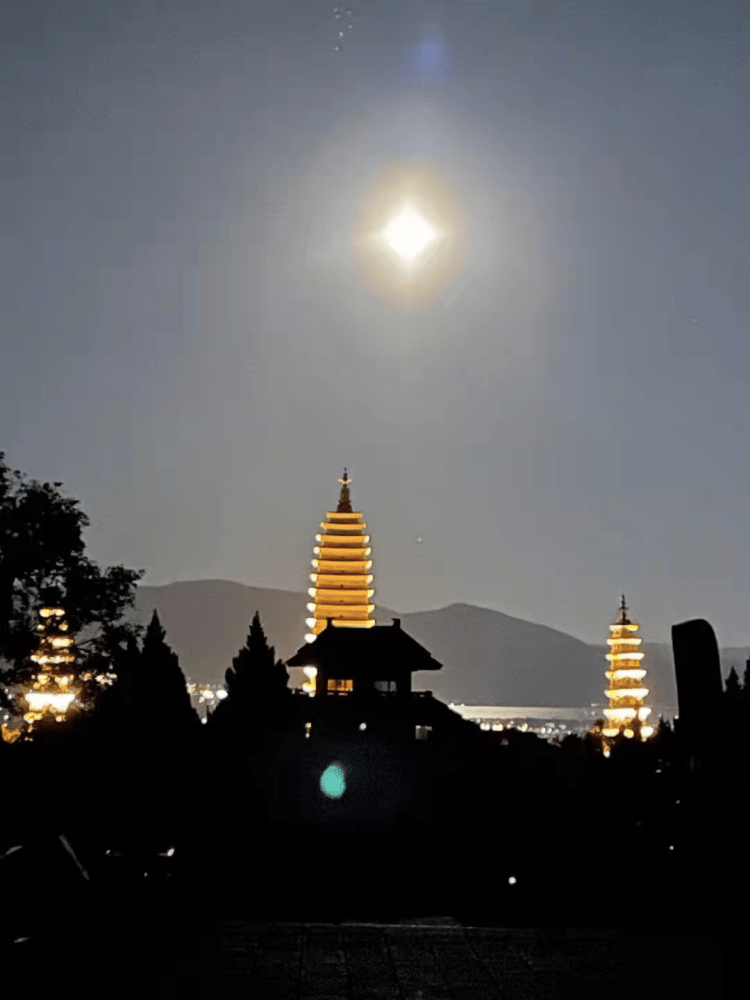
Besides the beautiful scenery, Jizu mountain is a legendary buddhist holy place.
According to Buddhist scriptures, in ancient times, Shakyamuni Buddha demonstrated to the assembly at the Lingshan Meeting by holding up a flower, and everyone remained silent. Only Venerable Mahakasyapa deeply understood the Buddha’s intention and broke into a faint smile. The Buddha said, “I have the true Dharma eye treasury, the wondrous heart of Nirvana, which I entrust to you.” He also told Mahakasyapa that he would pass on the kasaya robe to him, which would then be transferred to Maitreya when he appears in the world. Venerable Mahakasyapa bowed to the Buddha’s feet and respectfully followed the Buddha’s intention. After the Buddha’s Nirvana, Venerable Mahakasyapa gathered the true Dharma three treasures in the city of Vaishali. He later entrusted the true Dharma three treasures to Ananda and went to Jizu Mountain alone, holding the kasaya robe given to him by the Buddha. He entered meditation at the Huashoumen.
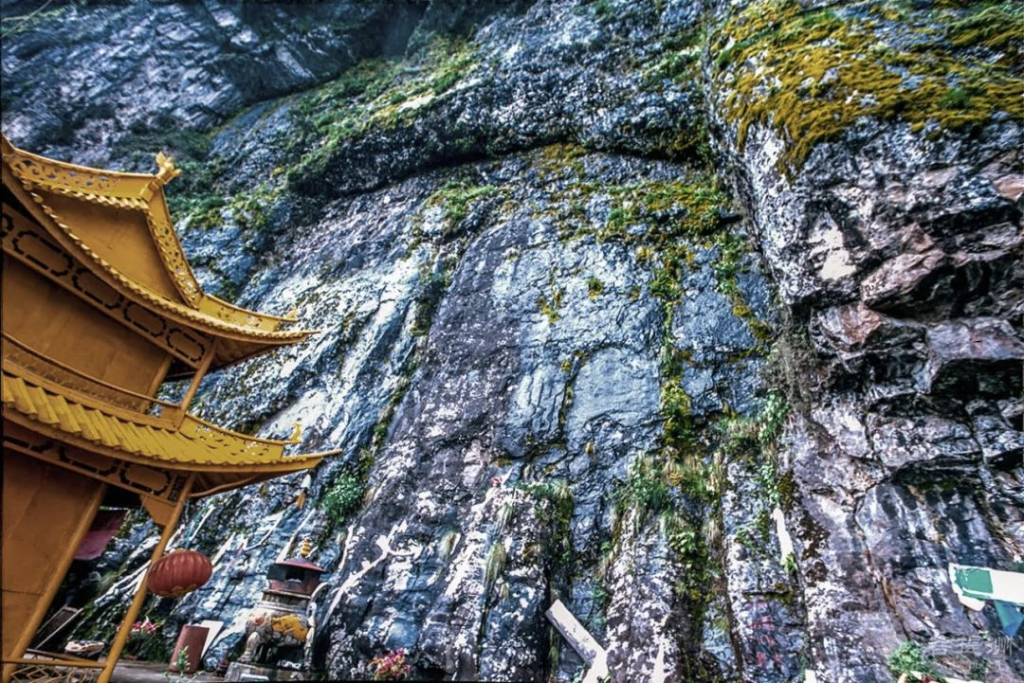
Huashou Gate is 40 meters high, with a sheer cliff face as if cut with a knife. A large stone gate is embedded at the top, and a vertical crack in the middle divides the cliff into two panels, with a “stone lock” hanging in the middle. The stone gate is covered with Hada (ceremonial scarves), and there are prayer flags around it. With an altitude of nearly 3000 meters, the landscape is very similar to that of Tibet.
When Maitreya Buddha is born in this world, he will also climb Jizu Mountain and go to the place where Venerable Mahakasyapa meditated. With a snap of his fingers, the mountain peak will open, and Mahakasyapa will pass on the robe and say his farewell. After the respectful ceremony, he will ascend into the sky, display divine transformations, and enter nirvana.
From the Buddhist scriptures, it can be seen that Jizu Mountain is the place where Venerable Mahakasyapa meditated, and it is also the future place of Maitreya. Its connection with Buddhism will never be severed for billions and trillions of years.
Jizu Mountain’s religious story stretches back nearly 1,000 years. Beginning during the Three Kingdoms period, several nunneries were built upon its slopes. But it was not until the time of the Tang Dynasty, four hundred years later, that the first known Buddhist temple was completed.
Throughout the following centuries, the construction of many other shrines and sanctuaries continued. By the late seventeenth century, during the Qing Dynasty, Jizu Mountain’s religious importance reach its zenith. At that point, according to official historical accounts, there were 42 temples and monasteries, 65 separate nunneries and more than 5,000 religious devotees residing on the mountain.
The mountain enjoys great prestige in South Asia and Southeast Asia, and shares the same fame with Wutai Mountain, Ermei Mountain, Putuo Mountain and Jiuhua Mountain in China. The mountain is a birthplace for Zen Buddhism.
The main sacred sites of Jizu Mountain include: Zhusheng Temple, Huashou Gate, Jinding Temple, Bronze Buddha Hall, Mahakasyapa Hall, Xuyun Zen Temple, Biyun Temple, Huashou Fangguang Temple, etc.
Jinding Temple


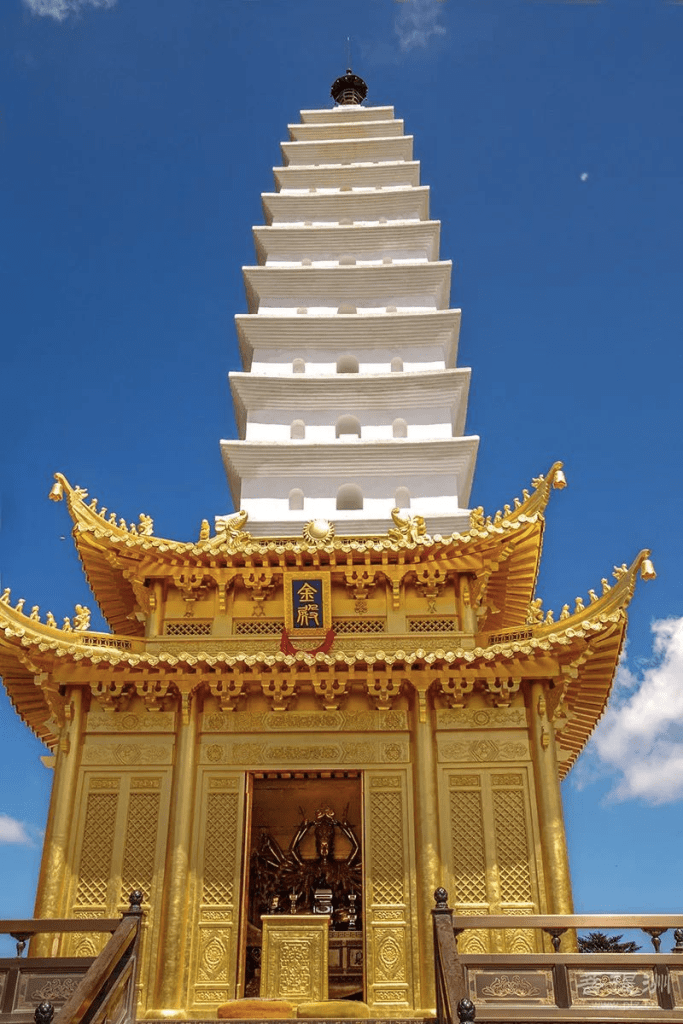

The front entrance of Jinding Temple is typical Baizhu architecture style
Mahakasyapa Hall


Source: https://www.visityunnanchina.com/attractions/natural-attractions/mount-jizu, http://zgt.china.com.cn/v2/content/2022-06/17/content_11117.html, https://www.buli.page/en/article/wechat/0967339c-67be-4d26-bada-c2d7a5bc1709/

 Peace LiLy