
During the time of Namo Shakyamuni Buddha, there was an old man who heard that by renouncing the worldly life and practicing cultivation, one could be free from suffering, attain happiness, and achieve liberation and ease. Filled with joy, he went to the monastic dwelling, hoping to take refuge under the Buddha.
When the old man arrived at the monastery, he learned that the Buddha had already gone out to teach and transform beings. He thought to himself, “Although the World-Honored One is not here, I’ve heard that Venerable Shariputra is foremost in wisdom—why not ask him to allow me to become a monk?”
Shariputra silently observed the old man to see whether he had the necessary virtuous roots. After careful contemplation, he discovered that this person, in this life and even through countless past kalpas, lacked sufficient virtuous roots and blessings.
When the other monks heard that even the most wise Venerable Shariputra had declined him, they said, “If even Venerable Shariputra will not accept you, you must have some grave shortcomings. How can we possibly let you enter monastic life? You’d better leave.”
The old man felt deeply ashamed and heartbroken. Through tear-filled eyes, he suddenly felt an incredibly gentle hand caressing his head, as tenderly as a loving parent would touch their child. The figure before him radiated a pure and gentle light—it was none other than the Buddha, beloved and revered by all.

The Buddha compassionately asked the old man why he was crying. The old man replied, “I wish to renounce the worldly life, learn the Buddha’s teachings, and cultivate the path, but the monks all refused my request. They said my causes and conditions are not yet sufficient, so I feel very sad.”
“Who said that you lack the causes and conditions to become a monk?” the Buddha asked.
The old man replied, “It was Venerable Shariputra, who is foremost in wisdom.”
The Buddha then turned to ask Venerable Shariputra. Shariputra answered, “World-Honored One, I observed his past life causes and conditions and found that he truly does not have even the slightest virtuous root.”
The Buddha said to Shariputra, “You must not think this way. This person’s virtuous roots are extremely subtle. A long, long time ago, in an eon far in the past, there was a poor man who went into the deep mountains to gather firewood. He encountered a tiger, and in his panic and terror, he cried out, ‘Namo Buddha!’ That one utterance of the Buddha’s name planted the seed for his future aspiration to learn the Dharma and attain liberation. That poor man is the old man in this life. Because the seed of his virtuous root has now matured, he has the conditions to renounce the world and cultivate the path.”
So the old man was ordained under the Buddha’s guidance and received personal instruction from the Buddha himself. Through continuous diligence and effort in his cultivation, he ultimately attained corresponding realization and achievement.
In the Dharma discourses of Namo Dorje Chang Buddha III, there is also a story (a gong’an, or spiritual case) that was told. Once, while Namo Shakyamuni Buddha was expounding the Dharma, seven tall beings suddenly appeared. These were exceptionally tall figures who entered and immediately prostrated before the Buddha, saying:

“Oh Buddha! Great Holy One! You have liberated us—we are deeply, deeply grateful!”
At that moment, Maitreya Bodhisattva saw them and thought: “How could these people be disciples of the Buddha? They’re clearly not!” Maitreya Bodhisattva, known for his incredible abilities to see into countless past and future kalpas, believed they were lying and said:
“Why are you speaking falsehoods? You must not lie! You are clearly not disciples of the Buddha!”
Hearing this, the seven tall beings had no choice but to explain: “We became his disciples in past lifetimes. We are disciples of the World-Honored One. If you don’t believe us, ask the Buddha.”
So Maitreya Bodhisattva turned to the Buddha and said: “Rare and wondrous World-Honored One, can you tell us—are these people truly your disciples?”
The Buddha replied: “They have not spoken falsely.”
From this story, we can understand that even a Bodhisattva of equal enlightenment like Maitreya could not perceive the subtle karmic causes and conditions of these seven beings. This shows just how profoundly deep and inconceivably subtle the true nature of karma is—only a Buddha of unsurpassed, perfect enlightenment can fully understand it.
In fact, there are many similar gong’an (spiritual cases). On one occasion, Namo Shakyamuni Buddha was transmitting the Dharma to a tall person who had been that way since beginningless kalpas. When the Buddha designated a particular yidam (personal deity) to guide him, the yidam refused. The Buddha asked, “Why won’t you teach him?”
The yidam replied, “This person has serious problems. He lacks virtuous roots.”
The Buddha asked, “How do you know?”
The yidam said, “As soon as you pointed to him, I immediately observed his karmic history over many kalpas. He has no virtuous roots and is incapable of learning the Dharma—he’ll only turn into a bad person.”
The Buddha said, “Let’s ask Manjushri Bodhisattva.”
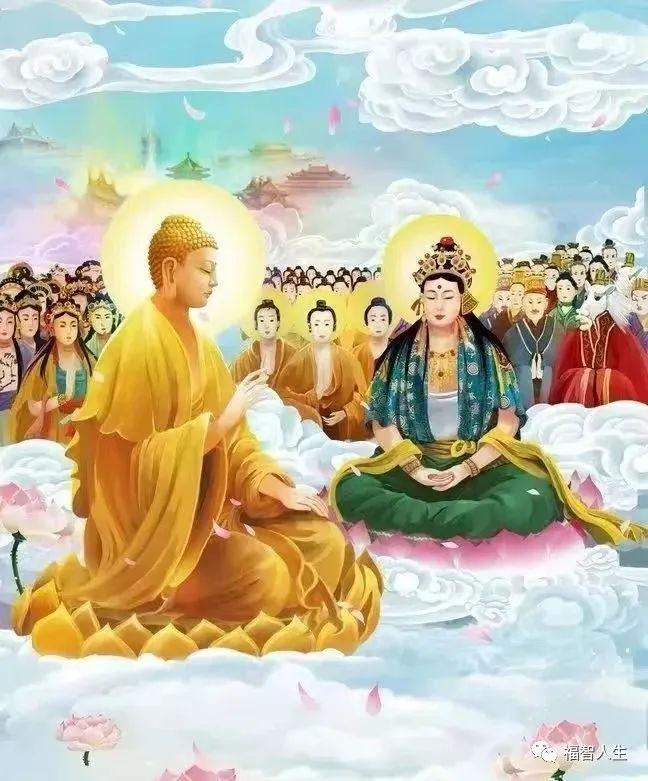
Manjushri then said, “This person does have virtuous roots. In the previous kalpa known as the Worthy Eon (Xian Jie), he was a crab. At that time, he committed many evil acts—catching and eating shrimp and other crabs. But later, he encountered the Dharma in the Dragon Palace and repented his sins. From that moment, he vowed to become vegetarian and made a great aspiration: from that moment until beginningless time, he would never again harm any living being. Gradually, through the force of that vow, he was reborn as a human in this lifetime. So, he does indeed possess wholesome karma.”
At that point, Namo Shakyamuni Buddha said to Manjushri Bodhisattva, “You should take the yidam to witness that past life.”
The yidam then said to the Buddha, “There’s no need. Since a Bodhisattva has verified it, and what the Buddha says is to be followed without question, I’ll abide by it. I simply didn’t see that part before—my cultivation is still shallow, and I feel deeply ashamed.”
Thereafter, the yidam vowed to accept the person as a disciple.
From this, we can see that only the enlightened state of a Buddha can, in a single thought, fully perceive the true reality of all beings’ karmic causes and effects.
Therefore, to cultivate and learn the Buddha’s teachings, one must begin with understanding karma—cause and effect—as it is the very root and essence of the Dharma.

As Namo Dorje Chang Buddha III has taught:
“One must know that all phenomena are governed by causality. With good causes, you receive good retributions. Good retributions yield good fruits. Good fruits enable you to receive the true Dharma. Relying on the Dharma, you can achieve perfect good fortune and wisdom. Then you can step into the state of accomplishment, break away from the sufferings that living beings experience, cease transmigrating in the cycle of birth and death, and accomplish the perfect enlightenment of a Buddha!“
We should uphold the precepts of Buddhism, develop firm faith in karma, and never err in understanding cause and effect. Only through proper and lawful cultivation can we transform our karma, perfect our blessings and wisdom, ultimately see through and fully realize karma, and attain the sacred path of bodhi enlightenment.

Link:https://peacelilysite.com/2025/05/08/the-subtle-truth-of-karma-only-a-buddha-sees-it-all/

 Peace LiLy