July, 2023. Out on the open sea.
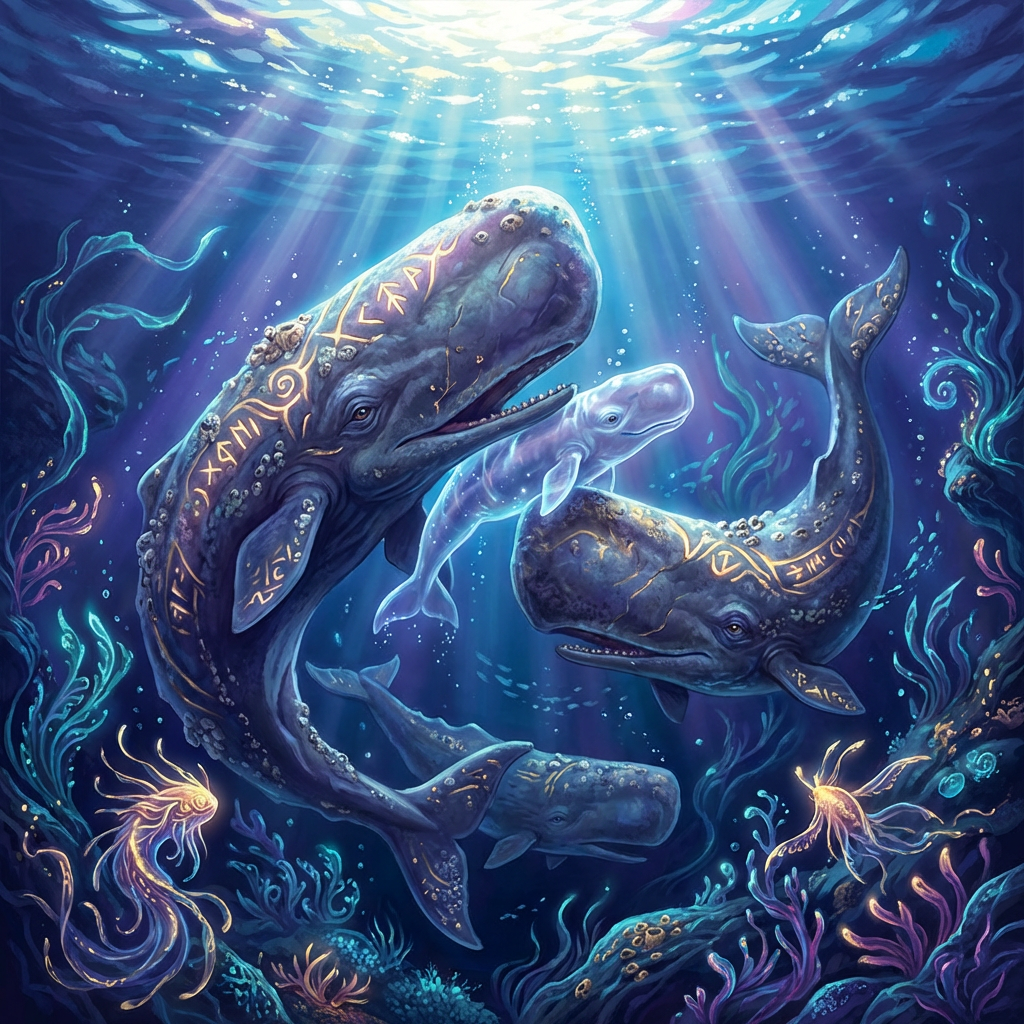
A group of marine biologists was tracking a pod of sperm whales. At first, something felt strange. Eleven whales floated motionless at the surface, as if time itself had paused. The ocean was eerily quiet.
Then, about an hour later, the stillness shattered. The water suddenly turned red.
Hearts racing, the scientists braced themselves for the harsh reality of nature.
Was this a hunt? A death? A moment of survival at another creature’s expense?
But as a drone camera moved closer, the truth revealed something entirely different.
There was no violence. No tragedy.
A mother whale—named Rounder—was giving birth.
In a rare and breathtaking moment, the scientists witnessed a new life entering the world. A tiny tail emerged first, as sperm whale calves are born tail-first, and slowly, a newborn began its journey into the vast ocean.
It should have been a moment of pure joy.
But in the ocean, birth is only the beginning of the struggle to survive.
A newborn sperm whale faces an immediate danger. Unlike adults, it has not yet developed the specialized organ in its head that helps regulate buoyancy. In simple terms, the baby cannot stay afloat on its own.
Without help, it would sink.
And sinking, in the open ocean, means death.
But what happened next was something no one could have predicted.
The ten other whales surrounding Rounder moved into action.
One by one, they swam beneath the newborn calf, using their massive bodies to gently push it upward—lifting it to the surface so it could take its first breaths. Again and again, they repeated this act, forming a living cradle beneath the fragile life.
This was not a brief effort.
For three hours, the whales took turns, tirelessly supporting the newborn, ensuring it did not sink. Each whale became a living buoy, offering strength, patience, and care.
It was a relay of compassion.
What makes this story even more extraordinary is what scientists later discovered: nearly half of the whales helping that day were not directly related to the mother or the calf.
They were not bound by blood.
And yet, they stayed. They helped. They gave their strength to protect a life that was not “their own.”
In the world of sperm whale, this is part of a deeper truth. These whales live in close-knit, matriarchal societies—grandmothers, mothers, aunts, and daughters supporting one another. But their care goes beyond family ties. It extends into a culture of mutual aid, a shared understanding:
Today I help you. Tomorrow, someone will help me.
In a world where nature is often described as ruthless and unforgiving, this moment tells a different story.
Survival is not driven by strength alone.
It is sustained by connection.
Even in the vast, indifferent ocean, life finds a way through cooperation, through presence, through something that looks very much like love.
Perhaps there is something for us to learn here.
In our own lives, we all face moments when we feel like we are sinking—overwhelmed, alone, unable to stay afloat. And sometimes, the help that lifts us does not come from those closest to us, but from unexpected kindness, from strangers, from quiet acts of support.
Like those whales in the open sea, we, too, are part of a larger web of life.
In Buddhism, there is a teaching that all beings are interconnected, bound together through causes and conditions. The kindness we offer today becomes the support we receive tomorrow. This is the quiet working of karma—not as fate, but as the natural unfolding of our actions.
The whales did not calculate reward or recognition. They simply responded to suffering with care.
In the same way, when we act with compassion, we become part of a greater flow of life—one that uplifts, protects, and sustains all beings.
Perhaps awakening does not begin with grand realizations, but with small, sincere acts:
To notice when another is sinking.
And to gently help them rise.
Link:

 Peace LiLy