Are We Already Happier Than We Think? A Lesson in Contentment

What if we already have many of the things we spend our lives searching for—but simply fail to recognize them as blessings?

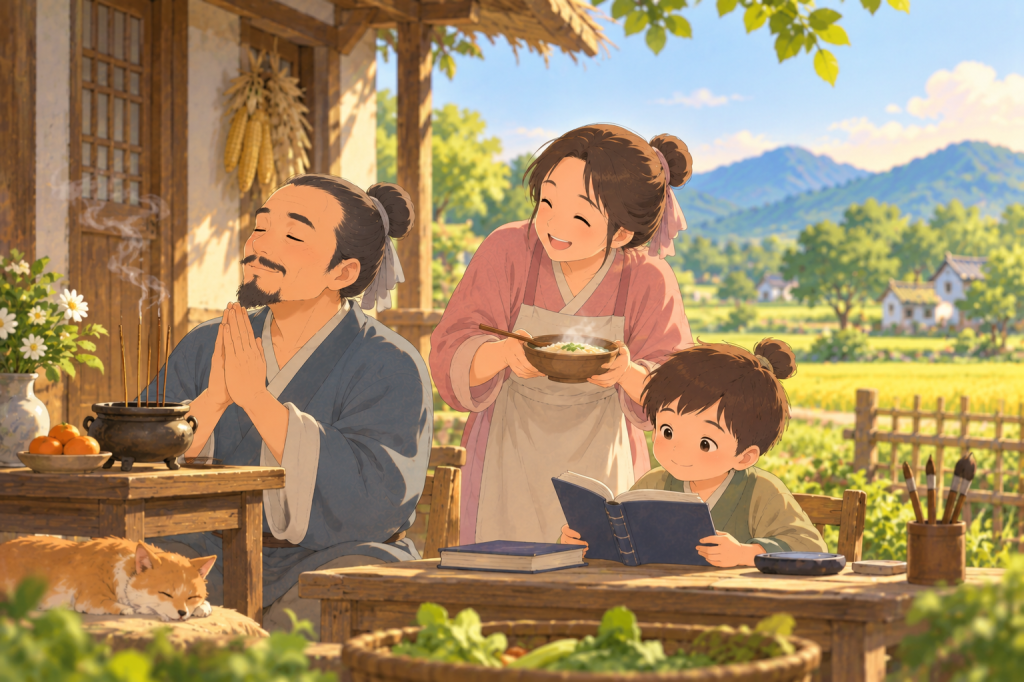
There is a beautiful story from the Ming Dynasty about a man named Hu Jiushao.

Hu was a farmer who also taught his son to read and study. His family lived simply, with enough to meet their basic needs. Every day, however, Hu would burn incense and offer prayers, thanking Heaven for blessing his family with another day of peace and contentment.

His wife found this amusing.

“We eat vegetable porridge for all three meals,” she said. “How can you call this a blessed life?”

Hu smiled and replied:

“First, we live in a time of peace. We do not have to suffer through war.

Second, our family has food to eat and clothes to wear. We are neither hungry nor cold.

Third, everyone in our family is healthy, and none of us has suffered the misfortune of imprisonment.

“Aren’t these blessings?”

His simple words carry a profound lesson.
We often think happiness comes from having more—more money, a bigger house, greater success, better possessions, or fewer problems. Yet when we constantly focus on what we lack, we can easily overlook the blessings already present in our lives.

This wisdom can also be found in the ancient teachings of Laozi. In Chapter 46 of the Tao Te Ching, he wrote:

“There is no greater calamity than not knowing what is enough. Therefore, knowing that enough is enough is always enough.”

These words beautifully echo the wisdom of Hu Jiushao.

Knowing what is enough does not mean that we should stop learning, growing, or improving ourselves. Rather, it means recognizing the value of what we already have instead of allowing endless desire to prevent us from experiencing gratitude.

As Namo H.H. Dorje Chang Buddha III has taught:

“A person not appreciative of the good life he is living is one who has forgotten his past miseries. A person in good health is not aware of its blessings until he loses it.”

How true this can be.

When we are healthy, we may hardly think about what a precious gift good health is. We go about our daily lives without giving it much attention. But when illness comes, something as simple as getting out of bed, walking freely, enjoying a meal, or sleeping peacefully can suddenly become deeply precious.

The same is true of many other things.

When we have peace, we may take it for granted. When we have enough food, a safe home, family, friends, and the freedom to live our daily lives, these things can seem ordinary simply because they are always there.

But ordinary does not mean insignificant.

Sometimes, we only recognize a blessing after it is gone.

Perhaps true happiness does not always require us to acquire something new. Sometimes it begins by seeing what we already have with a grateful heart.

Peace. Health. Food. Shelter. Family. The ability to wake up each morning and live another day.
These may sound like simple things, but they are among life’s greatest treasures.

Hu Jiushao’s story, together with Laozi’s ancient wisdom, reminds us to pause and ask ourselves:

What blessings am I enjoying today that I have stopped noticing?

Contentment does not mean giving up our dreams or never seeking a better life. It means learning to appreciate the life we have while continuing to grow.

When we learn to cherish what is already in our hands, we may discover that happiness was never as far away as we thought.

Perhaps the secret to a happier life is not always having more, but learning to recognize, appreciate, and cherish what we already have.

As Laozi reminds us, when we truly know what is enough, we may discover that we already have enough to be grateful for.

Link: https://peacelilysite.com/2026/10/02/are-we-already-happier-than-we-think-a-lesson-in-contentment/
A Hidden Wonderland: The World Within a Landscape

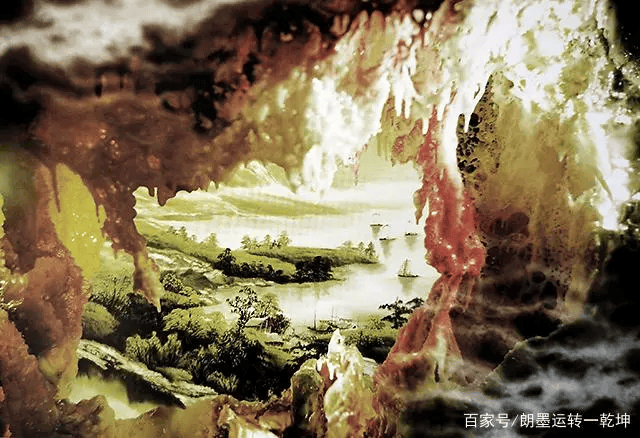
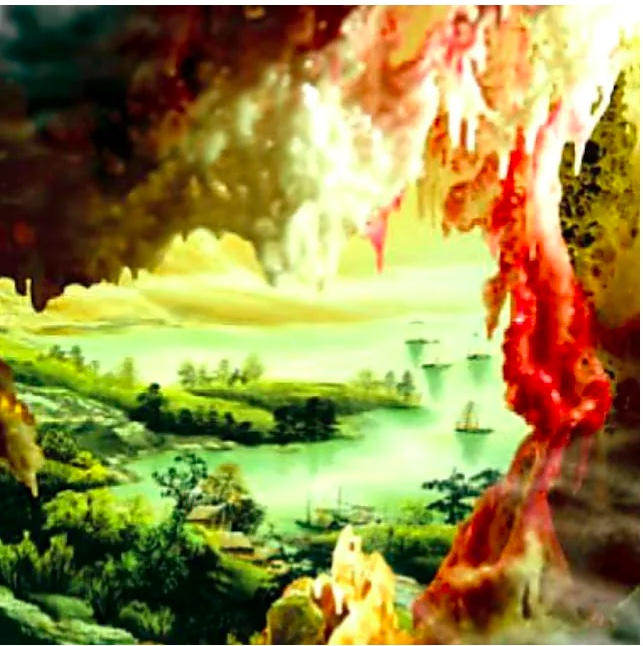
An Chinese Ink Painting by H.H. Dorje Chang Buddha III

The first time I saw this magnificent landscape painting, A Hidden Wonderland (別有洞天), I was immediately captivated by its dreamlike atmosphere and dazzling colors. For a moment, I even forgot to ask myself: Is this an oil painting or a traditional Chinese landscape?

The more I looked, the more fascinating the painting became.

Its colors, composition, and harmonious overall tone have the richness and realism of a Western oil painting. The luminous, almost surreal forms in the foreground appear to glow with extraordinary depth and texture. Creating such a convincing visual world requires a strong foundation in realistic Western painting.

Yet at the same time, the spirit of the work is unmistakably that of traditional Chinese landscape painting. Its atmosphere, poetic feeling, and especially its central landscape are deeply rooted in the aesthetics of Chinese shanshui—the art of expressing not only mountains and rivers, but also the spirit and energy of nature.

The longer I studied A Hidden Wonderland, the more I sensed that there was something beyond visual beauty. The composition seemed to contain a philosophical idea about perspective—about how the world can look completely different when we change where we stand.

It reminded me of a famous poem by the Chinese poet Bian Zhilin:

You stand upon the bridge, looking at the scenery;
The one looking at the scenery from the tower is looking at you.
The bright moon decorates your window;
You, in turn, decorate another’s dream.

The poem presents two perspectives at once. Someone believes they are simply observing the scenery, while from another viewpoint, they themselves have become part of someone else’s scenery. With this subtle shift in perspective, the poet reminds us that what we see depends greatly on where we stand.

A Hidden Wonderland carries a similar idea, but takes it even further.

The space surrounding the central landscape seems like a world beyond ordinary human life—a peaceful, radiant realm resembling a paradise. At the center, however, lies the familiar human world.

The artist creates a kind of visual frame within the painting. By changing the viewer’s position, the distance between “here” and “there,” between the world we inhabit and the world we imagine beyond it, suddenly becomes much greater.

For a moment, we seem to be standing outside the ordinary world, looking back at it from a higher and more peaceful place.

And then something remarkable happens.

After allowing our eyes to wander through the magnificent scenery beyond the frame, we look back toward the human world—and discover that it, too, is beautiful.

The morning sun has just appeared. Golden light gently pushes away the soft white mist floating above the river. Quiet sails drift across the water. Lush vegetation covers the riverbanks, while graceful trees partially conceal small houses scattered among them.

On the fertile hillsides, peach and plum blossoms fill the air with fragrance. In a beautiful pond, groups of geese and ducks play and call to one another. A winding mountain path leads into the distance, while the familiar sounds of village life—roosters crowing and dogs barking—rise and fall in the peaceful landscape.

Suddenly, the ordinary world we thought we had left behind no longer seems ordinary at all.

It is beautiful.

Perhaps this is one of the deepest messages hidden within A Hidden Wonderland. Sometimes we need to step outside our familiar perspective before we can truly appreciate the beauty of the world in which we live.

The artist, H.H. Dorje Chang Buddha III, has not only created a visually breathtaking landscape, but also a kind of window through which we can look at our own lives from a different perspective. The radiant world beyond the frame resembles a pure and luminous realm, while the human world below gradually reveals its own extraordinary beauty.

After being immersed in such a magnificent vision, we return our eyes to everyday life with a changed heart.

Perhaps the world itself has not changed.

Perhaps we have.

This brings to mind a profound teaching from the Vimalakirti Sutra:

“If a bodhisattva wishes to attain a pure land, he should purify his mind. As the mind becomes pure, the Buddha-land becomes pure.”

Maybe the “hidden wonderland” is not simply somewhere far away.

Perhaps it begins with the way we see.

When the mind becomes peaceful, the ordinary becomes beautiful. When the heart becomes pure, the world we see may also appear more pure.

And perhaps that is the true masterpiece hidden within A Hidden Wonderland—not only a beautiful landscape to look at, but a quiet invitation to look at ourselves, our world, and life itself from a higher perspective.

Link: https://peacelilysite.com/2026/10/02/a-hidden-wonderland-the-world-within-a-landscape/