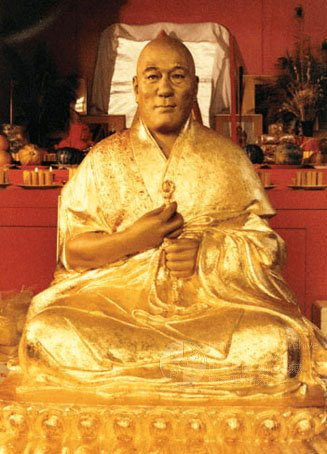
What happens to the body after death?
For most of us, the answer seems obvious. The body eventually returns to the elements. Yet in Buddhist history, there are extraordinary stories of great practitioners whose remains have been preserved in ways that inspire generations of people.
One such story is that of the Seventeenth Ganjurwa Khutukhtu, a highly respected Tibetan-Mongolian Buddhist master whose life eventually brought him to Taiwan.
A Life Devoted to Buddhism
Ganjurwa Khutukhtu was born in 1914 in the Amdo region of Qinghai. According to historical accounts preserved by the Ganjurwa Hermitage, he was recognized as a reincarnated spiritual master when he was very young.
As a child, he entered the monastery and devoted himself to Buddhist study and practice. He later studied at Wudangzhao, one of Inner Mongolia’s important Buddhist monasteries, and received full Buddhist monastic ordination from the Ninth Panchen Lama.
In 1949, he came to Taiwan. From there, he spent many years teaching Buddhism, giving Dharma teachings and initiations, and traveling to places including Hong Kong, Thailand, Cambodia, Canada, and the United States.
He was also elected chairman of the Buddhist Association of the Republic of China in 1957, following the passing of the Seventh Zhangjia Khutukhtu. Yet despite his respected position, accounts of his life describe him as a person who preferred spiritual practice and a quiet life to fame and status.
Eventually, he settled at Ganjurwa Hermitage (甘珠精舍) in Xindian, Taiwan, where he continued his practice and taught the Dharma.
Five Days and Five Nights in the Fire
The most extraordinary chapter of his story came after his death.
Ganjurwa Khutukhtu passed away peacefully at Ganjurwa Hermitage on June 13, 1978, at the age of 65.
On June 29, his body was taken to Fayusi Temple in Beitou for the traditional Buddhist cremation ceremony, known as tuhuo or j̄hāpiṭa (荼毗).
According to accounts preserved by the hermitage and Taiwan’s Veterans Affairs Council, the fire continued for five days and five nights.
When the cremation chamber was opened, those present were reportedly astonished. Rather than finding only ashes, they found that the master’s body had remained largely intact. His robes and prayer beads were reportedly still recognizable.
His disciples regarded this as an extraordinary manifestation of a vajra-indestructible body and preserved the remains as sacred relics.
For Buddhists, such accounts are not simply about the physical body. They point toward a deeper question:
Can spiritual practice transform the way we understand life, death, and impermanence?
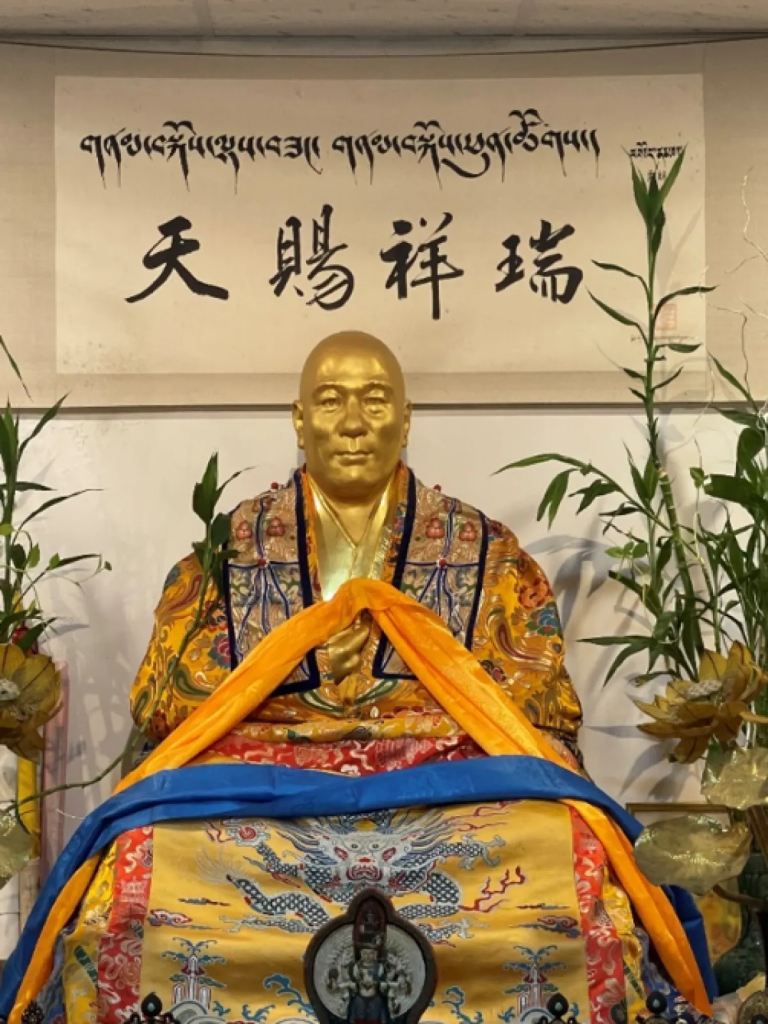
A Sculpture Created to Preserve His Sacred Remains
There is another remarkable part of this story.
To preserve the master’s remains, his disciples invited two of Taiwan’s most important modern sculptors, Yang Ying-Feng (楊英風) and Ju Ming (朱銘), to create a bronze statue.
The sacred remains were placed inside the sculpture, and the statue was installed at Ganjurwa Hermitage so that devotees could continue to pay their respects.
According to the Veterans Affairs Council, the full-body relics of Ganjurwa Khutukhtu remain enshrined there today.
It is an unusual meeting of Buddhism, history, sculpture, and faith—a spiritual legacy preserved not only through religious practice, but also through the hands of two remarkable Taiwanese artists.
Whether one approaches this story through faith, history, or simply human curiosity, it raises a profound question:
What remains of a person after the body is gone?
A building can disappear. Wealth can be lost. Fame eventually fades.
But wisdom, compassion, and the example of a life devoted to helping others can continue long after a person has left this world.
Perhaps this is the deeper meaning behind the story of Ganjurwa Khutukhtu.
The most precious legacy of a spiritual master may not be the physical remains left behind.
It may be the Dharma he taught, the lives he touched, and the goodness he inspired in others.
And perhaps that is the kind of legacy worth leaving behind.

Link:https://peacelilysite.com/2026/10/09/the-monk-whose-body-survived-five-days-in-the-fire/
Source: https://www.storm.mg/article/4494305, http://m.fosss.net/SheLi/GanZhu/Index.html


