No One to Blame: Understanding the Root of Anger

When Anger Has Nowhere to Stay

In our daily lives, anger often appears without invitation. A single word, a small inconvenience, or an unmet expectation can stir something deep within us. Before we realize it, the mind is no longer calm, and the heart feels as though it is burning.

There was once a woman who had a very bad temper. She often got angry over small things. Afterward, she would regret it. She knew her anger hurt others, and she truly wanted to change. But when anger came, she felt she could not control it.

One day, a friend told her, “There is a wise monk nearby. Maybe he can help you.”
So she decided to go.

When she met the monk, she told him everything—how easily she lost her temper, how much pain it caused, and how helpless she felt. She hoped he would give her some advice.

Elder woman talking to a Buddhist monk inside a temple with statues and worshippers in the background

The monk listened quietly. When she finished, he said nothing. He simply led her to a small room, stepped outside, and closed the door.

Soon she realized—the door was locked.

At first, she was confused. Then she became angry.

“I came here for help, and he locks me in?” she thought.

The room was dark and cold. The more she thought about it, the angrier she became. She started shouting, knocking on the door, and scolding the monk loudly.

But there was no answer.

No matter how much she shouted, the monk did not respond.

After a long time, she became tired. Her voice grew quiet.

Then the monk asked from outside, “Are you still angry?”

She said, “I’m angry at myself! Why did I come here?”

The monk replied, “If you cannot forgive yourself, how will you forgive others?” Then he left.

The room became quiet again.

After some time, the monk returned and asked, “Are you still angry?”

She said, “No, I’m not angry anymore.”

“Why?” he asked.

She said, “What’s the use of being angry? I’m still stuck in this dark, cold room.”

Her anger had weakened, but it was still there.

Later, when the monk asked again, she said, “I’m not angry anymore, because you are not worth my anger.”

The monk said, “The root of your anger is still there. You have not let it go.”

His words stayed in her mind.

After a long silence, she asked, “Can you tell me—what is anger?”

This time, the monk came to the door. He did not speak. He simply poured the tea in his cup onto the ground.

The woman watched quietly.

Suddenly, she understood.

“If I do not get angry, where does anger come from?” she thought.
“If my mind is clear, what is there to be angry about?”

At that moment, she saw the truth: anger does not come from others. It comes from our own mind.

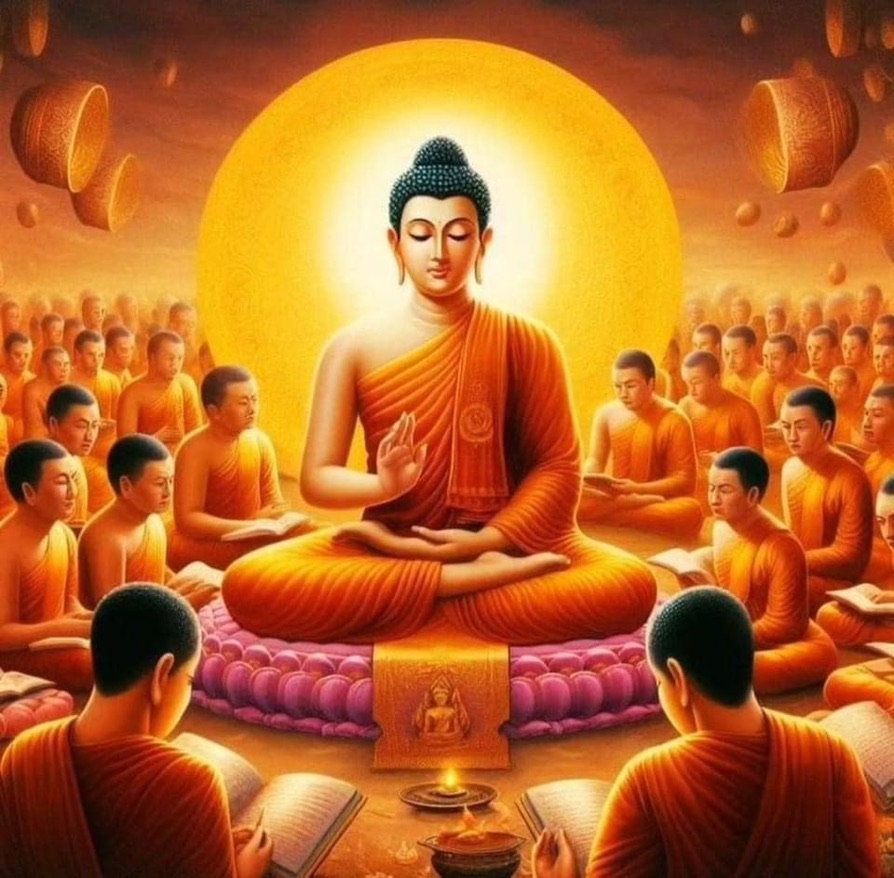
From the teaching of Gautama Buddha, we learn that anger arises when the mind is not open—when we hold on too tightly to our own thoughts, feelings, and expectations.

If we do not hold onto anger, it cannot stay.

In our daily life, anger often feels very real. We think others cause it. But if we look carefully, we see that it begins inside us.

When anger comes, we can pause and ask:
Why am I reacting this way?
What am I holding onto?
Can I let it go?

If we become more patient, more tolerant, and more willing to step back, anger will slowly lose its power.

Letting go of anger does not make us weak. It frees us.

When we put down the fire in our heart, we will see that things are not as bad as we thought. Other people are not as terrible as we imagined.

In the end, the lesson is simple:

If we do not create anger, it has nowhere to stay.

Link:https://peacelilysite.com/2026/04/21/no-one-to-blame-understanding-the-root-of-anger/

The Doctor Who Chose Compassion Over Wealth

A quiet light in a noisy world

In a modest clinic in Tanta, there once sat a doctor whose life quietly redefined the meaning of success. His name was Mohamed Mashally, but to thousands of ordinary people, he was simply known as the doctor who would never turn them away.

For more than half a century, Dr. Mashally devoted himself to serving those who had nowhere else to go. While many pursue medicine as a path toward status or financial security, he chose a different road—one shaped by compassion, humility, and an unwavering sense of responsibility to others.

His clinic was simple, almost unremarkable. Yet outside its doors, long lines would form each day. Patients came not only because his fees were extraordinarily low—sometimes less than the cost of a meal—but because they knew they would be treated with dignity. And for those who could not pay at all, he quietly asked for nothing.

Behind this life of selfless service was a moment of deep sorrow that transformed his heart. Early in his career, Dr. Mashally treated a young boy suffering from diabetes. The child’s family could not afford the medicine he needed. When the boy passed away, it left a lasting imprint on the young doctor’s soul. From that day forward, he made a silent vow: no one should lose their life simply because they are poor.

And so, he began a lifelong practice of giving.

He worked long hours each day, often seeing patient after patient without rest. Opportunities came—offers to move to wealthier places, chances to build a more comfortable life—but he declined them all. He believed that his place was among those who needed him most.

Even when people, moved by his story, tried to offer him financial help, he would gently refuse. “Give it to the poor,” he would say. For him, kindness was not something to be redirected—it was something to be lived.

In a world often driven by gain and recognition, Dr. Mashally remained rooted in something deeper. He did not seek fame, yet his story spread across countries. He did not chase wealth, yet he became rich in something far more enduring—the gratitude of countless lives he touched.

When he passed away in 2020, many mourned not just a doctor, but a rare kind of human being—one who embodied the quiet truth that compassion, when practiced sincerely, becomes a force that transforms the world.

His life leaves us with a gentle but profound question:

What does it mean to truly succeed?

Perhaps success is not found in how much we accumulate, but in how much we are willing to give. Not in recognition, but in sincerity. Not in grand gestures, but in the small, consistent acts of care that ripple outward in ways we may never fully see.

Like a lamp that asks for no reward, yet brings light to all who pass by, Dr. Mashally’s life reminds us that each of us, in our own way, has the ability to ease suffering and bring warmth into the lives of others.

And sometimes, the greatest legacy we can leave behind is simply this:

That because we lived, someone else suffered a little less.

Link:https://peacelilysite.com/2026/04/20/the-doctor-who-chose-compassion-over-wealth/

When Practice Becomes Real: Aligning Our Three Karmas with the True Master

In the path of cultivation, many of us begin with sincerity. We read the teachings, we listen, we reflect, and we believe that we are walking the path correctly. Yet a profound question remains:

Why is it that among so many practitioners, so few truly attain realization?

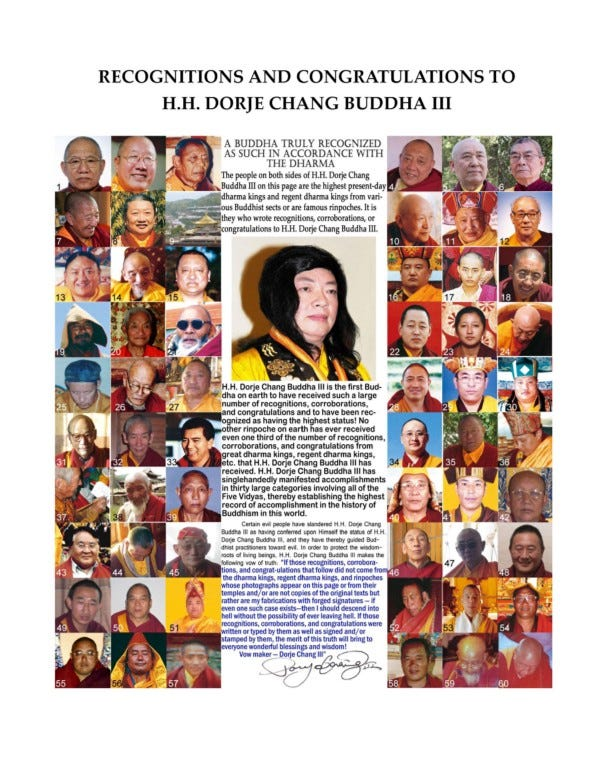
Photo taken in 1999. Elder Dharma King Dorje Losang (191?-2004) was a disciple of H.H. Dorje Chang Buddha III Wan Ko Yeshe Norbu (Great Dharma King Buddha Yangwo Yisinubu).

In a teaching given by Elder Monk Dorje Losang at Bodhi Monastery, a direct and uncompromising answer is offered. There are only two fundamental reasons.

First, one has not followed a true Master—one who is the incarnation of a Buddha or Bodhisattva—and therefore has not received the true Buddha-dharma, but only its outer forms, theories, or popular interpretations.

Second, even if one is fortunate enough to follow a true Master and has encountered the authentic Dharma, one’s three karmas—conduct, speech, and thought—do not truly correspond with the Master’s teachings. In this case, cultivation becomes superficial. Without true alignment, there can be no liberation, no genuine blessings, and no escape from the cycle of birth and death.

This teaching is simple, yet deeply penetrating.

It reminds us that the path is not only about what we learn—but how we live.

True devotion is not merely a feeling. It is expressed through what is called the “Four States of Corresponding”: unwavering loyalty, constancy without change, placing nothing above the Master and the Three Jewels, and reaching complete, wholehearted devotion. Only when these are truly practiced can one’s three karmas fully align.

And yet, for many of us, the challenge lies not in understanding these principles—but in applying them in the smallest moments of daily life.

A story shared by lay practitioner Wang Yuxiang offers a powerful reflection.

On an ordinary day, she decided to prepare steamed dumplings as an offering to her Master, H.H. Dorje Chang Buddha III. Her heart was joyful, filled with the intention to make a sincere offering.

As she prepared the filling, she followed a habit formed over years of cooking at home—she tasted a small portion to check the seasoning, then returned it to the mixture. It was a simple, unconscious action, something she had done countless times before.

But this time, it was different.

In that very moment, something unexpected occurred. A sealed bottle of soy sauce suddenly fell and shattered, creating a loud and startling crash. Shocked, she immediately realized her mistake.

Young woman with a bleeding cut on her foot from broken glass on the floor

This was not food for herself or her family.
This was an offering.

With deep remorse, she repented sincerely, recognizing her lack of mindfulness and reverence. Her tears flowed uncontrollably—not out of fear, but from a genuine awareness of having fallen short in her devotion.

Soon after, she discovered that her foot had been pierced by a sharp piece of glass, causing significant bleeding. Yet despite the injury, her only concern was not to delay her Master’s meal. She endured the pain, completed the offering, and only afterward returned home to tend to her wound.

And then, something extraordinary happened.

The wound—deep, bleeding, and undeniable—had completely disappeared. There was no scar, no swelling, no trace it had ever existed.

To many, such an account may seem difficult to comprehend. But beyond the event itself lies its deeper meaning.

Through this experience, she came to a clear realization: cultivation is not an abstract concept—it is present in every thought, every word, every action.

Even a small, habitual act, when lacking mindfulness and reverence, reveals a gap between one’s intention and one’s actual state of alignment.

From a Buddhist perspective, this story is not merely about a “miracle,” but about cause and condition, sincerity and response.

When one’s mind deviates, even subtly, there is consequence.
When one repents with genuine sincerity, there is also transformation.

More importantly, it reminds us that following a true Master is an immense blessing—but it also carries profound responsibility.

It is not enough to say we believe.
It is not enough to feel devotion in our hearts.

Our three karmas must align—completely, precisely, and without compromise.

Not only in great matters, but in the smallest details of daily life.

How we speak.
How we act.
What thoughts we allow to arise.

Because it is in these subtle moments that our true state is revealed.

If we treat ordinary matters casually, how can we claim sincerity in sacred ones?

If our habits remain unchanged, how can transformation occur?

The path of cultivation is, in truth, very direct.

When the Dharma is true, and when one’s devotion is unwavering, Elder Monk Dorje Losang teaches that liberation can be “as easy as turning over one’s hand.”

But if our practice remains external, if our alignment is incomplete, then no matter how long we cultivate, the result will remain distant.

This is both a warning and a profound encouragement.

It tells us that the path is not far away.
It is right here, in this very moment.

In every thought we choose.
In every word we speak.
In every action we take.

To truly align our three karmas is not something abstract—it is something we practice now.

Quietly.
Sincerely.
Completely.

And perhaps, in that sincerity, the path will naturally unfold.

For full lecture Given by Elder Monk Dorje Losang at Bodhi Monastery, please click here.

For the full account by lay practitioner Wang Yuxiang please refer to  H.H. Dorje Chang Buddha III — A Treasury of True Buddha-Dharma**, pp. 187-189.**

Link:https://peacelilysite.com/2026/04/17/when-practice-becomes-real-aligning-our-three-karmas-with-the-true-master/

The Blue Blood That Quietly Protects Us: A Lesson in Gratitude and Reverence

Healthcare worker giving vaccine injection to a hesitant child with mother supporting

There are lives in this world that support us in ways we rarely see, rarely think about, and almost never repay.

Each time we receive a vaccine, an IV drip, or undergo surgery safely, free from dangerous infection, we often feel gratitude toward medicine, toward doctors, toward science. Yet behind all of this, there has long been a silent contributor—ancient, resilient, and unknown to most.

The horseshoe crab.

Older than the dinosaurs by more than two hundred million years, these humble creatures have lived quietly along the shores of our planet, long before human beings ever appeared. While civilizations rose and fell, while continents shifted and climates changed, they endured—unchanged, steady, almost timeless.

And yet, in modern times, their lives became deeply intertwined with ours.

Their blue blood, colored by copper instead of iron, carries within it a remarkable biological defense system. Scientists discovered that the blood of horseshoe crabs contains a substance known as Limulus Amebocyte Lysate (LAL). What makes LAL extraordinary is its ability to detect bacterial endotoxins—harmful components from certain bacteria that can cause severe, even life-threatening reactions in humans.

When LAL encounters these toxins, it immediately forms a clot. This rapid response acts like a natural alarm system. In laboratories, even the tiniest trace of contamination in vaccines, injectable drugs, or medical equipment can be detected using this reaction. Before any medicine enters the human body, it must pass this test.

In this way, the horseshoe crab’s blood has quietly protected millions of lives. It has helped ensure that what is meant to heal does not instead harm.

They have been, in a very real sense, silent guardians of human health.

And yet, how often have we paused to thank them?

For decades, countless horseshoe crabs have been taken from the ocean, their blood carefully drawn, and then returned. Though efforts are made to minimize harm, the process is stressful, and not all survive. Their contribution has been largely unseen, unrecognized, and without voice.

Horseshoe crabs glowing and swimming underwater near ancient ruins with colorful coral and fish

Only in recent years has science developed synthetic alternatives, allowing this ancient species a chance to rest, to recover, and perhaps to continue their long journey on Earth with less human burden.

But beyond science, this story invites us into something deeper.

In Buddhist teaching, we are reminded that all beings are not separate from us. Across beginningless time, every living being has, in one way or another, been our parent, our relative, our companion in the vast cycle of existence. Though forms change, though appearances differ, the essence of life remains interconnected.

When we look at a small, unfamiliar creature, we may see something distant, something unrelated to ourselves. But in truth, the web of life is far more intimate than we imagine.

Who can say, in the endless turning of time, how many lives have supported ours?

Who can know how many unseen acts have allowed us to live safely, to grow, to continue?

The horseshoe crab does not know our names. It does not act with intention to help us as we understand it. And yet, through the natural unfolding of causes and conditions, it has become a protector of human life.

This alone is enough to awaken a quiet sense of gratitude.

Perhaps the deeper lesson is not only about one species, but about how we see the world itself.

If even a creature we rarely notice can play such an essential role in our survival, then how many other beings—seen and unseen—are supporting us at every moment?

The food we eat.
The air we breathe.
The countless forms of life that sustain ecosystems and maintain balance.

When we begin to reflect in this way, something within us softens.

Indifference becomes awareness.
Awareness deepens into respect.
And respect quietly transforms into gratitude.

To live with this understanding is to walk more gently upon this Earth.

It is to recognize that we are not isolated individuals, but participants in a vast and living network of interdependence.

And perhaps, in this recognition, a simple aspiration arises:

To harm less.
To care more.
To honor life in all its forms.

Because we never truly know—
which life is supporting ours,
which being is protecting us,
which silent presence is helping us continue on our path.

And in that not knowing, there is something profoundly beautiful.

A reason to be humble.
A reason to be grateful.
A reason to treat every life… with reverence.

Link:https://peacelilysite.com/2026/04/16/the-blue-blood-that-quietly-protects-us-a-lesson-in-gratitude-and-reverence/

The Wisdom in Our Hands: A Simple Path to a Clear Mind

Can doing the dishes help prevent memory loss?

In an age of endless scrolling and effortless convenience, we rarely stop to consider a quiet truth: our bodies were never designed for stillness without purpose.

A Chinese traditional doctor once shared a piece of advice with a patient who feared memory loss in old age. It was not a prescription. It was not a costly treatment. It was simply this:

“If you want to protect your brain, use your hands. Start by washing dishes every day.”

At first, it may sound almost too simple—perhaps even surprising. But both ancient wisdom and modern science seem to gently point in the same direction.

Neon cortical homunculus diagram with labeled body parts and brain connections

Neuroscience reveals that within our brain lies a remarkable structure known as the cortical homunculus—a “map” of the body drawn across the surface of the brain. Discovered by Wilder Penfield, this map shows that not all parts of the body are represented equally. The hands—especially the fingers and thumbs—occupy an unusually large area, as do the lips and mouth. These are the parts we use most delicately, most precisely, and most meaningfully to interact with the world.

Every time we use our hands—washing dishes, preparing food, writing, gardening—we are not just completing a task. We are activating the brain. We are strengthening neural pathways. We are maintaining coordination, attention, and awareness. In a very real sense, we are keeping the mind alive through the body.

And yet, in modern life, much of our time is spent swiping screens. Our hands move, but only in the smallest, most repetitive ways. Our eyes are active, but our bodies remain still. Our minds are filled, but not always nourished. Convenience has brought comfort, but it has also quietly taken away many opportunities to truly use ourselves. And when we stop using what we were given, we slowly lose it.

In Chinese wisdom, there is a simple yet profound saying: “大道至简”—the Great Way is simple. The path to health, clarity, and longevity is often not hidden in complexity, but revealed in the ordinary. Perhaps the protection we seek for our memory is not only found in medicine, but in movement; not only in supplements, but in simple, mindful actions.

To wash a dish.
To knead dough.
To tend a garden.
To write a note by hand.

These are not small things. They are quiet acts of preservation.

Our body is not just a vessel—it is an extraordinary, living system designed for engagement. When we use it fully, it supports us. When we neglect it, it slowly fades.

So perhaps we can begin, not with something grand, but with something simple: use your hands, move your body, and be present in small actions. Because sometimes, the most profound care we can offer ourselves… is already within reach.

Link:https://peacelilysite.com/2026/04/15/the-wisdom-in-our-hands-a-simple-path-to-a-clear-mind/

Between Instinct and Grace: A Moment the Ocean Remembered

Diver embracing a large whale surrounded by colorful fish and coral underwater

There are stories that belong not only to science, but also to wonder—stories that unfold in that quiet space where facts end and meaning begins.

One such moment took place in 2017, in the warm, crystalline waters off Rarotonga, part of the serene islands of the Cook Islands.

Marine biologist Nan Hauser had spent nearly three decades studying humpback whales in these waters. She knew their rhythms, their migrations, their presence. The ocean, to her, was not unfamiliar—it was home.

And yet, on that day, something happened that she herself would later struggle to fully explain.

As she swam, a massive humpback whale approached her—directly, powerfully, and without warning. It nudged her. Lifted her. Pressed her gently yet insistently through the water. Again and again, it positioned its enormous body around hers, guiding her in a direction she did not understand.

There was fear. How could there not be?
To be moved by a creature weighing tens of thousands of pounds is to feel the fragile nature of one’s own body. Every movement carried the possibility of harm.

For several long minutes, the whale would not leave her.

Then, beneath the surface, a shadow revealed itself.

A tiger shark moved through the deep—silent, powerful, and unmistakably dangerous.

Only later did the pieces begin to align.

The whale’s circling.
The persistent nudging.
The careful positioning.

It had remained between her and something she had not yet seen.

Whether the whale intended to protect her is something science cannot say with certainty. Researchers, including experts like Robert Pitman, have long documented how humpback whales sometimes intervene when predators such as killer whales threaten other marine life. They have been seen shielding seals, escorting injured animals, even disrupting hunts.

But a human?

That question remains open—resting quietly in the unknown.

And perhaps that is where the true beauty of this story lies.

Because not everything meaningful can be measured.

What we know is this:
A woman entered the ocean alone.
A powerful creature stayed beside her.
A danger passed.
And she returned safely.

Between those simple facts lives a mystery—one that invites not certainty, but reflection.

Was it instinct?
Was it coincidence?
Or was it something that gently echoes what we, as humans, might call care?

Standing at the edge of such a moment, we are reminded of how little we truly understand about the inner lives of the beings who share this world with us. The ocean, vast and ancient, holds countless stories like this—unwritten, unproven, yet deeply felt.

Perhaps what matters most is not defining the whale’s intention, but recognizing the invitation within the encounter.

An invitation to humility.
To reverence.
To a quieter way of seeing.

In a world where we often place ourselves at the center, moments like this shift the perspective. They remind us that we are participants, not masters—threads woven into a much larger, living tapestry.

And sometimes, in ways we cannot fully explain, that tapestry seems to respond.

Gently.
Powerfully.
And just when it is needed most.

Link:https://peacelilysite.com/2026/04/13/between-instinct-and-grace-a-moment-the-ocean-remembered/

Remembering Our Belonging to the Earth

Dear friends on this beautiful Earth,

I recently came across these words, and they felt less like something to read—and more like something to remember. In a time when the world often feels filled with urgency and uncertainty, this message gently invites us to pause, to listen, and to reconnect with the quiet heartbeat of our Mother Earth… and with one another.

May we breathe a little more deeply, walk a little more gently, and allow love—simple, steady, and sincere—to guide us back to what truly matters.

I hope these words bring you a moment of peace, reflection, and connection, just as they did for me 🌿

Mother Earth’s Humming

By Yuria Celidwen

Now, She still ripples. She still hums, pulses, quivers. She still sighs, murmurs under the Skies.

We pay attention, and all we hear is urgency. Waters whirl, winds rise, fires rage, irate. The challenges are innumerable, but also infinite are the opportunities. Our grief is daunting, but also heartening is our compassion. We course a cosmic webbing holding awe and horror, wonder and doubt, creation and transition . . . us and all others.

This abysmal relentless weaving is love in all its myriad forms.

We listen whole our Mother Earth’s humming, Her calling, Her heartbeat throbbing, and Her ails. We, as made of soil ourselves, are porous. Enacting love flows—throughout— quenching the cracked soils of hopelessness, helplessness, and isolation.

Breathing in, we return, expanding full gratitude.

Breathing out, we connect, unfolding kindness and care.

It is love who guides grief to meaning, anger to action, despair to transformation, fear to safety. Thus, from love, all injuries heal; they repair, restore . . . and bridges open.

Because our beings—whole—open.

Trust becomes.

Relatives, recall those early steps of unknowing and discovering!

Yes.

Those first steps we walk again right here, right now.

Today, we walk our steps attentive and intentional. Our past brings forth sensible alertness now. Tomorrow is right here— made of us—right now.

Yes.

Bring to heart the time we walked barefoot. When our feet caressed the skin of our Lands, concerned little of thorns and pebbles, seeking first to play and connect.

Relatives, evoke the gentle holding of our Mother Earth, Her caring gaze, and Her smiling.

We smile back because we are indeed listening.

Now, we ripple. We hum, pulse, quiver. We sigh, murmur under the Skies.

Earth floating amidst glowing turbulent waves under a vibrant starry sky with aurora and galaxy

Source: https://www.awakin.org/v2/read/view.php?tid=2623

Link:https://peacelilysite.com/2026/04/12/remembering-our-belonging-to-the-earth/

Where Compassion Lands: The Silent Rescue of a Hive

Two beekeepers in protective suits collecting honey from a large hanging hive at sunset

When a Home Was Lost, Compassion Found a Way—A Quiet Act That Redefined the Value of Every Living Being

There are moments in life when compassion is no longer an idea, but a living force—quiet, unwavering, and profoundly transformative.

This is the story of such a moment.

Shared by lay practitioner Qi Pengzhi(戚鹏直), it recounts an act of extraordinary care by Namo Dorje Chang Buddha III and Namo Yuhua Shouzhi Wang Buddha Mother—an act not directed toward kings or crowds, but toward a fragile colony of bees, hidden on the rooftop of an ordinary home.

It was 2011, a year marked by an unexpected turning point. The house in which they resided had been sold, and the new owner intended to demolish it. Time was short. Departure was inevitable.

And yet, above their heads, life was quietly unfolding.

A vast hive of bees had taken refuge beneath the roof—thousands of tiny lives bound together in delicate harmony. To most, this would have been an inconvenience, perhaps even a nuisance. The simplest solution, as suggested by the landlord, was extermination.

But compassion does not choose the convenient path.

“Under no circumstances should they be harmed,” came the firm and gentle instruction. “Their lives are no different from ours.”

In that moment, the fate of the hive was no longer incidental—it became a responsibility.

What followed was not a symbolic gesture, but a meticulous and determined effort. Beekeeping specialists were consulted. Plans were drawn. A new hive was carefully constructed in advance, shaped not by haste but by respect for the natural rhythms of the bees.

Time pressed on. The day of relocation arrived.

There is a quiet tension in handling something so easily broken. Bees do not understand human urgency; they respond only to the subtle language of instinct and survival. At the heart of their world lies the queen—without her, the colony dissolves into silence.

So every movement mattered.

The disciples stood watch as professionals gently removed the hive from the rooftop. No detail was overlooked. No life dismissed as insignificant. It was a scene both practical and deeply reverent—an unspoken recognition that even the smallest existence carries its own dignity.

Yet the journey did not end with removal.

True compassion does not abandon halfway.

They followed the bees—literally—escorting them to their new home. The destination was a secluded mountainside, where wildflowers stretched across the land and human disturbance faded into absence. It was a place where life could continue as it was meant to: freely, quietly, and whole.

Only after ensuring the bees were safely settled did they return.

What remains is not merely the memory of an act, but the echo of its meaning.

Knight resting against a maiden inside a glowing magical shield protecting them from dark and fiery creatures

In an age where humanity grapples with ecological imbalance, the significance of such care becomes ever more apparent. Bees, as science now repeatedly reminds us, are vital to the continuity of life. Their silent labor sustains ecosystems, nourishes crops, and binds the intricate web of nature together.

To protect them is, in truth, to protect ourselves.

And yet, beyond science, there is a deeper understanding—one that transcends utility.

It is the recognition that life, in all its forms, is not hierarchical but shared.

That the boundary between “us” and “them” is far thinner than we imagine.

That a single act of protection, offered without condition, can restore a fragment of harmony to a fractured world.

Perhaps true compassion is not measured by grand gestures, but by the willingness to pause… to notice… and to protect even that which the world has overlooked.

On a rooftop, in a fleeting moment before demolition, a choice was made.

Not to destroy—but to preserve.

Not to disregard—but to honor.

And in that choice, something far greater than a hive was saved.

This post is translated and edited from Interview with a Buddhist Disciple (64): AM1300 Chinese Radio Station – Exclusive Interview with U.S. Layman Qi Pengzhi 《佛弟子訪談(六十四):AM1300中文廣播電臺-專訪美國 戚朋直居士》 by Linda Chang. For original records, please click here.

Click here to Wikitia page on H.H. Dorje Chang Buddha III that list major accomplishments and teachings with links.

Link:https://peacelilysite.com/2026/04/09/where-compassion-lands-the-silent-rescue-of-a-hive/

When One Heart Becomes a River: A Story of Quiet Compassion in Kenya

Elephant, zebras, giraffe, lions, buffaloes, and other animals drinking at a watering hole in a dry savannah

In the vast wilderness of Tsavo West National Park at Kenya, drought once tightened its grip on the land. Rivers disappeared. Waterholes turned to dust. Under the relentless sun, the earth cracked open, and the animals—elephants, zebras, buffalo, and antelope—wandered in search of something that no longer existed: water.

Amid this silent crisis, there was a man named Patrick Kilonzo Mwalua.

He was not wealthy, nor powerful. He was an ordinary farmer. But sometimes, it is the most ordinary people who carry the most extraordinary hearts.

Each day, after tending to his own responsibilities, he made a choice—a choice that would quietly change the fate of countless lives. He filled a truck with water and drove for hours across dusty, rugged terrain. The journey was long, the heat unforgiving, and the road uncertain. Yet he returned again and again, carrying thousands of gallons of water into the parched wilderness.

He did not do this once.
He did not do this for recognition.
He did this every day.

And then, something remarkable happened.

The animals began to recognize him.

At the distant sound of his truck engine, elephants would slowly emerge from the horizon. Zebras and antelope gathered nearby. Buffalo stood waiting near the dry waterholes. There was no fear in their eyes—only a quiet trust.

They knew.

This man was bringing life.

Man driving water truck delivering water to animals in desert

In a world where humans often take from nature, here was someone who simply gave back. No speeches, no grand declarations—just the steady rhythm of compassion in action.

When asked why he did it, his answer was simple:
“If I don’t do it, they will die.”

There is a profound truth in those words. Compassion does not always arrive with ceremony. Sometimes, it appears as a single person who sees suffering and refuses to turn away.

This story brings to mind the spirit of Rabindranath Tagore, whose words remind us that a life can gently illuminate another life:

Live yourself as a light,
Because you don’t know
Who, by your light,
May walk out of the darkness.

Keep kindness in your heart,
Because you don’t know
Who, through your kindness,
May walk out of despair.

Though often shared in his name, whether these lines are directly his or inspired by his spirit, their meaning echoes here with quiet truth.

This story reminds us that kindness does not require abundance. It does not wait for perfect conditions. It begins in the heart, in that quiet moment when we choose to care.

Like a drop of water falling into dry soil, one act of goodness can bring life where there was none. And just as water sustains the body, compassion sustains the spirit of the world.

Perhaps we may not all drive water trucks across deserts. But in our own lives, there are always thirsty places—moments, people, and hearts in need of care.

And perhaps, like him, we can choose to become a small river.

Flowing quietly.
Giving steadily.
Nourishing life, one drop at a time. 🌿

Link:https://peacelilysite.com/2026/04/08/when-one-heart-becomes-a-river-a-story-of-quiet-compassion-in-kenya/

The Woman Who Planted Hope: How Wangari Maathai Changed the World One Tree at a Time

In a world often driven by ambition and material success, it is easy to overlook the quiet, transformative power of compassion. Yet history reminds us that lasting change is often born not from grand gestures, but from simple, sincere actions. The life of Wangari Maathai is a profound example of this truth. With unwavering courage and a heart rooted in service, she transformed the act of planting trees into a movement that restored both the land and the dignity of countless lives.

Born in rural Kenya, Wangari Maathai grew up closely connected to nature. She witnessed the gradual disappearance of forests, the drying of rivers, and the increasing hardship faced by local communities. Among those most affected were women, who depended on the land to sustain their families. Rather than accepting this decline, she chose to act. In 1977, she founded the Green Belt Movement, a grassroots initiative that encouraged women to plant trees in their communities.

What seemed like a simple solution carried deep wisdom. As trees took root, they began to restore the environment, protect water sources, and provide essential resources such as firewood. At the same time, the women who nurtured these seedlings gained a source of income and a renewed sense of independence. Through this work, Wangari Maathai did more than address environmental issues—she empowered women to reclaim their strength, their voices, and their place in society.

Yet her path was far from easy. As her movement grew, it began to challenge powerful interests tied to land exploitation and political control. Speaking out against injustice, she faced harsh resistance. She was arrested, harassed, and even subjected to violence. In the eyes of the authorities, her actions were seen as a threat. But in truth, she stood as a symbol of integrity and moral courage. She remained steadfast, guided not by anger, but by a deep commitment to what was right.

Her perseverance did not go unnoticed. In 2004, she was awarded the Nobel Peace Prize, becoming the first African woman to receive this honor. The recognition reflected more than her environmental achievements; it affirmed her vision that peace is deeply connected to justice, human dignity, and harmony with the Earth. Her life demonstrated that caring for the environment is not separate from caring for humanity—it is, in fact, an essential part of it.

Beautiful aerial forest on Earth, vibrant

There is a quiet spiritual resonance in her journey. In many traditions, we are reminded that every action plants a seed, and every seed will one day bear fruit. Wangari Maathai understood this deeply. Each tree she planted was also an offering of hope, a gesture of compassion, and a step toward a more balanced and just world. Over time, these small acts grew into something far greater than anyone could have imagined.

Her legacy invites us to reflect on our own lives. In a world that often feels overwhelming, it is easy to doubt the impact of our individual efforts. Yet her story gently reminds us that meaningful change does not require perfection or power—it begins with intention. A single act of kindness, a moment of courage, or a commitment to do what is right can ripple outward in ways we may never fully see.

Wangari Maathai planted trees, but more importantly, she planted hope. And that hope continues to grow, quietly and steadily, in the hearts of those who are willing to care, to act, and to believe that even the smallest seed can change the world.

Link:https://peacelilysite.com/2026/04/06/the-woman-who-planted-hope-how-wangari-maathai-changed-the-world-one-tree-at-a-time/