How long has it been since you truly quieted your mind to listen to a bird’s song or feel the subtle arrival of spring?
When we slow down and face a masterpiece of freehand flower-and-bird ink painting—Su Shi Nao Chun (The Scholar’s Spring) by H.H. Dorje Chang Buddha III—we find a soothing remedy for the weary soul. With just a few expressive brushstrokes, this painting captures the boundless vitality of early spring. It is not merely a visual feast of fine art; it is a profound spiritual cleansing.
Traditional Chinese ink painting is deeply rooted in the philosophy of “using objects to express one’s will, and borrowing landscapes to convey emotion.” Through the vivid depiction of nature, the artist projects their inner spiritual world and genuine feelings, achieving a sublime state where scene and emotion blend, and the self merges with nature.
The Awakening of Spring: Dialogue in the Willow Branches
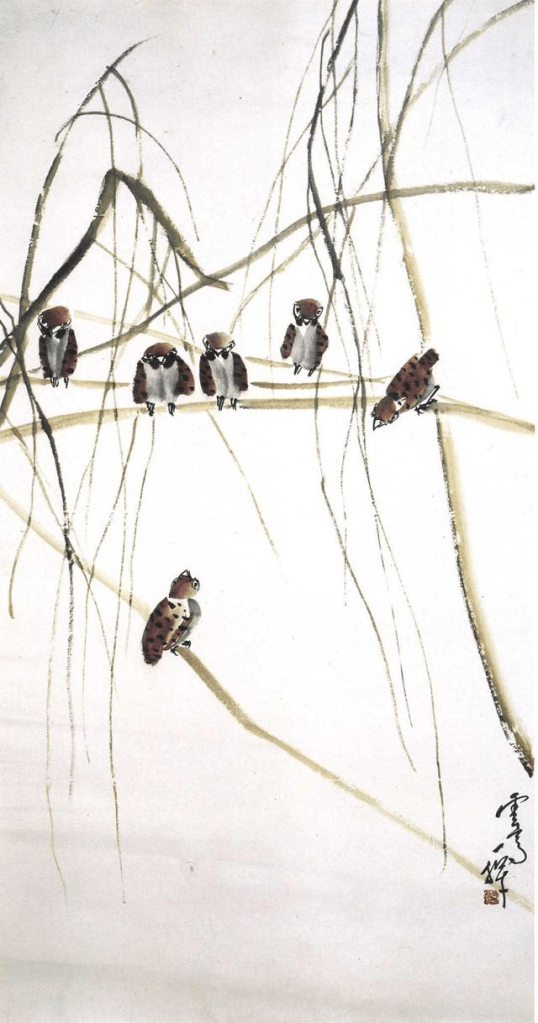
Stepping into the world of the painting, what immediately catches your eye and captures your breath is the lively group of birds awakening from their slumber. Facing the spring that has quietly arrived, they chirp and frolic on the branches with joyful abandon.
If you look closely, a bird at the bottom and another at the top right gaze at each other. Their eyes and postures suggest an intimate conversation, as if they are dueting a cheerful folk song, tirelessly spreading the beautiful news of spring’s return.
The artist’s depiction of these birds features exceptionally distinct and precise body language. The fresh, vivid artistic imagery springs to life, showcasing a masterful command of ink and a brilliant compositional mind.
Mastery of Ink: Finding Hope at the Edge of a Cliff
Traditional Chinese painting dictates that “the brush establishes the form and texture, while the ink distinguishes the substantial from the ethereal.” The artistic conception of a piece is born entirely from the movement of brush and ink. The brilliance of Su Shi Nao Chun lies first and foremost in its brushwork.
The lines in this piece are remarkably crisp, rising and falling with an organic, rhythmic tension. Through the controlled weight of pressing and lifting the brush, combined with sudden pauses and sharp turns, the ink gains a raw, powerful, and profound texture.
With simple, concise, and perfectly echoed strokes, the artist wonderfully captures the living dynamism of the willow branches. The entire canvas instantly becomes alive—this aliveness reveals a pure innocence, and it is only through such innocence that true spirituality shines. Once that spirituality emerges, the painting overflows with wit and charm, effortlessly ushering the viewer into a realm of subtle wonder.
This state of effortless, natural creation stems from the artist’s extraordinarily deep spiritual and artistic cultivation. As a master of art, H.H. Dorje Chang Buddha III has dedicated Himself to various forms of painting—including landscapes, figures, flowers, and birds—since youth. His art observes the universe and all living things through the light of Prajna (transcendental wisdom). Moving from the magnificent to the microscopic, the concepts under his brush evolve from the complex to the simple, leaving the ink pure and the brushwork liberated.
His brush often ventures into positions of extreme peril, where the composition seems pushed to a cliff’s edge. Yet, with a sudden, subtle turn of the brush, a whole new horizon opens up—just like the classic Chinese idiom: “Where hills bend and streams wind, the pathway seems blocked; yet past the dark willows and festive flowers, a new village appears.” A fresh, delightful, and breathtaking realm suddenly unfolds.
Flower-and-bird ink painting is not only a vital component of traditional Chinese art holding a significant place in the global artistic landscape, but it is also a symbol of the spiritual character and cultural soul of the Chinese nation.
The philosopher Jonathan Edwards once wrote:
“Spiritual holiness… brings an inexpressible purity, brightness, peacefulness and ravishment to the soul. In other words, that it made the soul like a field or garden of God.”
True works of art possess this exact power—to cultivate the soul and inspire people to look inward at their own spiritual world.
#ChineseArt #InkPainting #ArtAppreciation #Mindfulness #EasternAesthetics #SpiritualHealing #FineArt

 Peace LiLy