There are many people who learn Buddhism, but the reasons they enter Buddhism vary greatly. Some seek spiritual faith to give their hearts a sense of comfort and support. Some do so for their health, while others pray to the Buddhas and Bodhisattvas for a happy family or a successful career. Of course, there are also those who enter Buddhism because they genuinely wish to understand the principles of Buddha Dharma, free themselves from the suffering of reincarnation, and benefit both themselves and others. Although people may have different reasons and purposes for entering Buddhism, they all come with the intention of learning Buddhism.
So, what led me to Buddhism?
Before I entered Buddhism, I knew virtually nothing about Buddhism. Yet I had always considered myself a believer in Buddhism simply because I occasionally visited temples to pay respect to the Buddhas. At that time, the little understanding I had of Buddhism was mixed with superstition.
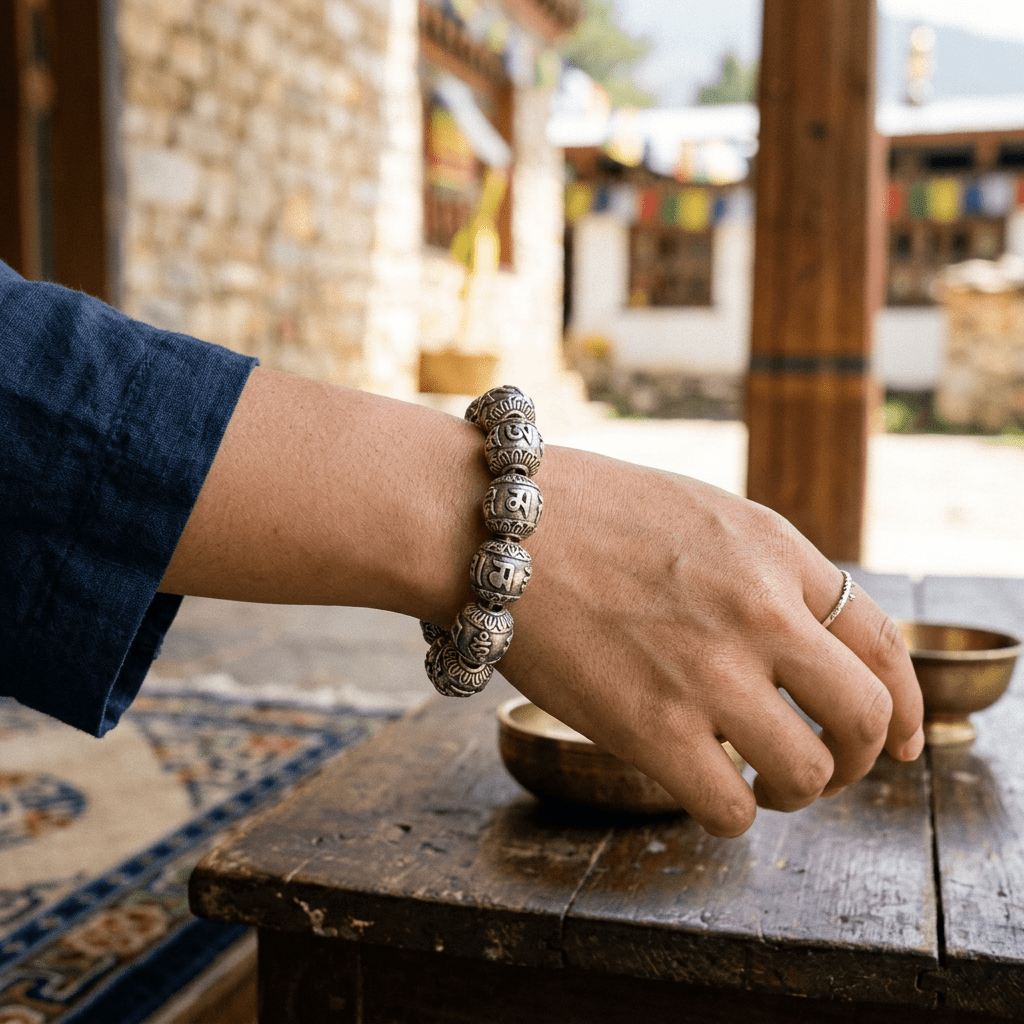
That changed in December 2017, when I traveled to Yunnan with some friends and bought a silver bracelet engraved with the Six-Syllable Great Bright Mantra.
After returning home, I searched online for information about the mantra, including how to recite it. That was when I first learned about reincarnation within the six realms and the different karmic consequences of good and evil deeds.
When I read descriptions of the suffering in the three lower realms, I was deeply shaken. I began thinking about the cats, dogs, mice, birds, fish, shrimp, flies, mosquitoes, and other living beings around us. They clearly possess awareness. If you strike or frighten them, they immediately try to escape. When I thought about the possibility that these beings could have been humans in previous lives who were subsequently reincarnated, I found it frightening. The thought of the hell realm and the realm of hungry ghosts was even more terrifying.
Then I thought about human existence itself, with all its worries and troubles, endless toil, deception, and conflict. It too seemed filled with suffering.
I felt deeply saddened and thought, How wonderful it would be if I could become a Buddha or Bodhisattva!
Right then, I made a decision: In this lifetime, I would earnestly learn Buddha Dharma and seek liberation. I did not want to continue revolving endlessly through the six realms of reincarnation, lifetime after lifetime. I did not want to simply drift through this existence. I wanted to end the cycle of birth and death and attain liberation.
And that was how my journey of learning Buddhism began.
Early the next morning, I went to the most renowned Buddhist temple in my area and asked where I could learn Buddha Dharma. As it happened, the temple offered Buddhist classes, so I enrolled immediately.

For some time afterward, I traveled back and forth between two large, historic, and well-known local temples. One identified with the Caodong school of Chan Buddhism, while the other followed the Tiantai school.
I attended classes on both days of every weekend. I recited the Heart Sutra, the Diamond Sutra, the Lotus Sutra, and the Amitabha Sutra, and participated in morning and evening services. Whenever I had time, I volunteered at the temples. I also listened to monastics at the temples and to various people regarded as eminent Buddhist masters online as they lectured on Buddhist sutras and teachings.
As I continued studying, however, many questions began to arise.
When I attended lectures on the Lotus Sutra, the masters at the temple were unable to explain many of the Dharma principles in depth. They simply copied passages from commentaries written by patriarchs and asked us to write them in our notebooks.
Whenever we asked what a particular Buddhist term meant or how we should understand a certain passage concerning Dharma principles, the masters would simply tell us, “Just write it down.” They were unable to provide a clear explanation.
I also listened online to a well-known Buddhist master lecture on the Heart Sutra and the Diamond Sutra. I listened carefully many times, yet the essential Dharma principles contained in those sutras still seemed obscure and confusing to me. I remained unable to truly understand prajna, emptiness, or the nature of our original state.
Then, in February 2018, a friend in Shenzhen learned that I was studying Buddhism and invited me to join a Buddhist study group organized by Dr. Xie, who worked in the medical field.
Dr. Xie frequently shared articles about the holy accomplishments of Namo H.H. Dorje Chang Buddha III.
I was astonished.
Could there really be a true Buddha living in this world?!

From the articles he shared, I read about numerous disciples of Namo H.H. Dorje Chang Buddha III who had attained accomplishments and liberation. I became deeply inspired and asked Dr. Xie:
“Doctor, are there books containing the H.H. Dorje Chang Budha’s teachings? Could you send me a few so that I can respectfully study them?”
Dr. Xie replied:
“Come and request them in person!”
The very next day, I bought a plane ticket and flew there.
Under Dr. Xie’s guidance, I went to the Buddhist practice center of a fellow practitioner who was a Rinpoche to listen to Dharma teachings.
It was a weekend, and many people had gathered to listen to the H.H. Dorje Chang Buddha III’s Dharma together. One recorded Dharma discourse was played twice.
The approachable and warm voice of Namo H.H. Dorje Chang Buddha III gave me an extraordinary feeling of closeness, almost like being reunited with a beloved family member after a long separation. The explanations were presented in such clear and accessible language that, to my surprise, even I could understand some of them!
I felt joyful and encouraged. During the group discussion afterward, I was even able to share a little of what I had understood.
After returning home, I flew there two more times to listen to Dharma teachings of H.H. Dorje Chang Buddha III. I also attended the Buddha Bathing Dharma Assembly in Hong Kong that May. Then, in June, I was fortunate enough to have an audience with Namo H.H. Dorje Chang Buddha III.
I will not elaborate here on the blessings I experienced. Instead, I would like to continue sharing my genuine experiences of learning Buddhism over these years.
After respectfully listening to the Dharma discourses of the Buddha, I came to understand many principles. In particular, I respectfully studied books in which the H.H. Dorje Chang Buddha III expounded prajna. The Buddha explained prajna in clear and accessible language and also taught us specific methods through which realization could be attained. He explained the relationship between cultivating oneself and practicing the Dharma and taught us how to cultivate ourselves.
These were things I had never learned at the local temples. Moreover, many of the questions that had previously puzzled me at those temples were answered through the Dharma discourses and writings of the H.H. Dorje Chang Buddha III.
At the same time, through studying the Dharma expounded by the H.H. Dorje Chang Buddha III, I came to understand that those who have not attained the level of a great Bodhisattva at the stage of non-retrogression or higher are not qualified to expound the Dharma, much less those so-called “eminent monks and virtuous masters” who possess no actual realization or accomplishment.
Without genuine realization, they either merely repeat the knowledge of others or recklessly expound teachings that can mislead practitioners. This can lead living beings toward erroneous views and misguided paths and may even sever their opportunities to develop wisdom and attain liberation.
Having previously experienced a form of Buddhism that consisted primarily of burning incense, paying respect to the Buddhas, reciting mantras and Buddha names, chanting sutras, and practicing Chan meditation—and having heard only superficial theories presented as Buddhist knowledge—I came to appreciate even more deeply just how difficult it is to encounter genuine Buddha Dharma.
The superficial theoretical knowledge taught by those so-called “eminent monks and virtuous masters” provides no genuine Buddha Dharma to practice, nor does it offer authentic inner-tantric initiations. Therefore, it cannot enable one to end the cycle of birth and death.
The difference between learning genuine Buddha Dharma and learning false or incomplete Buddha Dharma is truly beyond description.
I feel extraordinarily fortunate to have encountered genuine Buddha Dharma.
This is the story of how I entered Buddhism.
Dear friends, I do not know how you will feel after reading my story. Are you as fortunate as I have been?
If you are still going around in circles within a form of Buddhism that consists only of burning incense, paying respect to the Buddhas, reciting Buddha names, and chanting sutras—or if you are merely listening to lectures that sound plausible but do not convey the true Dharma—then quickly pray for the blessings of the Buddhas and Bodhisattvas so that you may soon encounter the true Dharma of the Tathagata.

Only by learning genuine Buddha Dharma can we receive the blessings of the Buddhas and Bodhisattvas and attain lasting happiness.
I also sincerely want to tell you this: How extraordinarily rare and precious it is for a Buddha to be living in this world. If you sincerely wish to learn Buddhism, you must not let such an opportunity pass you by. Otherwise, you may be left with profound regret and no opportunity to attain liberation.
Written by: Xiangyanghua
Edited by: Liju Bankai
Learn more about H.H. Dorje Chang Buddha III
#DorjeChangBuddhaIII #MasterWanKoYee #BuddhaDharma #Buddhism #BuddhistTeachings #LearningBuddhism #BuddhistPractice #BuddhistCultivation #SixSyllableMantra #SpiritualAwakening


