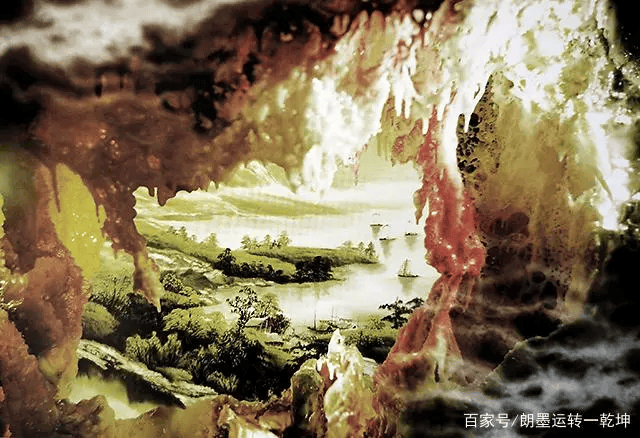
The first time I saw this magnificent landscape painting, A Hidden Wonderland (別有洞天), I was immediately captivated by its dreamlike atmosphere and dazzling colors. For a moment, I even forgot to ask myself: Is this an oil painting or a traditional Chinese landscape?
The more I looked, the more fascinating the painting became.
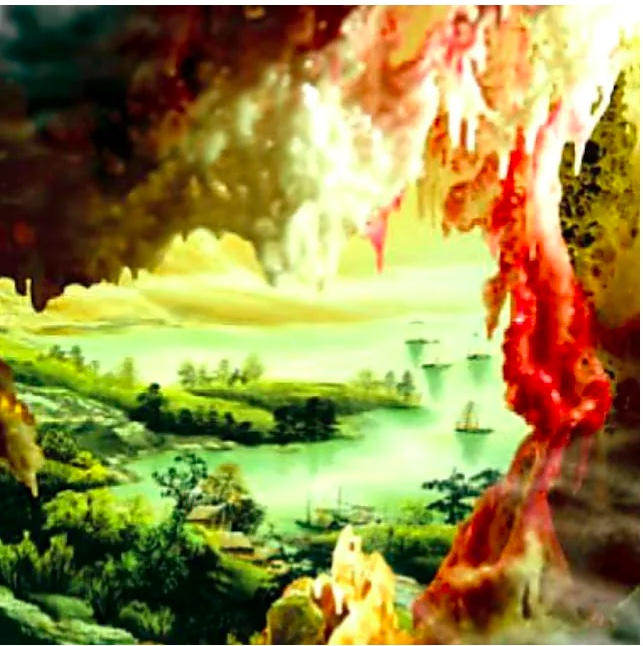
Its colors, composition, and harmonious overall tone have the richness and realism of a Western oil painting. The luminous, almost surreal forms in the foreground appear to glow with extraordinary depth and texture. Creating such a convincing visual world requires a strong foundation in realistic Western painting.
Yet at the same time, the spirit of the work is unmistakably that of traditional Chinese landscape painting. Its atmosphere, poetic feeling, and especially its central landscape are deeply rooted in the aesthetics of Chinese shanshui—the art of expressing not only mountains and rivers, but also the spirit and energy of nature.
The longer I studied A Hidden Wonderland, the more I sensed that there was something beyond visual beauty. The composition seemed to contain a philosophical idea about perspective—about how the world can look completely different when we change where we stand.
It reminded me of a famous poem by the Chinese poet Bian Zhilin:
You stand upon the bridge, looking at the scenery; The one looking at the scenery from the tower is looking at you. The bright moon decorates your window; You, in turn, decorate another’s dream.
The poem presents two perspectives at once. Someone believes they are simply observing the scenery, while from another viewpoint, they themselves have become part of someone else’s scenery. With this subtle shift in perspective, the poet reminds us that what we see depends greatly on where we stand.
A Hidden Wonderland carries a similar idea, but takes it even further.
The space surrounding the central landscape seems like a world beyond ordinary human life—a peaceful, radiant realm resembling a paradise. At the center, however, lies the familiar human world.
The artist creates a kind of visual frame within the painting. By changing the viewer’s position, the distance between “here” and “there,” between the world we inhabit and the world we imagine beyond it, suddenly becomes much greater.
For a moment, we seem to be standing outside the ordinary world, looking back at it from a higher and more peaceful place.
And then something remarkable happens.
After allowing our eyes to wander through the magnificent scenery beyond the frame, we look back toward the human world—and discover that it, too, is beautiful.
The morning sun has just appeared. Golden light gently pushes away the soft white mist floating above the river. Quiet sails drift across the water. Lush vegetation covers the riverbanks, while graceful trees partially conceal small houses scattered among them.
On the fertile hillsides, peach and plum blossoms fill the air with fragrance. In a beautiful pond, groups of geese and ducks play and call to one another. A winding mountain path leads into the distance, while the familiar sounds of village life—roosters crowing and dogs barking—rise and fall in the peaceful landscape.
Suddenly, the ordinary world we thought we had left behind no longer seems ordinary at all.
It is beautiful.
Perhaps this is one of the deepest messages hidden within A Hidden Wonderland. Sometimes we need to step outside our familiar perspective before we can truly appreciate the beauty of the world in which we live.
The artist, H.H. Dorje Chang Buddha III, has not only created a visually breathtaking landscape, but also a kind of window through which we can look at our own lives from a different perspective. The radiant world beyond the frame resembles a pure and luminous realm, while the human world below gradually reveals its own extraordinary beauty.
After being immersed in such a magnificent vision, we return our eyes to everyday life with a changed heart.
Perhaps the world itself has not changed.
Perhaps we have.
This brings to mind a profound teaching from the Vimalakirti Sutra:
“If a bodhisattva wishes to attain a pure land, he should purify his mind. As the mind becomes pure, the Buddha-land becomes pure.”
Maybe the “hidden wonderland” is not simply somewhere far away.
Perhaps it begins with the way we see.
When the mind becomes peaceful, the ordinary becomes beautiful. When the heart becomes pure, the world we see may also appear more pure.
And perhaps that is the true masterpiece hidden within A Hidden Wonderland—not only a beautiful landscape to look at, but a quiet invitation to look at ourselves, our world, and life itself from a higher perspective.