
Sometimes, the greatest heroes are not famous leaders, wealthy businessmen, or powerful people. They are ordinary people who refuse to give up, even when the world tells them something is impossible.
The story of Dashrath Manjhi, an ordinary laborer from India, is one of the most remarkable examples of human courage and determination I have ever encountered.
He did not have money, education, modern equipment, or anyone’s support. All he had was a hammer, a chisel, and an extraordinary determination to make a difference.
And with these simple tools, he literally moved a mountain.
A Tragedy That Changed His Life
Dashrath Manjhi lived in a small village called Gehlaur in Bihar, India. A massive rocky mountain separated his village from nearby towns where people could find doctors, schools, and other essential services.
Villagers had to travel a long and difficult route around the mountain to reach medical facilities.
In 1959, tragedy struck. His beloved wife, Falguni Devi, was seriously injured after slipping on a narrow mountain path while bringing food and water to him. Manjhi desperately tried to get her medical attention, but the journey was simply too long. She died before reaching the hospital.
Heartbroken by her death, Manjhi made a decision that would change the future of his village.
He decided to cut a road straight through the mountain so that no one else would have to suffer the same fate.
He sold the few goats his family owned and bought a hammer and a chisel. Then, around 1960, he began working on the mountain.
People thought he had lost his mind. Some laughed at him, while others criticized him for wasting his time on an impossible task.
But Manjhi did not listen.
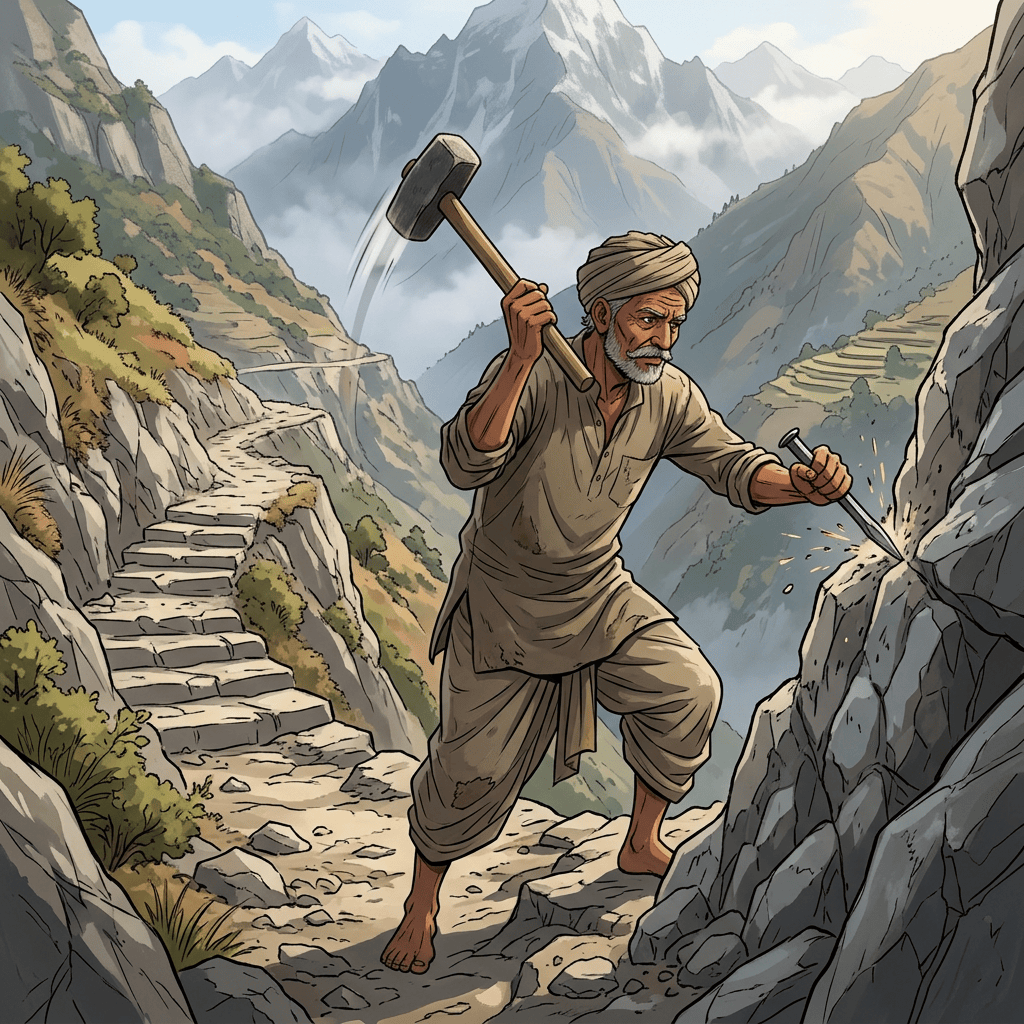
Manjhi was a poor laborer who still had to earn a living. During the day, he worked in the fields to support himself. Whenever he had time, he returned to the mountain and continued chipping away at the rocks.
He worked through scorching summers, heavy rains, and countless difficult days.
Sometimes, he heated the rocks with fire and poured water over them to make them crack. Then he broke the rocks into smaller pieces and carried them away.
Day after day, year after year, he continued.
Imagine spending 22 years doing something that everyone around you believes is impossible. Imagine facing the same enormous mountain every morning, knowing that you still have so much work ahead of you.
Yet he never gave up.
In 1982, after 22 years of extraordinary effort, he finally completed the passage.
The road he carved was approximately 110 meters long and 9 meters wide. His work shortened the distance between nearby communities from about 55 kilometers to just 15 kilometers, making access to essential services much easier.
The man whom villagers once called crazy had accomplished something that seemed beyond human ability.
He became known throughout India as “The Mountain Man.”
Manjhi eventually received recognition for his extraordinary achievement. His story attracted national attention, and the Bihar government recommended him for the prestigious Padma Shri civilian honor. In 2015, his life inspired the Bollywood film Manjhi – The Mountain Man, starring Nawazuddin Siddiqui.
He passed away from gallbladder cancer in 2007 at the age of 73 and was given a state funeral.
But what I find most touching is that, despite all the recognition, his dreams were never about becoming famous or wealthy.
He wanted better roads, a hospital, and improved living conditions for the people of his village. He wanted children to have easier access to education and families to receive medical care without having to travel such dangerous distances.
He had turned his personal tragedy into something meaningful for thousands of others.
Today, the road he carved bears his name, and generations of villagers continue to benefit from his determination.
When I read Manjhi’s story, I was deeply moved.
In our lives, we often encounter difficulties that seem too big to overcome. We may give up before even trying because the obstacles appear overwhelming. Sometimes, we are discouraged by other people’s criticism or afraid that our efforts will lead nowhere.
But Manjhi reminds us that great achievements do not always begin with great resources. Sometimes, they begin with one small decision and the courage to keep going.
He did not move the mountain in one day. He moved it one hammer strike at a time.
This is perhaps the most important lesson: We may not be able to accomplish everything immediately, but if we remain determined and keep taking small steps, we can achieve things we once thought impossible.

There is another lesson in his story that touches my heart. Manjhi could have allowed his grief to turn into bitterness. Instead, he transformed his pain into a gift for others. His love for his wife became a determination to protect other families from experiencing the same tragedy.
That is a beautiful expression of love and compassion.
We may not all have a mountain to move, but we all have something we can improve, someone we can help, or a difficult situation we can face with greater courage.
Perhaps the real meaning of determination is not simply refusing to give up on our own dreams. It is also finding the strength to make life better for others.


