
Have you ever been deeply hurt by someone’s words? Perhaps someone criticized you unfairly, blamed you for something, or said something cruel that you simply could not forget.
Sometimes, the hurtful words last only a few seconds, but the anger and resentment stay in our hearts for days, months, or even years.
How can we face such situations without allowing other people’s anger to destroy our inner peace?
There is a beautiful story recorded in the Samyutta Nikaya (Connected Discourses, SN 7.2), known as the Akkosa Sutta, or the Discourse on Insults. It offers a profound lesson from Shakyamuni Buddha.
One day, while the Buddha was staying at the Bamboo Grove Monastery in Rajagaha, a Brahmin named Akkosaka Bharadvaja became furious after learning that a member of his family had joined the Buddha’s monastic community.
Blaming the Buddha for influencing his family, he went to the monastery and began insulting him with harsh and offensive words.
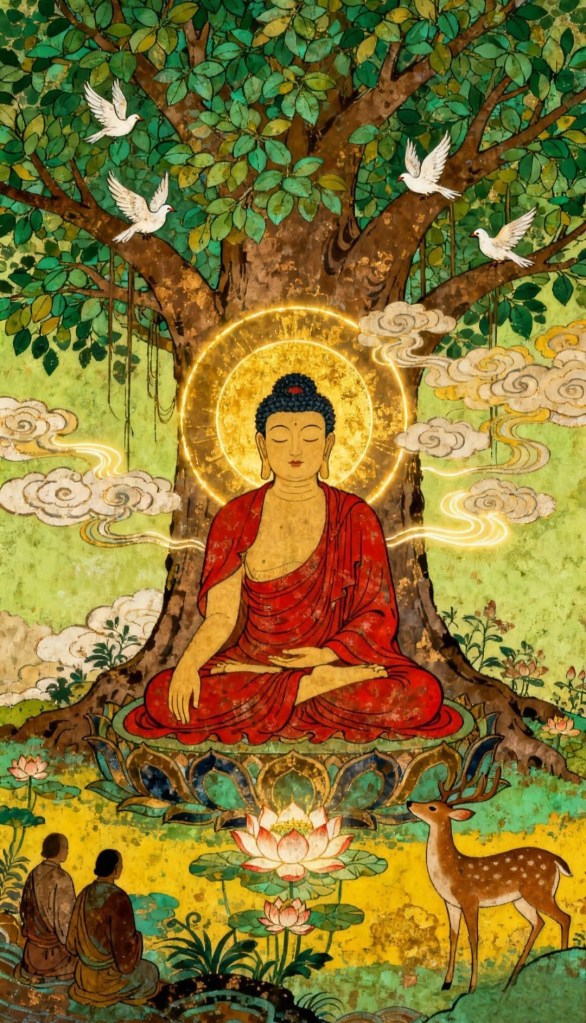
But the Buddha remained completely calm and did not respond with anger.
After the man finished speaking, the Buddha asked him:
“Do you sometimes have friends and relatives visiting your home?”
The Brahmin replied, “Yes, of course.”
“Do you prepare food to offer them when they visit?”
“Yes, I do.”
“But what if your guests refuse to accept the food you offer? Who does the food belong to then?”
The Brahmin answered, “It still belongs to me.”
The Buddha then explained:
“Just as the food remains yours when your guests refuse to accept it, I do not accept the insults you have offered me. You insult me, but I do not insult you. You become angry with me, but I do not become angry with you.”
The Buddha was teaching him that when someone offers us anger and insults, we do not have to accept them or respond in the same way.
If someone becomes angry and we respond with anger, the conflict simply grows. One person’s anger becomes two people’s anger, and one person’s hostility creates more hostility.
The Brahmin was deeply moved by the Buddha’s wisdom. He eventually changed his attitude, asked to become a follower, and later entered the monastic order. According to the scripture, he eventually attained enlightenment as an arahant.
What a remarkable transformation!
Do Not Let Other People’s Anger Become Your Suffering
I find this story especially meaningful because it reflects something we all experience in everyday life.
Someone may say something hurtful, and even after the conversation is over, we continue replaying it in our minds.
We remember it while eating, think about it before going to sleep, and sometimes become upset all over again months or even years later.
The person who insulted us may have already forgotten what they said, but we continue carrying those words in our hearts.
It is almost like holding a piece of broken glass. We know it can hurt us, yet we keep holding on to it. Every time we remember the incident, we hurt ourselves all over again.
Perhaps the greatest suffering does not come only from what someone said, but also from our unwillingness to let go of the hurt.
The Buddha teaches us that our peace of mind should not depend entirely on how other people treat us.
We cannot always control what others say, how they behave, or whether they understand us. But we can learn to control our own reactions.

This does not mean we must accept injustice, tolerate abuse, or remain silent when we need to protect ourselves. We can establish boundaries, speak up calmly, and walk away from unhealthy situations without allowing anger to control us.
Life is too short to spend so much time carrying resentment and anger.
When someone criticizes or blames us, perhaps we can pause before responding. We can ask ourselves: Is responding with anger going to solve anything? Will holding on to these words make my life better?
The Buddha showed us that true strength is not about defeating someone in an argument. It is about maintaining wisdom and compassion even when others lose their peace of mind.
Other people may offer us anger, but we do not have to accept it. Other people may speak harshly, but we do not have to let their words become our suffering.
Perhaps this is one of the most valuable lessons we can learn from the Buddha: we may not be able to change other people’s behavior, but we can always work on changing the way we respond.
And sometimes, the greatest victory is simply keeping our hearts peaceful.
Link: https://peacelilysite.com/2026/11/18/stop-letting-other-peoples-words-steal-your-peace/


