
A Buddhist Lesson from a Horse That Forgot How to Run
There is a fascinating story in the Da Zhuangyan Lun Jing (Sutra of Great Adornment).
A king once raised many excellent horses, originally prepared for battle. Because neighboring countries knew he possessed such strong horses, they were afraid to attack.
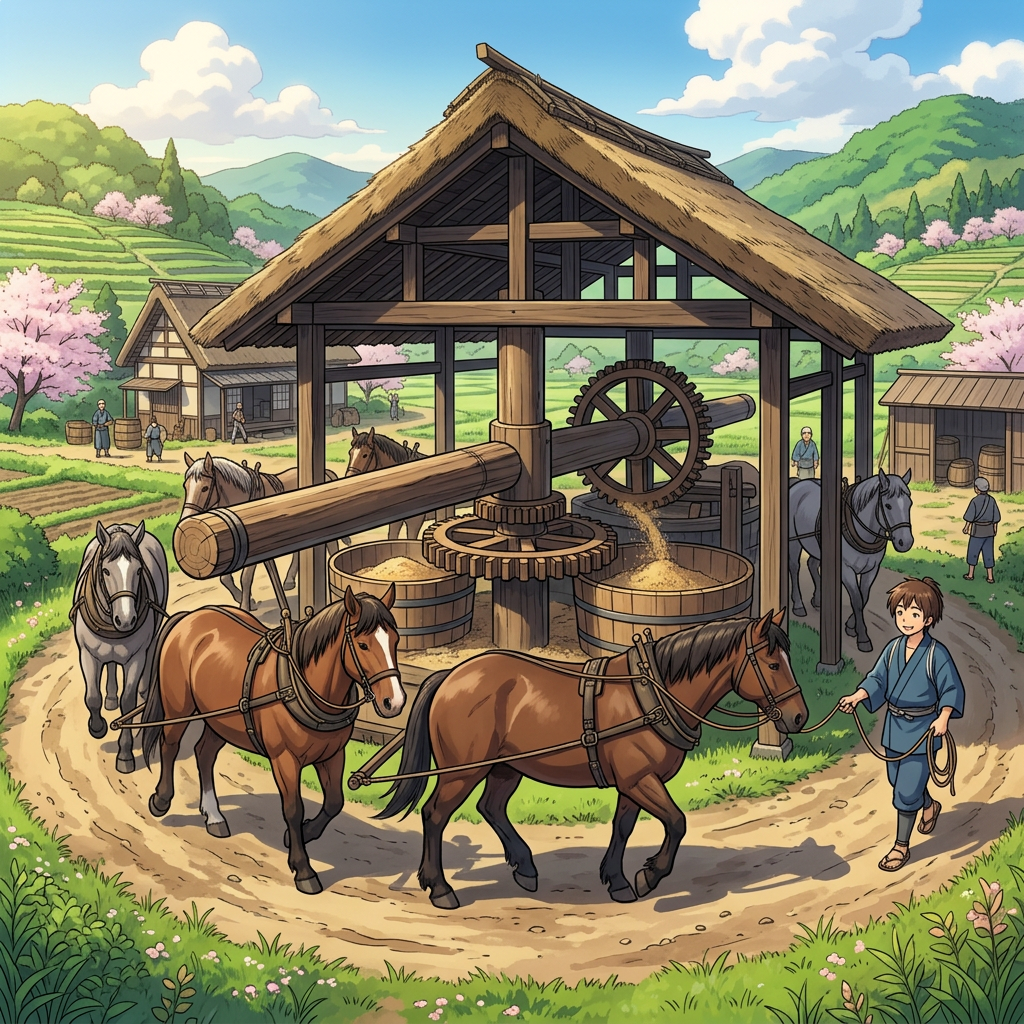
As the years passed without war, however, the horses were given to ordinary people for daily work. They were used to turn grinding mills. Day after day, year after year, the horses walked in circles around the mill.
Then one day, an enemy invaded.
The king quickly called the horses back and prepared them for battle. But when they reached the battlefield, something unexpected happened. Instead of charging forward, the horses continued walking in circles—the same movement they had practiced for years.
Even when the soldiers tried to drive them forward, the horses found it difficult to change.
The Da Zhuangyan Lun Jing uses this story to illustrate an important truth: what we repeatedly practice becomes our habit, and what becomes our habit can shape how we respond when it matters most.
The Circle We Walk Every Day
The most meaningful part of this story is that the horses did not suddenly learn to walk in circles on the battlefield.
They had practiced that circle for years.
Our minds can be like that too.
What do we do first when we wake up?
For many of us, we reach for our phones.

We check one message, then another. We watch one short video, then automatically swipe to the next. We see someone else’s life and begin comparing ourselves. We read a comment we dislike and immediately become irritated.
Each individual moment may seem insignificant.
But repeated thousands of times, these moments become habits.
And habits do more than organize our daily lives. They train our minds.
So perhaps an important question is not only:
“What did I do wrong today?”
but also:
“What am I teaching my mind to become?”
If we constantly train ourselves to seek the next notification, the next video, the next piece of stimulation, it should not surprise us when we later sit down to meditate, pray, or recite the Buddha’s name and find that our minds cannot remain still.
We may wonder, “Why is my mind so scattered?”
But the scattering did not begin when we sat down.
We simply became quiet enough to notice it.
We Are Always Practicing Something
This is where the Buddhist teaching of 熏习, xunxi—habitual conditioning or repeated imprinting becomes meaningful.
In Buddhist teachings, repeated actions of body, speech, and mind leave tendencies that influence what arises again in the future. In Yogācāra thought, the relationship between “seeds” and “manifestations” describes how repeated mental and behavioral patterns can strengthen similar tendencies.
If we repeatedly become angry, anger becomes an easier path to follow.
If we repeatedly compare ourselves with others, dissatisfaction and jealousy can become easier to generate.
If we constantly seek stimulation, restlessness can gradually become our normal state.

The same principle, however, can work in a wholesome direction.
If we repeatedly practice patience, patience becomes more familiar.
If we repeatedly practice gratitude, gratitude becomes easier to access.
If we repeatedly return our attention to the present moment, returning becomes easier.
If we repeatedly cultivate compassion, compassion can gradually become a more natural response.
This gives us a hopeful understanding of spiritual practice.
Every day, we are training the mind in one direction or another.
Practice is not simply about waiting until a difficult situation appears and then trying desperately to control ourselves.
It is about working with the mind before the battlefield arrives.
When someone says something unpleasant to us, can we pause before responding?
When anger arises, can we notice it before turning it into harsh words?
When we have a few empty minutes, must we immediately reach for the phone?
When disturbing thoughts appear, can we recognize them without automatically following them?
These small moments may seem ordinary.
But they are where practice actually happens.
We do not need to wait for a major crisis to practice Buddhism.
The battlefield is often hidden inside ordinary life.
Habits Are Not a Life Sentence
There is another important lesson here.
If our habits have been formed through repetition, does that mean we are trapped by them?
No.
If habits could never change, there would be no such thing as cultivation.
Old habits may be strong, but they can gradually be transformed through right understanding, mindfulness, and repeated practice of wholesome actions.
Perhaps yesterday we immediately reacted when someone upset us.
Today, we pause for three seconds.
Perhaps yesterday every moment of boredom led us to our phones.
Today, we put the phone down and sit quietly for five minutes.
Perhaps yesterday an unpleasant thought appeared and carried us away.
Today, we notice it and gently return to the Buddha’s name, a prayer, our breath, or the present moment.
These may seem like very small victories.
But they matter.
Every time we do not follow an old habit, we walk that old road a little less. Every time we return to mindfulness, we make a new road a little stronger.
What Are You Practicing Today?
The story of the horses teaches us something that is easy to forget.
The horses did not become accustomed to walking in circles overnight.
They simply repeated the same movement until it became natural.
Our lives can work the same way.
The way we speak, the things we watch, the thoughts we repeatedly entertain, the emotions we feed, and the actions we practice every day are quietly shaping who we are becoming.
This does not mean we must live perfectly.
It means we should become more conscious of what we practice.

Perhaps tonight, before going to sleep, we can ask ourselves:
What did I practice today?
Did I practice impatience or patience?
Comparison or gratitude?
Fear or compassion?
Distraction or awareness?
Anger or forgiveness?
We may not be able to change our entire life in one day.
But we can change one response.
And then another.
The old road became familiar because it was walked again and again.
A new road can become familiar in exactly the same way.
Perhaps this is one of the quietest and most practical forms of Buddhist wisdom:
Every ordinary moment is a moment of cultivation.
What we repeatedly do today may become the direction our mind naturally takes tomorrow.
Link: https://peacelilysite.com/2026/09/18/what-are-you-training-your-mind-to-become/

 Peace LiLy