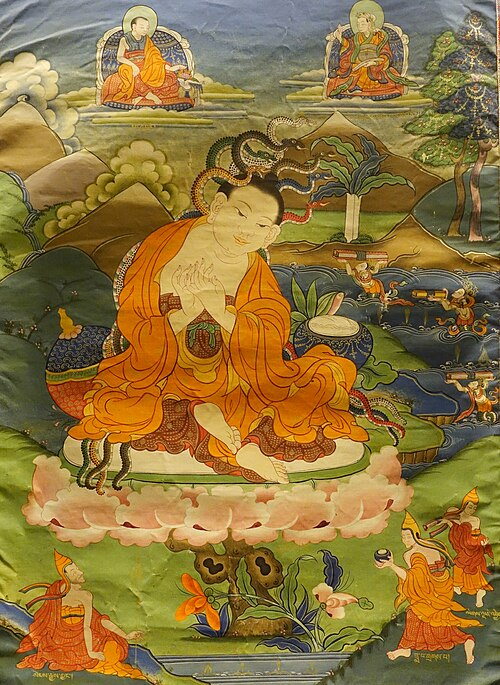
Throughout the two-thousand-year history of Buddhism, if one were to ask which master’s life was the most thrilling and dramatic, the answer would undeniably be Nagarjuna Bodhisattva.
He was not only the founder of the Madhyamaka (Middle Way) school and a foundational pillar of Mahayana Buddhism, but also an enlightened master whose incredible wisdom was matched only by his extraordinary life story. Revered by later generations as the “Ancestor of Eight Schools,” this legendary figure actually began his youth walking a path of extreme rebellion and reckless indulgence.
Nagarjuna was born into a noble Brahmin family in Southern India, displaying gifts from an early age that far exceeded ordinary human limits. As a child, he possessed a photographic memory—listening to the four sacred Vedas of Brahmanism just once before reciting them by heart with a complete grasp of their deepest meanings. By the time he reached his youth, he had transformed into a true polymath, mastering everything from astronomy and geography to divination, worldly arts, and various esoteric sciences.

However, genius without wisdom often becomes fuel for pride and unchecked desire. Believing he had already learned everything the worldly realm had to offer, the young Nagarjuna gathered with three like-minded friends to ponder a fateful question: “Life is short, and we have already mastered all human knowledge. What is left for us to pursue?” Their conclusion was as absurd as it was dangerous—to pursue ultimate pleasure and indulge in every sensory distraction.
Determined to indulge without restrictions, the four young men sought out a sorcerer and learned the art of invisibility. Armed with this miraculous power, they brazenly snuck into the royal palace, engaging in reckless escapades and chaotic antics for months while plunging the court into fear and suspicion. Realizing something unnatural was occurring, the King devised a clever trap by ordering fine sand scattered across the palace hallways and gates to track the invisible intruders’ footprints.
When the four entered the palace once more, soldiers surrounded their footprints and swung their swords wildly through the air. Nagarjuna’s three friends were unable to dodge the blades and were executed on the spot. Showing quick thinking under intense pressure, Nagarjuna saved his own life by pressing himself tightly against the King’s throne—knowing the soldiers would never dare swing their swords near the monarch’s seat.
Watching his closest companions cut down in a flash of blood and terror, Nagarjuna experienced a profound, shocking epiphany:
“Desire is the root of suffering, the source of all calamity. Misconduct and defilement know no greater depth than this!”
In that single, terrifying moment, he saw through the illusion and danger of worldly desires, resolving to abandon his past and walk the path of virtue.
Immediately after escaping the palace, Nagarjuna renounced the worldly life and took monastic vows. He fully mastered the entire Tripitaka—the Buddhist canon—in a mere nine months. Unsatisfied with basic mastery, he journeyed deep into the snow-capped mountains to seek out renowned masters and broaden his spiritual horizons.
According to tradition, sensing that the teachings available in the human realm were incomplete, Nagarjuna was guided by the Great Naga (Dragon) Bodhisattva to the underwater Dragon Palace. Inside its vast scriptural library, he discovered profound, high-level Mahayana sutras, including the Avatamsaka Sutra (Flower Garland Sutra), which he brought back to the human world to spread among spiritual seekers.
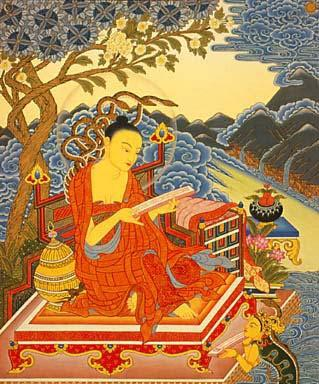
Upon his return, Nagarjuna authored countless seminal treatises that transformed Buddhist philosophy forever. He penned foundational texts such as the Mulamadhyamakakarika (Fundamental Verses on the Middle Way), the Twelve Door Treatise, and the Mahaprajnaparamita Upadesa (Commentary on the Great Perfection of Wisdom). Through these works, he formulated the profound doctrine of Dependent Origination and Emptiness (Pratītyasamutpāda and Śūnyatā), establishing the core philosophy of the Madhyamaka school while shattering the worldly attachments and misconceptions of his era.
Nagarjuna’s life is a remarkable journey from extreme pride and confusion to ultimate enlightenment. Through his own transformation, he proved to the world that delusion and awakening exist only a single thought apart. It was precisely that thrilling trial on the edge of life and death that forged his supreme wisdom to break all worldly attachments, ultimately creating one of the most revered spiritual grandmasters in human history.


